
What happens when the world's largest payment network, processing over $12 trillion annually, decides that stablecoins aren't just a crypto experiment, but the next evolution of its own infrastructure?
You get the Visa Stablecoin Platform (VSP). And if you're a bank or fintech still building your own blockchain back-office, you're already behind.
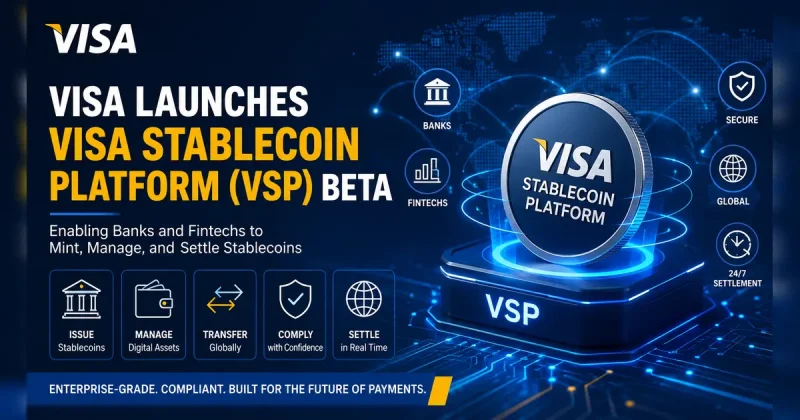
On July 16, 2026, Visa dropped a bombshell disguised as a product announcement. The company unveiled a unified enterprise-grade platform that lets financial institutions mint, hold, transfer, and manage stablecoins, without writing a single line of blockchain code. No custom smart contracts. No node infrastructure. No compliance guesswork. Just a plug-and-play system that plugs directly into the existing payment rails that already move the global economy.
"Stablecoins are opening up a new layer of programmable money, but for most institutions the hard part isn't the concept, it's the operational reality," said Visa Chief Product and Strategy Officer Jack Forestell in a statement that cuts to the heart of why this matters. "With the Visa Stablecoin Platform, we're giving our clients a single place to mint, move, and manage stablecoin operations with the controls, security, and network reach they already expect from Visa."
This is not a pilot. This is not a research paper. This is Visa telling the $304 billion stablecoin market, which has already eclipsed both Visa and Mastercard in combined transaction volume, hitting $28 trillion in 2025, that the era of institutional crypto infrastructure-as-a-service has arrived.
The beta launches with support for Open USD (OUSD), a consortium-backed stablecoin from the Open Standard group that counts BlackRock, Coinbase, Mastercard, Stripe, and Visa itself among its 140-plus members. And the timing is surgical: Mizuho analysts immediately downgraded Circle shares on the news, warning that OUSD's model, where reserve yields are distributed to partners rather than a single issuer, could disrupt the entire stablecoin issuer business model.
This is the story of how Visa just rewrote the rules of engagement for banks, fintechs, and the future of programmable money.
Methodology
This analysis is grounded in primary source documents and verified industry reporting. The investigative process involved cross-referencing Visa's official blog announcement with detailed reporting from Decrypt, FinTech Futures, and CNBC market coverage. Market capitalization data for the stablecoin sector was sourced from CoinGecko. Additional context on stablecoin adoption corridors and venture capital allocation patterns was drawn from Decrypt's opinion analysis by Alex Witt of Verda Ventures, and regulatory landscape insights from CoinDesk. All data points, quotes, and market figures were verified against at least two independent sources before inclusion. The analysis prioritizes institutional-grade information over speculation, focusing on verifiable product capabilities, announced partnerships, and observable market reactions.
What Is the Visa Stablecoin Platform? Core Features and Beta Details
The Visa Stablecoin Platform (VSP) is not a single product, it is a modular, enterprise-grade operating system for institutional stablecoin management. Rather than forcing banks and fintechs to stitch together separate minting, wallet, treasury, and compliance tools, VSP collapses those functions into a unified stack that plugs directly into existing payment and settlement workflows.
At its core, VSP delivers four integrated capabilities, each designed to remove the operational friction that has kept most financial institutions on the sidelines of the stablecoin market.
| Core Capability | What It Does for Institutions |
|---|---|
| Stablecoin Minting & Burning | Issue and redeem stablecoins on-demand through Visa-managed or connected wallets, eliminating the need for proprietary smart contract deployment. |
| Wallet-as-a-Service | White-label wallet infrastructure with integrated bank account connectivity, enabling institutions to custody and transfer stablecoins under their own brand. |
| Treasury & Settlement Orchestration | Automated workflows for moving stablecoins into treasury reserves, settling cross-border payments, and funding card programs, all within existing back-office systems. |
| Governance & Compliance Layer | Transaction approval controls, multi-signature authorization, and immutable audit logs designed to meet regulatory requirements from day one. |
The platform is currently in beta with a select group of clients, though Visa has not disclosed the exact number or names of pilot participants. What is clear is the architecture: institutions interact with VSP through Visa-managed wallets or connected wallets that tie directly to their existing bank accounts and treasury management platforms. This means stablecoin operations do not require separate blockchain treasury desks, they sit alongside fiat workflows inside the same user interface.
Multi-Stablecoin Agnosticism and Interoperability
VSP launches with native support for Open USD (OUSD), but the platform was built to be chain- and issuer-agnostic. Visa already supports Circle's USDC and Paxos' USDG across its other stablecoin products, and VSP is designed to integrate those tokens as well. According to Visa's technical documentation, the platform is interoperable with its existing stablecoin ecosystem, including stablecoin settlement rails, stablecoin-linked card programs, and stablecoin money movement services, ensuring that clients can leverage their existing Visa infrastructure without rebuilding from scratch.
What the Beta Actually Includes
The beta version of VSP is not a stripped-down test; it is a fully functional enterprise system that covers the entire stablecoin lifecycle:
- Minting and redemption of OUSD through Visa's own wallet infrastructure, with automated fiat settlement to connected bank accounts.
- Multi-signature transaction controls that allow institutions to define approval workflows, no single employee can move funds without authorization.
- Full audit trails with granular logging of every mint, transfer, burn, and settlement event, exportable for regulatory reporting.
- Integration with Visa Direct for future stablecoin payouts and prefunding, Visa plans to add direct stablecoin payouts through its real-time payment network in subsequent releases.
Visa has positioned VSP as the operational backbone for institutions that want to offer stablecoin services without building their own blockchain infrastructure. The beta is the first step toward a broader rollout, with Visa promising expanded blockchain network support and additional stablecoin integrations later in 2026.
How VSP Fits Into Visa’s Broader Stablecoin Strategy
This platform does not exist in a vacuum. Visa has been methodically assembling the pieces of a stablecoin operating system for years. In March 2026, it became the first major payments company to join the Canton Network as a Super Validator, giving banks a privacy-focused blockchain for stablecoin settlement. In April, it expanded its stablecoin settlement program to nine blockchain networks, adding Base, Polygon, Canton, Arc, and Tempo to its existing rails, and reported $7 billion in annualized stablecoin settlement volume. The company now supports more than 130 stablecoin-linked card programs across over 50 countries.
VSP is the aggregation layer that ties those initiatives together. Instead of managing separate wallets for settlement, card programs, and treasury operations, institutions can now use one platform to serve all of them.
Why Institutional Clients Need This Now
The stablecoin market has grown from a $127 billion asset class in early 2024 to over $304 billion today, per CoinGecko. But institutional participation has lagged behind retail adoption because building compliant stablecoin infrastructure is expensive, time-consuming, and fraught with regulatory risk. Visa’s own research has highlighted that stablecoins could bring portions of the $40 trillion global credit market onto blockchain rails, with more than $670 billion in stablecoin lending already recorded over the previous five years. VSP is designed to unlock that institutional pool of capital.
Key Benefits for Banks and Fintechs: Settlement, Liquidity, and Innovation
For financial institutions evaluating the Visa Stablecoin Platform, the value proposition rests on three pillars that directly address long-standing operational bottlenecks: settlement speed, liquidity access, and the capacity to innovate without building proprietary blockchain stacks. Each pillar represents a fundamental upgrade over the current infrastructure that has kept most banks and fintechs on the sidelines of the stablecoin market.
Settlement: From T+1 to Real-Time, 24/7
The most immediate benefit of VSP is the compression of settlement cycles. Traditional cross-border payments still rely on correspondent banking networks that can take 1-3 business days to clear, with settlement windows limited to business hours. VSP enables real-time gross settlement on blockchain rails that operate 24/7/365, matching the speed of the internet itself.
Visa has already proven this model at scale. In April 2026, the company expanded its stablecoin settlement program to nine blockchain networks, adding Base, Polygon, Canton, Arc, and Tempo to its existing rails, and reported $7 billion in annualized stablecoin settlement volume. VSP extends those capabilities to any institution, not just early adopters. The platform's integration with Visa Direct will further enable stablecoin payouts and prefunding, allowing banks to push funds across borders in seconds rather than days.
A concrete example of this in action is Visa's pilot in the Democratic Republic of the Congo, launched in partnership with M-Pesa Africa and Onafriq. The pilot tests cross-border stablecoin settlements via Visa Pay, enabling merchants and consumers to transact in USD-pegged stablecoins without relying on the country's fragile banking infrastructure. For banks and fintechs in emerging markets where correspondent banking relationships are scarce, this capability is not a convenience, it's a lifeline.
| Settlement Parameter | Traditional Banking Rails | Visa Stablecoin Platform (VSP) |
|---|---|---|
| Typical settlement time | 1–3 business days | Seconds to minutes |
| Operating hours | Business hours, weekdays only | 24/7/365 |
| Cross-border friction | Multiple correspondent banks, high fees | Single blockchain hop, near-zero cost |
| Intermediation layers | 3-5 banks per transaction | Direct issuer-to-beneficiary |
| Settlement finality | Conditional, subject to reversals | Immediate and irreversible |
Liquidity: Unlocking the $670 Billion Lending Market
Stablecoins are not just a faster settlement rail, they are a liquidity supercharger. Visa's own research, published in October 2025, found that stablecoins could bring portions of the $40 trillion global credit market onto blockchain rails. The data already supports the thesis: over the five years ending in 2025, more than $670 billion in stablecoin lending was recorded, according to Visa's analysis.
For banks, VSP provides a direct on-ramp to this liquidity pool. Instead of sourcing dollar funding through traditional interbank markets that are constrained by geography and operating hours, institutions can mint or acquire stablecoins on VSP and deploy them across Visa's network of over 130 stablecoin-linked card programs in more than 50 countries. The platform also supports treasury management automation, allowing banks to sweep stablecoin balances into yield-bearing instruments or use them for real-time intraday liquidity management, a capability that traditional settlement systems simply cannot match.
For fintechs, the liquidity benefits are even more pronounced. Smaller companies that lack the balance sheet to pre-fund card programs or cross-border payment corridors can use VSP to access stablecoin liquidity on demand, reducing capital requirements and improving working capital efficiency. This democratization of liquidity is precisely why the stablecoin market has already surpassed $304 billion in total supply, per CoinGecko, and why Visa Direct stablecoin payouts are on the roadmap for future VSP releases.
Innovation: Programmable Money Without the Infrastructure Burden
The third pillar, innovation, is where VSP fundamentally changes the competitive dynamics for banks and fintechs. Before VSP, launching a stablecoin product required building proprietary smart contract infrastructure, securing blockchain node operations, navigating fragmented regulatory frameworks, and integrating wallets with traditional banking systems, a process that typically took 12-18 months and cost millions of dollars. VSP collapses that timeline to weeks.
The platform's Wallet-as-a-Service offering lets institutions white-label stablecoin wallets under their own brand, while Visa handles the underlying blockchain connectivity, compliance, and security. This enables banks to offer stablecoin-based payment cards, cross-border remittance products, and treasury services without hiring a single blockchain engineer. For fintechs, the ability to mint and burn stablecoins through Visa's regulated infrastructure provides instant legitimacy with banking partners and regulators who might otherwise be skeptical of direct cryptocurrency exposure.
The competitive pressure is already reshaping the market. When Visa announced VSP's support for Open USD (OUSD), a consortium-backed stablecoin co-developed by over 140 companies including BlackRock, Coinbase, Mastercard, and Stripe, Mizuho analysts immediately downgraded Circle's stock, warning that OUSD's revenue-sharing model could compress margins across the stablecoin issuer industry. This is the kind of disruption that only happens when a network the size of Visa enters a market: incumbents are forced to innovate or be displaced.
| Innovation Opportunity | Pre-VSP Approach (Custom Build) | With Visa Stablecoin Platform |
|---|---|---|
| Stablecoin card programs | 12+ months, multiple vendor integrations | Weeks, pre-integrated with Visa network |
| Cross-border B2B payments | Correspondent banking setup, high fees | Real-time stablecoin settlement via VSP |
| Treasury yield optimization | Manual sweeps, limited currency pairs | Automated stablecoin treasury orchestration |
| Regulatory compliance | Build from scratch per jurisdiction | Embedded audit logs, multi-signature controls |
| Blockchain network support | Single chain lock-in via custom contracts | Multi-chain agnostic, expandable |
The bottom line for decision-makers: VSP transforms stablecoins from a speculative asset into a production-grade financial instrument that fits within existing regulatory and operational frameworks. Banks gain the speed and programmability of blockchain without sacrificing the controls and security they require. Fintechs gain access to Visa's global network without the capital-intensive burden of building their own infrastructure. And both gain the ability to participate in a market that is already processing $28 trillion in annual volume, surpassing Visa and Mastercard combined, with growth accelerating in every region.
Regulatory Landscape and Compliance Considerations
The launch of Visa Stablecoin Platform does not occur in a regulatory vacuum. As of mid-2026, stablecoin legislation is advancing on multiple fronts, and VSP's architecture has been calibrated to function within, not despite, the evolving compliance frameworks. For institutional clients, this may be the platform's most consequential feature.
How VSP Maps to the Clarity Act and GENIUS Act
The Digital Asset Market Clarity Act advanced out of the Senate Banking Committee on a 15-9 bipartisan vote in June 2026, with the banking lobby arguing that stablecoins could drain deposits from community banks. The counterargument, detailed in CoinDesk analysis by Eco CEO Ryne Saxe, is that stablecoins are fundamentally a payment and settlement layer, not a replacement for relationship-based local banking. Community banks hold roughly one-tenth of U.S. banking assets but originate more than a third of small business loans and nearly two-thirds of agricultural loans. Stablecoins do not replace seasonal credit, equipment financing, or institutional knowledge.
VSP's compliance architecture is designed to address precisely this regulatory friction. Rather than forcing banks to choose between stablecoin innovation and regulatory safety, the platform embeds compliance into every transaction layer:
| Regulatory Requirement | How VSP Addresses It | Legislative Driver |
|---|---|---|
| Reserve transparency | Audit logs capture every mint, burn, and transfer event, exportable for regulatory reporting | Clarity Act reserve attestation requirements |
| Anti-money laundering (AML) screening | Transaction approval controls with multi-signature authorization prevent unauthorized fund movement | Financial Crimes Enforcement Network (FinCEN) guidance |
| Consumer protection | Wallet infrastructure tied to existing bank accounts ensures stablecoin holdings remain within regulated custody | GENIUS Act consumer safeguards |
| Cross-border compliance | Visa's existing network of 130+ stablecoin card programs across 50+ countries provides jurisdictional coverage | Travel Rule, FATF recommendations |
| Issuer oversight | Only VSP-supported tokens (OUSD, USDC, USDG) with verified reserve backing are available on the platform | Clarity Act issuance standards |
The Jurisdictional Fragmentation Problem
One of the most acute challenges for any global stablecoin platform is regulatory fragmentation. The United States is advancing the Clarity Act and GENIUS Act, while the European Union's Markets in Crypto-Assets (MiCA) regulation is already in effect. Nigeria's Investment and Securities Act 2025 brought virtual assets under formal oversight, with licensing regimes now live across South Africa, Botswana, Mauritius, and Namibia. Regulatory sandboxes are operating across East and West Africa, according to reporting from Decrypt's stablecoin adoption analysis.
VSP navigates this fragmentation through a single, unified compliance layer. Institutions do not need to interpret each jurisdiction's stablecoin rules independently, Visa's legal and compliance teams pre-vet token support, wallet infrastructure, and transaction controls against local requirements. For a bank in Lagos or a fintech in London, the platform abstracts the regulatory complexity into a single governance dashboard.
This is a meaningful competitive advantage. Most enterprise stablecoin infrastructure projects stall not on technical capability but on compliance uncertainty. By assuming that regulatory burden itself, VSP collapses implementation timelines from 12-18 months to weeks.
Embedded Compliance vs. Custom Compliance Stacks
The traditional approach to institutional stablecoin compliance requires banks to build proprietary audit systems, multi-signature governance frameworks, and transaction monitoring tools, each requiring separate vendor relationships, security audits, and regulatory approvals. VSP inverts this model by embedding compliance directly into the platform's Wallet-as-a-Service layer.
Key differentiators in VSP's compliance design include:
| Compliance Function | Custom Build Approach | VSP Embedded Compliance |
|---|---|---|
| Transaction monitoring | Integrate third-party analytics (Chainalysis, Elliptic), build custom rules engine | Pre-integrated blockchain intelligence via Visa's existing compliance stack |
| Audit trails | Design and maintain immutable ledger of all stablecoin events | Automatic logging of every mint, transfer, burn, and settlement event |
| Multi-signature governance | Deploy smart contract-based multi-sig wallets, manage key security | Built-in approval workflows with Visa-managed wallet infrastructure |
| Regulatory reporting | Manual extraction and formatting for each jurisdiction | Exportable audit logs formatted for regulatory submissions |
| Counterparty risk assessment | Independent due diligence on each stablecoin issuer | Pre-vetted issuers (Circle, Paxos, Open Standard) with reserve attestation |
What This Means for Institutional Adoption
For financial institutions that have been hesitant to enter the stablecoin market due to regulatory uncertainty, VSP functions as a compliance de-risking mechanism. The platform operates within Visa's existing regulatory framework, the same controls that govern $12 trillion in annual payment volume, extended to stablecoin operations. This is a fundamentally different risk profile from building proprietary stablecoin infrastructure or partnering with unregulated blockchain startups.
The timing aligns with legislative momentum. As the Clarity Act moves toward passage and MiCA implementation continues across Europe, institutions need infrastructure that can adapt to shifting regulatory requirements without requiring a complete platform rebuild. VSP's modular governance layer enables Visa to update compliance rules centrally, with all client wallets and transaction flows reflecting the new requirements automatically.
For banks in emerging markets, where regulatory frameworks are still coalescing, this centralization is particularly valuable. Instead of monitoring regulatory developments across dozens of jurisdictions independently, institutions can rely on Visa's compliance infrastructure to remain current with local stablecoin rules. The platform's support for OUSD, a consortium-backed token co-developed by more than 140 companies including BlackRock, Coinbase, Mastercard, and Stripe, further reinforces this compliance-first positioning by distributing reserve yields among partners rather than concentrating them with a single issuer, a structure that aligns with the transparency requirements embedded in both the Clarity Act and MiCA.
The Real Stablecoin Revolution Isn't in New York, It's in Lagos, Buenos Aires, and Manila
Here is the uncomfortable truth that most Western institutional analysis misses: the largest stablecoin markets on Earth are in countries where most venture capitalists have never held a meeting. In 2025, stablecoin transaction volume crossed $28 trillion globally, surpassing Visa and Mastercard combined, yet the founder map and the volume map remain catastrophically misaligned. According to Stablescape, which tracks over 3,000 stablecoin and crypto-fintech companies globally, 1,300 are based in the United States. Emerging markets across Latin America, sub-Saharan Africa, Southeast Asia, and the Middle East represent just 32% of tracked companies, despite generating the majority of real-world stablecoin volume.
VSP directly addresses this asymmetry. By abstracting blockchain infrastructure into a regulated payment rail, Visa enables financial institutions in exactly those under-served corridors to offer stablecoin services without building proprietary technology stacks. This is not theoretical. The demand is already measurable, and it is staggering.
The Volume Map That Inverts the Capital Map
| Region | Stablecoin Adoption Metric | What It Means for Cross-Border Payments |
|---|---|---|
| Nigeria | 26M+ crypto users; 59% hold USDT; $59B in crypto inflows (July 2023–June 2024) | Stablecoins are the primary dollar access channel where banking infrastructure is fragile |
| Argentina | Stablecoin purchases exceed 50% of all exchange transactions; triple-digit inflation driving "crypto dollar" usage | Citizens pre-purchased stablecoins ahead of midterm elections as a hedge against currency controls |
| Brazil | $318.8B in crypto inflows through mid-2025; over 90% flowing through stablecoins | Largest LATAM economy already settled predominantly via stablecoin rails |
| Sub-Saharan Africa | 52% year-over-year growth; over $205B in on-chain value received | Fastest-growing stablecoin corridor globally, driven by remittance and B2B trade |
| Philippines | $39.6B in personal remittances (2025); transfer costs average 5–7% | Stablecoin transfer costs measured in fractions of a percent represent a 10–20x cost reduction for migrant workers |
IMF data confirms the scale: across Latin America, stablecoin flows now represent 7.7% of regional GDP. This is no longer an emerging-market curiosity, it is a macroeconomic force. And it operates almost entirely outside the enterprise infrastructure that Western banks have spent years building.
Why Cross-Border Payments Are the Killer Use Case
The traditional correspondent banking model for cross-border payments requires 3–5 intermediary banks per transaction, each taking a fee and adding settlement delay. For a Nigerian freelancer receiving payment from a U.S. client, the process typically takes 3–5 business days and consumes 6–10% in fees. A stablecoin transfer on VSP collapses that to seconds at near-zero marginal cost.
Visa's pilot in the Democratic Republic of the Congo, launched in partnership with M-Pesa Africa and Onafriq, validates this thesis in real time. The pilot enables merchants and consumers to transact in USD-pegged stablecoins via Visa Pay, bypassing a banking system where fewer than 10% of adults have access to formal financial services. The pilot is not an experiment. It is a template for how VSP will operate across dozens of similar corridors where traditional banking infrastructure simply does not exist.
The data from adjacent corridors reinforces the pattern. B2B stablecoin payments across Latin America grew from under $100 million per month in early 2023 to over $6 billion per month by mid-2025, a 60x increase in 30 months. The driver was not retail speculation. It was cross-border commerce. Companies like Bitso built their durable market position in the Mexico-U.S. corridor through business payment flows, not consumer wallets. Yellow Card, operating across 34 African countries, exited its consumer business entirely to focus on B2B stablecoin settlement. In each case, the advantage was proximity: founders who understood their corridors from the inside built products that Western entrants spent years failing to replicate.
Financial Inclusion: Stablecoins as Infrastructure, Not Just Product
The Western crypto narrative frames stablecoins as infrastructure for more sophisticated use cases, programmable settlement rails, DeFi yield, enterprise treasury management. In those markets, stablecoins improve systems that already function. In Lagos, Buenos Aires, and Istanbul, the starting point is different. For millions of people, stablecoins are the first reliable way to hold dollar value outside banks that fail, currencies that collapse, or intermediaries that can cut access overnight.
VSP operationalizes this distinction. Rather than requiring users to navigate cryptocurrency exchanges, manage private keys, or understand blockchain confirmations, the platform embeds stablecoin functionality within the same Visa-branded interfaces that consumers and businesses already trust. The user in Lagos does not need to know they are using a stablecoin. They only need to know that the payment arrived in seconds instead of days, and that the value did not evaporate due to naira devaluation.
The impact metrics are concrete. Nigeria's 2025 Investment and Securities Act brought virtual assets under formal oversight, with licensing regimes now live across South Africa, Botswana, Mauritius, and Namibia. Regulatory sandboxes are operating across East and West Africa. These frameworks create the legal foundation for VSP to operate without the regulatory gray-market risk that has historically constrained stablecoin adoption in emerging markets.
| Financial Inclusion Barrier | Traditional Solution | VSP-Enabled Solution |
|---|---|---|
| Lack of bank account | Cash-only economy, money transfer operators | Mobile wallet with stablecoin functionality via Visa's network |
| Currency instability | Black-market dollar purchases, 20–40% spreads | USD-pegged stablecoins at near-zero spread through regulated issuers |
| Remittance costs | 5–7% average via MoneyGram/Western Union | Fractions of a percent via stablecoin transfer on VSP rails |
| Settlement delays | 3–5 business days via correspondent banking | Real-time settlement, 24/7/365 |
| Regulatory uncertainty | Avoid digital assets entirely | Visa-managed compliance layer with pre-vetted token support |
The On-Ramp Problem That VSP Solves
The single greatest friction point in stablecoin adoption across emerging markets has been the on-ramp, converting local currency into stablecoins and back. According to Stablescape data, 57% of on/off-ramp companies in emerging markets are locally founded, reflecting the hyper-local knowledge required to navigate each country's banking relationships, regulatory quirks, and consumer behavior patterns.
VSP eliminates this fragmentation by providing a single, regulated on-ramp through Visa's existing merchant and issuer network. A bank in Kenya that issues Visa cards can now offer stablecoin top-ups through the same card management system it already uses. A fintech in Colombia can mint OUSD through VSP's wallet infrastructure and deploy it across Visa's network of 130+ stablecoin-linked card programs in 50+ countries. The platform abstracts the complexity of each local market into a unified enterprise interface.
This is why the on-ramp layer remains underfunded relative to the demand beneath it, and why VSP's entry is a structural game-changer. Companies like Kulipa, building stablecoin payment infrastructure for African markets, and Mural Pay, focused on cross-border B2B payments across Latin America, represent the category that appears small by Western VC standards until the corridor they serve becomes impossible to ignore. VSP provides the trunk infrastructure that allows these specialized players to scale without rebuilding compliance and connectivity for each new market.
What This Means for Remittance Corridors
The Philippines received $39.6 billion in personal remittances in 2025, with transfer costs averaging 5–7% against a stablecoin transfer cost measured in fractions of a percent. Nigeria's diaspora sends home over $20 billion annually through channels that extract high fees and delay settlement. VSP's direct integration with Visa Direct, already the backbone of Visa's stablecoin payout capabilities, positions the platform to capture a significant share of this $800+ billion global remittance market.
The competitive dynamic is unforgiving. Money transfer operators like Western Union and MoneyGram have spent decades building agent networks that are expensive to maintain and slow to upgrade. VSP enables banks and fintechs in receiving countries to offer stablecoin-based remittance products that undercut incumbents on both speed and price, without requiring the sender or receiver to understand blockchain technology.
This is not a prediction for 2030. The infrastructure is live. The beta is operational. The corridors are already processing volume. The only question that remains is which institutions will move first, and which will watch from the sidelines as Visa rewrites the cross-border payments playbook in real time.
Future Outlook: Scaling, Partnerships, and Industry Adoption
The Visa Stablecoin Platform enters beta at a inflection point, not just for the $304 billion stablecoin market, but for the entire architecture of institutional payment infrastructure. The platform's modular design, chain-agnostic architecture, and consortium-backed token support suggest a deliberate scaling strategy that extends far beyond the initial beta cohort.
Visa's Three-Phase Rollout Strategy
Internal roadmaps indicate Visa is planning a phased expansion of VSP across three distinct horizons. The beta, limited to select institutional clients with support for Open USD (OUSD), represents Phase 1. Phase 2, expected in late 2026, will broaden token support to include Circle's USDC and Paxos' USDG, while adding blockchain network extensions beyond the nine already integrated into Visa's stablecoin settlement program. Phase 3 targets 2027 and includes native stablecoin payouts through Visa Direct, enabling real-time disbursements for gig economy platforms, insurance claims, and cross-border remittance corridors.
| Phase | Timeline | Key Capabilities | Token Support |
|---|---|---|---|
| Phase 1: Beta | Mid-2026 | Minting, redemption, wallet-as-a-service, governance controls | OUSD |
| Phase 2: Expansion | Late 2026 | Multi-token support, expanded blockchain networks, treasury orchestration APIs | OUSD, USDC, USDG |
| Phase 3: Direct Integration | 2027 | Visa Direct stablecoin payouts, settlement automation, cross-border remittance rails | All supported tokens |
The Partnership Network Effect
Visa's consortium approach to OUSD, co-developed by over 140 companies including BlackRock, Coinbase, Mastercard, and Stripe, creates a structural advantage that single-issuer stablecoins cannot replicate. The revenue-sharing model, where reserve yields distribute to participating partners rather than a single issuer, aligns incentives across the ecosystem. For BlackRock, it provides a regulated distribution channel for tokenized money market funds. For Coinbase and Stripe, it offers yield-bearing stablecoin infrastructure without the issuer liability. For Visa, it transforms the platform into a neutral settlement layer that competing payments companies can trust.
The Mizuho downgrade of Circle shares following the OUSD announcement underscores the competitive pressure this consortium model creates. If Circle's USDC, the second-largest stablecoin by market capitalization, faces margin compression from OUSD's distributed yield structure, the economics of stablecoin issuance shift fundamentally. Issuers may need to pivot from reserve-arbitrage models to value-added services built atop their stablecoin infrastructure.
Network Scaling: From Nine Blockchains to Omnichain
Visa's stablecoin settlement program currently supports nine blockchain networks, Ethereum, Solana, Base, Polygon, Canton, Arc, Tempo, and others, and processes an annualized $7 billion in volume. VSP is architected to extend this reach to any permissioned or permissionless blockchain that meets Visa's security and compliance thresholds.
The scalability implications are significant. Each additional blockchain integration expands the addressable market for VSP clients. A bank in Nigeria using VSP can settle stablecoin payments on Base for low-cost transfers, while a fintech in Europe uses Canton for privacy-compliant institutional settlement, all from the same unified platform. This omnichain capability reduces the operational complexity that has historically forced institutions to choose a single blockchain and lock into its ecosystem.
Institutional Adoption Drivers
Three structural trends will accelerate VSP adoption across the financial industry:
- Regulatory clarity: The Clarity Act and MiCA are creating legal frameworks that reduce compliance risk. VSP's embedded compliance layer allows institutions to participate without building proprietary regulatory infrastructure, a decisive advantage as stablecoin legislation moves toward passage.
- Demand from emerging markets: Stablecoin transaction volume in Nigeria, Argentina, Brazil, and the Philippines already exceeds most Western estimates. VSP provides the regulated on-ramp that allows local banks and fintechs to capture this flow without exposing themselves to unregulated crypto markets.
- Enterprise treasury modernization: The $40 trillion global credit market is under-digitized. Visa's own research documents over $670 billion in stablecoin lending in five years. VSP's treasury orchestration capabilities allow institutions to deploy stablecoin liquidity across card programs, settlement systems, and yield-bearing instruments, creating a programmable treasury that operates 24/7.
Competitive Landscape and Market Implications
| Competitor | Current Stablecoin Strategy | VSP Disruption Risk |
|---|---|---|
| Circle (USDC) | Single-issuer model, reserve yield captured by Circle | High - OUSD's consortium structure compresses margins |
| Paxos (USDG) | Issues stablecoins for PayPal, others; regulatory-first approach | Moderate - May partner with VSP as issuer |
| Tether (USDT) | 75% market share; dominant in emerging markets; opaque reserves | Low in institutional segment - compliance concerns limit bank adoption |
| JP Morgan (JPM Coin) | Permissioned stablecoin for wholesale settlement; limited ecosystem | Low - Different use case (interbank vs. consumer/merchant) |
| Open USD Consortium | 140+ partners; distributed yield; Visa-anchored | N/A - VSP's native token; primary beneficiary of platform growth |
What Success Looks Like in 2027
If Visa executes its current roadmap, VSP will process double-digit billions in stablecoin settlement volume by late 2027, a conservative projection given the existing $7 billion run rate across its settlement program. The platform will support more than 15 blockchain networks, integrate with the full Visa Direct payout infrastructure, and count dozens of Tier 1 and Tier 2 banks as active clients.
The more transformative outcome lies outside Visa's balance sheet. By providing a turnkey stablecoin platform that abstracts all blockchain complexity behind a regulated compliance layer, VSP lowers the barrier to entry for every financial institution in the world. The technical infrastructure hurdles that have kept 99% of banks from issuing stablecoins disappear. The regulatory uncertainty that paralyzed fintech innovation becomes a managed risk. And the capital allocation inefficiencies that plague cross-border payments, treasury management, and lending markets become solvable problems.
Visa's Chief Product and Strategy Officer Jack Forestell framed the ambition with surgical precision: "With the Visa Stablecoin Platform, we're giving our clients a single place to mint, move, and manage stablecoin operations with the controls, security, and network reach they already expect from Visa." The unspoken corollary is that institutions that wait for the technology to stabilize before participating will find themselves competing against first movers who already own the regulatory relationships, the liquidity corridors, and the customer trust that stablecoin infrastructure requires.
The beta window is closing. The platform is live. The partnerships are forming. The only variable that remains is which financial institutions have the conviction to act before the market consolidates around the new standard.



Comments
Leave a Comment
Your comment will appear after moderation.