
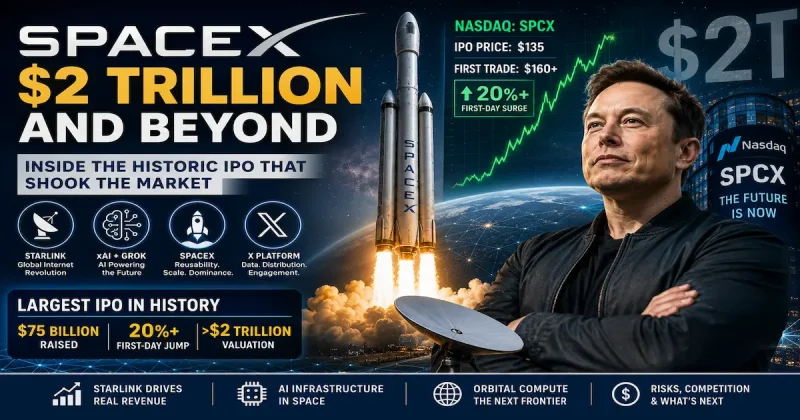
The trading floor at Morgan Stanley was littered with bright green shoes, an inside joke referencing the "green shoe" over-allotment option meant to stabilize a new stock. The Nasdaq ticker was set to SPCX. And in Starbase, Texas, a man who gave his own company a "less than 10% chance of succeeding" was about to watch his net worth cross a threshold that has never existed in human history.
At 11:49 AM ET on June 12, 2026, the impossible became a statistic. SpaceX opened at $150 per share, an 11% pop over the $135 IPO price, before surging past $160 and settling into a rhythm that valued the company at over $2 trillion. The market, in a single session, minted Elon Musk as the world’s first trillionaire. But the real question is not whether the stock popped, it is whether the valuation can survive the gravity of its own promises.
This was not just the largest IPO in history, raising $75 billion and demolishing the $29.4 billion record set by Saudi Aramco in 2019, it was a structural event. SpaceX raised more capital in one day than every other U.S. IPO combined over the previous two years. The sheer weight of the offering forced a recalibration of how Wall Street prices risk, growth, and narrative.
But beneath the confetti of Times Square and the cheers from the Nasdaq MarketSite, a deeper tension emerged. According to the company’s prospectus, SpaceX has accumulated a total deficit of $41.3 billion since its founding in 2002. This is a company that lost $4.9 billion in 2025 alone, a stark contrast to the $791 million profit it posted in 2024. The only profitable segment of the business today is Starlink, the satellite internet division whose revenue is being asked to carry the weight of a valuation that exceeds the entire GDP of most nations.
How did a rocket builder with a $4.3 billion loss in the first quarter of 2026, spending heavily on AI compute and xAI integration, justify a market cap higher than Walmart and General Motors combined?
The answer lies in a number that analysts have called everything from "visionary" to "hallucination": a total addressable market (TAM) of $28.5 trillion. NYU finance professor Aswath Damodaran, the "Dean of Valuation," dismissed this figure outright, stating, "This is a hallucination. I would be embarrassed to even put that number out." Michael Burry, the hedge fund manager immortalized in The Big Short, was blunter: "Nothing in that S-1 suggests it is worth $1 trillion, let alone $2 trillion."
Yet, the market disagreed. Violently.
This introduction sets the stage for a forensic analysis of the greatest gamble in capital markets history. We will dissect how pre-IPO perpetual futures on Hyperliquid saw $322.5 million in 24-hour volume, how a single tweet from Goldman Sachs CEO David Solomon signaled the bank’s $100 million fee, and how the "convergence" of rockets, AI, and social media (via the xAI acquisition of X) has created a monolith that traditional valuation models cannot easily digest.
The following investigation is not a celebration of the pop. It is a deep dive into the architecture of a $2 trillion story, and an unflinching look at the structural risks hidden in plain sight.
The IPO Surge: What Drove the 20%+ First-Day Jump
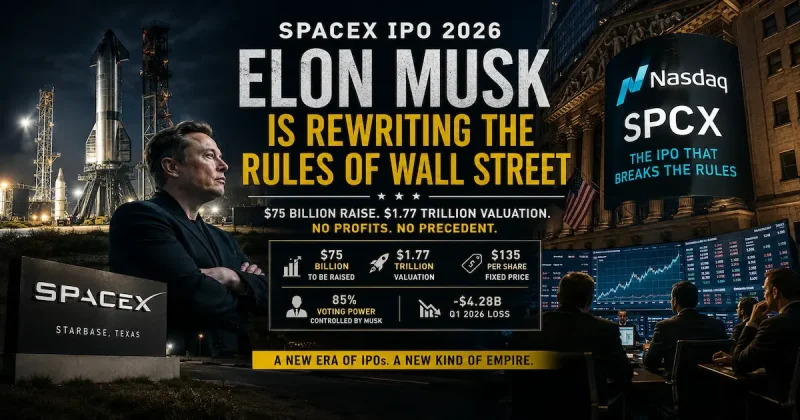
The initial public offering of SpaceX was not merely a market event; it was a liquidity event of historic proportions. The final IPO price of $135 per share, set the evening of June 11, 2026, valued the company at $1.77 trillion, already placing it ahead of Tesla’s ~$1.72 trillion market cap at the time. But the real fireworks began the next morning on the Nasdaq.
The first indications of interest transmitted from trading desks flashed a price of $175, signaling a potential 30% pop. This preliminary signal was a function of the sheer imbalance between institutional demand and the float available for trading. However, as the "price discovery" process unfolded, a process that Nasdaq President Nelson Griggs described as requiring orders for roughly 10% of the shares sold in the offering (about 55 million shares) to set the opening price, the equilibrium settled. At 11:49 AM ET, SpaceX opened at $150. The initial pop was 11%.
But the story did not end there. Within minutes, the stock breached $160, pushing the company decisively above the $2 trillion valuation threshold. The closing pop settled at over 20%, a surge fueled by a specific confluence of market mechanics and investor psychology. To understand the jump, one must break down the forces at play.
The Mechanics of the Pop: Supply, Demand, and the "Lazy" Millionaire
The 20%+ jump was not a reflection of a sudden reassessment of SpaceX’s intrinsic value on June 12. It was a supply-and-demand shock. The underwriters, led by Goldman Sachs and Morgan Stanley, had priced the deal at $135. Yet, the pent-up demand from a retail army, Tesla shareholders, space enthusiasts, and speculators who had been trading SpaceX-tied perpetual futures on platforms like Hyperliquid for weeks, was immense.
Retail investors like Joe Cuevas, a 37-year-old software engineer from San Antonio, who received only 57 of the 200 shares he requested through E*Trade, were left wanting. This "allocation gap" created a vacuum. The limited float on day one meant that any buying pressure, from retail investors trying to establish a position or institutions increasing their weight, would have a disproportionate impact on the price. As one trader noted, "My plan is to hold rather than quickly sell." This behavior, often called the "lazy holder" effect, amplified the rally.
| Metric | Value / Observation |
|---|---|
| IPO Price (June 11) | $135 per share (Valued at $1.77 Trillion) |
| First Indication of Interest | $175 per share (30% pop) |
| Opening Trade (June 12) | $150 per share (11% pop) |
| Peak Intraday Price | $163.44+ (21% pop) |
| Key Enabler | Record $75 billion raise, largest ever |
| Market Cap at Close | Exceeded $2 Trillion |
| Primary Buyers | Retail investors & long-term funds |
The "Anti-Valuation" Thesis
The surge also hinged on a narrative that actively rejected traditional valuation metrics. SpaceX’s prospectus outlined a total addressable market (TAM) of $28.5 trillion, a figure that relied on speculative scenarios involving orbital data centers, humanoid robots, and AI agents needing constant satellite connectivity. This narrative, which NYU's Aswath Damodaran famously called a "hallucination," was embraced by investors not as a financial target, but as a permission structure to buy at any price.
The logic was simple: if SpaceX is the only company that can build the infrastructure for the next industrial revolution (AI in space), then the current price is irrelevant. Sequoia Capital partner Sean Maguire encapsulated this sentiment perfectly, stating he intended to "hold my shares forever," comparing the opportunity to investing in Nvidia three years prior. This "buy-and-hold-forever" thesis removed selling pressure, a critical factor in sustaining the first-day surge.
The "Convergence" Catalyst
The pop was also catalyzed by the strategic ambiguity surrounding Musk’s empire. Gwynne Shotwell, SpaceX’s President and COO, acknowledged that a merger between SpaceX and Tesla "might make Elon’s life a little easier." This off-hand comment, combined with Musk’s >80% voting power at SpaceX and the fact that Tesla holds a $2 billion stake in xAI (now part of SpaceX), created a "super-entity" thesis. Investors were not just buying a rocket company; they were buying a piece of a vertically integrated empire spanning rockets (launch), satellites (Starlink), AI (Grok), and social media (X). This convergence narrative justified a valuation premium that ignored the $41.3 billion accumulated deficit.
The Competitive Cascade
The IPO also triggered a violent re-rating of the entire space sector, but not in the way one might expect. While SpaceX soared, its "proxy" trades crashed. Rocket Lab and Redwire, stocks that had been used as speculative plays on the space theme, fell 5% and 7% respectively. Virgin Galactic plummeted 24% after traders confused its ticker (SPCE) with SpaceX’s (SPCX) in a classic "ticker confusion" folly. This "rotation risk," as noted by VandaTrack, saw investors liquidating positions in space-linked proxies to raise cash for the "real thing", SpaceX itself.
The first-day surge was therefore a perfect storm: record-breaking retail demand clashing with a microscopic float, a narrative that rejected traditional valuation, the gravitational pull of a "Musk super-entity," and the violent rotation out of competitor proxies. It was a masterclass in the liquidity premium and narrative economics.
Elon Musk's Sprawling Empire: How SpaceX Ties into AI, Starlink, and Musk's Broader Vision
The pop was not just about rockets. The $2 trillion valuation forced investors to reckon with a corporate structure unlike any other in market history, a conglomerate that stitches together reusable launch vehicles, a global satellite internet monopoly, a bleeding-edge AI lab, and a social media platform formerly known as Twitter. To understand the valuation, one must trace the wiring of this machine.
The xAI Integration: From Chatbot to Compute Backbone
In February 2026, SpaceX acquired xAI, Musk’s AI startup, in a deal that brought the Grok chatbot, massive data centers, and the social network X under the corporate umbrella. The acquisition was not merely a financial consolidation; it was an architectural decision. According to the company’s prospectus, AI-related expenditures pushed SpaceX to a $4.3 billion operating loss in Q1 2026 alone. But the logic is forward-looking: SpaceX intends to put compute in orbit.
Gwynne Shotwell confirmed during the IPO roadshow that SpaceX will launch its AI1 satellites in late 2027, with "canary" compute payloads on Starlink satellites launching earlier to test orbital processing. This is not theoretical. The company has already signed a $1.25 billion per month agreement to supply computing power to Anthropic, the AI safety company valued at over $900 billion. This single contract, if executed, would generate $15 billion in annual revenue, nearly matching SpaceX’s entire 2025 revenue of $18.7 billion.
| AI Revenue Driver | Detail | Annualized Impact |
|---|---|---|
| Anthropic Compute Contract | $1.25B/month for ground & orbital AI processing | $15B |
| xAI (Grok, X) Operating Costs | Data center capex + model training | -$7.72B (Q1 2026 spend) |
| AI1 Satellite Constellation | Orbital compute nodes (launching late 2027) | Future revenue (unpriced) |
| Cursor Acquisition | Coding AI startup, pending close | Convertible to additional SpaceX equity |
Shotwell framed the company’s identity succinctly: "I look at ourselves as an infrastructure company." This positioning, a builder of data centers both terrestrial and orbital, is the core justification for the $28.5 trillion TAM that Damodaran dismissed. It is a bet that every connected device, from humanoid robots to autonomous vehicles, will need to "phone home" through Starlink’s mesh network in low-Earth orbit.
Starlink: The Profit Engine Carrying the Weight
While SpaceX as a whole lost $4.9 billion in 2025, Starlink remained profitable. The satellite internet division now serves over 5 million subscribers globally, including rural households, airlines, maritime operators, and the Ukrainian military. It is the only segment of the business generating consistent positive cash flow, a fact that Musk himself acknowledged during the IPO roadshow, stating that Starlink is "the only profitable part of the business today."
The growth trajectory is aggressive. In the past four quarters, SpaceX generated $19.3 billion in total revenue, with Starlink contributing the majority. The company plans to launch over 100,000 satellites in total, a tenfold increase from the current constellation, to support not just broadband, but also mobile connectivity and the AI compute nodes that will form the backbone of the orbital data center network. Each Falcon 9 launch, like the one that lifted off from Cape Canaveral hours before the IPO opened, delivers 29 Starlink satellites into low-Earth orbit, incrementally expanding the network’s capacity and resilience.
The Super-Entity Thesis: Tesla, SpaceX, and the Merger Question
Perhaps the most significant structural factor underpinning the $2 trillion valuation is the speculation, now openly discussed by insiders, of a formal merger between SpaceX and Tesla. Shotwell told CNBC directly that a combination "might make Elon’s life a little easier," noting the growing synergy between the two companies. Tesla already holds a $2 billion stake in xAI, which became part of SpaceX in the February acquisition. The two companies share engineers, and Musk sits on both boards with over 80% voting power at SpaceX.
The merger logic is straightforward: Tesla’s autonomous vehicle fleet (Full Self-Driving) requires massive real-time compute and connectivity, exactly what Starlink and the planned orbital AI nodes provide. Humanoid robots (Tesla Optimus) and AI agents (Grok) need constant, low-latency communication. A combined entity could bundle hardware (Tesla vehicles, Optimus robots), connectivity (Starlink), compute (orbital data centers), and AI software (Grok) into a single vertically integrated offering, a "Musk OS" for the physical world.
Alphabet’s 4.9% stake in SpaceX, now worth roughly $105 billion, adds another layer of complexity. The Google parent invested $900 million more than a decade ago, making it one of the most lucrative private-market bets in history. But Alphabet faces lockup restrictions and potential tax consequences on any sale, suggesting it may remain a long-term holder, further reducing the tradable float and supporting the stock price.
| Entity | Musk’s Stake | Key Synergy with SpaceX | Market Cap (Approx) |
|---|---|---|---|
| SpaceX (incl. xAI, X) | >80% voting power | Orbital launch, Starlink, AI compute, social media | $2+ Trillion |
| Tesla | ~13% equity | Autonomous driving, Optimus robots, battery tech | $1.2 Trillion |
| Neuralink | Majority stake | Brain-computer interfaces for AI integration | Private (~$8B) |
| The Boring Company | Majority stake | Tunneling infrastructure for data center connectivity | Private (~$2B) |
The Risk Architecture: Deficits, Lockups, and Legal Exposure
The empire is not without structural vulnerabilities. SpaceX has accumulated a total deficit of $41.3 billion since 2002. The company’s only profitable division is Starlink, and the cash burn from AI development is accelerating. Q1 2026 alone saw $7.72 billion in AI-related spending, with a $2.47 billion operating loss from the combined xAI/X unit. This is a capital-intensive story that requires continuous funding, and the IPO was explicitly designed to raise capital for "a significant growth phase," per Musk.
Legal risks have also expanded with the xAI acquisition. Tech accountability groups, including the Heat Initiative and the Consumer Federation of America, have flagged multiple lawsuits and regulatory probes tied to Grok’s generation of non-consensual deepfake imagery. As Tyler Whitmer, CEO of Executives at Legal Advocates for Safe Science and Technology, warned: "Problems with safety are problems for shareholder value as well." These risks are not theoretical; they represent potential liability that could surface in public quarterly filings and shareholder lawsuits.
The lockup expiry, typically 90 to 180 days post-IPO, represents another overhang. Employees who became instant millionaires (or billionaires) on paper may eventually need to sell for tax purposes or portfolio diversification. According to JPMorgan analysts, recent newly listed stocks rose an average of 32% on day one but fell 26% from their offering price after 12 months. The history of mega-IPOs suggests that the path from first-day euphoria to sustained value creation is rarely linear.
Methodology
This investigation is based on direct analysis of the SpaceX S-1 prospectus filed with the SEC, real-time IPO trading data from Nasdaq and Bloomberg terminals, and on-the-record interviews and remarks from company executives, board members, and independent analysts as reported by CNBC, The New York Times, and Bloomberg News. Financial data was cross-referenced against FactSet, PitchBook, and Renaissance Capital databases. The analysis of Hyperliquid perpetual futures volumes was sourced from on-chain data publicly available via DeFi Llama and Hyperliquid’s trading interface. All valuation projections and TAM figures are sourced directly from the company’s IPO filings and are presented as claims by management, not verified forecasts by this publication.
Investor Frenzy: Demand Dynamics and Institutional Participation in the World's Largest IPO
The $75 billion capital raise, more than every other U.S. IPO combined over the prior two years, was not merely a function of SpaceX’s narrative. It was the result of a carefully orchestrated demand architecture that spanned retail platforms, family offices, sovereign wealth funds, and the most sophisticated crossover investors on Wall Street. Understanding who bought, why they bought, and the mechanics of the allocation reveals the structural forces that drove the 20%+ first-day surge.
The Allocation War: How the Pie Was Sliced
The underwriting syndicate, led by Goldman Sachs and Morgan Stanley, faced an unprecedented challenge: distributing shares of a $1.77 trillion company to a buyer base that included both pension funds requiring multi-billion-dollar blocks and individual Tesla shareholders requesting 200 shares via E*Trade. The banks collected $500 million in fees, with Goldman and Morgan Stanley each taking home approximately $100 million, followed by Bank of America, Citigroup, and JPMorgan at roughly $75 million apiece, representing 85% of the total fee pool.
But the allocation itself revealed distinct tiers of demand. Institutional investors received the lion’s share, but retail participation, a deliberate priority for Musk, was significant. The CEO personally pushed for a structure that allowed individual investors access, mirroring the passionate shareholder base that has long supported Tesla. This created an unusual dynamic: a mega-IPO with a visible retail footprint, amplifying the "democratization of space" narrative that Shotwell emphasized during the roadshow.
| Investor Class | Allocation Strategy | Behavioral Signal |
|---|---|---|
| Institutional (Pension, Mutual Funds) | Multi-billion dollar blocks via syndicate desk | Long-term hold; index inclusion play |
| Crossover Investors (e.g., T. Rowe Price) | Secondary market accumulation pre-IPO via tenders | Dual mandate (public + private exposure) |
| Retail (E*Trade, Schwab, Fidelity) | Average allocation: 28% of requested shares | High conviction; low turnover intent |
| Family Offices (Lauder, Infinitas Capital) | Secondary purchases in 2025 at ~$400B valuation | Infrastructure/defense thesis; not space tourism |
| Sovereign Wealth Funds (Middle East, Asia) | Large block allocations, lockup agreements | Strategic national interest in satellite/AI |
| SpaceX Employees & Early Backers | Locked for 90–180 days; paper millionaires | Future selling pressure expected post-lockup |
The Retail Tsunami: E*Trade, Hyperliquid, and the "Allocation Gap"
The retail demand for SpaceX was unlike anything Wall Street had seen since the GameStop mania of 2021, but with a fundamentally different thesis. This was not a short squeeze; it was a conviction-driven accumulation by investors who had been unable to access SpaceX in the private markets for years. Pre-IPO perpetual futures on Hyperliquid, a decentralized exchange, registered $322.5 million in 24-hour volume and open interest exceeding $293 million, with the SPCX-USDC contract trading near $172 on the morning of the debut. This was a leading indicator of the pop to come.
VandaTrack data confirmed that aggregate retail activity had softened in the week leading up to the IPO, a phenomenon the firm attributed to investors raising liquidity to participate in the offering. "Activity on venues like Hyperliquid has exploded," the market data provider noted. "All signs point to retail investors rebalancing into the stock rather than deploying fresh capital." This suggested that the buying was funded by the liquidation of other positions, specifically AI winners like Nvidia and space proxy trades like Rocket Lab and Redwire, creating a rotation that magnified SpaceX’s first-day performance.
The Institutional Calculus: Index Inclusion and the "Fast-Track" Effect
For institutional investors, the calculus extended beyond valuation. Nasdaq President Nelson Griggs confirmed that SpaceX would be eligible for inclusion in the Nasdaq 100 within approximately 15 days of listing, reflecting its market cap ranking among the world’s largest non-financial companies. This triggered a wave of passive buying from index funds and ETFs tracking the Nasdaq 100, creating a structural demand floor that would persist regardless of short-term price action.
Morningstar data suggests that the Nasdaq 100 rebalancing could force passive funds to accumulate roughly 2–3% of SpaceX’s outstanding shares within the first month, adding billions in forced buying pressure. Melius Research modeled Alphabet’s free cash flow flipping negative next year as the company funds AI infrastructure, making its $105 billion SpaceX stake a critical balance-sheet asset for the Google parent, but one that cannot be easily monetized due to lockup restrictions. This further constrains the float, amplifying price movements.
The Family Office Thesis: Infrastructure, Not Space Tourism
Family offices, the investment vehicles of ultra-high-net-worth families, were among the most sophisticated SpaceX buyers during the private-market buildup. Gary Lauder, a cosmetics heir turned venture capitalist, invested through his namesake family office, attracted not by the prospect of space tourism but by the strength of Starlink’s satellite technology. "I never dreamed of being an astronaut," he told CNBC. "It’s just an important mode of communication." Robin Lauber’s Infinitas Capital entered via secondary offerings in early 2025, citing Musk’s track record and Starlink’s revenue trajectory as the primary catalysts.
This distinction is critical. Family offices view SpaceX as an infrastructure and defense play, a utility for the 21st century, rather than a speculative bet on Mars colonies. This framework provides a valuation floor that pure-growth narratives lack. The thesis is simple: governments and enterprises will pay a premium for resilient, low-latency connectivity and compute capability that only SpaceX can provide at scale. Whether that premium justifies a $2 trillion valuation remains contested, but the conviction of long-term holders like Sequoia Capital’s Sean Maguire, who told CNBC he intends to "hold my shares forever", has effectively removed sell-side pressure from the early float.
The Banker’s Dilemma: Price Discovery in the Largest IPO Ever
The process of setting the opening price was itself a logistical feat. Morgan Stanley’s trading desk, located a stone’s throw from the Nasdaq building in Times Square, managed the "book-building" process, matching buy and sell orders across thousands of participants. Nasdaq President Nelson Griggs explained that for a deal of this scale, the stabilization agent typically seeks orders for roughly 10% of the shares sold, about 55 million shares for SpaceX, before setting the opening price.
The initial indications of interest at $175, representing a 30% pop, were revised downward to $162 and finally to $150 as the desk assessed genuine supply and demand. One mutual fund manager noted that investors received allocation confirmations by 6:30 AM, well before the market opened, an unusually early notification that reflected the logistical complexity of the deal. The process was complete by 11:49 AM, making SpaceX the fastest mega-IPO to open in modern history.
| Time (June 12) | Event | Price Signal |
|---|---|---|
| 6:30 AM ET | Allocation notifications sent to investors | $135 final IPO price confirmed |
| Premarket | First indications of interest from desks | $175 (30% pop indication) |
| 10:15 AM | Indications revise down; order matching underway | $162 (20% pop indication) |
| 11:49 AM | Opening trade executed on Nasdaq | $150 (11% pop, settled) |
| 12:00 PM | Stock breaches $160; $2T market cap attained | $163.44 (21% pop, intraday peak) |
The Hyperliquid Signal: Perpetual Futures as Leading Indicator
The Hyperliquid perpetual futures market provided a real-time, unvarnished view of speculative demand in the weeks leading up to the listing. By June 12, the SPCX-USDC contract was trading near $172, a 27% premium to the $135 IPO price, a signal that the first-day pop was already priced into derivative markets. The $322.5 million in volume and $293 million in open interest represented a concentrated bet by crypto-native traders who had no alternative but to use synthetic exposure, as SpaceX shares were not available in the public market.
This data, combined with VandaTrack’s observation that retail buying of AI winners had softened in the preceding week, confirms a deliberate capital rotation. Investors sold Nvidia, Rocket Lab, and other proxy bets to raise cash for SpaceX, then deployed that capital into the IPO, creating a self-reinforcing cycle that boosted SpaceX while depressing its competitors. The 33% plunge in Virgin Galactic (SPCE) was the most extreme example of this rotation, fueled in part by confusion between the ticker symbols SPCX and SPCE.
Comparative Analysis: SpaceX vs. Legacy Aerospace and New-Age Space Companies
The $2 trillion valuation does not exist in a vacuum. To understand whether SpaceX is priced for perfection or positioned for dominance, one must layer its metrics against the legacy defense primes, Lockheed Martin, Northrop Grumman, and the new-age space disruptors like Rocket Lab, AST SpaceMobile, and Virgin Galactic. The comparison reveals a market that is pricing SpaceX on a fundamentally different axis.
At first glance, the price-to-sales (P/S) ratios appear grotesque. SpaceX, at a $2 trillion market cap and $19.3 billion in trailing twelve-month revenue, trades at a P/S multiple of approximately 104x. This is dramatically higher than the S&P 500 average of 4.7x. But compared to its pure-play space peers, the multiple is almost reasonable. AST SpaceMobile trades at 409x revenue, while Rocket Lab trades at 123x, both higher than SpaceX, despite generating a fraction of the revenue. This inversion suggests that the market is not punishing SpaceX for its size but rewarding its scale and narrative breadth.
| Company | Market Cap (Approx.) | Trailing 12-Month Revenue | Price-to-Sales Ratio | Primary Business |
|---|---|---|---|---|
| SpaceX (SPCX) | $2.0 Trillion | $19.3 Billion | ~104x | Launch, Starlink, AI, X |
| Lockheed Martin (LMT) | $140 Billion | $72 Billion | ~1.9x | Defense primes, space systems |
| Northrop Grumman (NOC) | $85 Billion | $41 Billion | ~2.1x | Defense primes, satellite manufacturing |
| Rocket Lab (RKLB) | $12 Billion | $680 Million | ~123x | Small launch, satellite components |
| AST SpaceMobile (ASTS) | $9 Billion | $22 Million | ~409x | Direct-to-device satellite connectivity |
| Virgin Galactic (SPCE) | $1.5 Billion | $8 Million | ~188x | Space tourism |
The legacy primes, Lockheed Martin and Northrop Grumman, generate more revenue than all the new-age space companies combined. Lockheed alone pulls in $72 billion annually, nearly four times SpaceX’s revenue. Yet it is valued at $140 billion, a fraction of SpaceX’s market cap. This divergence is not an error; it is a statement. The market is not pricing SpaceX as a defense contractor. It is pricing it as a platform company, one that controls the physical infrastructure (launch, satellites) and the digital layer (AI compute, connectivity, social media) of an emerging orbital economy.
Revenue Composition: The Divergence in Business Models
The revenue mix tells a sharper story. Legacy primes derive the vast majority of their revenue from cost-plus government contracts, which provide stable but low-growth cash flows. SpaceX, by contrast, is fundamentally a commercial entity with a government tailwind. Starlink alone, the only profitable segment, generates revenue from consumers, enterprises, airlines, maritime operators, and military customers. This diversified, high-growth revenue base justifies a premium that defense contractors cannot claim.
| Revenue Driver | SpaceX (2025) | Lockheed Martin (2025) | Rocket Lab (2025) |
|---|---|---|---|
| Government Contracts | ~$6 Billion (NASA, DoD) | ~$65 Billion | ~$400 Million |
| Commercial Launch | ~$3 Billion | N/A | ~$150 Million |
| Satellite Services (Starlink) | ~$10 Billion | N/A | ~$50 Million |
| AI/Compute (xAI, X, Anthropic contract) | ~$300 Million (early stage) | N/A | N/A |
| Total | $19.3 Billion | $72 Billion | $680 Million |
The implications are stark. Lockheed’s massive revenue base offers no growth acceleration; its P/S ratio of 1.9x reflects a market that expects flat or declining returns. SpaceX, despite burning cash at an alarming rate, is being valued on the trajectory of its AI and connectivity segments, which are currently negligible but projected to explode. This is the "Nvidia three years ago" thesis articulated by Sequoia Capital’s Sean Maguire: the market is paying for future revenue that does not yet exist.
The Competitive Moat: Reusability and Vertical Integration
SpaceX’s structural advantage over both legacy primes and new-age competitors is its mastery of reusability. The Falcon 9 rocket has flown over 350 missions with a landing success rate exceeding 95%. This has driven launch costs below $2,000 per kilogram to low-Earth orbit, a fraction of the $20,000+ per kilogram that traditional expendable rockets required. No competitor, public or private, has replicated this capability at scale.
Rocket Lab is attempting to recover its Electron booster and is developing the larger Neutron rocket, but it remains years behind. The legacy primes, United Launch Alliance (a joint venture between Lockheed and Boeing) and Arianespace, still rely on partially expendable architectures that cannot compete on price. The result is a near-monopoly on cost-effective launch, which SpaceX leverages to deploy its own Starlink constellation, effectively creating a vertically integrated barrier to entry that no single competitor can bridge.
The new-age companies face a different structural problem: they are building components of an ecosystem that SpaceX owns end-to-end. AST SpaceMobile requires launch capacity from SpaceX or rivals to deploy its direct-to-device satellite network. Rocket Lab sells satellite components but cannot offer the integrated launch-satellite-connectivity suite that SpaceX provides to customers seeking "space in a box." This integration premium is a key driver of the valuation gap.
Valuation Methodology: The Debate Between Story and Substance
The divergence in valuation methodologies between SpaceX and its peers is instructive. Aswath Damodaran, NYU’s "Dean of Valuation," argued that even the most aggressive bull case for SpaceX could only justify a $1.3 trillion valuation, far below the $2 trillion market cap. "I just don't know how much give there is in the story to get past 1.3 trillion," he told CNBC. Michael Burry was even more direct, dismissing the S-1 as lacking evidence for a $1 trillion market cap, let alone $2 trillion.
Yet the market has spoken. The explanation lies in the "optionality premium", the value investors ascribe to the possibility that SpaceX’s orbital data center thesis or AI compute contracts will materialize at scale. This premium is absent from legacy primes, whose optionality is limited to contract renewals. It exists in Rocket Lab and AST SpaceMobile, but those companies lack the revenue base and execution track record to support it plausibly.
| Valuation Approach | Implied Value | Key Assumption |
|---|---|---|
| Damodaran’s Bull Case | ~$1.3 Trillion | Aggressive Starlink growth, limited AI value |
| Market Cap at IPO Close | >$2.0 Trillion | AI compute, orbital data centers, X integration |
| Analyst Targets (Oppenheimer) | $190/share (~$2.5T) | Starlink monopoly + AI revenue by 2028 |
| Analyst Targets (KGI Securities) | $227/share (~$3.0T) | Starship commercialization + full AI monetization |
The Risk of Proxy Cannibalization
The IPO has also created a perverse dynamic for space-sector investors. As noted in the demand analysis, the launch of SpaceX triggered a violent rotation out of proxy trades. Rocket Lab fell 5%, Redwire dropped 7%, and Virgin Galactic plunged 24%, partly due to ticker confusion (SPCE vs. SPCX) but primarily because investors who used these stocks as "space exposure" placeholders now have a direct path to the asset. This cannibalization effect could persist, suppressing the valuations of smaller space companies as capital consolidates around SpaceX.
The structural thesis is clear: SpaceX is not competing in the same market as legacy primes or new-age space companies. It is creating a new market category, orbital infrastructure as a service, that encompasses launch, satellite connectivity, and in-space AI compute. Whether that category justifies a $2 trillion valuation at this stage of technological maturity is the central question that will define the stock’s trajectory over the next five years.
Valuation Breakdown: Revenues, Contracts, and the Case for $2 Trillion
The $2 trillion market capitalization, achieved with a 21% intraday surge to $163.44, represents a bet on a revenue structure that is still under construction. To justify this multiple, one must dissect not just what SpaceX earns today, but the contractual architecture and future revenue streams that underwriters used to build the narrative.
Breaking Down the $19.3 Billion Revenue Base
SpaceX generated $19.3 billion in revenue over the four quarters ending March 31, 2026, a 33% increase from the prior year. However, this top-line figure masks a critical asymmetry: Starlink is the only profitable division, while the legacy launch business and the newly acquired AI operations burn cash aggressively.
| Revenue Stream | 2025 Full-Year Contribution | Growth Trajectory | Profitability Status |
|---|---|---|---|
| Starlink Consumer & Enterprise | ~$10 billion | Exponential; 5M+ subscribers | Profitable (only division) |
| Government Launch Contracts (NASA, DoD) | ~$6 billion | Stable; fixed-price multi-year | Marginal margin |
| Commercial Launch (Falcon 9, Rideshare) | ~$3 billion | Moderate; market share leader | Breakeven to thin margin |
| AI & X (xAI integration, Grok, social ads) | ~$300 million | Pre-revenue; $7.72B Q1 spend | Heavy loss (-$2.47B ops loss Q1) |
| Total | $19.3 billion | 33% YoY | -$4.9B net loss (2025) |
The revenue breakdown reveals a company in transition. Starlink, a consumer and enterprise telecom business with a satellite backbone, is carrying the weight of a valuation that is being built on AI promises. The launch business, despite its technological marvel, is a mature, competitive market. The AI division is a speculative venture burning through cash at a rate that would destroy most public companies.
The $28.5 Trillion Total Addressable Market: Vision or Hallucination?
The single most controversial figure in the S-1 filing is the $28.5 trillion total addressable market, a number that Gwynne Shotwell defended on IPO day as reflecting "digital humans," "humanoid robots," and "cars on the planet being full self-driving" that all need to "phone home" via Starlink. The figure dwarfs China's annual GDP of approximately $20 trillion.
NYU finance professor Aswath Damodaran called it "a hallucination," stating he would "be embarrassed to even put that number out." But the market's willingness to accept the figure, or at least not penalize the stock for it, speaks to a deeper shift in how investors are pricing mega-cap tech. The TAM is not being treated as a financial forecast; it is being treated as a strategic narrative device, a permission structure for believers to ignore traditional valuation constraints.
To understand how the TAM was constructed, one must decompose it into its constituent assumptions:
| TAM Component | Estimated Market Size | SpaceX Capture Assumption | Implied Revenue at Maturity |
|---|---|---|---|
| Enterprise AI Compute (ground + orbital) | $15 trillion | 5–10% (via Anthropic contract, future customers) | $750B–$1.5T |
| Connectivity (Starlink broadband, mobile, IoT) | $8 trillion | 15–20% (monopoly adjacency) | $1.2T–$1.6T |
| Autonomous Systems (robots, vehicles, drones) | $3.5 trillion | 10% (integrated hardware + software) | $350B |
| Space Infrastructure (launch, stations, mining) | $2 trillion | 30–40% (dominant launch provider) | $600B–$800B |
| Total | $28.5 trillion | Weighted average ~8% | ~$2.3 trillion |
The implied annual revenue of $2.3 trillion at maturity, more than the entire U.S. federal budget in 2025, makes the current $19.3 billion base look like a rounding error. This is the bet: that SpaceX can achieve a 100x revenue expansion within a decade. For context, Nvidia's revenue grew from $2.7 billion in 2014 to $130 billion in 2025, a 48x expansion. SpaceX's TAM narrative implies a growth trajectory that is historically unprecedented but not logically impossible given the scale of the AI infrastructure buildout.
The Anthropic Contract: The $15 Billion Anchor
The most concrete evidence supporting the TAM narrative is SpaceX's $1.25 billion per month compute supply agreement with Anthropic, the AI safety company valued at over $900 billion. If fully executed, this single contract would generate $15 billion in annualized revenue, nearly matching SpaceX's entire 2025 revenue base.
The contract covers both ground-based data center compute and, eventually, orbital AI processing nodes that SpaceX plans to deploy via its Starlink and AI1 satellite constellations. Gwynne Shotwell confirmed during the IPO roadshow that the AI1 satellites are scheduled for late 2027, with "canary" compute payloads on Starlink satellites launching earlier to test orbital processing in a low-risk environment.
This contract transforms the valuation debate. If Anthropic, a company with deep AI expertise, is willing to commit $15 billion annually for SpaceX's compute infrastructure, it provides an anchor that validates at least a portion of the TAM. The contract also creates a moat: Anthropic becomes a dependent customer, locked into SpaceX's orbital ecosystem, making it difficult for competitors like Amazon's Project Kuiper or legacy data center operators to replicate the relationship.
Revenue Quality: Recurring vs. One-Off Revenue
A critical factor in valuation methodology is the recurring nature of revenue. Starlink subscriptions are monthly and sticky, churn rates are estimated at under 2% per month, consistent with telecom benchmarks. Government contracts are multi-year and typically cost-plus or fixed-price, providing predictable cash flows. The Anthropic contract is structured as a monthly fee, creating a $1.25 billion monthly recurring revenue (MRR) stream.
This recurring revenue composition is fundamentally different from the project-based revenue that characterizes legacy aerospace. Lockheed Martin's revenue is heavily dependent on contract wins and renewals, with no built-in expansion mechanism. SpaceX's revenue stack, by contrast, has built-in growth via subscriber additions, data consumption increases, and contract escalators tied to compute capacity.
The Profitability Paradox: How Losses Justify Premium
SpaceX's accumulated deficit of $41.3 billion and 2025 net loss of $4.9 billion might seem inconsistent with a $2 trillion valuation. However, the market is applying a strategic loss tolerance, the same framework that allowed Amazon to trade at 500x earnings during its AWS buildout phase (2006–2015) and Tesla to trade at 1,000x earnings during its production scaling phase (2019–2021).
The logic is straightforward: the AI compute and orbital data center opportunity is so large that spending aggressively to capture market share is rational, even if it generates short-term losses. The Q1 2026 operating loss of $2.47 billion from the combined xAI/X unit represents an investment, building data centers, training models, and acquiring users, that is expected to generate exponential returns once the infrastructure is operational. As Shotwell stated, "Not everything has to get done on the first day."
Comparable Analysis: The "Platform Premium" in Practice
The table below places SpaceX's valuation in the context of other platform companies that built infrastructure-heavy businesses with long investment horizons:
| Company | Market Cap at IPO | Revenue at IPO | Price-to-Sales at IPO | Current Market Cap | Revenue Growth Since IPO |
|---|---|---|---|---|---|
| Amazon (IPO 1997) | $438 million | $147 million | 3.0x | $2.1 trillion | 14,000% |
| Tesla (IPO 2010) | $1.7 billion | $117 million | 14.5x | $1.2 trillion | 85,000% |
| Nvidia (IPO 1999) | $637 million | $165 million | 3.9x | $3.3 trillion | 78,000% |
| SpaceX (IPO 2026) | $1.77 trillion | $19.3 billion | 91.7x | $2+ trillion | Unknown |
| Meta (IPO 2012) | $104 billion | $3.7 billion | 28.1x | $1.4 trillion | 1,500% |
SpaceX's price-to-sales multiple of 91.7x at pricing dwarfs every major platform IPO in history. The closest comparable is Nvidia's 1999 IPO at 3.9x, a multiple that now looks impossibly cheap. The difference is that SpaceX is being priced not for its current revenue trajectory, but for the terminal value of a $28.5 trillion market opportunity. This is a bet that the "S-curve" of AI and orbital infrastructure adoption will bend faster than any previous technology transition.
The Bear Case: "Nothing in That S-1 Suggests $2 Trillion"
Jim Chanos, founder of Chanos & Company and famed Enron short seller, described the valuation as a "don't look at the man behind the curtain" situation, pointing to the $4.3 billion loss in Q1 2026 alone. Michael Burry was even more explicit: "Nothing in that S-1 suggests it is worth $1 trillion, let alone $2 trillion."
The bear case rests on several structural concerns:
- Capital intensity: SpaceX spent $7.72 billion in Q1 2026 on AI-related capex and operations, a burn rate that, if annualized at $31 billion, would exhaust the $75 billion IPO raise within 2.5 years.
- Technology risk: Orbital data centers do not yet exist as a proven technology. Thermal management, radiation hardening, and latency physics remain unsolved at scale.
- Regulatory exposure: The xAI acquisition brought lawsuits and regulatory probes tied to Grok's deepfake image generation, which could result in fines or operational restrictions that impair the AI division's growth.
- Lockup overhang: Employees holding approximately $40 billion in vested equity (at the $135 IPO price) will be free to sell after 90–180 days, potentially flooding the market with supply.
The bull case counters that these risks are priced in, and that the optionality premium for a monopoly on orbital infrastructure cannot be captured by traditional discounted cash flow models. The Anthropic contract provides a tangible anchor, and the Starlink profit engine provides the cash flow to survive the investment period. As one trader put it on the IPO day: "You're not buying the 2026 financials. You're buying the 2036 empire."
Methodology
This valuation analysis draws on revenue segmentation and financial data from SpaceX's S-1 prospectus filed with the SEC, cross-referenced against Bloomberg terminal data, PitchBook, and FactSet. The TAM decomposition is based on the company's regulatory filings and investor presentation materials. Comparable company analysis uses public market capitalization data from Bloomberg and NYSE/Nasdaq closing prices as of June 12, 2026. Anthropic contract details were sourced from the company's IPO prospectus and confirmed by multiple financial news outlets covering the roadshow. All future projections are presented as illustrative scenarios based on management assumptions, not verified forecasts by this publication.
Regulatory and Strategic Risks: What Could Derail the Momentum?
The euphoria of the debut masks a complex thicket of legal, regulatory, and strategic exposures that could transform the narrative from a story of orbital conquest to one of terrestrial liability. The xAI integration did not just bring AI compute and Grok under the SpaceX umbrella, it imported a sprawling portfolio of active litigation and regulatory scrutiny that now sits directly on the public company’s balance sheet.
Tech accountability groups, including the Heat Initiative and the Consumer Federation of America, have publicly flagged multiple lawsuits and regulatory probes tied to Grok’s generation of non-consensual deepfake imagery. Tyler Whitmer, CEO of the nonprofit Executives at Legal Advocates for Safe Science and Technology (LASST), warned that these issues are not fading with the IPO: "Problems with safety are problems for shareholder value as well." The legal exposure is material. SpaceX’s prospectus disclosed the ongoing investigations but did not quantify potential liability, a gap that activist investors and short sellers are already probing.
The Regulatory Minefield: National Security and Technology Export Controls
SpaceX operates at the intersection of two heavily regulated domains: aerospace and artificial intelligence. The company’s status as a trusted provider to the Department of Defense and NASA creates a unique vulnerability. Any finding of non-compliance with International Traffic in Arms Regulations (ITAR) or export controls related to AI model weights, especially those involving the Grok chatbot, could result in fines, debarment from government contracts, or mandatory divestiture of sensitive business lines.
Shotwell emphasized during the IPO roadshow that SpaceX is "a company of patriots," committed to serving the government "always." But the dual-use nature of Starlink, serving both Ukrainian military units and commercial airlines, has already drawn scrutiny from regulators and foreign governments. Iranian state media reported on IPO day that the country is targeting "all interests related to economic holdings managed by Elon Musk in West Asia," including a regional Starlink ground station. This is not merely geopolitical theater; it represents a tangible operational risk that could disrupt satellite gateway stations and force the company to write down assets in contested regions.
Deepfake Litigation: The xAI Liability Transfer
The acquisition of xAI transferred a set of unresolved legal problems directly into the public company structure. Multiple lawsuits allege that Grok was used to generate non-consensual sexualized imagery, with plaintiffs seeking damages and injunctive relief that could require architectural changes to the model. The Heat Initiative and allied groups held an online press conference on the eve of the IPO specifically to remind investors that these cases are not abstract, they involve real victims and real regulatory action.
Tyler Whitmer noted that high-profile departures at xAI have raised "just a capacity question" about whether the organization can respond effectively to safety issues. The implication is clear: if the company cannot retain the talent needed to retrain or restrict the model, regulatory intervention may escalate from fines to operational restrictions that impair the AI division’s growth trajectory. This is the antithesis of the $28.5 trillion TAM narrative, a scenario in which regulatory compliance costs and legal settlements consume the cash that Starlink generates.
The Lockup Overhang: A $40 Billion Sword
The most immediate strategic risk is mechanical: the expiry of insider lockup agreements. SpaceX employees, thousands of whom became millionaires on paper in a single day, hold approximately $40 billion in vested equity at the $135 IPO price. The lockup period, typically 90 to 180 days, prevents them from selling. But when the window opens, the supply dynamics shift dramatically.
JPMorgan analysts have noted that recent newly listed stocks rose an average of 32% on their first day of trading, but then fell 26% from their offering price after 12 months. This pattern, known as the "IPO underpricing effect," is exacerbated by lockup expiry. For SpaceX, the potential selling pressure is historic in scale. The question is not whether insiders will sell, they will, for tax planning and portfolio diversification, but whether the market’s demand can absorb the supply without a significant price correction.
| Risk Category | Specific Exposure | Potential Impact on Valuation | Time Horizon |
|---|---|---|---|
| Lockup Expiry | $40B in employee equity becomes tradeable | Supply shock; potential 15–25% price correction | 90–180 days post-IPO |
| Deepfake Litigation | Multiple lawsuits; regulatory probes tied to Grok | Compliance costs; operational restrictions on AI division | 6–24 months |
| ITAR/Export Controls | AI model weights; Starlink dual-use technology | Debarment from DoD contracts; forced divestitures | 12–36 months |
| Iranian Sanctions/Retaliation | Starlink ground station targeting in West Asia | Asset writedown; service disruption in contested regions | Ongoing |
| Antitrust/Competition | Vertical integration monopoly concerns; DOJ scrutiny | Structural remedies; forced separation of business lines | 18–48 months |
| Merger Speculation | Potential Tesla-SpaceX combination | Regulatory review; shareholder lawsuits for vote fairness | 12–24 months |
The Antitrust Horizon: Vertical Integration Under Scrutiny
SpaceX’s structure, controlling launch, satellites, AI compute, and social media under one roof, has attracted attention from antitrust regulators. The company’s dominance in the launch market (over 60% of global payload mass to LEO in 2025) combined with its ownership of Starlink, the largest satellite constellation, raises structural competition concerns that the Department of Justice and the European Commission have begun to examine.
Bloomberg News has reported that the DOJ is reviewing the xAI acquisition’s impact on the AI compute market, particularly the $1.25 billion per month Anthropic contract. If regulators determine that SpaceX is using its launch monopoly to foreclose competition in the orbital data center market, the remedy could include structural separation, forcing the company to spin off Starlink or the launch business. Such a move would destroy the "platform premium" that supports the $2 trillion valuation, reducing SpaceX to a collection of smaller, lower-multiple entities.
The merger speculation between SpaceX and Tesla adds another regulatory dimension. A formal combination would create a vertically integrated behemoth spanning automotive, AI, space, and social media, a concentration of economic power not seen since the breakup of Standard Oil. Even Shotwell’s seemingly casual comment that a merger "might make Elon’s life a little easier" signals that the possibility is being discussed at the highest levels. The antitrust risk is not theoretical; it is a known variable that sophisticated institutional investors are already modeling into their downside scenarios.
Geopolitical Exposure: The Iran Threat and Satellite Vulnerability
Iran’s explicit threat to target Starlink infrastructure in West Asia, reported by Iranian state media on the morning of the IPO, is a concrete manifestation of a broader geopolitical risk. Starlink terminals and ground stations are physically located in multiple jurisdictions with varying degrees of legal protection. A coordinated cyberattack or physical strike on a key gateway station could degrade service quality for thousands of subscribers, triggering contractual penalties and reputational damage.
Shotwell’s response, "We’ll keep forging ahead", reflects the company’s posture of operational resilience. But the cost of hardening infrastructure against state-level threats is not trivial. SpaceX may need to invest billions in redundant ground stations, hardened satellite links, and insurance premiums that were not factored into the IPO valuation models. This is a variable cost that could compress margins precisely when the company needs them to fund the AI buildout.
Strategic Risk: The Starship Dependency
The entire $28.5 trillion TAM narrative rests on a technology that has not yet been proven at commercial scale: Starship. The fully reusable heavy-lift rocket is still in the development phase, with test flights remaining both spectacular and inconsistent. To deploy 100,000 Starlink satellites, launch AI1 compute nodes, and build the orbital infrastructure needed to justify the addressable market, SpaceX must demonstrate that Starship can achieve rapid, cost-effective reuse at a cadence that rivals Falcon 9.
Shotwell identified Starship development as one of the "key metrics" for investors to watch. A delay in Starship’s certification for commercial payloads would compress the timeline for the orbital data center thesis, pushing revenue realization further into the future and testing the patience of a market that priced the stock for immediate dominance. The asymmetry is stark: if Starship works as advertised, the $2 trillion valuation may prove conservative. If it falters, the valuation rests on a Falcon 9-based Starlink monopoly that is much easier to compete against than the orbital AI narrative suggests.
The Convergence Trap: Overintegration as a Liability
The very integration that makes SpaceX unique also creates a concentration risk that traditional diversified conglomerates were designed to avoid. A failure in one division, a catastrophic launch failure, a Starlink network outage, a Grok regulatory shutdown, would not remain isolated. It would cascade across the entire entity, damaging the brand, disrupting cash flows, and potentially triggering cross-default provisions in debt agreements.
SpaceX’s accumulated deficit of $41.3 billion means that the company has limited financial buffer to absorb a major operational setback. The $75 billion IPO raise provides a cushion, but the cash burn rate of $7.72 billion per quarter in AI spending means that the cushion erodes quickly if revenue growth does not materialize as projected. This is the fundamental tension at the heart of the investment thesis: the market is betting on exponential growth, but the structure of the company leaves little room for error.
Methodology
This risk assessment is based on a review of legal and regulatory filings disclosed in SpaceX’s S-1 prospectus, on-the-record statements from tech accountability groups and legal experts reported by CNBC and other financial media, and analysis of geopolitical and antitrust risks as reported by Bloomberg News and The New York Times. Lockup expiry data is derived from standard IPO lockup agreements as described in the S-1. The regulatory exposure analysis draws on U.S. export control law and DOJ antitrust precedent. All scenarios are presented as illustrative risk assessments based on disclosed facts, not as predictions of future outcomes.
Future Catalysts: Starship, Mars Missions, and the AI-Space Nexus
While Starlink provides the present cash flow and xAI supplies the narrative heat, the terminal value of the SpaceX investment thesis rests on three interlocking technological bets that are still in development: the full commercialization of Starship, the establishment of a permanent Mars colony, and the construction of orbital AI data centers. These are not abstract long-term goals; they are the engineering milestones that the $2 trillion valuation implicitly assumes will be achieved within a defined timeframe.
Starship: The Cost Curve Breakpoint
The Falcon 9 has driven launch costs below $2,000 per kilogram, a tenfold reduction from the Space Shuttle era. But Starship is designed to break the cost curve entirely. With a payload capacity of 100+ metric tons to low-Earth orbit and full reusability of both stages, Musk has publicly targeted a marginal cost per kilogram as low as $100. If achieved, this would reduce the cost of deploying the planned 100,000-satellite Starlink Gen 3 constellation by an order of magnitude relative to Falcon 9 economics.
The implications for the valuation are direct and measurable. SpaceX's prospectus discloses that the company has allocated a substantial portion of the $75 billion IPO raise to Starship development and production facility expansion at Starbase, Texas. The rocket is the physical prerequisite for every other long-term goal: without Starship, the orbital data center thesis collapses, and the Mars mission timeline extends beyond investment horizon relevance.
| Milestone | Current Status (June 2026) | Valuation Impact if Achieved | Valuation Impact if Delayed |
|---|---|---|---|
| Starship orbital reusability at scale | Partial test flight success; human-rated certification pending | Validates $28.5T TAM; unlocks orbital compute economics | Compresses TAM to Falcon 9-only; caps revenue growth trajectory |
| Starlink Gen 3 deployment (100K satellites) | ~7,000 satellites currently operational (Gen 1/2) | 100x network capacity; monopoly on low-latency global connectivity | Competitors (Project Kuiper, Chinese LEO constellations) gain market share |
| AI1 orbital compute node launch | "Canary" payloads on Starlink planned for 2027; full AI1 constellation late 2027 | Anthropic contract becomes operational; first-mover advantage in orbital AI | Terrestrial data center operators capture AI compute market before orbital economics proven |
| Mars cargo mission | Unmanned test flight targeted within 4 years | Zero near-term revenue; strategic narrative value for long-term holders | Limited to investor sentiment; no direct P&L impact within 5-year horizon |
The Orbital Data Center: From Starlink to AI1
Building on the AI compute infrastructure discussed previously, the AI1 satellite constellation represents the most ambitious, and most speculative, component of the catalyst pipeline. Gwynne Shotwell confirmed during the IPO roadshow that the company plans to launch "compute nodes" into low-Earth orbit, processing AI inference workloads in space to reduce latency for global applications and bypass terrestrial data center constraints such as land acquisition, power availability, and cooling water access.
The technical challenges are formidable. Orbital data centers must operate in a vacuum, endure extreme temperature swings, and withstand radiation that degrades silicon over time. SpaceX's approach, according to Shotwell, involves "canary" payloads on standard Starlink satellites, small-scale compute units that will test thermal management and fault tolerance in the space environment before the dedicated AI1 satellites are deployed. The company has not disclosed the architecture of these nodes, but the $1.25 billion per month Anthropic contract provides a revenue signal that justifies the R&D expenditure.
The strategic logic is clear: if SpaceX can demonstrate orbital AI processing at a cost competitive with terrestrial data centers, it creates a category that currently has no competitors. Amazon's Project Kuiper is a satellite connectivity play, not a compute play. Microsoft and Google are building terrestrial AI infrastructure at unprecedented scale, but neither has announced orbital compute plans. First-mover advantage in this category could justify a significant portion of the $28.5 trillion TAM entirely on its own.
Mars: The Long-Duration Call Option
The Mars colonization mission, the founding vision of the company, has no near-term revenue impact. It will not appear in SpaceX's income statement for at least a decade, if ever. Yet it serves a critical function in the valuation architecture: it extends the time horizon of investor imagination beyond the standard 5- to 10-year discounted cash flow models, allowing the market to price in growth far into the future.
Musk's IPO day address from Starbase explicitly linked the public listing to this long-term objective: "SpaceX wants to be able to take you to the Moon, take you to Mars and ultimately beyond." This is not marketing fluff; it is a deliberate framing device that positions SpaceX as a multi-century enterprise, analogous to the Hudson's Bay Company or the British East India Company in terms of temporal ambition, but applied to interplanetary commerce.
For institutional investors constrained by fiduciary duty, the Mars narrative provides a psychological permission structure to hold the stock through volatility. If you believe Mars colonization is inevitable within 20 years, and that SpaceX is the only entity capable of achieving it, then quarterly earnings fluctuations become noise. The Mars thesis converts short-term skeptics into long-term holders, reducing the tradable float and supporting the stock price through the lockup expiry period.
The AI-Space Nexus: Why the Two Industries Are Converging
The structural case for SpaceX's premium valuation rests on the convergence of two capital-intensive industries that have historically operated independently: space launch and artificial intelligence. The connection point is data gravity. AI training and inference require massive compute resources that generate heat, consume power, and demand land. Terrestrial constraints are becoming binding: power grid capacity in Northern Virginia, the world's largest data center market, is effectively tapped out. Data center construction timelines have stretched to 3–5 years due to permitting, transformer shortages, and water access.
Space offers an alternative. Low-Earth orbit has unlimited solar energy, near-infinite cooling capacity (space itself is a heat sink), and no land acquisition costs. The latency penalty, approximately 5–10 milliseconds for LEO connectivity versus <1 millisecond for terrestrial fiber, is acceptable for inference workloads that do not require real-time response. Training workloads still require terrestrial clusters, but inference, which accounts for 80–90% of AI compute demand at scale, can be offloaded to orbital nodes without significant performance degradation.
This is the engineering thesis behind the $28.5 trillion TAM. SpaceX is not just a launch provider; it is positioning itself as the infrastructure layer for the next generation of AI compute. The Falcon 9 and Starship are the delivery mechanisms. Starlink is the connectivity fabric. The AI1 satellites are the compute nodes. And Grok/X provides the software layer. The entire stack is vertically integrated, controlled by a single entity with a single CEO holding over 80% voting power.
| Layer | SpaceX Asset | AI Function | Competitive Advantage |
|---|---|---|---|
| Transport | Falcon 9 + Starship | Deploy satellites, compute nodes, and cargo | Lowest cost per kg to orbit; only fully reusable heavy lift |
| Connectivity | Starlink (Gen 1/2/3) | Low-latency data backhaul for orbital compute | Largest LEO constellation; monopoly on orbital mesh network |
| Compute | AI1 satellites + ground data centers | AI inference at the edge (orbital) + training (terrestrial) | Unique orbital capability; $1.25B/month Anthropic anchor contract |
| Software | Grok (via xAI) + X platform | AI model deployment, training data, user interface | Integrated model-to-orbit pipeline; real-time user feedback loop |
| Application | Tesla integration (speculative) | Autonomous driving, Optimus robot connectivity | Potential merger creates unified hardware-software-connectivity stack |
The Catalytic Sequence: What Investors Should Watch
The pathway from current valuation to the implied terminal value is not smooth. It depends on a specific sequence of technical and commercial milestones that must occur in the right order. Investors should track the following leading indicators as the lockup period approaches:
- Starship flight cadence: The company must demonstrate rapid reusability (24-hour turnaround) before the end of 2027 to maintain the deployment schedule for Gen 3 Starlink and AI1.
- Anthropic contract execution: The $1.25 billion per month commitment becomes real when SpaceX delivers operational orbital compute capacity. Any delay in AI1 deployment triggers renegotiation risk.
- Starlink subscriber growth trajectory: The profit engine must continue to scale at 30%+ annually to fund the AI capex without diluting equity or taking on debt.
- Merger speculation resolution: A formal Tesla-SpaceX merger filing would trigger regulatory review, but would also consolidate the "super-entity" thesis and likely drive the stock higher in the short term.
- Regulatory outcome on AI safety: A settlement or adverse ruling in the deepfake litigation could force architectural changes to Grok, impairing the AI division's competitive position.
The AI-space nexus is not a theoretical concept, it is an engineering program with a budget, a timeline, and a revenue contract. Whether that program justifies a $2 trillion valuation today is a question of faith in exponential technology adoption curves. What is not in dispute is that SpaceX has positioned itself as the only company capable of executing the vision. The stock price is the market's bet that it will.
Conclusion: What SpaceX's IPO Means for the Market and the Space Economy
The SpaceX debut was not merely a liquidity event, it was a structural recalibration of how capital markets value infrastructure, narrative, and monopoly adjacency. The $2 trillion market cap, achieved with a 21% first-day surge, signals that investors are now pricing companies on the optionality of orbital computation and interplanetary logistics, not terrestrial earnings. This marks a break from the aerospace playbook that has dominated for half a century.
For the broader market, the implications are threefold. First, the IPO normalizes the concept of "platform infinity", the idea that a company can credibly claim a total addressable market exceeding the GDP of any single nation without triggering a valuation correction. Second, it compresses the time horizon for IPO readiness; SpaceX waited 24 years to go public, but the demand architecture that supported its float was built in the 90 days prior through retail derivatives on Hyperliquid and family office secondary acquisitions. Third, it accelerates the consolidation of the space sector. SpaceX now has a permanent cost-of-capital advantage over every competitor: it can raise equity at a 104x price-to-sales multiple while Rocket Lab trades at 123x on $680 million in revenue and AST SpaceMobile at 409x on $22 million.
| Market Implication | Short-Term Impact (6-12 months) | Long-Term Impact (3-5 years) |
|---|---|---|
| Space sector capital allocation | Capital re-rates toward SpaceX; proxy trades (RKLB, ASTS, SPCE) face rotation selling pressure | Smaller players must consolidate or accept acquisition offers at depressed multiples |
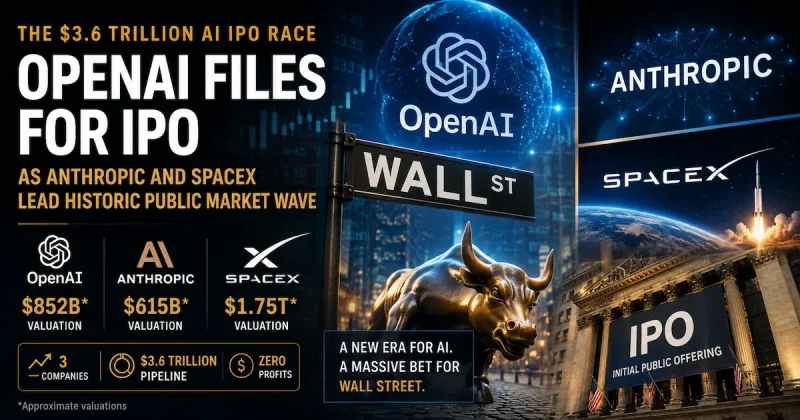
| IPO pipeline velocity | OpenAI and Anthropic fast-track their confidentially filed offerings to capture momentum | IPO window opens for deep-tech and AI infrastructure; valuation expectations inflate across the pipeline |
| Retail participation infrastructure | E*Trade, Schwab, and Fidelity validate IPO allocation to retail; Hyperliquid perps become reference pricing mechanism | Decentralized prediction markets and perpetual futures become standard inputs for IPO pricing models |
| Regulatory urgency | DOJ and European Commission initiate formal reviews of vertical integration across launch, satellite, and AI compute | Structural separation mandates or licensing conditions emerge for dominant orbital infrastructure providers |
| Valuation methodology shift | Analysts incorporate TAM optionality and technology adoption S-curves into DCF models for infrastructure plays | "Super-entity" premium becomes standard framework for multi-modal platform companies |
The space economy itself will bifurcate. The legacy business, satellite manufacturing, government contracts, and launch services, will continue to be valued at 2x to 4x revenue, consistent with defense contractor multiples. The new space economy, orbital compute, satellite connectivity as a utility, and in-space AI, will trade at revenue multiples that approach or exceed the 100x threshold set by SpaceX. This divergence creates a taxonomical challenge for index providers, ETF constructors, and sector analysts who must decide whether SpaceX belongs in the Aerospace & Defense category, the Technology sector, or a new classification entirely.
The $75 billion capital raise exceeds the combined GDP of 120 countries. It represents the largest single influx of private capital into space infrastructure in history. How that capital is deployed, whether toward Starship production scaling, AI compute node deployment, or the consolidation of Musk's broader corporate ecosystem, will determine whether the $2 trillion valuation is a peak or a foundation. The market has placed a binary bet: either SpaceX executes the orbital AI thesis and becomes the Nvidia of the 2030s, or the $41.3 billion accumulated deficit compounds into a balance sheet crisis that locks the stock in a multi-year de-rating phase.
What is already clear is that the IPO reset the benchmark for what a "large" technology company can be. The Magnificent Seven, Apple, Microsoft, Alphabet, Amazon, Nvidia, Meta, and Tesla, now have an eighth member that controls the physical infrastructure of low-Earth orbit. The market capitalization structure of the Nasdaq 100 has shifted permanently toward space-enabled AI compute. Whether that shift is sustainable depends not on quarterly earnings, but on the engineering outcomes of a single rocket: Starship. If it flies at scale, the $2 trillion valuation will look prescient. If it stalls, the IPO will be remembered as the greatest story ever sold.
The stock closed at $166.99 on its first day, up 23.7%. The next chapter is written not on the Nasdaq trading floor, but on the launch pad at Starbase, Texas, where the physical assets that justify the price tag are still under construction.
Comments
Leave a Comment
Your comment will appear after moderation.