
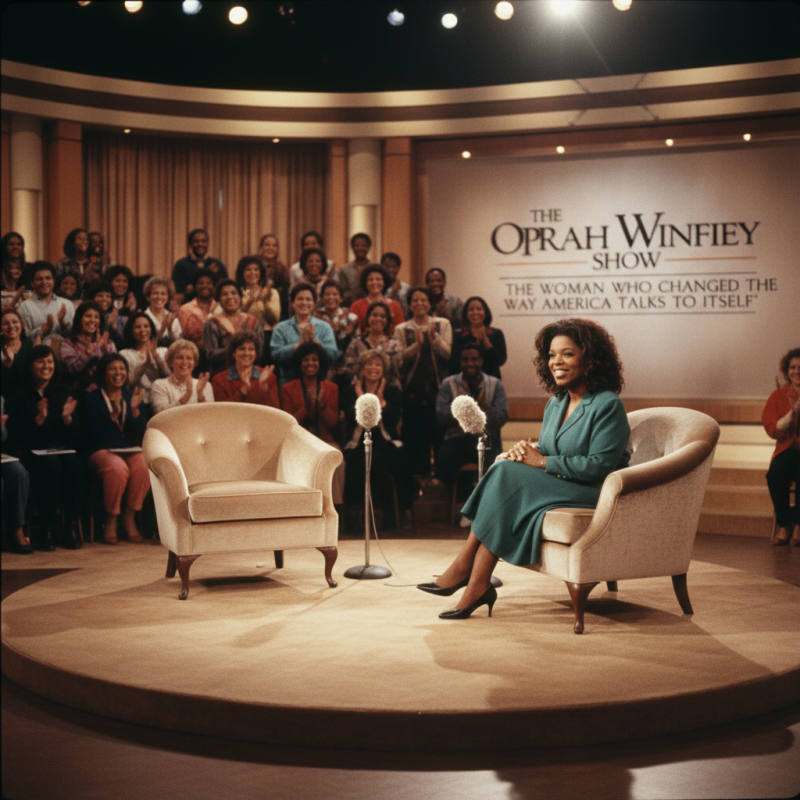
Introduction to Oprah Winfrey: Why Her Life and Career Still Matter
Picture this. January 1986. A television set flickers to life in a cramped apartment on Chicago's South Side. A woman settles into her couch, expecting nothing. What she gets instead changes her week, then her month, then, quietly, profoundly, the way she thinks about herself. This is the Oprah effect. Not a marketing term. Not a brand strategy. A lived, documented, physiological response that researchers would spend decades trying to quantify and media executives would spend billions trying to replicate. None succeeded.
Here is the reckoning: Oprah Gail Winfrey was born in rural Kosciusko, Mississippi, on January 29, 1954, to an unmarried teenage mother and a father she would not know for years. She wore potato sacks to school. She was sexually abused as a child. She delivered a premature baby at fourteen who did not survive. By every actuarial measure of mid-century rural Black poverty in the American South, Oprah Winfrey was not supposed to make it. And yet, by her late thirties, she had become the first Black woman billionaire in American history, wielding a level of cultural authority that presidents would court and corporations would fear.
The numbers alone do not tell the story, but they cannot be ignored. The Oprah Winfrey Show ran for 25 landmark seasons, airing in 145 countries and commanding audiences that regularly exceeded 40 million viewers per week at its peak. Her production company, Harpo Productions, "Oprah" spelled backwards, a quiet declaration of self-ownership in an industry that had owned women's images for a century, became one of the most powerful independent media operations in the United States. She did not just host a talk show. She fundamentally restructured what television could be: confessional, cathartic, commercially ferocious, and yet, somehow, deeply human.
But relevance is not simply a matter of history. In 2024, Oprah Winfrey appeared at the Democratic National Convention, delivering a speech so meticulously rehearsed, she reportedly wore sunglasses and a face mask during run-throughs to avoid recognition, that it cracked open a new debate: Is she a media figure, a political force, or something entirely new that American public life has no proper category for? The question itself is the answer. No one asks that about former talk show hosts. They ask it about Oprah.
That same year, she moved her book club, her podcast, and her curated consumer universe to Amazon in a multiyear deal that signaled the tech giant's sharpened ambitions in video podcasting, a transaction that would have been inconceivable without the trust infrastructure she spent five decades building, one vulnerable conversation at a time. When WeightWatchers filed for bankruptcy in 2025 amid the seismic disruption of GLP-1 weight-loss drugs, the financial press noted almost as an afterthought that Oprah had already quietly departed the company's board the previous year, a single exit that had sent the stock into a tailspin. That is not celebrity. That is market force.
This biography is not a shrine. Oprah Winfrey is a complicated figure, a woman whose public battles with weight became a cultural spectacle she herself helped engineer; whose extraordinary gift for empathy was critiqued by sociologists who argued her confessional format exploited vulnerable guests and sensationalized private pain for prime-time consumption. She has been a kingmaker and a target. A philanthropist and a polarizing political symbol. An artist and a brand. Holding all of that simultaneously, without flattening any of it, is the only honest way to read a life this large.
What follows is that reading. From a Mississippi sharecropper's porch to the corridors of Harpo Productions on Chicago's West Washington Boulevard; from a local Baltimore news anchor desk to the most-watched daytime television program in broadcast history; from the first woman to own and produce her own talk show to a media executive whose fingerprints are on the publishing industry, the film world, satellite radio, cable television, and now streaming, this is the architecture of an American life built entirely from scratch, in public, under the most unforgiving scrutiny imaginable.
She is still building. That, above everything else, is why her story still matters.
Early Life and Childhood: Family Background, Poverty, Education, and Formative Influences
Kosciusko, Mississippi, in the winter of 1954 was not a place that telegraphed possibility. It was a small, hardscrabble town in Attala County, deep in the agricultural belly of a state that had not yet felt the first tremors of the Civil Rights Movement, a state where Black poverty was not an anomaly but a structural condition, enforced by law and maintained by custom. Into this world, on January 29, 1954, Oprah Gail Winfrey arrived, born on a farm to Vernita Lee, an eighteen-year-old unmarried domestic worker, and Vernon Winfrey, a young man who was away doing military service and would remain, for the early years of her life, essentially a stranger.
The name itself carries a small, telling error. She was supposed to be named Orpah, after the biblical figure in the Book of Ruth, Naomi's daughter-in-law, the one who turned back. Somewhere between intention and the birth certificate, the letters transposed. Oprah. A typographical accident that became one of the most recognized names in the history of human media. There is something almost mythological about that origin: the woman who would never turn back, named after the one who did.
A Grandmother's Farm and the First Education
For the first six years of her life, Oprah did not live with her mother. Vernita Lee had moved north to Milwaukee, Wisconsin, chasing domestic work and a different kind of life. Oprah was left in the care of her maternal grandmother, Hattie Mae Lee, on a pig farm outside Kosciusko with no indoor plumbing and no television, no mirror, in other words, of the empire she would one day build. Hattie Mae was a woman of severe religious conviction and fierce pedagogical ambition for her granddaughter. She taught Oprah to read before the age of three. By the time Oprah entered kindergarten, she wrote a letter to her teacher explaining, with characteristic directness, that she belonged in first grade. The teacher agreed. She was skipped ahead.
This is the granular detail that gets lost in the mythology: Oprah Winfrey's first act of professional self-advocacy happened before she was six years old, in rural Mississippi, in a dress stitched from burlap and feed sacks. The intellectual confidence, the bone-deep certainty that her voice deserved a larger room, did not come from privilege. It came from a grandmother who drilled scripture into her at dawn and made her read aloud from the Bible before breakfast.
Hattie Mae also delivered her to the local church, where Oprah recited sermons and speeches before congregations who called her "the little speaker." It was her first audience. She learned, in those wooden pews, that words delivered with conviction could alter the emotional temperature of a room. Decades later, in a television studio before forty million people, the mechanism would be identical. Only the scale would change.
Milwaukee: Instability, Abuse, and the Cost of Dislocation
At six, Oprah was sent north to join her mother in Milwaukee. The transition was brutal. Vernita Lee's apartment was cramped and chaotic, shared with a half-sister, and later a half-brother. There was little money and less stability. The warmth and structure of Hattie Mae's farm, however austere, gave way to a household where Oprah was largely unsupervised and profoundly lonely.
It was in Milwaukee that the abuse began. Between the ages of nine and thirteen, Oprah was sexually abused by multiple men she knew, a cousin, an uncle, a family friend. She did not disclose it for years, carrying the weight of it in silence through a childhood that was already testing every conceivable limit of resilience. The abuse would shape her understanding of trauma, of silence, of the particular damage done when children are not believed, and it would eventually inform the most consequential episodes of her talk show, where she gave voice to survivors in a way that American television had never attempted and largely never dared.
The behavioral consequences were immediate and visible, even if the cause was hidden. By her early teenage years in Milwaukee, Oprah was running away from home, stealing money from her mother, and cycling through a series of escalating crises. At thirteen, she was sent briefly to a juvenile detention facility, turned away, the story goes, because there were no available beds. At fourteen, she gave birth to a premature baby boy who died shortly after birth. She has spoken of this, in the years since, not with self-pity but with a calibrated honesty that refuses to perform suffering while refusing equally to minimize it.
Nashville and Vernon Winfrey: The Intervention That Held
What saved her, if a single word can carry that much structural weight, was geography. Her mother, unable or unwilling to manage the escalating situation, sent Oprah to Nashville, Tennessee, to live with her father, Vernon Winfrey, and his wife, Zelma. Vernon Winfrey ran a barbershop. He was a city councilman. He was, by every account, a man of disciplined expectations and zero tolerance for excuses. He required Oprah to read one book per week and submit a written report. He enforced curfews. He inspected homework. He created, in effect, the first editorial process Oprah Winfrey ever endured.
It was rigorous. It was sometimes suffocating. And it almost certainly saved her life.
Nashville was where Oprah Winfrey began to become herself in a more public, traceable way. She enrolled at East Nashville High School, later transferring to the more academically prestigious East High, where her gifts became institutionally visible for the first time. She joined the drama club. She competed in oratory and speech competitions, winning a full scholarship to Tennessee State University through a public speaking contest. At sixteen, she was invited to the White House Conference on Youth. At seventeen, she won the Miss Fire Prevention contest in Nashville, an almost absurdly minor achievement that nonetheless represents the first time her image and her voice were formally instrumentalized for public consumption.
Tennessee State University and the First Broadcast Steps
Oprah enrolled at Tennessee State University in 1971, majoring in speech communications and performing arts, a degree path that reads, in retrospect, less like a choice and more like a formal confirmation of what she had always been doing. While still a student, she was approached by WVOL, a Nashville radio station, and hired to read the news. She was nineteen. She had never been inside a professional broadcast studio. She took the job anyway.
That radio gig led, almost inevitably, to television. Nashville's CBS affiliate, WTVF-TV, hired her as a reporter and co-anchor, making her the first Black female news anchor in Nashville's broadcast history. She was still in college. The achievement was genuinely remarkable by any standard. But Oprah herself has said, with characteristic candor, that she was not, in those early years, a particularly good hard-news journalist. She was too emotionally invested in the stories. She cried on camera. She improvised when she should have stayed on script. The professional framework of journalism, with its enforced emotional distance, fit her like a suit cut for someone else's body.
What she was, even then, was something journalism had no category for: a presence. A conduit. A person whose emotional availability was not a professional liability but the entire point.
| Life Stage | Location | Key Formative Experience | Long-Term Impact |
|---|---|---|---|
| Birth – Age 6 | Kosciusko, Mississippi | Raised by grandmother Hattie Mae Lee on a pig farm; taught to read before age 3; church oratory | Foundational literacy, public speaking confidence, scriptural grounding |
| Ages 6 – 13 | Milwaukee, Wisconsin | Reunited with mother Vernita Lee; sexual abuse by family members; instability and behavioral crisis | Deep empathy for trauma survivors; later defined her most significant television work |
| Age 14 | Milwaukee, Wisconsin | Premature birth of a son who did not survive | Personal reckoning with loss; later discussed publicly as a turning point in self-awareness |
| Ages 14 – 17 | Nashville, Tennessee | Moved in with father Vernon Winfrey; strict academic discipline; speech competitions; Miss Fire Prevention title | Academic redirection; first public platform; scholarship to Tennessee State University |
| Ages 17 – 21 | Nashville, Tennessee | Tennessee State University; radio work at WVOL; hired as co-anchor at WTVF-TV | First broadcast credentials; first Black female news anchor in Nashville history |
The Texture of Early Poverty and What It Built
It would be an editorial disservice to frame Oprah's poverty as merely a narrative device, the obligatory hardship before the triumph. The deprivation was material and specific. There were winters in Kosciusko without adequate heat. There were school days in clothes that invited the cruelty of other children. There was hunger that was not metaphorical. And there was the particular psychological weight that accumulates in a child who is simultaneously intellectually gifted and structurally invisible, too smart for the circumstances, with no obvious ladder out.
What that environment produced, alongside its damage, was an almost preternatural attunement to human need. Oprah Winfrey learned to read rooms before she learned to read books, because reading rooms was a survival skill. She learned to modulate her voice and her affect to match whatever emotional temperature the adults around her required, because that modulation was how she stayed safe. These are not romantic interpretations of suffering. They are the documented behavioral adaptations of children raised in high-stress, low-resource environments, adaptations that, in Oprah's particular case, would become the technical instruments of a billion-dollar media career.
The sociologists who would later critique her confessional television format as exploitative of vulnerable guests were not entirely wrong. But they missed the biographical context: the woman asking the questions had lived several of the answers. Her empathy was not performed. It was earned, at a cost that no television contract has ever fully accounted for.
First Steps in Broadcasting: From Local Radio and News Anchor Roles to Television Breakthrough
There is a specific kind of courage required to walk into a professional radio station at nineteen years old, with no broadcast training, no industry connections, and an accent shaped by Mississippi farms and Milwaukee housing projects, and simply begin. Not audition. Not apply. Begin. That is what Oprah Winfrey did at WVOL, a Nashville radio station that served the city's Black community, sometime around 1971. The station's program director, who heard something in her voice that resisted easy categorization, handed her a microphone and pointed her at a news desk. She read the news. The city listened. And the machinery that would eventually produce the most successful daytime talk show in broadcast history clicked forward one notch.
The WVOL position was, by any objective measure, modest. A small-market radio station. A part-time slot. The kind of entry-level work that is barely mentioned in most profiles of Winfrey, filed away beneath the more photogenic milestones. But the granularity matters here. She was simultaneously enrolled full-time at Tennessee State University, studying speech communications and performing arts, carrying an academic load while holding down a professional broadcast role that most of her classmates would have considered a ceiling, not a floor. The discipline required to manage both, the reading lists Vernon Winfrey had drilled into her through high school now converted into broadcast copy deadlines, established a professional metabolism she would never lose.
WTVF-TV: The Television Desk and Its Uncomfortable Truths
The radio work at WVOL functioned, in retrospect, less as a career destination and more as a living audition tape. Nashville's CBS affiliate, WTVF-TV (then known as NewsChannel 5), offered Winfrey a position as a reporter and co-anchor while she was still completing her undergraduate degree. The appointment was historic in the plainest, most documentable sense: she became the first Black woman to anchor the news in Nashville. She was barely twenty years old.
The significance of that barrier, broken so quietly, in a mid-sized Southern city, without fanfare or formal recognition at the time, is easy to underestimate from the vantage point of contemporary media. Nashville in the early 1970s was a city still negotiating the lived terms of desegregation. The presence of a young Black woman behind a news anchor desk was not a diversity initiative. It was an act of institutional transgression disguised as a staffing decision. Whether the station understood it that way is a different question entirely.
What is not disputed, and what Winfrey herself has discussed with unsparing honesty, is that she was not a natural fit for the conventions of hard-news journalism. The format demanded a quality she could not manufacture on command: emotional detachment. She became too invested in the stories she was covering. She cried on camera during difficult reports. She rewrote copy on instinct rather than following scripts. In the parlance of the broadcast newsroom, she was a liability risk. In the parlance of what she would later build, she was simply operating in the wrong medium.
"I became too emotionally involved," she recalled in later interviews, describing her early television news work. "Every story I covered, I wanted to save the people in it."
That impulse, which a news director might log as a performance deficiency, was, in fact, the entire thesis of the media empire she had not yet invented. The news format punished her for exactly the quality that would make her irreplaceable.
Baltimore and WJZ-TV: The Crucible Nobody Talks About
The move that truly stress-tested Winfrey's early broadcast identity was not Nashville. It was Baltimore. In 1976, at twenty-two years old, she was recruited by WJZ-TV, the ABC affiliate in Baltimore, Maryland, to co-anchor the evening news. The promotion sounded like acceleration. It was, in practice, something considerably more complicated.
Baltimore was a larger market. The scrutiny was proportionally more intense. And the station's management, by multiple accounts, found her difficult to fit into the mold they had designed for her. In a decision that remains one of the more extraordinary footnotes in American broadcast history, WJZ-TV pulled Winfrey from her co-anchor position after only a matter of months, citing on-air presentation concerns. The station then sent her, at network expense, to a stylist and image consultant, reportedly to address her nose, her hair, her weight, and what producers described as an insufficiently "polished" appearance. The beauty treatments damaged her hair, causing it to fall out. She was, briefly, bald.
Let that land for a moment. One of the most recognizable faces in the history of global media was sent to an image consultant, in 1977, and told she was not television-ready. The institution tasked with broadcasting reality to the American public could not see what was directly in front of it.
The demotion from co-anchor was delivered in a form that was at once professionally devastating and, as events would prove, directionally clarifying. Rather than fire her outright, WJZ-TV reassigned Winfrey to co-host a local talk and entertainment program called People Are Talking. The decision was likely intended as a consolation placement, a softer landing for a hire that hadn't performed as projected. It became, instead, the most consequential reassignment in the history of American daytime television.
People Are Talking: The Accidental Laboratory
People Are Talking premiered on August 14, 1978, with Winfrey alongside co-host Richard Sher. The format was conversational and relatively unstructured, exactly the kind of environment where the qualities that had made Winfrey a difficult news anchor became irreplaceable assets. She did not need to maintain professional distance. She was encouraged to engage. She could ask the question that was not on the card. She could follow the emotional thread of a guest's answer into territory the producer had not anticipated and emerge with something the audience had not expected: the truth, or the nearest approximation of it that television has ever managed.
The show was a local production with a limited footprint, but its internal data was unmistakable. Ratings climbed. Viewer mail accumulated. The audience responded not to the format but to the specific gravitational pull of Winfrey's presence, her ability to make a guest feel, across a camera and a studio audience, that they were the only person in the room who mattered. It was not a technique she had been taught. It was something she had practiced, in various forms, since she was performing scripture recitations in Hattie Mae's church before she was old enough to read chapter headings independently.
She spent six years at WJZ-TV, co-hosting People Are Talking while Baltimore slowly, then dramatically, became an audience. By the early 1980s, the show had grown sufficiently prominent that Winfrey was a genuine local celebrity, recognized on the streets of Baltimore, discussed in the city's media columns, her contract a matter of some competitive interest. The industry was beginning, haltingly, to understand what it had on its hands.
| Year | Role | Station / Market | Format | Significance |
|---|---|---|---|---|
| c. 1971–1973 | News Reader | WVOL Radio, Nashville, TN | Radio news broadcast | First professional broadcast role; part-time while attending Tennessee State University |
| c. 1973–1976 | Reporter and Co-Anchor | WTVF-TV (CBS), Nashville, TN | Television news | First Black female news anchor in Nashville history; still completing undergraduate degree |
| 1976–1977 | Co-Anchor, Evening News | WJZ-TV (ABC), Baltimore, MD | Television news | Larger market debut; removed from anchor role after months due to management concerns over on-air presentation |
| 1977 | Reassignment Period | WJZ-TV, Baltimore, MD | Station-directed image overhaul | Sent to image consultant; hair damaged by treatments; moment of profound professional humiliation that reoriented her trajectory |
| 1978–1983 | Co-Host | People Are Talking, WJZ-TV, Baltimore, MD | Local talk and entertainment | First sustained talk format; audience response established the commercial and emotional blueprint for The Oprah Winfrey Show |
Chicago Calls: The AM Chicago Gambit
In 1983, a Chicago television executive named Dennis Swanson made a phone call that would alter the topology of American media. Swanson, then vice president and general manager of WLS-TV, the ABC owned-and-operated station in Chicago, was looking for someone to rescue a failing morning talk program called AM Chicago. The show was dead last in its time slot, trailing Phil Donahue, the reigning sovereign of daytime television, whose audience Swanson desperately wanted, by a margin that would have discouraged most rational hiring decisions. Swanson, by his own account, was not looking for someone conventional. He flew Winfrey to Chicago, sat across from her in a meeting room, and made a decision inside of an hour.
She was offered the hosting role at AM Chicago. She accepted. She moved to Chicago in January 1984, a city she did not know, a show she had not built, in a market where she had no existing audience and no institutional support structure. The competitive environment was, by any television industry standard, forbidding. Donahue was not merely popular in Chicago; he was dominant in a way that had come to seem permanent. His audience was loyal, sophisticated, and specifically his.
Within one month of Winfrey's debut, AM Chicago was tied with Donahue in the ratings. Within three months, it had surpassed him. The displacement of television's most established daytime talk host happened so rapidly that the industry did not have an adequate explanation ready. Ratings analysts cited her warmth. Producers cited her spontaneity. Television critics cited her authenticity. All of them were partially correct and collectively insufficient. What Winfrey had was something the medium had not previously encountered in that specific configuration: a Black woman who spoke to an overwhelmingly white, female, midday audience not by making herself less than she was, but by being, publicly and without apparent editing, entirely herself.
Donahue himself, whose pioneering audience-participation format had effectively written the grammar of modern daytime television, reportedly acknowledged the shift with something close to genuine admiration. He had built the template. She had made it obsolete.
The Roger Ebert Factor and the Path to National Syndication
The trajectory from local phenomenon to national syndication was accelerated by an unlikely catalyst: film critic Roger Ebert. After watching AM Chicago in 1985, Ebert, whose own syndicated platform gave him enormous institutional reach, encouraged Winfrey to syndicate the show nationally. He has been widely credited with being among the first media figures to articulate, in print and in conversation with industry insiders, what the ratings data was beginning to suggest: that what was happening in Chicago on weekday mornings was not a local success story. It was the emergence of something categorically new.
By September 1985, AM Chicago had been expanded from a half-hour to a full hour and renamed The Oprah Winfrey Show, a rebranding that was itself a statement. In an industry where hosts were generally understood to be interchangeable faces deployed atop institutional formats, naming the show after its host was an assertion of creative and commercial identity that the network could not walk back. The show entered national syndication in September 1986, airing in 138 cities simultaneously. By the end of its first national season, it had been watched by an estimated 10 million viewers daily and had won three Daytime Emmy Awards.
The arc from WVOL's modest news desk to national syndication had taken roughly fifteen years. In broadcast terms, that is not a slow ascent. But the internal logic of that arc, the continuous pattern of being misread by institutions that were measuring the wrong things, then succeeding despite or because of that misreading, is the structural signature of Winfrey's entire career. Every demotion was a redirection. Every format that couldn't contain her became the chrysalis for the format she would build to contain herself.
What the Early Broadcast Years Reveal About the Career That Followed
The biographical lesson encoded in these early broadcast years is not simply one of resilience, a word that has been applied to Oprah Winfrey so frequently it has nearly ceased to mean anything. The more precise and more interesting observation is institutional. The American broadcast industry in the 1970s had constructed its on-air talent infrastructure around a very specific set of assumptions about what a television news presenter should be, should look like, and should suppress. Winfrey failed those tests. Repeatedly. Conspicuously.
And then she went on to demonstrate that those tests were measuring the wrong competencies entirely. Her emotional investment in stories was not unprofessional, it was the methodology. Her improvisational instinct was not undisciplined, it was the editorial process. Her inability to maintain distance from the people she interviewed was not a liability, it was the product. The industry's diagnosis of her deficiencies was, in each case, an accurate description of her strengths in a different medium that she had not yet been given access to build.
That medium, confessional, conversational, intimacy-scaled daytime television, did not fully exist before she arrived in Chicago. It had predecessors, sketches, approximations. But the specific form that would eventually reach more than 40 million viewers per week at its peak was not inherited. It was invented. And the raw material for that invention was accumulated across every radio booth, every anchor desk, and every image consultant's chair that had tried, and failed, to make Oprah Winfrey into something smaller and more manageable than what she actually was.
The Oprah Winfrey Show: Rise to National Fame, Cultural Impact, Ratings Success, and Signature Interview Style
September 8, 1986. The date is precise enough to be carved somewhere. On that Monday morning, The Oprah Winfrey Show entered national syndication across 138 American cities simultaneously, not as a tentative pilot, not as a regional experiment, but as a fully formed cultural detonation. The ratings apparatus registered the impact almost immediately. Within weeks, the show was not merely performing. It was dominating. Within its first national season, it drew an estimated 10 million daily viewers, won three Daytime Emmy Awards, and generated roughly $125 million in revenue, a figure that made network executives recalibrate every assumption they held about the commercial ceiling of daytime television.
What the numbers could not capture, what they still cannot, even in retrospect, was the specific quality of attention the show commanded. This was not passive viewership. Audiences did not watch The Oprah Winfrey Show the way they watched other programming, with one eye on the clock and one hand on the remote. They leaned in. They called friends. They arranged their schedules around it. Social scientists would later develop the term "parasocial relationship" to describe the phenomenon, the sense, measurably documented in audience research, that viewers experienced Winfrey not as a television personality but as a personal acquaintance who happened to live inside their screen. The intimacy was not manufactured. It was architectural. Built into every production decision, every guest selection, every camera angle that placed Winfrey in the studio audience rather than behind a desk.
The Production Philosophy: Tearing Up the Desk
The desk mattered. Or rather, its deliberate absence did. When Winfrey and her producers made the decision to remove the traditional anchor desk from the set, that physical barrier which had, for decades, separated the host from the audience and the guest from the conversation, they were making a statement that television critics recognized only gradually: the format itself was the content. The show's spatial design encoded its emotional proposition. There was nowhere to hide. No surface to grip. No professional furniture to retreat behind when the conversation moved into territory that journalism would have declared off-limits and daytime television had previously simply avoided.
This spatial decision had a lineage. Phil Donahue had pioneered the studio-audience participation format in the 1960s and '70s, moving into the crowd with a microphone in a way that felt radical at the time. Winfrey retained the mobility but transformed its emotional register. Where Donahue's engagement with his audience tended to be intellectually probing, issue-driven, sometimes combative in the style of civic debate, Winfrey's was empathically porous. She did not go into the audience to interrogate. She went in to inhabit. The audience was not a constituency to be polled. It was a congregation to be joined.
The distinction sounds subtle. The ratings differential was not. By 1987, one year into national syndication, The Oprah Winfrey Show had displaced Donahue in markets across the country, including several where his show had run unchallenged for more than a decade. By 1988, the show was the highest-rated talk show in television history. By the early 1990s, it was the highest-rated program of any format in daytime television, full stop, a position it would hold, with only minor fluctuations, for the next two decades.
The 1987 Emmy and the First Pivot: From Sensational to Substantive
The show's first national season was not entirely a display of the elevated confessional format that Winfrey would eventually become synonymous with. In its early national run, The Oprah Winfrey Show competed directly with the tabloid energy that defined mid-1980s daytime television, a landscape populated by topics designed to shock, titillate, and generate mail. Guests with unusual relationship structures. Controversial lifestyle choices. The kind of content that drew eyeballs by trading in the social equivalent of rubbernecking.
Winfrey has spoken about this period with a candor that is worth registering directly. She participated in it. She understood what it was commercially. And then, following what she has described as a specific moment of conscience around 1994, triggered partly by an episode that she felt had irresponsibly exploited the guests involved, she made a deliberate, industry-defying editorial turn away from that format. At the precise moment when competitors like Jerry Springer were discovering that escalating the tabloid register was a reliable ratings mechanism, Winfrey moved in the opposite direction.
The pivot carried real financial risk. Industry analysts predicted a ratings collapse. The conventional wisdom of daytime television held that audiences watched for conflict, spectacle, and the reassurance of other people's dysfunction. Winfrey's production team was, in effect, betting that the audience was better than the format had assumed. They were right. Viewership did not collapse. It deepened. The audience that remained after the tabloid period was smaller in some metrics and far more loyal in all of them, the kind of viewer who organized their television consumption around the show rather than simply encountering it.
Signature Interview Methodology: The Architecture of Confession
To watch archival footage of Winfrey conducting an interview is to observe a technique that looks effortless and is, in fact, highly engineered. The apparent spontaneity is the product of meticulous pre-interview preparation combined with a cultivated ability to abandon that preparation entirely the moment a more interesting emotional thread presents itself. Her production staff conducted detailed pre-interviews with every guest. Winfrey herself reviewed the material. And then, on camera, she would frequently ignore the prepared questions entirely, following instead the micro-expression that crossed a guest's face when a word landed harder than expected, the slight shift in posture that suggested an answer had not been fully given, the pause that meant something was being held back.
Several specific techniques recur across her most consequential interviews. First: the deliberate silence. Where most interviewers rush to fill conversational voids, an instinct born partly from broadcast training and partly from social discomfort, Winfrey would allow silence to sit on the set, visible and unresolved, until the guest filled it with something unplanned. Second: the personal disclosure. Winfrey routinely offered her own experiences, her childhood abuse, her weight struggles, her professional failures, as a form of conversational currency, a signal to the guest that vulnerability was safe, that the room would not punish honesty. Third: what might be called the lateral question, the inquiry that appeared to change the subject but in fact approached the real topic from an angle the guest's defenses had not anticipated.
These techniques produced moments that remain singular in the history of broadcast journalism. Her 1993 interview with Michael Jackson, watched by an estimated 90 million viewers globally, making it the fourth most-watched interview in American television history at the time, was not the work of a journalist operating within the conventions of adversarial inquiry. It was the work of someone who had built, over seven years of national broadcasting, an interviewing methodology capable of getting past the defenses of the most media-trained subject in the world. Jackson discussed his skin condition, his childhood, his relationship with his father, and his capacity to love in a single 90-minute conversation that no other interviewer had come close to extracting.
| Interview / Episode | Year | Subject | Viewership / Cultural Impact | Defining Technique Used |
|---|---|---|---|---|
| Michael Jackson Interview | 1993 | Michael Jackson (first TV interview in 14 years) | ~90 million global viewers; fourth most-watched TV interview in U.S. history at the time | Sustained personal rapport; permission-giving through vulnerability disclosure |
| Childhood Sexual Abuse Episode | 1986 | Winfrey's personal disclosure on air | Unprecedented viewer response; established confessional format as viable daytime television | Personal disclosure as conversational currency; deliberate breaking of host-guest boundary |
| The "Wagon of Fat" Episode | 1988 | Winfrey's 67-lb weight loss reveal | One of the show's highest-rated episodes; launched national conversation on weight and body image | Radical self-exposure; host as subject; blurring of entertainment and personal testimony |
| James Frey Confrontation | 2006 | Author James Frey (A Million Little Pieces fabrication controversy) | Widely cited as one of the most dramatic live reversals in talk show history; Frey resurfaced in public discourse two decades later | Public accountability; departure from empathy-first framework; direct confrontation on live television |
| "Favorite Things" Annual Episode | 1996–2011 (recurring) | Studio audience / consumer culture | Generated measurable retail surges; coined the phrase "Oprah effect" in commerce; individual product appearances drove millions in sales | Communal gifting as emotional experience; conversion of audience into participants |
The 1988 On-Air Disclosure: When the Host Became the Story
No single episode in the show's 25-season run demonstrates the radical nature of Winfrey's format more precisely than the November 1988 episode in which she wheeled a wagon holding 67 pounds of animal fat onto the stage, a visceral, almost theatrical representation of the weight she had lost on a liquid diet. She appeared in a pair of size-10 Calvin Klein jeans. The audience's response was immediate and sustained. The episode drew one of the highest ratings in the show's history to that point.
But the complexity of that moment, which Winfrey herself has revisited with considerable nuance in subsequent years, is not reducible to its ratings. What she had done, deliberately or not, was collapse the professional boundary between host and subject in a way that was genuinely unprecedented in the medium. The show was no longer simply a platform on which other people's vulnerabilities were examined. The host was the vulnerability. The audience was not watching someone else's struggle. They were watching their own, reflected and amplified by the most trusted figure in daytime television.
That collapse carried consequences that Winfrey did not fully anticipate. The weight returned. The public relationship with her body, which she had made, in that 1988 episode, a matter of shared communal investment, became a decades-long running narrative that she has acknowledged she did not entirely choose and could not entirely control. The intimacy that made the show powerful also made the host exposed in ways that extended beyond the broadcast hour and beyond her ability to edit.
Cultural Impact: The "Oprah Effect" as Measurable Phenomenon
The term "Oprah effect" has been applied so liberally in media commentary that it risks becoming meaningless. The underlying phenomenon is not meaningless. It is, in fact, one of the most rigorously documented influence mechanisms in the history of American consumer culture and public discourse.
In publishing, the data is unambiguous. When Winfrey selected a title for her book club, launched in 1996, discussed in detail in a subsequent section of this biography, the commercial effect was immediate and enormous. Publishers who received an Oprah Book Club selection reported sales increases of between 400 and 1,000 percent in the weeks following an announcement. Toni Morrison's Song of Solomon, selected in 1996, saw its sales multiply by a factor that Morrison's publisher described as transformative for the book's long-term catalogue position. The selection effect was so consistent and so large that economists at the University of Maryland published formal research quantifying the "Oprah effect" as a statistically significant independent variable in book sales, a finding that had no analogue for any other media personality in the country's history.
The consumer effect extended well beyond books. Products featured on the show's annual "Favorite Things" episodes generated retail surges that individual brands tracked and planned around. When Winfrey mentioned a specific product in any context, not necessarily in a dedicated commercial segment, the resulting demand spike was sufficiently predictable that retail analysts developed monitoring protocols specifically designed to detect Oprah references before inventory ran out. The mechanism was not advertising. It was something closer to trusted personal recommendation operating at population scale, a distinction that every brand strategist in America spent the 1990s and 2000s trying to understand and replicate through proxies, influencers, and eventually the entire architecture of social media endorsement.
In politics, the effect was equally measurable and considerably more contested. Her 2007 endorsement of Barack Obama during the Democratic primary, at a time when Hillary Clinton was considered the presumptive front-runner, was subsequently analyzed by economists Craig Garthwaite and Timothy Moore, who estimated that Winfrey's endorsement generated approximately 1 million additional votes for Obama in the primary election. The methodology of that study has been debated. The existence of a measurable endorsement effect has not been.
The Sociological Critique: When the Format Turned on Itself
Not everyone processing the show's cultural impact arrived at a celebratory conclusion. The most sustained academic critique came from sociologists who argued that the confessional format, however humane its intentions, systematically exploited the very vulnerability it appeared to honor. Penn State sociologist Vicki Abt, who died in February 2026 at 83, spent years arguing that hosts like Winfrey exploited vulnerable guests and sensationalized deviancy in ways that coarsened public discourse and cheapened the very empathy they claimed to offer.
Abt's critique was specific and structurally grounded. The guests who appeared on confessional talk shows to discuss trauma, addiction, sexual abuse, and family dysfunction were, she argued, rarely in a position to provide meaningful informed consent, not because they were deceived, but because the asymmetry of the production apparatus and the seductive promise of national visibility distorted their decision-making in ways that became apparent only after broadcast. The host's empathy, however genuine in the moment, could not undo the exposure. The audience's identification, however real, offered nothing to the guest once the cameras stopped rolling.
This critique landed differently on Winfrey than it did on the more explicitly exploitative practitioners of the form. She had, after all, disclosed her own trauma as a regular production strategy, an act that her defenders argued distinguished her from hosts who extracted vulnerability without offering any. But Abt's structural point held regardless of the host's sincerity: the format's commercial imperatives and its therapeutic aspirations were in tension that could not be resolved by good intentions alone. The show was simultaneously a space of genuine witness and a revenue-generating media product. Holding both was not a contradiction Winfrey always fully interrogated on air.
Ratings Architecture: 25 Seasons of Dominance in Context
The longevity of the show's ratings dominance requires historical contextualization to be properly understood. Television formats do not typically sustain competitive primacy across a quarter century. The media landscape through which The Oprah Winfrey Show maintained its position was not static, it was repeatedly and fundamentally disrupted. Cable television fragmented the audience in the late 1980s and early 1990s. The daytime talk explosion of the early 1990s introduced dozens of competitive programs operating in the same confessional register. The internet began migrating attention away from scheduled broadcast viewing in the late 1990s and accelerated that migration through the 2000s. DVR technology disrupted the appointment-viewing model on which daytime television depended.
Through each of these disruptions, the show adapted without fundamentally reconstituting itself. The core proposition, an emotionally present host, an audience that felt personally known, a guest whose humanity was treated as the subject rather than their celebrity, remained stable while the surrounding media environment churned. That stability was not inertia. It was precision. Winfrey and her producers understood, perhaps more clearly than any other production team in television history, what the show was actually selling. Not topics. Not guests. Not controversy. Trust. And trust, unlike ratings formulas, is not easily replicated or disrupted by competitive programming.
| Era | Years | Approximate Peak Viewership | Dominant Format Characteristic | Key Competitive Context |
|---|---|---|---|---|
| National Launch Era | 1986–1989 | ~10–15 million daily viewers | Mixed: issue-driven and tabloid-adjacent topics; audience participation central | Direct competition with The Phil Donahue Show; displacement within first year of syndication |
| Peak Dominance Era | 1990–1995 | ~20–33 million viewers at peak episodes | Elevated personal disclosure; celebrity interviews; social issue advocacy | Jerry Springer, Geraldo Rivera, Maury Povich intensify tabloid competition; Winfrey moves away from format |
| Editorial Reinvention Era | 1994–2000 | ~22 million daily viewers | Explicit shift to "change your life" television; book club launch (1996); spirituality and self-improvement content | Cable fragmentation accelerates; daytime audience shrinks industry-wide; show maintains disproportionate share |
| Cultural Institution Era | 2000–2011 | ~40 million weekly viewers across markets | Landmark specials; humanitarian content; celebrity interviews of record; political engagement | DVR disruption; internet migration of audiences; show increasingly positioned as cultural event rather than daily habit |
| Final Season | 2010–2011 | ~16 million for series finale | Legacy framing; retrospective; audience farewell | Simultaneous launch of OWN: Oprah Winfrey Network signals transition from broadcast to cable media executive |
The Finale and What It Measured
When the show broadcast its final episode on May 25, 2011, a single-camera, no-audience, no-guest monologue that Winfrey delivered alone, directly into the lens, for approximately 45 minutes, the choice of format was itself an act of editorial courage. The network expected a spectacle. A retrospective. A greatest-hits farewell calibrated for maximum emotional impact and maximum ratings. What they got instead was something closer to a sermon: Winfrey addressing her audience directly, without production scaffolding, and articulating, with unusual philosophical precision, what she believed the show had always been about.
"I won't say goodbye," she told her audience in the closing moments. "I'll say until we meet again."
The line was unremarkable by the standards of broadcast valediction. Its context was not. Twenty-five years. More than 4,500 episodes. An audience in 145 countries. A format that had, by 2011, spawned an entire ecosystem of imitation, critique, academic analysis, and cultural mythology. The finale drew approximately 16 million viewers, a number that would represent a triumph for almost any other program and was, for this one, understood as an undercount of the audience that had already internalized the show so completely that watching the final episode felt redundant. They already knew how it ended. It ended the way it had always operated: with the host looking directly at them and refusing to look away.
That refusal, to look away from discomfort, from ugliness, from her own contradictions, is the most precise description of what made The Oprah Winfrey Show historically significant. Not the ratings, though those were extraordinary. Not the commercial power, though that was without precedent. The significance was methodological: a demonstration, running for 25 years across 4,500 episodes and into the living rooms of 145 countries, that attention paid to another human being's inner life is not a soft proposition. It is, in fact, the hardest and most durable currency in the history of mass media.
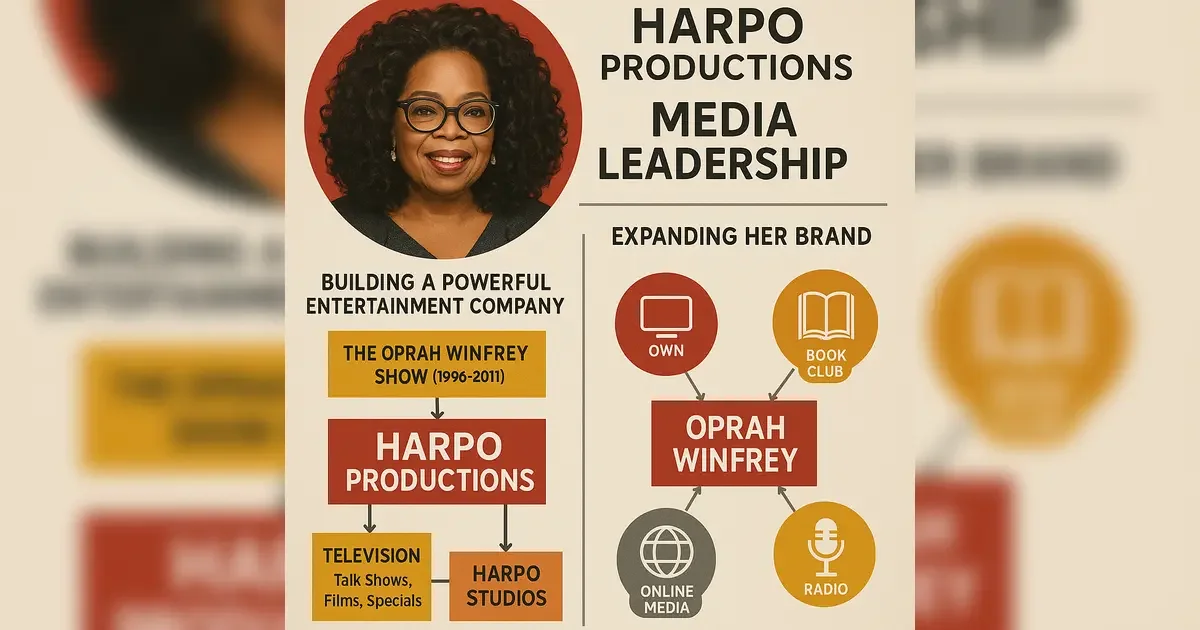
Harpo Productions and Media Leadership: Building a Powerful Entertainment Company and Expanding Her Brand
There is a moment, precise and consequential, that separates Oprah Winfrey from every other talk show host in the history of American television. It did not happen on camera. It happened in a lawyer's office in Chicago in 1986, when Winfrey negotiated the ownership of her own show away from King World Productions and ABC, and in doing so, became the first woman in broadcast history to own and produce her own television talk show. The industry did not immediately recognize what had occurred. The business press filed it as a contract detail. What had actually happened was a structural revolution: a Black woman from rural Mississippi had claimed ownership of the mechanism that was making other people very rich, and had done it before the age of thirty-five, without a single precedent to reference.
The company through which she executed that ownership is named Harpo Productions. The name, "Oprah" spelled backwards, sounds like a whim. It was, in fact, a declaration. In an entertainment industry where the names above the credits belong to studios, networks, and male executives whose photographs appear in trade publications, Winfrey quietly reversed the lettering and placed herself inside the title. Self-ownership, encoded in a palindrome. It would take most of the media world nearly a decade to fully decode what she had done.
The Genesis of Harpo: Ownership as Strategic Instrument
Harpo Productions was incorporated in 1986, the same year The Oprah Winfrey Show entered national syndication. The timing was not coincidental. Winfrey and her longtime partner Stedman Graham, along with her attorney Jeff Jacobs, who would become perhaps the most underacknowledged architect of the Oprah business empire, structured the company specifically to capture the economic value that was about to be generated by the show's national launch. Jacobs, who had been advising Winfrey since the early 1980s, understood something that the networks did not yet appreciate: the show's value was not in its format. Its value was in her. And value that resided in a person, rather than in a format, was portable. Ownable. Controllable.
This distinction, between being a talent asset for someone else's company and being the principal of your own, is the foundational business logic of Harpo Productions. Winfrey had watched, in her early broadcast years, as network executives made decisions about her hair, her weight, her presentation, and her professional positioning. She had been managed, reassigned, and aesthetically overhauled by institutions that understood her as a cost on a ledger rather than a generator of value. Harpo was the structural instrument by which she reversed that power relationship permanently.
The company's first major physical infrastructure came in 1988, when Harpo acquired a 100,000-square-foot production studio complex on West Washington Boulevard on Chicago's Near West Side. The facility, which Harpo renovated extensively and would expand repeatedly over the following decades, became known simply as Harpo Studios. It was, at the time of its acquisition, a former armory. The symbolic weight of that repurposing is almost too precise to be coincidental: a building designed for military storage, converted into the headquarters of a media operation that would influence the purchasing behavior, reading habits, political opinions, and emotional lives of tens of millions of people. The armory became the arsenal of a different kind of power entirely.
The Financial Architecture of Independence
Understanding Harpo Productions requires understanding the economics of syndication, because it is within that structure that Winfrey's financial leverage became extraordinary. When The Oprah Winfrey Show was distributed nationally through King World Productions, the syndication revenue was split according to a contract that reflected the power dynamics of 1986, a moment when King World held the distribution infrastructure and Winfrey held, in the industry's estimation, a promising but unproven asset. As the show's ratings demonstrated its commercial scale, Harpo systematically renegotiated those terms, extracting an increasingly larger share of the syndication revenue while retaining creative and editorial control.
By the mid-1990s, Harpo Productions was generating revenues that made it one of the most profitable independent production companies in the United States, not merely in the context of woman-owned businesses or Black-owned businesses, but by the standards of the entertainment industry as a whole. The company's revenue streams were diversified in a way that most production companies of comparable size had not achieved: syndication fees, advertising revenue from the show, production fees from third-party projects, and increasingly, the commercial licensing value of the Oprah name across product categories that extended far beyond television.
The financial consequence of this structure was measurable and historic. By the late 1990s, Winfrey's net worth had crossed the billion-dollar threshold, making her the first Black woman billionaire in American history, a distinction that was reported with appropriate gravity at the time and has since been somewhat flattened by repetition. The precision of that achievement deserves restoration: this was not wealth accumulated through inheritance, investment returns on inherited capital, or marriage. It was built, company by company and contract by contract, from a standing start, by a woman who had been told by a Baltimore television station in 1977 that she was not ready for prime time.
Harpo Films: From Television to the Cinema Screen
The production company's ambitions were never confined to the talk show format that generated its initial capital. Harpo Films, the theatrical production arm, announced itself to the industry in 1998 with Beloved, directed by Jonathan Demme and starring Winfrey in the lead role of Sethe, a formerly enslaved woman haunted by the ghost of her dead daughter. The film was an adaptation of Toni Morrison's Pulitzer Prize-winning novel, a book that Winfrey had, in a separately significant act, already selected for her book club, driving its sales to a new generation of readers before she brought it to the screen.
Beloved was a project Winfrey had pursued for a decade before it reached production. She has described it as the most personally significant work of her professional life, a characterization that takes on additional weight when you consider that the film was a commercial disappointment at the box office, grossing approximately $22.8 million against a production budget widely reported at over $53 million. The film's failure was a genuine blow, both financially and personally. Winfrey had poured her own trauma, her understanding of generational suffering, of what slavery had done to Black women's relationship with their own bodies and their own children, into a performance that critics generally praised and audiences largely did not see.
The box office result did not arrest Harpo Films' trajectory. It recalibrated it. The company shifted toward projects where Winfrey's name could function as a curatorial signal rather than a box-office draw dependent on her star power alone. The 2023 adaptation of The Color Purple as a musical film, produced by Harpo Films and Amblin Entertainment, with Winfrey as a producer, represented a very different commercial and artistic calculation than Beloved: a broadly appealing property, a proven musical stage adaptation as source material, and a production model designed to capture the film's cultural relevance without relying on Winfrey's presence in front of the camera. The film had a strong Christmas opening before its second-weekend box office softened, a mixed commercial result that nonetheless demonstrated Harpo Films' continued operational presence in major theatrical releases nearly three decades after its founding.
| Project | Year | Type | Winfrey's Role | Commercial Result | Cultural Significance |
|---|---|---|---|---|---|
| The Women of Brewster Place | 1989 | TV miniseries (ABC) | Executive producer and lead actress | High-rated ABC broadcast; one of the most-watched miniseries of the season | First major Harpo production; first Black female-led miniseries to achieve mainstream ratings dominance |
| Beloved | 1998 | Theatrical film | Producer and lead actress | ~$22.8M gross vs. ~$53M+ budget; commercial disappointment | Adaptation of Toni Morrison's Pulitzer Prize-winning novel; widely considered Winfrey's most ambitious artistic undertaking |
| Their Eyes Were Watching God | 2005 | TV film (ABC) | Executive producer | Strong network ratings | Adaptation of Zora Neale Hurston's novel; part of Harpo's sustained commitment to Black literary adaptation |
| The Great Debaters | 2007 | Theatrical film | Executive producer | ~$30M gross on modest budget; profitable | Denzel Washington-directed drama; reinforced Harpo Films' positioning in prestige Black American storytelling |
| Selma | 2014 | Theatrical film | Co-producer and supporting actress | ~$66M domestic gross; Academy Award for Best Original Song | Civil rights biography; Oscar-nominated for Best Picture; Winfrey's on-screen return after a 16-year absence from acting |
| The Color Purple (musical film) | 2023 | Theatrical film | Producer (Harpo Films / Amblin Entertainment) | Strong opening weekend; second-weekend box office declined sharply | Continuation of Harpo's 35-year relationship with the source material; reached new generation of viewers |
O, The Oprah Magazine: Publishing as Personal Infrastructure
In April 2000, Harpo launched O, The Oprah Magazine in partnership with Hearst Magazines. The launch was, by any publishing industry benchmark, extraordinary. The debut issue sold approximately 1.6 million copies, the most successful magazine launch in publishing history at the time. The second issue sold 1.7 million. By the end of its first year, O had achieved a rate base of 2.3 million paid subscribers, a figure that established magazines typically required a decade to reach.
The editorial proposition of O was not journalism in any conventional sense. It was curated self-improvement, the monthly print equivalent of the show's post-1994 editorial direction, organized around wellness, personal growth, literary recommendation, and the specific aesthetic sensibility that Winfrey had developed across fifteen years of daily television. Each issue featured Winfrey on the cover, a decision that publishing industry analysts initially questioned and subsequently recognized as the magazine's single most important circulation mechanism. The cover was not a photograph of a celebrity. It was a monthly reaffirmation of the trust relationship between Winfrey and her reader, a signal that the editorial content had been curated by a specific person whose judgment the subscriber had already, in effect, endorsed by purchasing the issue.
The magazine ran in its original format for twenty years before transitioning to a digital-only publication in 2021, a structural decision driven by the pandemic-accelerated collapse of print advertising revenue that affected the entire industry. The transition preserved the brand while eliminating the production costs of a print operation, a financially rational pivot that nonetheless marked the end of an era in which a monthly magazine could function as a primary cultural touchpoint rather than a supplementary digital product.
XM Satellite Radio and the Harpo Radio Venture
In 2006, Harpo Productions signed a multi-year deal with XM Satellite Radio to launch Oprah & Friends, a dedicated channel featuring Winfrey and members of her broader professional circle, including her best friend Gayle King and health and wellness experts associated with the show. The deal, which involved a reported investment of $55 million from XM, was one of the largest talent contracts in satellite radio history at the time and represented Harpo's most deliberate expansion into an audio medium since Winfrey's career had begun at WVOL in Nashville thirty-five years earlier.
The strategic logic of the satellite radio venture was consistent with Harpo's broader media philosophy: extend the trust relationship into new consumption contexts, rather than simply repurposing existing content. The Oprah & Friends channel was not a simulcast of the television show or a replay of archived content. It was original programming, designed for an audience that was already in the car, already in motion, and already predisposed to Winfrey's specific brand of conversational intimacy. The format's audio-only nature stripped away the visual production values that television required and placed the entire communicative burden on voice, pacing, and the quality of the ideas being discussed, conditions in which Winfrey, who had built her first professional credentials in radio, was entirely at home.
OWN: The Oprah Winfrey Network and the Limits of Brand Extension
The most ambitious and, in some ways, most instructive chapter in Harpo's expansion into media ownership was the launch of OWN: Oprah Winfrey Network. The channel launched on January 1, 2011, simultaneously with the final season of The Oprah Winfrey Show, as a joint venture between Harpo Productions and Discovery Communications, replacing the existing Discovery Health Channel on the cable dial. The structural arrangement gave Harpo a 50 percent ownership stake in a cable network with existing distribution infrastructure reaching approximately 80 million American households.
The launch was, by almost every early metric, a crisis. OWN's initial programming, a mix of lifestyle content, documentary series, and self-help programming that attempted to translate the show's editorial DNA into a 24-hour cable format, drew ratings that were, in the cable industry's clinical language, disappointing. The channel's first year produced ratings significantly lower than those of the Discovery Health Channel it had replaced. Discovery Communications, which had a financial stake and a strategic interest in the network's success, considered restructuring the arrangement. Industry analysts wrote with increasing frankness about the possibility that the OWN experiment might not survive its infancy.
What salvaged OWN was not a strategic pivot engineered in a boardroom. It was a phone call to Tyler Perry. Beginning in 2012, Perry's scripted dramas, produced in Atlanta and characterized by the kind of emotionally direct, culturally specific Black storytelling that OWN's lifestyle programming had not been delivering, began airing on the network and producing ratings that Discovery's analysts had not projected. Perry's programming drew audiences that the network had been unable to reach through its initial content strategy, and those audiences, once on the channel, began sampling OWN's other programming in ways that lifted the entire schedule.
By 2013, OWN had turned its first quarterly profit. By 2015, it had become the fastest-growing cable network among women twenty-five to fifty-four, the demographic that had formed the core of The Oprah Winfrey Show's audience for a quarter century. The recovery was real. It was also instructive about the limits of brand extension: the Oprah name could open a network's distribution and attract an initial audience, but it could not, by itself, program 24 hours of compelling cable television. The infrastructure of a functional cable network required content generators, scheduling expertise, and audience development strategies that operated independently of any single personality's gravitational pull.
| Harpo Venture | Launch Year | Partner / Structure | Initial Scale | Outcome / Current Status |
|---|---|---|---|---|
| Harpo Productions (television) | 1986 | Independent; distributed via King World / CBS | One show; one production facility | Core operating entity; produced 4,500+ episodes of flagship show; remains active |
| Harpo Studios (facility) | 1988 | Wholly owned; 100,000 sq. ft. Chicago complex | Former armory repurposed into production complex | Sold to Riot Games in 2022; Harpo relocated production operations |
| Harpo Films | 1990 | Wholly owned subsidiary | TV miniseries production | Active; produced theatrical releases through 2023 (The Color Purple) |
| O, The Oprah Magazine | 2000 | Joint venture with Hearst Magazines | 1.6M debut issue sales; 2.3M subscribers within year one | Transitioned to digital-only in 2021 |
| Oprah & Friends (XM Satellite Radio) | 2006 | Multi-year deal with XM; reported $55M investment from XM | Dedicated 24-hour channel | Concluded with XM/Sirius merger integration |
| OWN: Oprah Winfrey Network | 2011 | 50/50 joint venture with Discovery Communications | ~80M U.S. household distribution | Profitable by 2013; sold majority stake to Warner Bros. Discovery; continues operating |
| Oprah's Book Club (digital) | 2012 (digital relaunch) | Harpo-operated; Apple TV+ partnership (2019) | Global digital audience | Moved to Amazon as part of 2026 multiyear deal |
| Amazon Multiyear Deal | 2026 | Partnership with Amazon | Podcast, book club, curated products | Signals Amazon's growing ambitions in video podcasting; active |
The Harpo Studios Sale: Reading the Exit
In 2022, Harpo Productions sold its Chicago studio complex, the physical headquarters of the empire, the converted armory on West Washington Boulevard where The Oprah Winfrey Show had been produced for more than two decades, to Riot Games, the video game developer behind League of Legends. The sale price was not publicly disclosed. The strategic signal was unmistakable.
By 2022, Harpo no longer needed a 100,000-square-foot production facility in Chicago. The flagship show had ended eleven years earlier. OWN's programming was produced by independent studios under licensing agreements rather than in-house at Harpo. The company's new media strategy, podcast content, digital book club programming, streaming partnerships, did not require a physical production campus of the scale that had been essential in 1988. The sale of the building was not a retreat. It was a recapitalization: converting a fixed real estate asset into liquidity that could be deployed in the digital media environment where Harpo's next chapter was being written.
That next chapter arrived with unusual clarity in April 2026, when Winfrey signed a multiyear deal with Amazon that transferred her podcast, her book club, and her curated consumer products into the tech giant's ecosystem. The deal was widely reported as a significant expression of Amazon's strategic ambitions in video podcasting, which it was. But the more interesting reading is Harpo's: a production company that had built its initial power through ownership of broadcast syndication rights was now deploying that same ownership logic in a streaming context, partnering with the world's largest e-commerce platform at a moment when the convergence of video content and direct consumer purchasing was becoming the defining commercial structure of digital media. The mechanism had changed. The underlying strategy, control the relationship with the audience, own the value that relationship generates, had not moved an inch since 1986.
Jeff Jacobs and the Invisible Architecture of the Harpo Empire
No account of Harpo Productions as a business entity is complete without a serious examination of the role played by Jeffrey Jacobs, Winfrey's attorney and business partner, who has operated as the company's chief architect with a consistency and a preference for anonymity that is almost structurally inverse to Winfrey's own public presence. Where Winfrey is the face of everything Harpo produces, Jacobs has been the legal and financial intelligence behind the contractual structures that made Harpo's ownership model possible and progressively more lucrative.
Jacobs negotiated the syndication agreements with King World. He structured the Discovery Communications joint venture for OWN. He managed the intellectual property portfolio that protects the commercial licensing value of the Oprah name, a portfolio whose scope extends across publishing, consumer products, wellness, and digital media, and whose enforcement has been sufficiently rigorous that the "Oprah effect" has remained a commercially meaningful signal rather than a diluted brand. His professional partnership with Winfrey, which has extended across more than four decades, represents one of the most enduring and commercially productive talent-attorney relationships in the history of American entertainment.
Winfrey herself has acknowledged, in various interviews across the years, that she did not arrive in the entertainment business with financial literacy as a developed skill. She arrived with an extraordinary instinct for human connection and an equally extraordinary talent for media performance. The business infrastructure that converted those talents into a billion-dollar enterprise was learned, built, and staffed, which is itself an important corrective to the mythology of the self-made mogul as a solitary, omniscient genius. The empire is real. It was also a collective construction.
Brand Stewardship and the Weight of the Oprah Name
The Harpo brand has not been without its commercial miscalculations and their consequences. The most publicly visible was Winfrey's years-long involvement with WeightWatchers International, in which she purchased approximately a 10 percent stake in 2015 for a reported $43.2 million, a transaction that, driven by her public endorsement, sent the company's stock surging by more than 100 percent in the days following the announcement. The subsequent years saw her personal weight-loss journey once again become a public narrative entangled with a commercial investment, a conflation that generated ethical commentary from media critics who noted the unusual nature of a celebrity simultaneously being a brand ambassador for and a major equity holder in the product she was endorsing.
When WeightWatchers filed for bankruptcy in May 2025, overwhelmed by the disruption of GLP-1 weight-loss medications that had effectively repositioned the entire traditional diet industry as obsolete, Winfrey had already departed the company's board in February 2024, a move that had itself sent the stock into a significant decline. The sequence, massive stock surge on entry, stock collapse on exit, eventual bankruptcy, illustrated both the extraordinary market power of the Oprah endorsement and its structural fragility when the underlying product was disrupted by forces operating entirely outside her sphere of influence.
Winfrey's public engagement with GLP-1 medications, she acknowledged taking a weight-loss drug in December 2023 and hosted a primetime special on the subject in March 2024, was itself an act of brand management, navigating the WeightWatchers entanglement while simultaneously positioning herself as an honest participant in the national conversation about obesity, medication, and shame. The New York Times columnist Tressie McMillan Cottom noted that the special functioned as a harbinger of how the weight-loss industry was rebranding, obesity as a disease rather than a failure of willpower, in a way that served both the pharmaceutical industry's messaging and Winfrey's own need to separate her identity from a dieting culture she had helped normalize for thirty years. The maneuver was sophisticated. Whether it was entirely coherent is a question the audience continues to answer for itself.
The Organizational Culture of Harpo: What the Inside Reports Reveal
The internal culture of Harpo Productions, the experience of working within the empire rather than consuming its output, has been described, across the years, with a consistency that is itself revealing. Former employees and industry figures who have worked with the company describe a workplace of unusually high standards, demanding timelines, and an organizational culture shaped directly by Winfrey's personal perfectionism. The pre-interview process for show guests was reportedly exhaustive. Production decisions were reviewed at multiple levels. The editorial voice of the final product was maintained with a consistency across 25 seasons that required active, deliberate management rather than institutional inertia.
The company's leadership structure evolved substantially as Harpo expanded beyond the flagship show. In its talk-show era, Harpo functioned effectively as a production unit with a single dominant product. In its post-2011 configuration, managing OWN programming strategy, film productions, magazine oversight, digital content, licensing agreements, and brand partnerships simultaneously, it required a more conventional corporate infrastructure. Winfrey has not operated as a day-to-day media executive in the traditional sense; her function within the company has always been more analogous to a creative director whose aesthetic and ethical judgments set the parameters within which the organization operates, rather than a chief executive managing quarterly earnings targets.
That distinction matters for understanding both Harpo's strengths and its limitations. The company is extraordinarily good at producing content and brand experiences that reflect Winfrey's personal sensibility with precision and consistency. It has been less consistently successful at scaling those sensibilities into the impersonal operational demands of a 24-hour cable network or a mass-market streaming platform, environments where the content volume required exceeds what any single creative authority can curate without delegation. The OWN early struggles were, in part, a lesson in the organizational limits of genius-brand dependency: a model that works brilliantly at the scale of a single daily show or a monthly magazine encounters structural friction when applied to a network that must fill every hour of every day with content that maintains a coherent identity.
The Enduring Strategic Logic: Trust as Corporate Asset
Strip away the specific ventures, the magazine, the network, the radio channel, the film company, the Amazon deal, and the underlying strategic logic of Harpo Productions across four decades is consistent to the point of elegance. Every major business decision Harpo has made has been an attempt to extend, deepen, or protect one primary asset: the trust relationship between Oprah Winfrey and her audience. Not reach. Not impressions. Not brand awareness in the abstract. Trust. The specific, earned, personally calibrated confidence that an audience develops in a media figure who has shown them, over time and across formats, that she will not lie to them about things that matter.
That asset was built on the talk show. It was monetized through syndication. It was extended into publishing, satellite radio, cable television, and streaming. It was stress-tested by the James Frey confrontation, the WeightWatchers entanglement, the OWN launch crisis, and every public controversy that attached itself to Winfrey's name across five decades of the most sustained media scrutiny any individual entertainer has endured. And it has, with some wear and some legitimate damage, survived each of those tests with sufficient integrity to remain commercially and culturally functional.
The Amazon deal of 2026 is, in this reading, not a new chapter. It is the latest expression of a strategy that was fully articulated, if not yet fully understood, on the day in 1986 when a young woman from Kosciusko, Mississippi, incorporated a company, spelled her name backwards, and became the owner of the most valuable thing she possessed: the attention of people who believed her.
Beyond Talk Television: Film Roles, Publishing, OWN Network, Partnerships, and Business Ventures
The architecture of Harpo Productions, its ownership logic, its trust-as-capital philosophy, its satellite radio deal, the OWN launch crisis and recovery, has been mapped in the preceding section with the granularity it deserves. What that mapping necessarily left in the margins is the texture of the individual ventures: the specific films Winfrey chose to inhabit as an actress, the editorial sensibility of a magazine that outsold every launch in publishing history, the precise nature of the commercial partnerships that made the Oprah name a market-moving instrument independent of any single medium. Those are the threads this section pulls.
Because the business infrastructure is now established, the more interesting question becomes: what did she choose to do with it? The choices, examined closely, reveal a set of aesthetic and ethical priorities that the balance sheet alone does not surface. She was not simply building an empire. She was building a specific kind of empire, one governed by a coherent, if sometimes contradicted, set of convictions about Black storytelling, women's interiority, and the moral obligations of cultural power.
Acting as Vocation: The Roles She Chose and What They Cost Her
Oprah Winfrey's first major screen appearance predates Harpo's founding by two years and arrived, characteristically, through a process that resembles accident only on its surface. In 1985, she was cast as Sofia in Steven Spielberg's adaptation of Alice Walker's The Color Purple, a performance that earned her an Academy Award nomination for Best Supporting Actress and a Golden Globe nomination in the same category. She had never auditioned for a feature film before. She submitted a tape. Spielberg called.
The Sofia performance is worth examining as craft, not merely as biography. Sofia is not a warm character in the conventional Hollywood sense that daytime audiences associated with Winfrey. She is fierce, defiant, physically imposing, and ultimately destroyed by a white power structure that cannot tolerate her refusal to submit. Winfrey played the destruction without softening it, the scene in which Sofia is beaten by a mob and left permanently disfigured carries a specific, controlled anguish that has nothing of the television host's reassuring presence in it. She disappeared into someone else's suffering with a completeness that her own visibility as a public figure made genuinely difficult to achieve, and she achieved it anyway.
The Academy's nomination was not honorary. It was earned. And its significance in 1986, a Black woman, nominated for an Academy Award in a film about Black women's interior lives, in a performance that refused to aestheticize their pain, should not be diluted by the passage of four decades. It was a statement of artistic intent that preceded Harpo's formal film ambitions by years and set the ethical standard against which all of those subsequent film choices would be measured.
"When I read The Color Purple," Winfrey has said, "I felt seen for the first time in a way that fiction had never made me feel before. That is the only reason I do film. That feeling."
Her subsequent acting career follows the logic of that statement with unusual consistency. She did not pursue Hollywood stardom in the conventional sense, the studio franchise, the romantic lead, the prestige drama engineered for awards consideration. She pursued stories about Black women's survival, grief, and transformation, in roles that the mainstream film industry had historically considered too culturally specific to generate commercial returns. The bet, placed repeatedly across four decades, was that those stories were not niche. They were universal. The audience response, when the production execution matched the material's demands, proved the bet correct.
| Film / Project | Year | Role / Function | Directed By | Awards Recognition | Critical Assessment |
|---|---|---|---|---|---|
| The Color Purple | 1985 | Sofia (actress) | Steven Spielberg | Academy Award nomination (Best Supporting Actress); Golden Globe nomination | Career-defining screen debut; performance widely cited as the film's emotional anchor |
| Native Son | 1986 | Mrs. Thomas (actress) | Jerrold Freedman | None | Small role; Richard Wright adaptation; limited release and critical reception |
| Beloved | 1998 | Sethe (actress and producer) | Jonathan Demme | No major nominations; Screen Actors Guild consideration | Critically praised performance; commercially disappointing; Winfrey's most personally significant film work by her own account |
| Selma | 2014 | Annie Lee Cooper (actress and co-producer) | Ava DuVernay | Film: Academy Award for Best Original Song; Best Picture nomination; BAFTA nomination | On-screen return after 16-year hiatus from acting; supporting role anchored in historical authenticity |
| A Wrinkle in Time | 2018 | Mrs. Which (actress) | Ava DuVernay | None | Mixed reviews; modest commercial performance; Disney adaptation with significant visual ambition |
| The Immortal Life of Henrietta Lacks | 2017 | Deborah Lacks (actress and producer) | George C. Wolfe | Emmy Award nomination (Outstanding Lead Actress, Limited Series) | HBO film; rigorous science and ethics narrative; performance received strong reviews from medical humanities community |
The Beloved Wound: What Commercial Failure Teaches
The commercial failure of Beloved in 1998 has already been noted in this biography's account of Harpo Films. What has not been examined is its psychological and creative aftermath, specifically, what it revealed about the relationship between Winfrey's artistic ambitions and the audience she had built through daytime television. The film opened against the second installment of Bride of Chucky and was outgrossed on its opening weekend by a horror sequel aimed at teenagers. The juxtaposition was almost savage in its irony: the most ambitious literary adaptation Winfrey had ever undertaken, competing for multiplex screens against slasher-film franchise economics.
Industry analysts offered several structural explanations for the film's commercial failure: its nearly three-hour runtime, its unflinching portrayal of slavery's psychological devastation, the supernatural horror elements of Morrison's narrative that sat uneasily against the spiritual warmth audiences associated with Winfrey's public persona. What the explanations collectively suggest is that the audience trust Winfrey had built through The Oprah Winfrey Show was not automatically transferable to a theatrical experience that asked them to sit with unrelieved darkness for 172 minutes. The parasocial relationship they had developed was predicated on a specific emotional contract, she would take them into difficult territory, but she would also help them emerge. Beloved did not offer that emergence. It sat in the grief. That was its artistic integrity. It was also, commercially, its limitation.
What Winfrey did with that lesson was not retreat into safer material. It was to recalibrate the production context for ambitious material. Her subsequent producing work, Selma, The Immortal Life of Henrietta Lacks, the 2023 The Color Purple musical, identified directors, co-production partners, and distribution structures that could match the material's demands with the appropriate commercial scaffolding. She did not stop making difficult films. She stopped making them alone.
Oprah's Book Club: The Most Influential Reading Program in American History
On September 17, 1996, Oprah Winfrey told her television audience that she was starting a book club. The publishing industry, which had spent years watching the Oprah effect reshape retail sales figures without ever quite managing to systematize its impact, recognized immediately that something structural had shifted. What they had not fully anticipated was the scale or the durability of the shift.
The Book Club's mechanics were straightforward: Winfrey selected a title, almost always fiction, frequently by women, disproportionately by Black authors, announced it on the show, discussed it with the author in a dedicated episode, and invited her audience to read along. The commercial effect was, from the first selection, extraordinary. Jacquelyn Mitchard's debut novel The Deep End of the Ocean, the Book Club's inaugural selection, sold more than 800,000 copies in hardcover, a figure that no first novel by an unknown author had approached in modern publishing history. The publisher, Viking Press, had printed a conservative initial run and was caught entirely unprepared for the demand spike.
The pattern repeated with every subsequent selection, with variations in magnitude but not in direction. Toni Morrison's Song of Solomon, an existing novel with an established literary reputation, saw its sales multiply by a factor that Morrison's publisher later described as exceeding any previous marketing campaign the book had received. Winfrey's selection did not simply sell copies. It created readers: people who had not previously considered themselves fiction readers, who purchased the Book Club selection, read it, and returned for the next one. The Book Club was, in this sense, not merely a retail mechanism. It was a literacy intervention operating at population scale, without institutional sponsorship, through the voluntary participation of an audience that trusted the recommender.
The most revealing episode in the Book Club's history was not a triumph but a confrontation. In 2001, Winfrey selected Jonathan Franzen's The Corrections for the club, a selection that Franzen received with visible ambivalence, expressing concern in published interviews that the Book Club's association might compromise the novel's literary credibility among the serious reading public. The implication, that Winfrey's audience was not the intended audience for serious literature, was sufficiently explicit that Winfrey withdrew the invitation. The episode generated a media firestorm and a substantial critical examination of the class and racial assumptions embedded in Franzen's comments. It also, more quietly, demonstrated the degree to which the Book Club's cultural authority had become significant enough to generate anxiety among literary gatekeepers who had not previously considered daytime television a threat to their curatorial domain.
The James Frey confrontation of 2006, in which Winfrey publicly called Frey to account on live television for fabricating significant portions of his memoir A Million Little Pieces, which she had selected and defended before the fraud was exposed, was equally significant as an act of institutional self-correction. She had initially defended the book after The Smoking Gun published its investigation. When the evidence became overwhelming, she reversed course publicly and performed the reversal without equivocation. The episode damaged the Book Club's reputation temporarily. The willingness to correct publicly, on camera, before the same audience to whom she had made the original recommendation, ultimately reinforced the trust infrastructure more than the initial error had eroded it. Notably, Frey resurfaced in public literary conversation nearly two decades later, a durability that says something complicated about the American appetite for rehabilitated scandal and something equally complicated about the lasting power of the confrontation that defined his public disgrace.
The Book Club's Digital Evolution and Platform Migration
The Book Club's digital reinvention, from a television segment to an Apple TV+ partnership in 2019 to its eventual migration to Amazon as part of the 2026 multiyear deal, represents one of the most instructive case studies in media brand management across platform transitions. Each migration preserved the Book Club's core function (trusted literary recommendation by a known curatorial voice) while adapting the delivery mechanism to the dominant consumer technology of its moment.
The Apple TV+ partnership, announced in 2019, was particularly significant because it represented the Book Club's first formal integration into a streaming platform's content strategy. Apple's interest was not primarily in selling books. It was in the subscriber retention value of original content that gave subscribers a reason to return to the platform on a monthly basis, content that functioned, in Apple's streaming economics, less like entertainment and more like a subscription rationale. The Book Club provided that rationale: a recurring, culturally prestigious content event that aligned with the demographic profile of Apple's subscriber base and carried the trust infrastructure that Apple's own content had not yet had time to build.
The subsequent move to Amazon in 2026 intensified this logic. Amazon's interest in the Book Club is not separable from its interest in book sales, audiobook consumption on Audible, and the broader commercial ecosystem that surrounds literary recommendation when it operates at Winfrey's scale. For Amazon, the Book Club is simultaneously a content asset, a retail driver, and a signal of ambition in video podcasting. For Harpo, Amazon provides distribution infrastructure, commercial reach, and the kind of technology-platform partnership that transforms a cultural institution into a direct commerce mechanism, books recommended and purchased in a single frictionless interaction, without the retail intermediary that had always captured value between the recommendation and the transaction.
Strategic Partnerships: The Commercial Ecosystem Around the Oprah Brand
The partnerships Winfrey has entered across her career, beyond the major media ventures, form a commercial ecosystem whose coherence is not always visible from the outside but whose internal logic is consistent. Each major partnership has, at its center, a product or service that relates to the core themes of the show and the magazine: personal wellness, emotional health, literary culture, and the broad, aspirational concept of a "better life" that the O magazine editorial proposition articulated each month on its cover.
The WeightWatchers investment, already addressed in the context of Harpo's brand stewardship, was the most publicly scrutinized of these partnerships, but it was not the most commercially consequential. The more structurally interesting partnership was with Discovery Communications in the OWN venture, because it represented the first time Harpo entered a joint venture with a major media corporation as an equal equity partner rather than as a talent asset being licensed to an institutional platform. The 50/50 ownership structure of OWN was a direct expression of the ownership philosophy that had governed Harpo since 1986, a refusal to be a content supplier to someone else's platform when the option of co-ownership was available.
The evolution of that ownership stake, from the early crisis period through profitability, and eventually to a restructured arrangement as Discovery merged with WarnerMedia to form Warner Bros. Discovery, illustrates the complexity of maintaining independent equity in a media landscape undergoing consolidation at unprecedented speed. Harpo's OWN stake became progressively more complicated to manage as the corporate structure around it changed, a dynamic that accelerated the strategic logic of the Amazon pivot: rather than defending equity in a restructuring cable conglomerate, deploy the brand's commercial energy in a digital platform context where the economic terms are more directly tied to audience engagement than to cable carriage fees.
| Partnership / Investment | Year Initiated | Partner Entity | Nature of Arrangement | Commercial Outcome | Strategic Lesson |
|---|---|---|---|---|---|
| King World Productions (syndication) | 1986 | King World / CBS | Syndication distribution; Harpo retains production ownership | Generated foundational syndication revenue; first $100M+ annual revenue milestone | Ownership of production separated from distribution dependency |
| Hearst Magazines (O, The Oprah Magazine) | 2000 | Hearst Communications | Joint venture; Harpo editorial control; Hearst publishing infrastructure | Most successful magazine launch in U.S. publishing history at the time; 2.3M subscribers in year one | Editorial control as non-negotiable condition of partnership; Hearst's infrastructure without ceding brand governance |
| XM Satellite Radio | 2006 | XM Satellite Radio | Multi-year talent and programming deal; reported ~$55M XM investment | Established original audio programming brand; concluded with XM/Sirius merger | Audio medium as trust-delivery channel; format agnosticism in brand extension |
| WeightWatchers International | 2015 | WeightWatchers (WW International) | ~10% equity stake; brand ambassador; board seat; reported $43.2M investment | Stock surged 100%+ on announcement; board exit in 2024 triggered stock decline; company filed for bankruptcy 2025 | Endorser-equity holder conflict of interest; brand exposed to product disruption outside Harpo's control |
| Apple TV+ (Book Club) | 2019 | Apple Inc. | Content partnership; Book Club episodes as Apple Original programming | Enhanced streaming credibility; reached new digital audience demographic | Content as subscriber retention mechanism; platform partnership without equity requirement |
| Amazon (multiyear deal) | 2026 | Amazon Inc. | Podcast, Book Club, curated products; multiyear content and commerce integration | Active; signals Amazon's video podcasting ambitions; direct commerce integration for Book Club selections | Content-commerce convergence as strategic frontier; trust infrastructure monetized at e-commerce scale |
Philanthropy as Business Logic: The Oprah Winfrey Leadership Academy
The relationship between Winfrey's philanthropic activity and her business strategy is more structurally integrated than the conventional separation between corporate giving and commercial operations would suggest. Her philanthropy is not peripheral to the Harpo enterprise. It is, in important respects, the enterprise's ethical foundation, the activity that makes the trust relationship with her audience legible as something beyond commercial calculation.
The most ambitious and most personally revealing of her philanthropic commitments is the Oprah Winfrey Leadership Academy for Girls in Henley-on-Klip, South Africa, which opened in January 2007 at a reported personal cost to Winfrey of approximately $40 million. The school was built with a specificity that reflects Winfrey's own biographical experience: it serves academically gifted girls from impoverished backgrounds, providing residential education, university preparation, and the kind of structured intellectual environment that Vernon Winfrey's Nashville household had provided for her in ways that no institution had provided before him.
The school's early years were not without serious difficulty. In 2007, less than a year after opening, a dormitory matron was accused of sexually abusing students, an accusation that reached Winfrey's attention and that she addressed publicly, traveling to South Africa to meet with the students and their families, and overseeing a comprehensive institutional review of the school's safeguarding protocols. The episode was painful precisely because of its biographical resonance: a woman who had built a significant portion of her public identity around speaking for survivors of childhood sexual abuse found herself in a position of institutional accountability for the conditions under which abuse had allegedly occurred within a school she had built and personally overseen. She did not manage it from a distance. She went.
That response, the physical presence, the personal accountability, the refusal to delegate the discomfort, is consistent with the operational pattern that has characterized her management of crisis across five decades. It is also, in the coldly analytical terms that the philanthropic community sometimes uses, effective brand management: the trust relationship with her audience has survived every major crisis that might have destroyed it precisely because her response to crisis has been direct engagement rather than institutional deflection.
The Academy has, in the years since its difficult early period, produced graduates who have attended universities in South Africa, the United States, and the United Kingdom. Several alumnae have publicly credited the school with providing the educational access that their family circumstances would otherwise have denied them, the precise replication, in another country and another generation, of the educational intervention that Vernon Winfrey's discipline had provided for Winfrey herself in 1970s Nashville.
The "Favorite Things" Phenomenon: Commerce Disguised as Communion
No analysis of Winfrey's commercial ventures is complete without a forensic examination of the annual "Favorite Things" episodes, a format that, across fifteen years of annual production, became one of the most remarkable intersections of authentic enthusiasm and engineered consumer behavior in the history of American media.
The format was deceptively simple: Winfrey shared a curated list of products she genuinely used and appreciated, presented them to a studio audience that received all of them as gifts, and broadcast the resulting collective ecstasy to her national viewership. The studio audience's response, screaming, weeping, embracing strangers, exhibiting the kind of sustained emotional intensity that the human nervous system generally reserves for life-altering personal news, became the episode's primary entertainment value. The audience at home was not watching a product demonstration. They were watching a community experience of abundance, staged as generosity and consumed as aspiration.
The retail consequences were immediate and measurable. Products appearing on "Favorite Things" experienced sales increases that individual brands tracked in real time and prepared for months in advance, because inclusion on the list, which Winfrey and her producers controlled with the editorial discretion of a magazine review, was understood to be the most effective retail launching mechanism in the consumer marketplace. A single appearance could transform a small-batch artisan product into a nationally distributed consumer brand overnight. Manufacturers of products with limited production capacity were sometimes unable to fulfill the demand generated by a single mention, creating supply chain crises that were, paradoxically, excellent public relations.
The ethical complexity of the format, Winfrey presented the selections as personal enthusiasms rather than commercial arrangements, while the production accepted gifted products from brands that understood the commercial value of inclusion, was noted by media critics with varying degrees of severity. The format occupied a grey zone between editorial and advertorial that daytime television had never been required to resolve explicitly. Winfrey's defenders argued that the selections were genuinely personal, that she used the products herself, and that the format's transparency about its gift-giving nature was sufficient disclosure. The more critical reading was that the format's emotional architecture, the community of shared abundance, the host's visible delight, operated as an influence mechanism that was functionally indistinguishable from advertising while maintaining the credibility premium of personal recommendation.
Both readings are correct. That is the precise point at which the Oprah enterprise is most interesting and most difficult to evaluate cleanly: the place where genuine enthusiasm and commercial infrastructure become so thoroughly entangled that separating them is not an analytical exercise but an act of interpretation, and reasonable people interpret it differently.
OWN's Programming Evolution: From Identity Crisis to Cultural Niche
The OWN Network's recovery, from its 2011 launch crisis through Tyler Perry's programming intervention and eventual profitability, has been established in the Harpo section of this biography. What deserves separate examination is the specific character of OWN's programming identity once the network found its footing, because that identity reveals something important about what the Oprah brand means in practice when it is applied to a 24-hour cable schedule rather than a 60-minute daily show.
OWN's sustainable programming identity coalesced around Black American family drama: emotionally direct, plot-driven, morally complex stories about Black women's lives, relationships, and spiritual navigation of structural and personal challenges. Tyler Perry's The Have and the Have Nots and If Loving You Is Wrong established the template. Subsequent original programming, including Ava DuVernay's Queen Sugar, which premiered on OWN in 2016 and ran for seven seasons, reinforced and elevated it. Queen Sugar in particular represented OWN at its most editorially coherent: a critically acclaimed drama about a Black Louisiana farming family, directed exclusively by women in every episode of its run, operating at a level of narrative and visual sophistication that distinguished it sharply from the Perry-driven programming that had rescued the network's ratings.
Queen Sugar also, not coincidentally, represented the convergence of Winfrey's producing instincts with Ava DuVernay's directorial vision, a creative partnership that had begun with Selma and continued through A Wrinkle in Time and beyond. The Winfrey-DuVernay axis is one of the most significant creative alliances in contemporary Black American cinema, and its institutional home on OWN gave it a platform that the theatrical studio system, with its commercial risk calculations and its historical discomfort with Black women-centered stories, had been unwilling to provide consistently.
| OWN Programming | Years | Creator / Showrunner | Genre | Ratings Performance | Cultural Significance |
|---|---|---|---|---|---|
| The Have and the Have Nots | 2013–2021 | Tyler Perry | Primetime soap drama | OWN's first major ratings success; premiere drew 2.4M viewers | Rescued OWN's early ratings crisis; established Perry's OWN programming relationship |
| Iyanla: Fix My Life | 2012–2022 | Iyanla Vanzant / Harpo | Reality / life coaching | Consistent performer; core OWN daytime audience | Direct extension of the show's "change your life" editorial philosophy into cable reality format |
| Queen Sugar | 2016–2022 | Ava DuVernay | Prestige drama | Critically acclaimed; consistent cable drama audience; 7 seasons | All episodes directed by women; landmark in Black American prestige television storytelling |
| Greenleaf | 2016–2020 | Craig Wright | Drama (church community) | Strong OWN original; 5 seasons | Black megachurch family dynamics; Winfrey appeared in recurring guest role |
| Super Soul Sunday | 2011–ongoing | Harpo Productions | Spiritual interview / documentary | Steady OWN cornerstone; audience grew with podcast extension | Direct extension of The Oprah Winfrey Show's spiritual and philosophical content into cable format |
The Ozempic Pivot: When the Wellness Brand Meets the Pharmaceutical Age
In December 2023, Winfrey disclosed publicly that she had been taking a weight-loss medication, one of the GLP-1 class of drugs whose commercial name most frequently associated with the category is Ozempic, though she did not specify the exact drug. The disclosure was, characteristically, both personally honest and strategically timed: it preceded a primetime special on weight and obesity that aired in March 2024, which positioned obesity as a disease rather than a failure of personal willpower, a framing that aligned with emerging medical consensus, with the pharmaceutical industry's preferred messaging, and with Winfrey's own need to reposition her public relationship with weight after thirty years of a more complicated narrative.
The special was not, by the standards of Winfrey's most ambitious television work, a straightforward journalistic inquiry into GLP-1 medications. It was, as the New York Times columnist Tressie McMillan Cottom noted with characteristic precision, a rebranding event: the weight-loss industry reconstituting itself around a medical model at precisely the moment when its previous behavioral model, dieting, willpower, the point-counting architecture of WeightWatchers, had been rendered structurally obsolete by pharmaceutical intervention. Winfrey was the messenger best positioned to deliver that rebranding to the audience that had spent three decades watching her navigate the exact terrain being redrawn.
The ethical complexity of that position, a media figure who had publicly invested in WeightWatchers, then publicly disclosed taking a weight-loss drug that had helped drive WeightWatchers toward bankruptcy, then hosted a primetime special about that drug, was not lost on critics. Whether the disclosure of her medication use was an act of courageous transparency or a sophisticated management of a commercial conflict of interest is a question that reasonable observers have answered differently. What is not in question is the commercial and cultural precision of the timing, and the degree to which Winfrey's personal journey remained, at seventy years old, the primary editorial content of a media enterprise that had spent four decades treating her interior life as public property, sometimes with her full consent, sometimes at a cost she had not fully chosen.
Maui, Property, and the Politics of Billionaire Geography
Winfrey owns several hundred acres on Maui, Hawaii, a property portfolio that became publicly contested in August 2023 when the Lahaina wildfires destroyed significant portions of the island and killed at least 100 people. The fires exposed a pre-existing housing shortage that had been worsening under the pressure of wealthy property owners, including several celebrities, whose land holdings contributed to the scarcity and cost of residential property available to the island's working residents. Winfrey, who distributed aid at a Maui shelter in the immediate aftermath, subsequently partnered with Dwayne Johnson to establish the People's Fund of Maui, contributing $10 million and providing direct monthly payments of $1,200 to displaced residents.
The response drew both genuine appreciation and pointed criticism. Residents who had been displaced by a disaster partly attributable to structural conditions that wealthy landowners had helped create were receiving monthly checks from one of those landowners, a dynamic whose complexity the philanthropic framing did not fully resolve. The criticism was not that the $10 million was unwelcome. It was that it was insufficient as a response to systemic housing conditions while being very effective as a response to a public relations challenge. Winfrey navigated the tension publicly and imperfectly, which is perhaps the most honest thing that can be said about a situation in which no response was entirely clean.
Two years later, in July 2025, Winfrey opened a private road on her Maui property to allow residents to evacuate from coastal areas to higher ground during a tsunami warning. Hawaii officials acknowledged the access publicly. The gesture was practical, immediate, and not calibrated for media coverage, the kind of unglamorous local utility that private land ownership occasionally makes possible and that stands in useful contrast to the larger, more philosophical questions about billionaire property concentration in communities with structural housing crises. Both things are true simultaneously. That is, once again, the correct place to leave it.
The 2024 Democratic Convention and Political Brand Deployment
When Winfrey appeared at the 2024 Democratic National Convention to deliver a prime-time endorsement of Vice President Kamala Harris, an appearance so carefully protected that she reportedly wore sunglasses and a face mask during rehearsals to avoid recognition within the venue itself, she was deploying her political credibility in its most visible public form since the 2007 Obama endorsement that economists had subsequently estimated generated approximately 1 million additional primary votes.
The Convention speech was, by the judgment of most political observers who covered it, technically accomplished and emotionally effective. It was also, given the election's ultimate result, a demonstration of the limits of celebrity political capital when deployed against structural political conditions that no endorsement can override. Harris lost the 2024 general election to Donald Trump, who, in a characteristic move, falsely claimed to have appeared on The Oprah Winfrey Show's final week as part of his criticism of Winfrey's convention role, a claim that was debunked by fact-checkers across multiple outlets.
The political deployment of the Oprah brand in 2024, at the Convention, at a Michigan campaign event with Harris, and through fundraising participation, raised, once again, the structural question that has attended every significant public act of Winfrey's career: what is she, exactly? The media figure who built her authority by claiming to speak for everyone regardless of political identity had, by 2024, made that authority explicitly partisan in its application. Whether that represented the natural evolution of a moral commitment or the erosion of the cross-partisan trust that had made the Oprah effect commercially and culturally unique is a question whose answer will be written by the next decade of audience data rather than by any commentator working in the present.
The Sixty-Year Arc: What the Business Ventures Collectively Reveal
Examined as a portfolio rather than as individual decisions, Winfrey's film roles, publishing ventures, network ownership, strategic partnerships, philanthropic initiatives, and political engagements form a coherent pattern whose governing logic is not financial optimization, though the financial outcomes have been extraordinary, but something closer to narrative authority. Every major decision in this portfolio has been, at its core, a decision about whose stories get told, in what context, with what resources, and with whose name attached as a signal of seriousness and trustworthiness.
She chose Sofia in The Color Purple because it was a story about Black women's survival told honestly. She chose Sethe in Beloved because it was the most unsparing account of slavery's psychological devastation in American literature. She chose Queen Sugar for OWN because it was Black family drama directed entirely by women. She chose the Book Club selections, across thirty years and three platform migrations, because they were books that changed the way she saw the world and that she believed would change the way her audience saw it. The commercial infrastructure supporting each of these choices is real and consequential. But the choices themselves precede the commercial calculation. They are, in the most precise sense of the word, editorial.
That editorial identity, exercised across film, publishing, cable television, satellite radio, streaming, and now the vast commercial ecosystem of Amazon, is what distinguishes the Harpo enterprise from other celebrity media operations whose commercial logic is similar but whose content choices are driven by audience demand research rather than by a specific person's genuine aesthetic and moral convictions. The distinction may be subtle from the outside. It is not subtle in its effects. It is, in fact, the entire explanation for why the Oprah effect remains, in 2026, a commercially meaningful phenomenon after seven decades of the most public life in American media history.
She is not simply in the business of media. She is in the business of meaning. That turns out to be the most durable business of all.
Philanthropy, Advocacy, and Social Influence: Education, Leadership, and Charitable Initiatives
There is a particular kind of philanthropy that functions primarily as reputation management, the tax-advantaged check written at arm's length, the name attached to a hospital wing, the foundation staffed by surrogates who distribute money on behalf of someone who prefers their generosity managed from a comfortable distance. Oprah Winfrey's charitable engagement is not that. It is messier, more personally costly, and in several documented instances, more genuinely difficult than the smooth narratives of institutional giving tend to permit. Understanding it requires separating three distinct threads that the public conversation frequently collapses into one: the philanthropic infrastructure she has built, the advocacy positions she has taken at considerable personal and commercial risk, and the specific social influence she exercises that operates below the level of formal donation, in the texture of what her platform chooses to amplify, week after week, across five decades of the most-watched life in American media history.
The foundational number is worth stating precisely before it is contextualized. Winfrey has donated more than $500 million to educational causes over the course of her philanthropic career, a figure that places her among the most significant individual donors to education in American history, and that has been distributed not through a single institutional endowment but through a portfolio of targeted giving that reflects the specific biographical convictions of a woman who understands, from direct experience, that a single educational intervention at the right moment can alter the entire trajectory of a human life.
The Oprah Winfrey Charitable Foundation: Infrastructure of Intentional Giving
The formal vehicle for Winfrey's philanthropic activity is the Oprah Winfrey Charitable Foundation, established in 1987, one year after Harpo Productions was incorporated and one year into The Oprah Winfrey Show's national syndication. The timing reflects the same structural logic that governed the Harpo enterprise: build the institution while the revenue is beginning to flow, before the scale makes institutional discipline difficult to impose. The Foundation's earliest grants were modest by the standards of what would follow, concentrated in Chicago's social service infrastructure and in educational organizations serving low-income youth.
The Foundation's grantmaking philosophy has remained consistent across nearly four decades: a disproportionate emphasis on education at every level, from early childhood literacy through university scholarships; a specific commitment to institutions and programs serving Black women and girls; and a preference for direct-service organizations over policy advocacy, reflecting Winfrey's consistent biographical orientation toward the individual case rather than the systemic argument. She has said, in various formulations across the years, that she gives to what she can see working, a preference for demonstrated impact over theoretical frameworks that has sometimes drawn criticism from philanthropic strategists who argue that transformative social change requires investment in the structural conditions that produce individual need, not merely in the individuals who navigate those conditions.
The critique is legitimate. It is also, when applied to Winfrey's giving record specifically, partially answered by the scale of what her individual-focused giving has actually produced. The Morehouse College scholarship program, perhaps the most precisely documented of her major philanthropic commitments, illustrates both the power and the limits of that approach.
Morehouse College: A $12 Million Commitment and Its Human Arithmetic
In 1989, Winfrey donated $1 million to Morehouse College, the historically Black men's liberal arts institution in Atlanta, Georgia, to fund scholarships for students with demonstrated financial need and academic promise. The initial grant was significant by the standards of Black college philanthropy in the late 1980s. What distinguished it from comparable institutional gifts was not its initial size but what it became: a sustained, multi-decade commitment that eventually totaled more than $12 million and funded the education of more than 400 students, men who have collectively become doctors, lawyers, educators, entrepreneurs, and public servants.
Winfrey has maintained personal relationships with a number of the Morehouse scholars, attending graduations, corresponding with students, and in several documented instances providing additional support during personal crises that fell outside the formal parameters of the scholarship program. The scholars are called "Oprah's Kids" within the Morehouse community. The designation is not merely sentimental. It reflects the specific character of the giving: personal, ongoing, attentive to individual circumstances in ways that institutional philanthropy rarely manages.
The human arithmetic of the Morehouse commitment is the kind of data that aggregate charitable statistics tend to obscure. Four hundred men given access to a Morehouse College education have, over the course of their subsequent careers, themselves employed, mentored, taught, and served communities in numbers that compound the original investment in ways that cannot be precisely quantified but can be directionally estimated. This is the classic argument for educational philanthropy as the highest-leverage form of social investment. In Winfrey's case, the argument is supported not by theory but by four decades of documented outcome.
Spelman College and the HBCU Investment Pattern
The Morehouse commitment was not an isolated decision. Winfrey has directed substantial philanthropic capital toward Historically Black Colleges and Universities (HBCUs) with a consistency that reflects a specific conviction: that these institutions represent an irreplaceable infrastructure for Black intellectual life in America, and that their chronic underfunding relative to predominantly white research universities constitutes a structural inequity with measurable generational consequences.
Her gifts to Spelman College, Morehouse's sister institution and the country's oldest HBCU for women, have been substantial and have included support for a professorship in her name. The choice of Spelman as a philanthropic priority is biographically coherent: a school founded in 1881 to educate Black women at a time when virtually no other institution in the American South was willing to do so carries a specific resonance for a woman who built her career on the radical proposition that Black women's interior lives were worthy of serious, sustained public attention.
The HBCU giving pattern also extends to Tennessee State University, where Winfrey herself was educated and where her father Vernon Winfrey's influence on her academic formation was most directly expressed, through scholarship endowments and infrastructure support that have maintained her connection to the institution across the decades since her graduation. The biographical loop is precise: the scholarship that took her to Tennessee State came from a public speaking competition; the scholarships she has funded there have taken others somewhere they could not otherwise have reached.
The Oprah Winfrey Leadership Academy for Girls: South Africa and the Personal Stakes of Institutional Philanthropy
The philanthropic initiative that most completely exposes the intersection of Winfrey's biography and her charitable philosophy, and that most dramatically illustrates the difference between giving money and accepting institutional accountability, is the Oprah Winfrey Leadership Academy for Girls (OWLAG) in Henley-on-Klip, South Africa, which opened in January 2007 after years of planning and a personal investment that ultimately exceeded $140 million by the school's tenth anniversary.
The building already established in this biography's previous section. What demands examination here is the school's pedagogical design and its specific relationship to Winfrey's own educational experience, because the Academy is not a generic philanthropic gesture toward girls' education in a developing country. It is a precise, architecturally deliberate attempt to replicate, at institutional scale, the specific elements of the educational experience that had transformed Winfrey's own trajectory in 1970s Nashville.
The school serves girls from grades eight through twelve, selected from economically disadvantaged backgrounds across South Africa, with demonstrated academic potential. Admission is competitive. The physical campus, designed by South African architects with input from Winfrey herself, includes science laboratories, a library, a wellness center, a theater, and residential facilities built to a standard that is by any measure of South African educational infrastructure extraordinary. Winfrey's design brief reportedly specified that no element of the campus should communicate to its students that they were being given a diminished version of what wealth provides. The buildings, the library holdings, the equipment, all of it was specified to the standard that the most privileged private school education in the world would deliver. Because, Winfrey has argued, the girls who attend it are not less deserving of that standard. They are simply less likely, without institutional intervention, to have access to it.
"I wanted these girls to walk into those classrooms and feel that the world had made room for them," Winfrey said at the Academy's opening. "Not as charity cases. As leaders."
The abusive dormitory matron scandal of 2007, which broke less than a year after the school opened, was addressed in the preceding section's account of Winfrey's crisis response pattern. Its significance for this section is different: it revealed the degree to which Winfrey had structured her relationship to the Academy not as a donor who wrote a check and appointed a board, but as an institutional steward who understood herself as personally accountable for the conditions in which her students were educated. Her response to the crisis, traveling to South Africa, meeting personally with each of the students and their families, overseeing the institutional review, and remaining engaged with the school's governance through the subsequent legal process, was not the response of a philanthropist protecting a legacy investment. It was the response of someone who had told these girls they were safe under her watch and who understood that the credibility of that promise was not separable from her willingness to bear the consequences of its breach.
The Academy's academic outcomes have, in the years since its difficult early period, been precisely what Winfrey intended them to be. Graduates have been admitted to universities including Yale, Harvard, Columbia, the University of Cape Town, and the University of the Witwatersrand. Several alumnae have returned to South Africa in professional capacities in medicine, law, and education. The institution has, in the language of development philanthropy, demonstrated proof of concept. It has also demonstrated something that the development philanthropy language tends to undervalue: the difference between an institution built to minimum viable specifications and one built to the standard its students deserve, by someone who understood from her own experience what that difference feels like from the inside.
| Philanthropic Initiative | Year Established / Active | Recipient / Beneficiary | Total Commitment | Direct Impact | Distinctive Feature |
|---|---|---|---|---|---|
| Oprah Winfrey Charitable Foundation | 1987–present | Multiple organizations; education focus | $500M+ in total education giving over career | Thousands of scholarship recipients; hundreds of organizational grants | Established one year after Harpo; structured as parallel institutional commitment alongside commercial enterprise |
| Morehouse College Scholarship Program | 1989–present | Morehouse College, Atlanta, GA (HBCU) | $12M+ cumulative | 400+ students funded; graduates in medicine, law, education, entrepreneurship | Personal ongoing relationship with scholars; individual support beyond formal scholarship parameters |
| Spelman College Giving | Multiple tranches; ongoing | Spelman College, Atlanta, GA (HBCU for women) | Not publicly aggregated; includes named professorship | Named professorship; scholarship endowment support | Reflects specific commitment to Black women's higher education as irreplaceable institutional infrastructure |
| Tennessee State University Support | Ongoing since career establishment | Tennessee State University, Nashville, TN | Not publicly aggregated | Scholarship endowments; infrastructure support | Alma mater giving; biographical loop from received scholarship to funded scholarships |
| Oprah Winfrey Leadership Academy for Girls | 2007–present | Girls from low-income backgrounds, South Africa | $140M+ personal investment by 10th anniversary | Multiple graduating classes; alumnae at Harvard, Yale, Columbia, South African universities | Personal design input; campus built to world-class standard; Winfrey personally accountable for institutional governance |
| People's Fund of Maui | 2023 | Residents displaced by Lahaina wildfires, Maui, HI | $10M (with Dwayne Johnson); $1,200/month direct payments to residents | Hundreds of displaced families received direct monthly payments | Direct cash transfer model; bypassed traditional nonprofit infrastructure; drew both appreciation and structural criticism |
| COVID-19 Relief Giving | 2020 | Multiple food banks and community organizations | $12M+ in reported COVID-related charitable giving | Food security support; community organization operational funding during pandemic disruption | Rapid-response giving aligned with acute community need; geographically concentrated in underserved areas |
The Angel Network: Crowdsourcing Philanthropy at Scale
One of the most structurally innovative, and least formally analyzed, of Winfrey's philanthropic mechanisms was the Oprah's Angel Network, launched in 1998 and operating through 2010. The concept was architecturally distinct from conventional celebrity charity: rather than asking her audience to donate to a foundation she controlled, Winfrey asked her viewers to contribute their own money to a shared fund, pledging simultaneously that every dollar donated by the audience would go directly to charitable projects, with 100 percent of the operating costs of the Network covered by Winfrey personally.
The structure was significant for several reasons. It transformed the audience from passive consumers of Winfrey's philanthropic narrative into active participants in the philanthropic act itself, a conversion that is, in retrospect, entirely consistent with the show's broader philosophy of collapsing the boundary between observer and participant. It also demonstrated the commercial and social leverage of the Oprah platform in philanthropic terms: the Angel Network raised more than $80 million over its twelve-year operation, funding scholarships, building schools in underserved communities globally, and supporting organizations in more than thirteen countries. The schools built through the Angel Network included more than sixty structures in rural communities in the United States, South Africa, and the Caribbean, physical infrastructure that exists independently of the media operation that funded it and that continues to serve students whose access to education was directly created by the mechanism Winfrey designed.
The decision to close the Angel Network in 2010, coinciding with the final season of The Oprah Winfrey Show and the launch of OWN, reflected the operational reality that the Network's fundraising mechanism was inseparable from the show's platform. Without the daily television audience as its solicitation infrastructure, the Angel Network's distinctive model lost its primary functional advantage. Rather than convert it into a conventional foundation, Winfrey wound it down and concentrated philanthropic capital in the Oprah Winfrey Charitable Foundation and in the Academy, both of which could operate independently of any specific media vehicle.
Advocacy Beyond the Check: The Use of the Platform Itself
Winfrey's social influence is not adequately described by the sum of her charitable donations, because the philanthropic infrastructure represents only the formal, quantifiable dimension of an influence that operates continuously and at population scale through the platform itself. The more consequential, and more contested, dimension of her social advocacy is the use of the show, the magazine, the network, and her personal public statements to amplify issues, individuals, and arguments that carry political and social weight independent of any dollar amount attached.
The child protection advocacy is the clearest example. In 1991, Winfrey testified before the U.S. Senate Judiciary Committee, advocating for a national database of convicted child abusers that would prevent predators from crossing state lines to gain access to children in professional roles. The testimony was direct, personal, and grounded in her own disclosed history of childhood sexual abuse, she was speaking not as a celebrity deploying borrowed authority but as a survivor who understood the legislative gap from the inside. The testimony contributed to the passage of the National Child Protection Act of 1993, which established the national criminal background check system for individuals seeking to work with children. The law is sometimes informally referred to as the "Oprah Bill", a designation that is, in the context of legislative naming conventions, quite unusual for a non-legislator and that reflects the degree to which her personal testimony was understood as causally significant in the law's passage.
The structural implication of that legislative success is worth pausing on. A woman who had been sexually abused as a child, in circumstances where the adults responsible for her protection either did not know or did not act, used the platform she had built through three decades of public life to close the institutional gap that had allowed her own abuser to operate without consequence. The arc from victim to legislative advocate, compressed into a single Senate appearance, is one of the most precise examples in contemporary American life of personal trauma converted into systemic protection for others. It is also, it should be noted, the kind of advocacy that generates no revenue, carries reputational risk through the mandatory public disclosure of private suffering, and produces benefits that accrue entirely to strangers. It is, in the most literal sense, the opposite of a commercial transaction.
The Public Health Platform: When Winfrey Became an Unlikely Policy Driver
Beyond child protection, Winfrey's show functioned across its 25-season run as an involuntary, and sometimes deliberate, public health platform whose influence on American health behavior was documented with a precision that most formal public health campaigns cannot claim. The mechanism was not advertising. It was the specific trust relationship that had been built through years of personal disclosure and emotionally honest engagement with subjects that American culture had traditionally managed through euphemism, shame, and silence.
The breast cancer screening episodes of the 1990s, in which Winfrey discussed mammography on air, shared the experiences of guests who had received diagnoses, and explicitly encouraged her audience to schedule screenings, generated documented surges in mammography appointments that public health researchers tracked through hospital scheduling data. The phenomenon, which healthcare communication researchers termed the "Oprah effect" in a medical context, was sufficiently consistent and sufficiently large that academic papers specifically analyzed the show's role in closing screening gaps among Black women, who had lower baseline mammography rates than white women of comparable age groups and who composed a significant portion of Winfrey's core audience.
The HIV/AIDS episodes of the late 1980s and early 1990s, aired at a moment when the epidemic was reshaping American society and when mainstream media coverage was still structured around stigma, fear, and the implicit suggestion that AIDS was confined to populations that middle-class American women need not identify with, reached an audience that was demographically distinct from the populations the epidemic had most visibly affected. Winfrey's decision to bring HIV-positive guests, their families, and their doctors onto the show in a format that demanded empathy rather than distance was not without personal and commercial risk. The show's advertisers were not uniformly comfortable with the subject. Some audience members expressed discomfort with the programming. She aired it anyway.
The Ryan White episode, in which the Indiana teenager who had contracted HIV through a blood transfusion for hemophilia treatment and had been expelled from his school appeared on the show, was among the most-watched individual episodes in the show's history and contributed, by several documented accounts, to a measurable shift in public attitudes toward HIV-positive individuals in the months following broadcast. White died in 1990; the Ryan White CARE Act, passed the same year, remains the largest federally funded program specifically dedicated to HIV/AIDS care. Winfrey's platform had not passed the legislation. It had prepared the public to accept the moral argument the legislation made.
Mental Health Advocacy: Breaking the Silence Structurally
The mental health dimension of Winfrey's advocacy work has operated across multiple decades and multiple formats with a consistency that distinguishes it from the episodic celebrity mental health disclosure that has become commonplace in contemporary media culture. She was discussing depression, trauma, and psychological suffering on national daytime television in the late 1980s, a full decade before the mainstream cultural conversation about mental health had developed the vocabulary, the institutional support, or the media infrastructure to accommodate that discussion without stigmatizing it.
The structural significance of that timing cannot be overstated. The show reached an audience of predominantly women aged eighteen to fifty-four, a demographic that bore, and continues to bear, a disproportionate burden of undiagnosed and untreated depression, anxiety, and trauma-related conditions in the United States. The show's willingness to name those conditions, to present guests who had survived them, and to frame psychological suffering as a medical reality rather than a character deficiency had measurable effects on help-seeking behavior among that demographic that mental health researchers have documented in the academic literature.
The Super Soul Sunday programming on OWN, which extended the show's spiritual and psychological inquiry into a dedicated cable format beginning in 2011, continued and deepened this advocacy in a format that allowed for longer, more exploratory conversations with spiritual teachers, psychologists, philosophers, and public figures discussing the interior dimensions of human experience. The program brought figures including Dr. Brené Brown, Eckhart Tolle, and Thich Nhat Hanh to an audience whose exposure to those ideas through other media channels would have been limited. The commercial framing is cable programming. The functional effect is closer to continuing adult education in psychological and spiritual literacy, delivered to an audience that is opting in voluntarily rather than sitting in a classroom it was assigned to attend.
Racial Justice Advocacy: The Platform as Political Infrastructure
Winfrey's public engagement with racial justice, structured not as a single campaign but as a sustained pattern of platform choices, narrative amplifications, and occasional direct statements across five decades, represents one of the most consequential and least institutionally acknowledged contributions any individual media figure has made to the public conversation about race in America.
The choice to adapt The Color Purple, Beloved, Their Eyes Were Watching God, and Selma for screen audiences was not simply a series of production decisions. It was a sustained argument, made through the commercial infrastructure of American popular media, that Black American history and Black women's interior lives were the proper subject of the nation's most serious artistic attention. Each of these projects required fighting the institutional inertia of a film and television industry that had, across most of its history, treated Black American experience as a niche market rather than a universal subject. Winfrey used her platform to make that fight visible and her production company to make it financially viable.
The 2020 documentary The Death of George Floyd, and her broader public engagement during the period of national protest following Floyd's murder, demonstrated the continued willingness to deploy the platform in ways that carry commercial and political risk. Her decision to use her Apple TV+ relationship to air a documentary on this subject, at a moment of acute national tension, was not a neutral media decision. It was an act of institutional commitment to a specific account of American racial reality that her platform had been building for decades.
The political endorsements, Obama in 2007, Harris in 2024, are the most publicly visible expressions of this advocacy, and they have been the most commercially contested. The trust relationship that made the Oprah effect commercially functional was built on the implicit promise of universality: she spoke to everyone, about the things everyone experienced, across the political and demographic spectrum. Each explicit partisan endorsement tests that universality against the strength of the specific conviction driving it. The 2007 Obama endorsement, in retrospect, was processed by most of her audience as a human choice rather than a partisan one, the endorsement of a historic candidacy by a woman for whom that history was personally meaningful. The 2024 Harris endorsement, delivered from a Democratic National Convention stage, was structurally harder to distinguish from partisan political activity, and some portion of the audience processed it as such.
The tension between universal trusted voice and political advocate is not resolvable. It is simply the condition under which an individual with this much cultural authority operates once they have made specific political commitments public. Winfrey has made those commitments. She has done so with apparent awareness of the cost. Whether the cost is worth the commitment is, like most of the serious questions about this life, a matter she has answered for herself and that her audience continues to answer for itself.
Educational Philosophy: What Winfrey Actually Believes About Learning
The specific educational philosophy that underlies both the OWLAG and the Morehouse commitment, and that distinguishes Winfrey's giving from generic educational philanthropy, is worth articulating explicitly, because it is not simply a preference for education as a general social good. It is a specific theory of human development grounded in her own biography and made explicit in her public statements across decades of interviews, commencement addresses, and philanthropic announcements.
The theory has three components. First: that access to a high-quality educational environment is not merely instrumentally valuable (as a pathway to employment and economic mobility) but intrinsically transformative, that the experience of being taken seriously as a learner, of being given demanding material and trusted to meet it, changes a person's relationship to themselves in ways that economic outcomes alone do not capture. This is why the OWLAG campus is built to a standard of physical beauty and intellectual resource that reflects the students' worth rather than their circumstances. The building is not charity. It is a statement about what these girls are owed.
Second: that mentorship and sustained personal relationship are not supplementary to educational investment but central to it. The Morehouse scholars who have maintained ongoing relationships with Winfrey are not simply recipients of a financial grant. They are participants in a mentoring relationship whose value, in Winfrey's own account, is inseparable from the scholarship itself, because the scholarship that transformed her own life came not merely from a public speaking competition but from Vernon Winfrey's sustained, demanding, personally accountable engagement with her intellectual development. The money without the relationship is a reduced version of the intervention.
Third: that education is a form of radical self-ownership. The books Vernon Winfrey required her to read, the reports he required her to write, the speech competitions he insisted she enter, all of it was, in retrospect, an insistence that she develop an interior life that belonged to her and that no external circumstance could take. This is the philosophy encoded in the name "Harpo Productions" and reproduced in the name "Oprah Winfrey Leadership Academy for Girls": institutions named after the self, as a declaration that the self is the primary asset worth developing, protecting, and passing on.
| Advocacy Domain | Key Actions / Platforms Used | Documented Impact | Risk / Complexity Involved |
|---|---|---|---|
| Child Protection Legislation | 1991 U.S. Senate Judiciary Committee testimony; show episodes on childhood sexual abuse | Contributed to passage of the National Child Protection Act of 1993 ("Oprah Bill"); national criminal background check system for child-facing professions | Required public disclosure of personal abuse history; no commercial benefit; reputational risk in a pre-#MeToo cultural context |
| HIV/AIDS Awareness | Late 1980s–1990s show episodes; Ryan White appearance; explicit destigmatization framing | Documented shifts in public attitudes; reached demographic (heterosexual women) not previously engaged by AIDS messaging; contributed to cultural context for Ryan White CARE Act passage (1990) | Advertiser pressure; audience discomfort; political sensitivity of epidemic's social associations |
| Breast Cancer Screening | 1990s show episodes; personal disclosure framing; guest survivor stories | Measurable mammography appointment surges documented by healthcare researchers; demonstrated specific impact on Black women's screening rates | Minimal commercial risk; high potential personal benefit to audience; low political controversy |
| Mental Health Destigmatization | 1987–2011 show episodes; Super Soul Sunday (OWN, 2011–ongoing); sustained platform for psychological and spiritual inquiry | Documented help-seeking behavior increases; introduced mainstream American audience to therapeutic concepts, trauma awareness, and mindfulness frameworks a decade before mainstream cultural adoption | Sociological critique of therapeutic television as exploitative; tension between genuine witness and commercial production imperatives |
| Racial Justice and Black Storytelling | Film productions (Beloved, Selma, The Color Purple); OWN programming (Queen Sugar); documentary commissions; political endorsements | Built commercial and institutional infrastructure for Black American storytelling outside studio gatekeeping; produced landmark works of Black cinema and television; endorsements with measurable political impact | Commercial risk on individual projects (Beloved box office); cross-partisan trust erosion from partisan political engagement; ongoing negotiation between universal voice and specific political commitment |
| Girls' Education Globally | OWLAG (South Africa, 2007–present); Angel Network school-building program (1998–2010); international scholarship giving | 60+ schools built globally through Angel Network; OWLAG graduates at world-leading universities; $140M+ personal OWLAG investment | Institutional accountability for safeguarding failures (2007 dormitory incident); criticism of educational philanthropy as inadequate response to structural poverty; complexity of foreign institutional governance |
The Leadership Academies' Broader Network: Incubating Influence at Scale
Beyond the OWLAG and the Morehouse program, Winfrey has used the leadership development framework as a philanthropic model in multiple contexts, funding leadership training programs, supporting executive education initiatives for women of color, and providing scholarship support to institutions specifically designed to develop the next generation of Black American civic and professional leadership. The common thread across these investments is not geographic or institutional but philosophical: a conviction that leadership is a learnable set of capacities, and that the primary barrier preventing more women and more Black Americans from exercising it is not talent or motivation but access, to resources, to networks, to the specific kind of institutional environment that treats their development as a serious priority rather than a charitable afterthought.
This framework, leadership as learnable, access as the critical variable, institutional environment as the delivery mechanism, is, in effect, the autobiography rendered as educational philosophy. Winfrey did not become who she is because she had advantages. She became who she is in spite of their absence, and then used the resources she built to systematically provide to others the advantages she had been denied. The philanthropy is not separate from the biography. It is the biography made institutional and set in motion across the next generation.
The Criticism That Deserves Full Space: Structural Limits of Individual Philanthropy
Honest engagement with Winfrey's philanthropic record requires making space for the structural critique that her model of giving, however generous in absolute terms, does not fully answer. The $500 million in educational giving, the $140 million OWLAG campus, the $12 million Morehouse program: these are extraordinary individual commitments that have produced extraordinary individual outcomes. They have not changed the structural conditions, underfunded public schools, concentrated poverty, racialized educational inequality, that continue to produce the individual need they address.
This is not a critique specific to Winfrey. It is the fundamental tension of philanthropic capitalism: individuals who have accumulated wealth through economic systems that produce inequality using a portion of that wealth to address the individual consequences of that inequality, while the structural conditions generating those consequences remain largely intact. The critique does not require that Winfrey's giving be discounted or dismissed. It requires that it be contextualized honestly within a conversation about what individual philanthropy can and cannot accomplish, and about the relationship between the systems that produce billionaires and the systems that produce the poverty their philanthropy addresses.
Winfrey has not, in her public statements, engaged extensively with this structural critique. Her philanthropic philosophy, as she has articulated it, is individual-focused in both its theory of change and its practice: she gives to what she can see working, to specific people whose lives she can trace, to institutions whose impact she can evaluate in human rather than systemic terms. That is a coherent philosophy. It is also a limited one, and the limitation is worth naming with the same directness that Winfrey has brought to her own public accounting of her failures in other domains.
The Lasting Measure: Social Influence as Architecture
Strip the formal philanthropy to its foundations, and what remains is a social influence so deeply embedded in the architecture of contemporary American culture that it resists clean quantification. Oprah Winfrey did not simply donate money to causes she believed in. She built, across five decades and through the daily operations of the most-watched daytime program in television history, a cultural infrastructure that normalized the public discussion of trauma, depression, abuse, illness, and inequality for an audience of tens of millions who had no other mainstream media platform that addressed those subjects with comparable seriousness and comparable emotional honesty.
The value of that infrastructure is not reducible to legislation passed, scholarships funded, or schools built, though those are real and documented. Its value is in the millions of conversations it enabled in living rooms, in doctors' offices, in kitchens and cars and workplaces across America and eventually across 145 countries: conversations about things that had previously been managed through silence, shame, and the particular violence of pretending that the most difficult dimensions of human experience were private embarrassments rather than shared conditions deserving of public attention and institutional response.
That, ultimately, is the philanthropic act that cannot be entered on a foundation's tax return. The creation of a public space, lasting, trusted, watched by the widest possible demographic cross-section of American society, in which the most private and most painful human experiences were treated as worthy of serious attention. The check is impressive. The space is historic. And the space, unlike the check, does not diminish when it is given away. It expands with every conversation it enables.
Awards, Legacy, and Lasting Influence on Media, Popular Culture, and Future Generations
There is a specific problem that arises when you attempt to write about the legacy of someone who is still, actively, building it. The past tense does not fit. The epitaph form, the summation, the retrospective arc, the carefully arranged flowers of institutional recognition, sits uneasily alongside a woman who, in 2026, signed a multiyear deal with the world's largest e-commerce company, opened a private road on her Hawaiian property during a tsunami evacuation, and remained, at seventy-two years old, a measurable force in American electoral politics, consumer behavior, and literary culture simultaneously. Legacy implies completion. Oprah Winfrey has not completed anything. She has simply changed the room she is operating in.
And yet the awards exist. The honors accumulate. The institutional recognitions have piled up across five decades with a consistency that is itself a form of cultural argument: this person has altered something durable, and the institutions whose business it is to mark such alterations have said so, repeatedly, in the most formal language they possess. Those recognitions deserve examination, not as a trophy case arranged for admiration, but as a diagnostic tool. What, precisely, did American and international cultural institutions decide to honor, and when, and why? The pattern reveals as much about the culture doing the honoring as it does about the woman being honored.
The Daytime Emmy Awards: Industrial Recognition of a Form She Reinvented
The most routine, most repetitive, and in some ways most structurally significant honors Winfrey received were the Daytime Emmy Awards, which accumulated across her talk show career with a regularity that the Television Academy eventually addressed by creating a category specifically calibrated to acknowledge what she had done. The Oprah Winfrey Show won the Daytime Emmy Award for Outstanding Talk Show seven times. Winfrey herself won the Daytime Emmy for Outstanding Talk Show Host an additional multiple times across the show's national run. These are, by the standards of competitive broadcast television, extraordinary tallies, but their significance runs deeper than the numbers.
The Daytime Emmy is a category that the entertainment press has historically treated as a lesser award, a consolation prize for programming that does not compete in prime time, watched by audiences whose demographic profile made them, in the advertising industry's cruelly precise taxonomy, less valuable per eyeball than their prime-time equivalents. That Winfrey's show dominated this category for a quarter century is, in one reading, simply a description of competitive dominance. In another reading, the more interesting one, it is the story of an institution that could not quite bring itself to honor a form of television it had not previously known how to value, settling instead for awarding it the prize it had invented for programming it had always slightly condescended to. The show deserved better recognition. It received the best recognition available in the category it occupied. The gap between those two statements is itself a piece of cultural history.
The more consequential honor came in 1998, when the Television Academy presented Winfrey with the Daytime Emmy Lifetime Achievement Award. She was forty-four years old. Lifetime achievement awards given to individuals in their mid-forties are unusual institutional events. They signal that the awarding body has recognized something that has already become definitionally historic, that waiting for the conventional biographical endpoint would mean delaying the acknowledgment past the point of obvious relevance. The Television Academy, in 1998, was effectively conceding that Winfrey had already done something permanent to the medium, and that the medium's primary obligation was to say so before the moment passed into assumption.
The Presidential Medal of Freedom: The State's Recognition
On November 20, 2013, President Barack Obama presented Winfrey with the Presidential Medal of Freedom, the highest civilian honor the United States government confers. The citation was broad and appropriately imprecise, as Presidential Medal citations tend to be: it acknowledged her work as a communicator, philanthropist, and advocate for women and children. What the citation could not fully contain, what the formal language of state honors rarely manages, was the specific mechanism by which she had earned it.
The Presidential Medal of Freedom is interesting in Winfrey's case not simply as an honor received but as a relational document. Obama was, at that point, a president whose political career had been materially assisted by the most significant celebrity political endorsement in modern American electoral history, Winfrey's 2007 primary endorsement, which economists had subsequently estimated generated approximately one million additional primary votes for his campaign. The medal was presented by the man whose presidency her platform had helped make possible, to the woman who had used that platform to argue that his candidacy represented something historically necessary. The ceremony carried, beneath its formal surface, the specific weight of two extraordinary American lives whose intersection had changed both.
The medal placed Winfrey in company that frames the honor's institutional meaning: among its other 2013 recipients were Bill Clinton, Gloria Steinem, Ernie Banks, and Sally Ride. The selection committee's logic, pairing Winfrey with Gloria Steinem in a single ceremony, was not accidental. It positioned Winfrey's cultural contribution within the lineage of American feminist advancement while acknowledging that the form her contribution took bore no resemblance to the political organizing tradition Steinem represented. She had not organized. She had broadcast. The distinction matters, because broadcasting at the scale and with the trust quotient Winfrey achieved is its own form of political action, slower, less legible as activism, but operating on a population that political organizing rarely reaches.
Academy Award Nomination: Hollywood's Grudging Acknowledgment
The Academy Award nomination for Best Supporting Actress for her performance as Sofia in The Color Purple (1985) belongs in the legacy section rather than the film section of this biography for a specific reason: it was not simply a recognition of a single performance. It was the first formal institutional acknowledgment, delivered by the American film industry's most prestigious awards body, that Oprah Winfrey was a serious artist rather than a media personality who had been permitted to appear in a film.
The nomination arrived at a moment of extraordinary cultural significance for Black American cinema. The Color Purple received eleven Academy Award nominations in 1986 and won none, a shutout that remains one of the most discussed episodes of institutional racial bias in the Academy's history. Within that context, Winfrey's individual nomination was both a recognition of her specific achievement and a reminder of the ceiling that recognition bumped against. The Academy saw what she had done with Sofia. It did not see fit to give her the award. The distinction between those two institutional acts tells a story that the nomination alone, extracted from its context, does not.
She did not receive another Academy Award nomination for her subsequent acting work, despite performances, particularly her portrayal of Sethe in Beloved and Deborah Lacks in The Immortal Life of Henrietta Lacks, that critics frequently assessed as deserving of awards consideration. The 2024 Academy Awards ceremony found her at the Oscars in a different capacity: rehearsing for a presenter role alongside Goldie Hawn and Whoopi Goldberg, a tripling of cultural gravity on a single rehearsal stage that the entertainment press noted with appropriate recognition of what it represented: three women whose careers had collectively spanned seven decades of American popular culture, sharing a run-through in gym shorts and eating Girl Scout cookies, entirely unconcerned with their own improbability.
The Cecil B. DeMille Award and Hollywood's Longer Reckoning
On January 7, 2018, Winfrey received the Cecil B. DeMille Award at the Golden Globes, the Hollywood Foreign Press Association's lifetime achievement honor for outstanding contributions to the world of entertainment. The award had been given previously to figures including Audrey Hepburn, Judy Garland, Frank Sinatra, and Steven Spielberg. Winfrey was the first Black woman to receive it.
The acceptance speech she delivered that evening became, within hours, a separate cultural event. Delivered in the immediate context of the #MeToo movement, Hollywood's reckoning with decades of institutional sexual harassment and assault was less than three months old, the speech moved from personal biographical testimony (recalling a nine-year-old watching Sidney Poitier receive the honorary Oscar in 1964 and understanding, in that moment, that representation carried transformative power) to an explicit invocation of the moment's political weight:
"For too long, women have not been heard or believed if they dared to speak their truth to the power of those men. But their time is up."
The phrase "time's up", delivered from the most-watched moment of the Hollywood awards season, by the most trusted voice in American media, to an audience that was simultaneously in the room and watching on television, entered the cultural lexicon within the week. It became the name of a formal organization (Time's Up), a hashtag, a movement framework, and a specific rhetorical touchstone for the continued conversation about gender power and institutional accountability. The acceptance speech for a lifetime achievement award had functioned as a piece of activist oratory delivered at population scale. That is not what most lifetime achievement speeches do. That is not what most lifetime achievement speeches can do, because they are delivered by people who do not possess the platform architecture to make language travel at that velocity.
The speech also, by widespread media and public speculation, briefly made Winfrey a serious candidate for the 2020 presidential election, a possibility that generated significant discussion before Winfrey publicly declined the speculation. The fact that a Golden Globes acceptance speech produced a national presidential campaign conversation is, in itself, one of the more precise data points about the specific nature and scale of the cultural authority she had accumulated.
| Award / Honor | Year | Awarding Body | Category / Citation | Historical Significance |
|---|---|---|---|---|
| Academy Award Nomination (Best Supporting Actress) | 1986 | Academy of Motion Picture Arts and Sciences | Performance as Sofia in The Color Purple | First formal acknowledgment by the film industry's most prestigious body; part of a nominated film that won zero Oscars despite eleven nominations |
| Daytime Emmy Award (Outstanding Talk Show Host, first win) | 1987 | National Academy of Television Arts and Sciences | Outstanding Talk Show Host, The Oprah Winfrey Show | First of multiple wins; recognized in show's first national season |
| Daytime Emmy Lifetime Achievement Award | 1998 | National Academy of Television Arts and Sciences | Lifetime Achievement in Daytime Television | Received at age 44; one of the youngest recipients of a lifetime honor in television history; institutional acknowledgment of already-permanent contribution |
| Emmy Award (Outstanding Directing, limited series , nomination) | 2017 | Academy of Television Arts and Sciences | Outstanding Lead Actress, Limited Series (The Immortal Life of Henrietta Lacks) | Recognition of dramatic acting in a science ethics narrative; demonstrated cross-category artistic credibility beyond talk format |
| Presidential Medal of Freedom | 2013 | Office of the President of the United States | Highest civilian honor; communicator, philanthropist, advocate for women and children | First African American woman to receive the honor in the specific cohort; presented by President Obama; relational and historical layers between honoree and honoror |
| Cecil B. DeMille Award (Golden Globes Lifetime Achievement) | 2018 | Hollywood Foreign Press Association | Outstanding contributions to the world of entertainment | First Black woman to receive the award; acceptance speech coined "time's up" as cultural/movement phrase; generated presidential speculation |
| Kennedy Center Honors | 2010 | John F. Kennedy Center for the Performing Arts | Contribution to American culture through the performing arts | Among the most prestigious cultural honors in the United States; recognized cross-disciplinary contribution spanning media, film, and public discourse |
| Bob Hope Humanitarian Award (Emmy) | 2002 | Academy of Television Arts and Sciences | Outstanding humanitarian contributions by an individual in the television industry | Recognized the integration of philanthropic activity with media platform; rare honor for social impact generated through commercial television |
| Peabody Award | 1996 | George Foster Peabody Awards | Excellence in broadcasting | Recognition from broadcasting's most editorially rigorous awards body; acknowledged journalistic and social contribution alongside entertainment value |
| First Black Woman Billionaire (Forbes designation) | 2003 | Forbes Magazine | Net worth designation | Not an award but an institutional recognition with award-equivalent cultural weight; first Black woman to cross the billion-dollar threshold in American history |
Honorary Degrees and the University as Mirror
Winfrey has received honorary doctoral degrees from institutions including Harvard University, Duke University, Spelman College, Howard University, and Tennessee State University, her own alma mater, which conferred the honor in a ceremony that completed a biographical loop of unusual precision: the school that had trained her first broadcast voice, now formally certifying the career that voice had built. Harvard's commencement address, delivered in 2013, drew an audience that included both the institution's graduating class and a substantial national media footprint, the address was covered and quoted with a depth that most Harvard commencements, even those featuring prominent speakers, do not generate. The distinction reflected the specific nature of her honorary degree: not a ceremonial gesture toward celebrity but a genuine institutional acknowledgment that the intellectual project she had pursued across thirty years of public broadcasting, the serious examination of human consciousness, emotional intelligence, and the conditions necessary for human flourishing, was worthy of the university's most formal recognition.
That the same woman who had been told by a Baltimore television station in 1977 that she was not ready for prime time was now being awarded honorary doctorates by the institutions of American intellectual prestige is not simply an irony. It is a structural argument about what kinds of knowledge the university had historically failed to recognize, and about what happens when knowledge developed outside its walls accumulates sufficient cultural authority to demand formal acknowledgment.
The "Oprah Effect" as Academic Subject: When Legacy Enters the Research Literature
One of the more unusual dimensions of Winfrey's institutional legacy is the body of formal academic literature that her career generated, not biographical scholarship, which is conventional for figures of significant public impact, but empirical research using her platform's effects as independent variables in studies of consumer behavior, voter behavior, public health outcomes, and media influence mechanisms. A life that enters the research literature as a measurable causal force is, by definition, operating at a different order of legacy than the merely famous.
The economic literature on the "Oprah effect" in book sales, pioneered by researchers at the University of Maryland who documented the statistically significant and analytically distinct sales multiplier that a Book Club selection produced, controlling for all other marketing variables, established a methodological precedent that subsequent researchers applied across multiple domains. The political science literature on the 2007 Obama endorsement produced peer-reviewed estimates of electoral impact that have been cited in graduate seminars on media influence and political communication for nearly two decades. The public health literature on the show's effects on mammography screening rates, HIV/AIDS stigma reduction, and mental health help-seeking behavior constitutes a body of documented social impact that most formal public health campaigns, with institutional funding, dedicated staff, and specific behavior change objectives, would not claim to have matched.
This academic inheritance is not simply flattering. It is functionally significant. It means that the mechanisms Winfrey developed, trusted personal recommendation at population scale, emotional engagement as a driver of behavior change, the parasocial relationship as a vector for health and social advocacy, are now documented in peer-reviewed literature with sufficient methodological rigor that they inform the design of public health communications, political campaign strategy, and digital marketing architecture simultaneously. The influencer economy that has colonized social media in the twenty-first century is operating, frequently without acknowledging it, on principles that were empirically validated by research into her specific practice. She did not invent the concept of influence. She demonstrated it at a scale and with a consistency that allowed it to be measured, and the measurement produced a literature that is now teaching the next generation of communicators, marketers, and public health practitioners how she did it.
Legacy in Publishing: The Book Club's Permanent Alteration of American Reading Culture
The long-term legacy of Oprah's Book Club in American literary culture is sufficiently well-documented and sufficiently specific that it functions as a case study in every major publishing industry analysis of the post-1996 landscape. But the legacy operates on two distinct levels that the commercial data, the 400-1,000 percent sales increases, the debut-novel records, the backlist revivals, tends to obscure.
The first level is the commercial: the Book Club created and sustained a retail mechanism for literary fiction whose commercial power has no analogue in American publishing history before or since. The second level is the democratic: the Book Club created readers. Not book purchasers, readers. People who had not previously identified as part of the literary culture, who did not browse bookstore fiction sections or subscribe to literary review publications, found themselves reading novels about grief, addiction, racial violence, family trauma, and spiritual transformation because a woman on television whom they trusted had told them the book was worth their time. The publishing industry's commercial interest in the first level is transparent and well-documented. The second level is the one that matters for the question of legacy.
The novelist Toni Morrison, whose relationship with Winfrey's platform spanned Book Club selections, the film adaptation of Beloved, and decades of public intellectual friendship, articulated the second-level impact with characteristic precision in an interview that has been widely quoted but deserves reproduction here. She noted that the Book Club had done something that no publishing marketing campaign, no literary prize, and no critical endorsement had managed: it had made serious fiction feel personally necessary to people who had no previous relationship with the literary establishment and no reason to trust its recommendations. The trust infrastructure that Winfrey had built through personal disclosure and emotional honesty had been extended to books, and books, once trusted, have a tendency to generate their own expanding loyalties, independent of the platform through which they were recommended.
Morrison died in 2019. The Book Club she had participated in continued its operations through Apple TV+ and then migrated to Amazon, carrying with it a curatorial credibility that is now, seven years after Morrison's death and thirty years after the Club's founding, one of the most durable media properties in American literary culture. The platform has changed three times. The trust has not transferred its allegiance with each platform migration. It has followed the person.
Influence on the Architecture of Contemporary Media: What Came After
The most consequential and least formally acknowledged dimension of Winfrey's legacy is structural: the degree to which the media landscape of the twenty-first century, its podcasting culture, its influencer economy, its parasocial intimacy between content creators and audiences, its confessional social media discourse, its therapeutic self-improvement content infrastructure, was architecturally prefigured by the specific practice she developed and refined across twenty-five seasons of daily television.
Every successful podcast host who builds audience loyalty through personal disclosure is operating in a format that Winfrey validated commercially and emotionally before the technology existed to deliver it through earbuds. Every wellness content creator whose audience trusts their product recommendations because they trust the person making them is monetizing the parasocial relationship at a fraction of the scale Winfrey demonstrated was possible. Every celebrity who has built a media brand around their own name and refused to be a content supplier for someone else's platform is operating on the Harpo ownership logic, name backward, ownership forward, that she articulated in 1986 and that the entire influencer industry rediscovered independently thirty years later and called it new.
The differences are real. The podcast economy operates at a scale of individual reach that is, for most practitioners, a small fraction of what Winfrey commanded at her peak. The influencer economy's parasocial relationships are thinner, faster-cycling, and more algorithmically mediated than the deep, slow-built audience trust that decades of daily television produced. The wellness content industry operates, frequently, without the editorial discipline or the personal accountability that made the Oprah brand trustworthy enough to move markets. But the lineage is direct. The mechanism is the same. The emotional architecture, personal disclosure as audience-building strategy, trusted recommendation as commercial infrastructure, intimate conversational format as the container for cultural authority, was not invented by the creators who are currently practicing it. It was invented, refined, demonstrated at scale, and documented in the academic literature before most of them were professionally active.
Influence on Future Generations of Black Women in Media
The legacy Winfrey carries within the specific community of Black women working in American media is qualitatively different from her broader cultural legacy, not more important, but more precise, and better understood by examining specific rather than general effects. Before Winfrey, the structural reality of Black women in American broadcast media was defined by a set of institutional assumptions that operated as ceilings: roles limited to supporting positions in newsrooms, talent profiles managed within parameters set by networks that understood their Black female employees as niche rather than universal, and commercial logic that treated the Black female audience as too small to anchor a national media property.
After Winfrey, those assumptions had been empirically refuted. Not argued against. Refuted. The ratings data from 138 American cities in 1986 were not an opinion about what Black women could do in media. They were a measurement of what one specific Black woman had done, and the measurement could not be walked back. The institutional effect was not immediate, institutional change rarely is, but it was traceable. Networks that had previously not considered Black women as primary hosts for broadly appealing programming began making different calculations. Production companies began treating Black women's stories as potential mainstream properties rather than niche products. The executives, producers, directors, and writers who came of age in the decade after Winfrey's national breakthrough were operating in an industry whose assumptions about audience and talent had been permanently altered by what she had demonstrated.
The specific individuals who have cited Winfrey's influence on their own trajectories constitute a partial but revealing catalog. Shonda Rhimes, whose dominance of ABC's prime-time schedule through Grey's Anatomy, Scandal, and How to Get Away with Murder represented the most commercially significant breakthrough for Black women in prime-time drama since The Cosby Show era, has spoken explicitly about Winfrey as a structural precedent: a demonstration that a Black woman's creative sensibility could be the organizing principle of a media property that reached the broadest possible American audience without requiring that sensibility to be diluted or compromised. Ava DuVernay, whose directorial career has moved from independent film through OWN prestige television to Disney theatrical releases, worked directly within the Harpo institutional infrastructure and has acknowledged that infrastructure's role in giving her work a platform that the theatrical studio system was not, in its early stages, prepared to provide. Gayle King, whose own career in broadcast media has expanded from The Oprah Winfrey Show's inner circle to CBS Mornings' anchor desk, carries the institutional legacy of a specific professional development environment that Winfrey created and maintained.
These are not hagiographic attributions. They are documented professional lineages. The Winfrey professional orbit has functioned, across four decades, as a talent incubator whose graduates have shaped American media well beyond the specific properties they developed within Harpo's institutional structure.
The Next Generation's Inheritance: What Survives the Platform
The deepest question of Winfrey's legacy, the one that resists clean answering because it requires time to resolve, is what survives the platform. The talk show is over. The magazine is digital. The satellite radio channel concluded. OWN continues under a corporate ownership structure that is evolving. The Amazon deal is new. The Book Club moves. What, in this landscape of perpetual platform migration, constitutes the durable legacy?
The most precise answer is methodological. What Winfrey demonstrated, across every platform, every format, every medium she has occupied, is a specific methodology for building audience trust through sustained authentic disclosure, and for converting that trust into cultural authority that operates across commercial domains while remaining recognizable as the product of a single human sensibility. That methodology is not platform-dependent. It is not format-dependent. It is not even, entirely, technology-dependent. It is a set of practices, emotional availability, editorial courage, personal accountability, the willingness to be corrected publicly and to correct publicly, that function in any context where a human being is communicating with an audience that has chosen to pay attention.
The generation currently building media careers on platforms that did not exist when The Oprah Winfrey Show ended is learning, through trial and error and algorithm, principles that Winfrey developed through daily broadcast practice across twenty-five years. They are learning that authenticity scales. That personal disclosure builds loyalty. That accountability to your audience, including the accountability of admitting error, is a more durable commercial strategy than the management of a curated image. That the trust relationship, once built, is the most valuable asset a media practitioner possesses and the most difficult to rebuild once lost.
These are not lessons derived from Winfrey's career by academic analysis. They are lessons her career demonstrated, in real time, before the largest audience any individual daytime broadcaster has ever commanded. They are now embedded in the training and intuition of a generation of media practitioners who may not identify Winfrey as their direct influence, who may have grown up after the talk show ended, who consume their media through entirely different technological surfaces, but who are nonetheless operating within a media culture that her specific practice helped build.
| Legacy Domain | Specific Manifestation | Evidence of Durability | Generational Impact |
|---|---|---|---|
| Television Format | Confessional, empathy-first, audience-participatory daytime talk format | Format paradigm replicated globally; direct precedent for podcast intimacy, video essay culture, live streaming parasocial content | Every media practitioner building audience through personal disclosure is operating in her formal architecture |
| Publishing and Literary Culture | Oprah's Book Club; democratization of literary fiction readership; creation of non-traditional literary audiences | Book Club active and platform-migrating in 2026; academic literature on its retail and literacy effects ongoing; no comparable mechanism has been developed by any other individual | Publishers structure debut author campaigns around legacy of Book Club selection effect; literary recommendation culture of podcasts and social media operates in Book Club's conceptual lineage |
| Media Ownership Model | Harpo Productions as artist-owned production company; refusal to be a talent asset for someone else's platform | Ownership model now standard aspiration for major talent; athlete-owned media companies, creator-owned platforms explicitly cite Harpo logic | Post-Winfrey generation of talent negotiates ownership terms as baseline rather than bonus; the paradigm she established is now the industry expectation for significant talent |
| Black Women in Media | First Black woman to own and produce her own nationally syndicated talk show; first Black woman billionaire | Documented professional lineage includes Shonda Rhimes, Ava DuVernay, Gayle King, and dozens of second-generation executives and producers | Structural assumptions about Black women as niche rather than universal media talent empirically refuted; subsequent generations operating in an industry whose institutional ceiling she demonstrably removed |
| Philanthropy and Educational Access | $500M+ in educational giving; OWLAG; Morehouse; Angel Network; advocacy legislation | OWLAG graduates at world-leading universities; Morehouse scholars across professional domains; National Child Protection Act (1993) carrying her legislative fingerprint | Educational philanthropy model of sustained personal engagement over transactional institutional giving now influencing high-net-worth giving strategies; OWLAG graduates entering South African professional life |
| Public Health Communication | Mental health destigmatization; breast cancer screening; HIV/AIDS awareness; GLP-1 obesity reframing | Academic literature documenting measurable behavior change attributable to show content; public health researchers study Oprah effect as communication model | Therapeutic language normalized in American public discourse; mental health conversation accessible to audiences unreached by clinical settings; methodology studied and applied in contemporary health communication campaigns |
| Political and Civic Influence | Obama endorsement (2007); DNC Convention address (2024); National Child Protection Act advocacy; sustained civic platform use | Peer-reviewed research documenting ~1M additional primary votes attributable to 2007 endorsement; repeated deployment of platform in consequential civic moments across 5 decades | Debate about celebrity political endorsement as civic mechanism conducted, in significant part, through analysis of her specific effects; future media figures navigating political engagement in framework her practice created |
The Contradictions That Complete the Portrait
A legacy accounting that omits the contradictions is a press release, not a biography. Winfrey's lasting influence on media and popular culture is inseparable from the tensions that attended its construction, and those tensions are themselves part of what future generations of media practitioners and cultural historians will inherit and interrogate.
The confessional format she built and validated was also, as Penn State sociologist Vicki Abt spent her career documenting, a mechanism for the commercial extraction of private suffering. The trust relationship she cultivated with her audience was genuine, and it was also the infrastructure of a commercial operation whose revenues depended on that trust being maintained at market scale. The body she made public in 1988 when she wheeled the wagon of fat across her stage became, across the following three decades, a sustained media narrative about weight and self-worth that she acknowledged she had not fully chosen and could not fully control. The WeightWatchers investment that sent a stock surging on the strength of her endorsement and contributed, through her eventual exit, to a company's financial decline, and her subsequent endorsement of the very class of pharmaceutical products that had driven that decline, is a sequence whose ethical coherence requires more charitable interpretation than its chronology supplies unaided.
These are not arguments against her legacy. They are the legacy's full dimensions. What Winfrey demonstrated across five decades of the most public life in American media history is not a story of unambiguous virtue rewarded by extraordinary success. It is the story of a specific human being operating, with extraordinary skill and genuine moral seriousness and real human inconsistency, at a scale of cultural influence that the American media landscape had never previously produced in a single individual life, and doing so while remaining, in the most important sense, recognizably human. The scale did not simplify the contradictions. It amplified them. The legacy includes both.
What Endures: The Final Measure
The enduring measure of Oprah Winfrey's legacy is not the awards, though those are real. It is not the net worth, though that is historic. It is not even the documented social impact, though that is extraordinary. The enduring measure is simpler and more difficult to quantify: she changed what American public discourse believed was worth discussing, and she changed it by discussing it herself, in public, before the largest audience any individual woman had ever commanded, without asking permission from the institutions that governed what was permitted.
The subjects she brought into the American living room, childhood sexual abuse, clinical depression, racial grief, the psychology of poverty, the specific emotional experience of Black women, the interior life of people whose interiority the culture had never previously treated as news, were not, in 1986, considered appropriate subjects for daytime television. They were considered too private, too dark, too culturally specific, too uncomfortably real for the midday viewing habits of the American public. She disagreed. She broadcast them anyway. And the American public, forty million of them a week, in 145 countries, for twenty-five years, came to watch. Not because they were forced. Not because they had no alternative. Because someone was finally saying, in plain language, in real time, to a national audience, the things that were actually true about the texture of human experience. And that turned out to be the most-watched content in the history of daytime television.
That is the legacy. The rest, the Emmys, the medal, the DeMille Award, the billion dollars, the Book Club, the schools in South Africa, the million votes, is documentation of its scale. The thing itself is simpler: a woman from Kosciusko, Mississippi, who learned in a church pew before she was six years old that words delivered with conviction could alter the emotional temperature of a room, and spent the next seven decades testing the upper limit of what that room could be.
She has not found it yet.

Comments
Leave a Comment
Your comment will appear after moderation.