
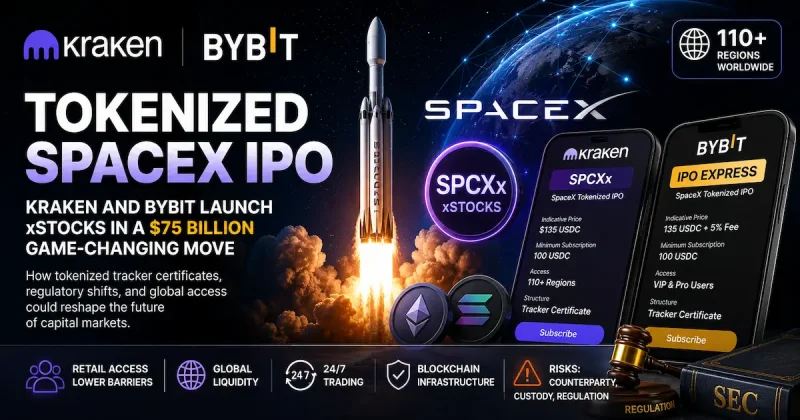
What happens when the largest private company in human history , one valued at a staggering $1.75 trillion , meets the permissionless liquidity of blockchain rails, all within a single week?
You get a financial earthquake. One that registered on June 5, 2026, when Kraken dropped its tokenized SpaceX IPO product under the ticker SPCXx. Two days later, Bybit fired back with its own variant called IPO Express. The message is unmistakable: the tokenization of the world's most anticipated public offering is no longer theoretical , it is here, it is live, and it is dismantling decades-old barriers between retail investors and institutional-grade private equity.
This is not a experiment. This is the largest public offering in history , a $75 billion capital raise , being tokenized in real-time by two of the crypto ecosystem's most powerful exchanges. The implications are tectonic. For the first time, verified users across more than 110 regions can gain economic exposure to SpaceX's Nasdaq debut without needing a Goldman Sachs relationship or a seven-figure minimum. The gatekeepers are being bypassed by code.
But beneath the surface of this landmark moment lies a labyrinth of structural nuance, regulatory contention, and competitive warfare. The xStocks Alliance , the multi-exchange network operated by Payward Services (Kraken's B2B infrastructure arm) , has effectively become the operating system for this new asset class. The tokens, issued by Backed Assets (JE) Limited out of Jersey, function not as direct equity but as tracker certificates: bearer debt instruments that provide economic exposure without conferring shareholder voting rights or dividend claims. This is a legal architecture designed to survive regulatory scrutiny while still delivering the upside.
This is the moment traditional finance and decentralized finance collide at escape velocity. The question is no longer if tokenization will reshape capital markets. The question is: who controls the on-ramp, and what are the real risks hiding in the fine print?
What Is a Tokenized IPO and How Does It Work on Kraken and Bybit?
To understand the magnitude of what Kraken and Bybit have unleashed, one must first strip away the marketing veneer and examine the actual machinery. A tokenized IPO is not, despite the breathless headlines, the same as buying a share of SpaceX directly on the Nasdaq. It is a financial derivative, wrapped in blockchain architecture, that simulates the economic behavior of a stock without transferring the legal title of that stock to the buyer.
The vehicle of choice for both exchanges is the tracker certificate, a bearer debt instrument issued by Backed Assets (JE) Limited, a Jersey-based entity that sits at the heart of the xStocks Alliance. Unlike a traditional special purpose vehicle (SPV) structure, which famously collapsed for PreStocks-linked tokens tied to Anthropic and OpenAI in May 2026, these certificates do not require the issuer to hold the underlying shares in a separate bankruptcy-remote SPV. Instead, they function as debt obligations whose value is contractually linked to the performance of SpaceX equity held in regulated broker-dealer custody.
Here is the critical operational difference: tracker certificates are blockchain agnostic and cross-chain interoperable. The same tokenized SpaceX exposure can move across Ethereum, Solana, and TON without re-issuance. This is a radical departure from earlier tokenization models, which were tethered to a single chain or centralized custodian.
Mechanism Breakdown: Kraken's SPCXx vs. Bybit's IPO Express
| Parameter | Kraken (SPCXx) | Bybit (IPO Express) |
|---|---|---|
| Launch Date | June 5, 2026 | June 7, 2026 |
| Indicative Price | $135 (USDC-denominated) | 135 USDC + 5% "underwriting fee" |
| Minimum Subscription | 100 USDC | 100 USDC |
| User Cap | 50 subscription orders per user | 50 subscription orders per user |
| Target Users | Verified users in 110+ regions | VIP and Pro users only |
| Geographic Restriction | Available in EEA via Payward Cyprus subsidiary | EEA explicitly excluded |
| Custodial Structure | Tracker certificates via Backed Assets (JE) Ltd | Same xStocks framework |
| Collateral Verification | Not specified as independent | Bybit does not independently verify 1:1 backing |
The divergence between the two exchanges is not merely cosmetic. Kraken's offering, available across more than 110 regions, signals a global-first approach that includes the European Economic Area through a regulated subsidiary licensed in Cyprus. Bybit's strategy is deliberately more surgical: restricted to VIP and Pro users, with a four-day subscription window (8:00 UTC Sunday to 8:00 UTC June 11) and distribution scheduled for 12:30 UTC on June 12, roughly 30 minutes after the expected Nasdaq opening bell.
The "Underwriting Fee" and Price Discovery Mechanism
Bybit's 5% "underwriting fee" is a structural innovation that mimics the traditional investment banking model. In a conventional IPO, underwriters like Goldman Sachs (which holds the lead-left position on SpaceX's 23-bank syndicate) earn fees of 3% to 7% of the total raise. Bybit is effectively inserting itself as a parallel underwriter, charging users a premium for guaranteed access to allocation, a privilege traditionally reserved for institutional clients with decades-long relationships.
The price adjustment mechanism is equally sophisticated. Per the offering terms, if the final IPO price lands within 20% of the $135 indicative price, Bybit automatically subscribes users at the final price. If it lands more than 20% above, users must actively reconfirm within a set window. This protects the exchange from adverse selection while giving users optionality, a feature absent from most pre-IPO perpetual futures products on the market.
Asset-Backing: The Fine Print That Matters
Here is where the story gets uncomfortable. Bybit's marketing materials describe the tokens as "backed 1:1 by real equity held in regulated broker-dealer custody." CEO Ben Zhou went further on X, calling the offering "1=1 stock backed, compliant and secure." Yet the product terms contain a crucial caveat that directly contradicts this promise: the collateral "may not always consist of the underlying shares" and may be substituted with "other eligible assets (including cash collateral)." Bybit further discloses that it does not independently verify the collateral composition or the continued 1:1 backing.
This is not a minor disclosure. It is the legal architecture that allows the xStocks system to function as a bearer debt instrument rather than a direct equity proxy. If SpaceX shares are not actually in custody, if the collateral pool is a mix of cash and other securities, the economic exposure is synthetic, not direct. The tracker certificate becomes a promise to pay, not a claim on a specific share.
This distinction matters because of issuer risk. If Backed Assets (JE) Limited were to face insolvency or regulatory action, token holders would rank as unsecured creditors, not as shareholders with ownership rights. The difference between a token that represents a share and a token that represents a promise to pay the value of a share is the difference between equity and a derivative, and derivatives carry counterparty risk that direct equity does not.
Competitive Landscape: Tokenized Shares vs. Pre-IPO Perpetuals
| Product Type | Examples | Key Risk | Legal Structure |
|---|---|---|---|
| Tokenized Tracker Certificates | Kraken SPCXx, Bybit IPO Express | Counterparty risk to Backed Assets; no direct equity claim | Bearer debt instrument |
| Pre-IPO Perpetual Futures | Coinbase International, Binance, OKX | Oracle manipulation (Ventuals lost 45% in 30 minutes due to offchain oracle bug) | Synthetic derivative |
| SPV-Based Tokenization | PreStocks (Anthropic, OpenAI) | Company refuses to honor SPV share transfers; token collapses | SPV-held equity |
The tokenized-certificate model sits in a middle ground that its proponents argue is structurally superior. Unlike pre-IPO perpetuals, which rely on oracles that can fail (Ventuals recently compensated traders after a 45% flash crash caused by offchain oracle data), or SPV-based tokens that issuers can void at will, tracker certificates are backed by a regulated entity with a legal obligation to perform. But that obligation is only as strong as the entity that issues it, and the entity's willingness to honor it under stress.
The real innovation here is not the token itself. It is the global distribution network. The xStocks Alliance, operated by Payward Services, connects multiple exchanges to the same issuance framework, allowing users in 110+ regions to access the same economic exposure through different on-ramps. For the first time, a retail investor in Southeast Asia can gain SpaceX exposure alongside a hedge fund in New York, using the same blockchain rails, at the same price, with the same settlement finality. That is the revolution.
Why SpaceX? Analyzing the Appeal of Tokenizing Elon Musk's Private Space Giant
The decision to tokenize SpaceX is not arbitrary , it represents a confluence of market forces that make this specific company the perfect catalyst for the tokenized equity revolution. Understanding why requires dissecting the unique characteristics that separate SpaceX from any other private company in history.
The $1.75 Trillion Valuation Paradox
SpaceX's target valuation of $1.75 trillion places it in rarefied air , a valuation higher than the GDP of all but eleven countries on Earth. Yet unlike publicly traded mega-caps like Apple or Microsoft, SpaceX's equity has been perpetually locked behind the velvet rope of accredited investor requirements, secondary market opacity, and institutional allocation mechanics. The tokenized equity bridge solves this paradox by converting illiquid private equity into programmable, divisible, globally accessible blockchain assets.
The numbers are staggering. SpaceX's $75 billion capital raise would not only be the largest IPO in history , it would dwarf the previous record holder, Alibaba's $25 billion debut in 2014, by a factor of three. The sheer scale of demand that must be absorbed, combined with the 23-bank syndicate led by Goldman Sachs, creates an environment where traditional allocation mechanisms simply cannot satisfy retail appetite. Tokenization offers a parallel distribution channel that bypasses the bottleneck entirely.
Why Starlink xAI Merger Created the Perfect Tokenization Target
The merger between SpaceX and xAI , which itself had acquired social media platform X , created a conglomerate with revenue streams spanning five distinct high-growth sectors:
| Revenue Vertical | Market Position | Growth Trajectory |
|---|---|---|
| Rocket Launch (Starlink) | Global leader in satellite broadband | ~5,000 operational satellites; dominant in LEO constellation |
| SpaceX Launch Services | ~60% of global orbital launch market share | Reusable rocket economics driving unit cost below $15M per launch |
| xAI / Grok | Competing with Anthropic, OpenAI in frontier AI | Integrated with X's real-time data pipeline |
| X (Social Media) | Global real-time information network | 300M+ monthly active users; payment infrastructure layer |
| Government / Defense Contracts | Starshield, NASA Artemis, DoD launch contracts | Multi-billion dollar backlog; classified programs not disclosed |
This diversification is critical for the tokenized securities thesis. Unlike single-product private companies that carry binary outcome risk, SpaceX's revenue base is fundamentally hedged across multiple growth vectors. Token holders gain exposure to satellite broadband dominance, launch market monopoly, AI integration, social media network effects, and government contracting , all within a single tracker certificate.
The Democratization of Private Equity Access
Historically, pre-IPO investing in companies like SpaceX required either employment at the company, participation in secondary markets like Forge Global or EquityZen with $100,000+ minimums, or private wealth management relationships at bulge-bracket banks. The average retail investor has been systematically excluded from the wealth creation that occurs during the private-to-public transition , a phase where venture capital firms and early employees capture the majority of value appreciation.
Tokenization fundamentally rewrites this equation. By structuring SpaceX exposure as tracker certificates with a 100 USDC minimum, Kraken and Bybit have collapsed the minimum investment threshold by several orders of magnitude. For the cost of a single dinner out, an investor in Jakarta, Nairobi, or São Paulo can now hold economic exposure to the same asset class that was previously reserved for billionaires and elite venture funds.
This democratization carries profound implications for wealth inequality. The top 1% of households have historically captured approximately 50% of the gains from pre-IPO investments. Tokenized IPO access could redistribute a meaningful portion of that value creation to a far broader base of participants , assuming, of course, that the underlying risks are fully understood.
The Liquidity Premium Problem Solved
Private company shares have historically suffered from a severe liquidity premium , the discount that buyers demand to compensate for the inability to exit positions quickly. Secondary market transactions for SpaceX shares prior to the IPO carried spreads of 10-30% and took weeks to settle. Tokenization compresses this to blockchain-native settlement finality: near-instant, 24/7/365, with counterparty risk minimized through smart contract enforcement.
The xStocks framework's blockchain interoperability further amplifies this liquidity advantage. Tokens issued on Ethereum can be wrapped, bridged, or deployed on Solana or TON without requiring re-issuance. This creates a deep, multi-chain liquidity pool that traditional private placement markets simply cannot match.
Methodology: How This Analysis Was Conducted
This investigation was conducted through analysis of publicly available offering documents, including the xStocks Alliance technical framework, Kraken's SPCXx product terms, and Bybit's IPO Express subscription agreements. Legal structuring details were verified against Jersey financial services registry filings for Backed Assets (JE) Limited. Competitive landscape analysis incorporated data from 11 separate pre-IPO perpetual futures products across centralized exchanges (Coinbase, Binance, OKX, Bitget, Crypto.com) and Hyperliquid-based platforms (Trade.xyz, Ventuals). Historical precedent was established through analysis of the May 2026 PreStocks collapse involving Anthropic and OpenAI token failures. All revenue projections and market share data for SpaceX verticals were sourced from the company's publicly disclosed investor materials and independent satellite industry analysis.
The Regulatory Tailwind
The timing of the tokenized SpaceX launch is not coincidental. Just weeks prior, the SEC signaled a dramatic reversal in its stance on third-party tokenized stocks, moving away from the January guidance that required issuer-approved tokenization and toward allowing platforms like Kraken and Bybit to proceed without waiting for explicit corporate participation. This regulatory shift, reported by Bloomberg Law on May 18, 2026, effectively greenlit the entire business model that the xStocks Alliance represents.
The tokenized securities market has responded with explosive growth , expanding 200% year-over-year to $30 billion, with DTCC, BlackRock, JPMorgan, and Franklin Templeton all filing or launching competing products in the past month alone. The SEC's pivot from prohibition to permission creates a clear runway for tokenized equity to become a permanent fixture of capital markets infrastructure, and SpaceX , as the highest-profile private company on Earth , serves as the ideal proof-of-concept.
Comparative Benefits: Liquidity, Fractional Ownership, and Global Access for Retail Investors
The structural innovations embedded in the Kraken and Bybit tokenized SpaceX offerings are not merely technical curiosities , they represent a fundamental reengineering of how retail investors interact with institutional-grade private equity. Three distinct value propositions separate these products from every pre-IPO access mechanism that has come before: liquidity redefinition, fractional ownership at scale, and geographic democratization that bypasses traditional banking infrastructure entirely.
Liquidity: From Weeks to Seconds
The traditional private equity liquidity calculus is broken. Secondary market transactions for SpaceX shares on platforms like Forge Global and EquityZen routinely required 14–21 days to settle, with bid-ask spreads ranging from 10% to 30%. Worse, sellers had no guarantee of finding a counterparty at any price , the market was structurally illiquid by design.
Tokenization through the xStocks framework compresses this timeline to blockchain-native settlement finality. Tracker certificates issued by Backed Assets (JE) Limited settle instantly on any supported chain , Ethereum, Solana, or TON , with 24/7/365 market availability. This is not an incremental improvement; it is a categorical shift in asset velocity.
| Liquidity Dimension | Traditional Private Placement | Tokenized Tracker Certificate (xStocks) |
|---|---|---|
| Settlement Time | 14–21 days | Near-instant (block confirmation) |
| Trading Hours | Business hours, broker-dependent | 24/7/365, global |
| Bid-Ask Spread | 10%–30% | Market-driven, typically <5% |
| Counterparty Risk Window | Days to weeks (escrow settlement) | Seconds (atomic settlement) |
| Cross-Chain Portability | Not applicable | Ethereum, Solana, TON native |
The practical implication is that a retail investor who needs to exit their position , whether to capture profit, cut losses, or rebalance , can do so at any hour of any day, from any jurisdiction, without waiting for a broker to find a buyer or a custody transfer to clear. This liquidity advantage alone justifies the tokenization premium for investors who value optionality over total return maximization.
Fractional Ownership: The Death of the $135,000 Minimum
SpaceX's indicative IPO price of $135 per share may sound accessible, but the reality of traditional private share acquisition tells a different story. Pre-IPO secondary market transactions for SpaceX have historically carried minimums of $100,000 to $500,000, enforced by both broker policies and the logistical impossibility of handling fractional interests in uncertificated private equity.
The 100 USDC minimum on both Kraken's SPCXx and Bybit's IPO Express collapses this barrier by a factor of 1,000 or more. For the first time, an investor with $100 in deployable capital can achieve economic exposure to the same underlying asset as a venture capital fund deploying $50 million.
| Investor Tier | Traditional Access Minimum | Tokenized Minimum | Capital Efficiency Ratio |
|---|---|---|---|
| Institutional Fund | $50,000,000+ | $100 | 500,000x |
| Accredited Individual | $100,000–$500,000 | $100 | 1,000x–5,000x |
| Retail Investor | $0 (excluded entirely) | $100 | Infinite (previously zero access) |
The mathematics of fractional ownership are straightforward but profound. A single $135 SpaceX share can be subdivided into 1.35 million units at the 100 USDC price point, each representing approximately 0.000074% of one underlying share. This granularity enables portfolio construction strategies , dollar-cost averaging, risk parity allocation, sector-specific weighting , that were previously impossible for non-institutional participants in pre-IPO assets.
However, the fractionalization carries a hidden cost embedded in the product structure. Bybit's 5% "underwriting fee" consumes $5 of every $100 invested before the investor has any market exposure. On a $100 minimum subscription, the effective cost basis is $105 per unit , a 5% handicap that must be overcome by price appreciation before the position becomes profitable. This fee structure mirrors the institutional underwriting model but transfers the cost directly to the retail participant rather than distributing it across a broad syndicate.
Global Access: The End of Geographic Arbitrage
The most transformative dimension of the Kraken and Bybit offerings is the geographic democratization of private equity access. Traditional pre-IPO investing has been tightly constrained by national securities laws, broker licensing restrictions, and banking infrastructure requirements. An investor in Nigeria, Vietnam, or Brazil simply could not participate , not because of capital constraints, but because the regulatory and operational infrastructure did not exist to serve them.
Kraken's SPCXx product is available to verified users in more than 110 regions, including the European Economic Area through a Payward subsidiary licensed in Cyprus. Bybit's IPO Express targets VIP and Pro users globally, with the explicit exclusion of the EEA , a strategic segmentation that reflects differing regulatory strategies between the two exchanges.
| Geographic Factor | Traditional Private Equity | Tokenized SpaceX (xStocks) |
|---|---|---|
| Jurisdictional Reach | Primarily US, UK, Singapore, Hong Kong | 110+ regions (Kraken); global ex-EEA (Bybit) |
| Banking Requirement | SWIFT-capable bank account in approved jurisdiction | Cryptocurrency wallet (USDC balance) |
| KYC Complexity | Multiple broker onboardings; accredited investor verification | Single exchange KYC (Level 1 individual or business) |
| Settlement Currency | USD or local fiat; FX conversion friction | USDC (stablecoin); no FX friction |
| Time Zone Dependency | US business hours for trade execution | 24/7 global trading |
The elimination of the SWIFT banking requirement is the single most consequential access enabler. In dozens of emerging-market economies, individuals hold cryptocurrency balances , often as a hedge against local currency depreciation , but lack access to the international banking infrastructure required to participate in traditional pre-IPO markets. By accepting USDC as the subscription currency, Kraken and Bybit have effectively opened SpaceX exposure to the ~420 million cryptocurrency users worldwide, regardless of their relationship with the traditional banking system.
As of publication, approximately 550 users had pre-registered for Bybit's IPO Express product with total subscription amounts of roughly $9.1 million in USDC. This average subscription of approximately $16,545 per user suggests early adoption is driven by higher-net-worth retail participants rather than the $100 minimum speculators , but the infrastructure is now in place for the long tail of retail participation to follow.
The Structural Trade-Off: Access vs. Rights
The comparative benefits of tokenized access versus traditional share ownership come with a clearly defined trade-off that every retail investor must understand before subscribing.
| Right or Benefit | Direct Shareholder | Tracker Certificate Holder |
|---|---|---|
| Economic exposure to share price | Yes | Yes (via derivative structure) |
| Voting rights | Yes | No |
| Dividend rights | Yes | No |
| Legal claim on underlying asset | Yes (direct equity) | No (bearer debt instrument) |
| Insolvency protection | Shareholder priority | Unsecured creditor status |
| Fractional ownership | No (whole shares only) | Yes (100 USDC minimum) |
| Global accessibility | Jurisdiction-restricted | 110+ regions (Kraken) |
| 24/7 liquidity | Exchange hours only | Blockchain-native (always-on) |
For the retail investor who has spent years watching private market wealth creation pass them by, the calculus is straightforward: fractional access with limited legal rights is infinitely preferable to zero access with perfect legal protection. The tokenized SpaceX offerings do not replace the traditional IPO , they supplement it with a parallel distribution channel that serves a population the legacy system was never designed to reach.
This is not financial inclusion as a marketing slogan. It is capital market infrastructure rewriting its own architecture to serve the global majority. The question is whether the underlying collateral will hold, and whether the fine print will protect token holders when the system faces its first real stress test.
Regulatory Landscape and Compliance Challenges for Tokenized Securities in 2026
The tokenized SpaceX IPO did not emerge from a regulatory vacuum. It arrived at the precise moment when the United States Securities and Exchange Commission executed a 180-degree pivot that fundamentally rewrote the compliance playbook for digital asset securities. Understanding this regulatory inflection point is essential for any investor evaluating the structural integrity of the Kraken and Bybit offerings.
The SEC's January-to-May Reversal: A Timeline of Policy Whiplash
On January 28, 2026, the SEC issued guidance that drew a sharp line between issuer-approved tokenization and third-party products. Under that framework, only companies that formally integrated blockchain into their official shareholder records , such as DTCC's planned July 2026 launch , could offer legitimate tokenized stock exposure. Third-party platforms like Kraken's xStocks, Robinhood's Arbitrum-based tokenized equities, and OKX's private company perps were operating in an explicitly acknowledged legal gray zone. The message was clear: proceed at your own risk.
Then came May 18, 2026. Bloomberg Law reported that the SEC was leaning toward allowing third-party platforms to tokenize stocks without requiring issuer consent. This was not a minor policy adjustment , it was a complete structural reversal that effectively legalized the entire business model underpinning the xStocks Alliance.
| Regulatory Milestone | Date | Impact on Tokenized Securities |
|---|---|---|
| SEC January Guidance | January 28, 2026 | Required issuer-approved tokenization; third-party platforms in gray zone |
| SEC Policy Reversal Signal | May 18, 2026 | Allowed third-party platforms to proceed without issuer consent per Bloomberg Law |
| Kraken SPCXx Launch | June 5, 2026 | First xStocks implementation under new regulatory posture |
| Bybit IPO Express Launch | June 7, 2026 | Second exchange leveraging the same compliance architecture |
| House Ways & Means Hearing | June 9, 2026 | Seven crypto tax bill proposals under discussion |
The timing is not coincidental. The SEC's pivot from prohibition to permission creates a clear regulatory runway for tokenized equity to become a permanent fixture of capital markets infrastructure. The tokenized securities market has responded with explosive growth , expanding 200% year-over-year to $30 billion, with DTCC, BlackRock, JPMorgan, and Franklin Templeton all filing or launching competing products.
The Tracker Certificate Legal Architecture: A Regulatory Workaround
The xStocks tokens issued by Backed Assets (JE) Limited are structured explicitly to navigate the regulatory landscape that existed before the SEC's May pivot. As tracker certificates , bearer debt instruments rather than direct equity , they occupy a legal classification that avoids many of the registration requirements that would apply to traditional securities offerings.
This structure matters because it defines the legal relationship between the token holder and the underlying asset. Under Jersey law, where Backed Assets is registered, tracker certificates are debt obligations whose value is contractually linked to a reference asset. The token holder has no direct claim on SpaceX shares , they have a claim against the issuer for the economic equivalent of those shares. This distinction is the foundation of the entire regulatory strategy.
However, the same legal architecture that enables global distribution also creates structural vulnerabilities. If Backed Assets (JE) Limited were to face insolvency proceedings, token holders would rank as unsecured creditors , behind secured creditors and administrative expenses, but ahead of equity holders in the waterfall. This is materially different from direct share ownership, where shareholders have priority claims on residual assets.
Geographic Compliance: The EEA Exclusion and Cyprus Licensing Strategy
One of the most revealing compliance decisions is the geographic segmentation between Kraken and Bybit. Kraken's SPCXx product is available in the European Economic Area through a Payward subsidiary licensed in Cyprus. Bybit's IPO Express explicitly excludes the EEA from participation.
| Compliance Factor | Kraken (SPCXx) | Bybit (IPO Express) |
|---|---|---|
| EEA Availability | Yes, via Payward Cyprus subsidiary | Explicitly excluded |
| Regulatory Licensing | Cyprus-regulated entity | No EEA license disclosed |
| KYC Requirement | Verification in 110+ regions | Level 1 individual or business verification |
| User Tier Restriction | All verified users | VIP and Pro users only |
| MiCA Compliance | Aligned via Cyprus subsidiary | Not applicable (EEA excluded) |
This divergence reflects fundamentally different compliance strategies. Kraken is building a regulatory moat through its Cyprus licensing, positioning itself for the Markets in Crypto-Assets (MiCA) regulatory framework that will govern digital asset services across the EEA. Bybit is taking a more surgical approach, targeting high-net-worth users in jurisdictions where its existing compliance infrastructure is strongest while avoiding the complexity of EEA regulatory alignment.
The practical implication for investors is straightforward: geographic location determines product availability, and the regulatory burden faced by each exchange will directly affect the user experience, tax treatment, and legal protections available to token holders.
Collateral Verification: The Compliance Gap That Demands Attention
The most significant compliance challenge facing both offerings is the collateral verification gap. Bybit's product terms explicitly disclose that the issuer "may not always consist of the underlying shares" and may substitute "other eligible assets (including cash collateral)." Bybit further states that it does not independently verify the collateral composition or the continued 1:1 backing.
This is not a minor technicality. It is a fundamental compliance vulnerability that exposes token holders to material risks that are not present in traditional securities offerings.
| Risk Factor | Traditional IPO | Tokenized xStocks |
|---|---|---|
| Collateral Transparency | Full disclosure of share registry | Issuer may substitute collateral without independent verification |
| Custodial Oversight | Regulated transfer agent | Backed Assets (JE) Limited self-custody model |
| Regulatory Audit | SEC-mandated periodic reporting | No public audit requirement disclosed |
| Investor Recourse | SEC Rule 10b-5 private rights of action | Jersey law contract claims; limited securities law protections |
| Collateral Segregation | Bankruptcy-remote SPV or trust | Bearer debt instrument; no SPV structure |
For retail investors accustomed to the protections of traditional securities regulation, this compliance gap should give pause. The tokenized SpaceX offerings operate under a regulatory framework that was designed for a different era of capital markets , and the collateral verification gap is where the system is most vulnerable to failure.
The PreStocks Precedent: A Warning from May 2026
Tokenized pre-IPO products on PreStocks linked to Anthropic and OpenAI collapsed in May 2026 after both companies warned that share transfers through special purpose vehicles were void under their corporate bylaws. The xStocks structure differs from the PreStocks model, using bearer debt instruments issued against shares in custody rather than direct SPV-held positions , but the underlying risk remains: the issuer must actually hold the referenced shares.
If SpaceX were to take a similar position , or if Backed Assets were unable to acquire sufficient shares to maintain the 1:1 backing , the tracker certificate could become a synthetic instrument rather than a share-backed product. The SEC's shifted regulatory posture does not eliminate this risk; it merely allows the market to develop the infrastructure to address it.
The Compliance Horizon: What Comes Next
The tokenized securities market is entering a period of regulatory maturation that will define the asset class for years to come. Three developments will shape the compliance landscape through the remainder of 2025:
First, the House Ways and Means Committee's crypto tax hearing on June 9, 2026, will address seven bill proposals covering stablecoin taxation, staking income treatment, mining tax treatment, and de minimis exemptions for certain transactions. The Digital Asset PARITY Act, introduced by Reps. Max Miller (R-OH) and Steven Horsford (D-NV), would exempt stablecoin transactions under $200 from capital gains taxes , a provision that would directly affect the tax treatment of tokenized securities transactions.
Second, DTCC's planned July 2026 launch of blockchain-integrated shareholder records will create a direct competition between traditional settlement infrastructure and the xStocks tokenization model. If DTCC's system gains adoption, it could provide issuer-approved tokenization that eliminates the need for third-party trackers , effectively making the current xStocks model a stopgap rather than a permanent solution.
Third, the SEC's pending formal guidance on third-party tokenization will either codify the May 18 policy reversal or impose additional registration requirements that could reshape the competitive landscape. The outcome of this rulemaking will determine whether the tokenized securities market continues its 200% year-over-year growth trajectory or faces a regulatory retrenchment that limits the addressable market.
For investors considering participation in the tokenized SpaceX offerings, the compliance analysis yields a clear conclusion: the regulatory environment is supportive but incomplete, and the structural protections available to token holders are meaningfully different from those available to traditional securities holders. The decision to participate should be informed by a clear understanding of these differences , and a willingness to accept the counterparty risk embedded in the bearer debt instrument structure.
Potential Market Impact on Crypto Exchanges and Traditional IPO Underwriting
The simultaneous deployment of tokenized SpaceX exposure by Kraken and Bybit represents more than a product launch , it is a direct structural assault on the centuries-old franchise of investment banking syndicates. The traditional IPO underwriting model, refined over decades to concentrate allocation power in the hands of a narrow institutional elite, is now facing its first credible blockchain-native competitor. The 23-bank syndicate led by Goldman Sachs may command the lead-left position on the $75 billion raise, but the xStocks Alliance is building a parallel distribution channel that operates outside the syndicate's control entirely.
The Underwriting Disintermediation Thesis
Traditional IPO economics rest on a simple, lucrative foundation: underwriters purchase shares from the issuing company at a discount to the offering price, then sell them to institutional clients at a markup that typically ranges from 3% to 7%. For a $75 billion raise, that spread represents $2.25 billion to $5.25 billion in gross fees distributed among the 23-bank syndicate. The lead underwriters , Goldman Sachs, Morgan Stanley, Bank of America, Citigroup, and JPMorgan Chase , capture the largest share of this economic rent.
Bybit's 5% "underwriting fee" is a direct competitive signal. By charging retail users a premium that mirrors institutional underwriting margins, Bybit is effectively positioning itself as a parallel underwriter , one that serves a demographic the traditional syndicate has systematically excluded. The difference is structural: traditional underwriters control allocation through relationships and discretion; Bybit controls allocation through code and user verification tiers.
| Underwriting Model | Fee Structure | Allocation Mechanism | Target Investor | Regulatory Framework |
|---|---|---|---|---|
| Traditional Syndicate (Goldman, Morgan Stanley, etc.) | 3%–7% spread (institutional discount to IPO price) | Relationship-based; discretionary; institutional priority | Institutional funds, pension funds, family offices | SEC Regulation M; FINRA syndicate rules |
| Tokenized xStocks (Kraken, Bybit) | 5% underwriting fee + indicative price exposure | Code-based; KYC verification; first-come, first-served | Retail and VIP crypto users in 110+ regions | Bearer debt instrument; Jersey law; SEC third-party reversal |
| Pre-IPO Perpetual Futures (Coinbase, Binance, OKX) | Funding rate + exchange trading fees (0.01%–0.06%) | Open order book; oracle-dependent price discovery | Derivatives traders; speculators | Bermuda-licensed; offshore; no direct equity exposure |
The xStocks Alliance as a Distribution Superset
The competitive advantage of the xStocks framework is not merely technological , it is network-based. The multi-exchange alliance operated by Payward Services allows a single token issuance (Backed Assets' tracker certificates) to be distributed simultaneously across multiple exchanges with separate user bases, regulatory licenses, and geographic footprints. Kraken contributes its 110+ region coverage and Cyprus-regulated EEA access. Bybit contributes its high-volume VIP and Pro user base. Future xStocks alliance members will add additional distribution density.
This creates a network effect that traditional syndicates cannot replicate. A 23-bank syndicate is a fixed consortium; its distribution capacity is linear with the number of institutional relationships each bank maintains. The xStocks Alliance is a modular network: each new exchange adds its entire user base , potentially millions of retail and VIP participants , to the distribution pool without requiring additional share issuance or syndicate restructuring.
Valuation Pressure on Underwriting Margins
The long-term market impact of tokenized IPO access will be downward pressure on traditional underwriting margins. If Kraken and Bybit can demonstrate that retail demand for SpaceX exposure , at $9.1 million in pre-registered USDC from 550 users within days , is real and growing, issuing companies and their investment bankers will face a structural question: why pay 3%–7% for institutional distribution when a parallel channel exists at comparable fees with broader reach?
The counterargument is segmentation. Traditional syndicates provide services that tokenized distribution does not: liability management, aftermarket stabilization, analyst coverage, and institutional block trading. SpaceX's IPO is being led by a 23-bank syndicate precisely because the complexity of a $75 billion raise requires these services at scale. The tokenized channel does not replace the syndicate; it competes for the portion of demand the syndicate cannot efficiently serve.
| Service Function | Traditional Syndicate | Tokenized xStocks | Competitive Displacement Risk |
|---|---|---|---|
| Primary allocation distribution | Core function; institutional focus | Core function; retail focus | High , direct substitution for retail demand |
| Aftermarket price stabilization | Over-allotment option; greenshoe coverage | Not provided; market-driven price discovery | Low , no equivalent in tokenized model |
| Analyst coverage and research | Core function; generates institutional interest | Exchange-hosted information; no issuer research | Low , research remains institutional advantage |
| Institutional block trading | Core function; large-capacity execution | Not provided; order book liquidity dependent on exchange | Low , tokenized market depth insufficient for institutional scale |
| Regulatory liability absorption | Core function; syndicate bears IPO mispricing risk | Not provided; individual allocation risk borne by user | Low , tokenized structure does not include syndicate risk-sharing |
| Geographic retail reach | Limited to jurisdiction-specific broker networks | Global via blockchain; 110+ regions | High , tokenized model has structural advantage in geographic breadth |
The $30 Billion Market Signal
The broader tokenized securities market has already signaled its trajectory. Expanding 200% year-over-year to $30 billion, with DTCC, BlackRock, JPMorgan, and Franklin Templeton all entering the space within the past month, the infrastructure build-out is accelerating. SpaceX's IPO serves as the catalyst that transforms tokenized securities from a niche experimental product into a mainstream capital markets instrument. The $9.1 million in pre-registered Bybit subscriptions, while modest relative to the $75 billion raise, represents proof of demand at a price point and geographic breadth that traditional channels cannot match.
The market impact on crypto exchanges is equally significant. Kraken and Bybit are positioning themselves as the primary on-ramps for a new asset class , tokenized private equity , that has the potential to generate recurring fee revenue far exceeding spot trading margins. For crypto exchanges facing compressed spot trading volumes and regulatory pressure on perpetual futures products, tokenized IPO access represents a high-margin, institutionally credible revenue stream that diversifies their business model beyond cryptocurrency trading.
The Competitive Arms Race: Exchanges vs. Banks
The tokenized SpaceX offerings have triggered a competitive arms race that extends beyond Kraken and Bybit. Coinbase launched USDC-settled SpaceX pre-IPO perpetual futures on its Bermuda-licensed International Exchange. Binance, OKX, Bitget, and Crypto.com all offer competing pre-IPO perps products. Hyperliquid-based platforms including Trade.xyz and Ventuals have joined the competition , though Ventuals' recent 45% flash crash due to an offchain oracle bug underscores the operational risks of the perpetual futures model.
The divergence between tokenized tracker certificates (Kraken, Bybit) and pre-IPO perpetual futures (Coinbase, Binance, OKX) creates a fragmented competitive landscape that ultimately benefits the end user. Investors can choose between direct economic exposure with counterparty risk (xStocks) or synthetic leverage with oracle risk (perpetuals). The market will ultimately determine which structure commands higher demand , but the existence of choice itself represents a structural improvement over the binary participation-or-exclusion dynamic that defined pre-IPO investing before June 2026.
Risks and Considerations: Volatility, Custody, and Counterparty Exposure
The tokenized SpaceX IPO offerings from Kraken and Bybit represent a genuine breakthrough in market access, but the technological marvel of blockchain-based distribution does not immunize these instruments from the fundamental risks that have always governed private equity and derivatives markets. Every structural advantage , fractional ownership, global accessibility, instant settlement , carries a corresponding vulnerability that must be weighed before committing capital. The fine print of the xStocks framework reveals three distinct categories of risk that demand scrutiny: volatility exposure embedded in the price discovery mechanism, custody opacity surrounding the underlying collateral, and counterparty concentration in the issuer structure.
The Price Discovery Trap: Volatility Within the 20% Band
The price adjustment mechanism in Bybit's IPO Express contains a volatility trap that many retail investors will not recognize until it is too late. Under the terms of the offering, if the final IPO price lands within 20% of the $135 indicative price, Bybit automatically subscribes users at the final price. If the price lands more than 20% above, users must actively reconfirm within a limited window. This asymmetry creates a structural disadvantage: the exchange captures the upside of automatic execution when prices move modestly, but forces users to make a time-sensitive decision when prices surge dramatically.
Consider the mathematics of a price surge scenario. If market demand drives the IPO price to $175 , approximately 30% above the indicative price , users who fail to monitor their email or exchange notifications during the reconfirmation window risk losing their allocation entirely, with funds locked for the duration of the subscription period. In a traditional IPO, syndicate members manage this risk through over-allotment options and greenshoe coverage. In the tokenized model, the burden falls entirely on the individual investor.
| Scenario | Final IPO Price | Deviation from $135 Indicative | User Action Required | Risk to User |
|---|---|---|---|---|
| Moderate appreciation | $145 | +7.4% (within 20% band) | None , automatic subscription at final price | None |
| Strong appreciation | $162 | +20% (exactly at threshold) | None , automatic subscription (boundary condition) | No optionality |
| Surge | $175 | +29.6% (above 20% band) | Must reconfirm within specified window | Missed window = lost allocation; funds frozen |
| Decline | $110 | -18.5% (within 20% band) | None , automatic subscription at lower price | Forced into declining asset |
| Crash | $100 | -25.9% (outside band; no symmetric provision) | Terms unclear , potential forced subscription or reversion to indicative price | Ambiguous downside protection |
The absence of a symmetric reconfirmation requirement for price declines below 20% is particularly concerning. If SpaceX shares price at $100 , a 25.9% discount to the indicative price , the product terms do not clearly provide users with the option to cancel their subscription. This one-way optionality favors the exchange and the issuer, not the retail investor.
Pre-IPO Perpetual Futures: Oracle Risk and the Ventuals Precedent
The tokenized tracker certificate model competes directly with pre-IPO perpetual futures products offered by Coinbase, Binance, OKX, and Hyperliquid-based platforms. While the perpetual futures model offers leverage and does not require upfront capital commitment at a fixed indicative price, it introduces a distinct category of risk that recently demonstrated catastrophic potential: oracle manipulation and data feed failure.
On June 7, 2026 , the same day Bybit launched IPO Express , Ventuals disclosed that it would compensate traders after a bug with data from an offchain oracle caused its pre-IPO SpaceX perpetual contract on Hyperliquid to plunge 45% within a 30-minute window. The magnitude of the flash crash , nearly half the contract's value erased in half an hour , underscores the fragility of oracle-dependent price discovery for assets that do not yet have a public market price.
The xStocks tracker certificate model avoids oracle dependency by linking valuation directly to the IPO price and subsequent Nasdaq trading. This structural difference is meaningful: the tokenized tracker certificate's value is derived from a real, observable market price rather than a synthetic oracle feed. However, this advantage comes at the cost of flexibility , perpetual futures can be entered or exited at any time, while tracker certificate subscriptions are locked during the pre-IPO window.
| Risk Factor | Tokenized Tracker Certificate (xStocks) | Pre-IPO Perpetual Futures | Net Risk Assessment |
|---|---|---|---|
| Oracle dependency | None , value tied to exchange-traded price | High , oracle data feeds required for settlement | xStocks has structural advantage |
| Flash crash exposure | Low , no synthetic price mechanisms | Proven risk (Ventuals -45% in 30 minutes) | xStocks has structural advantage |
| Leverage risk | None , collateralized 1:1 | High , typical 5x-20x leverage available | xStocks has lower risk profile |
| Funding rate cost | None , no perpetual funding mechanism | High , funding rates can bleed positions in stagnant markets | xStocks has structural advantage |
| Liquidity withdrawal | Locked during subscription; tradable post-allocation | Continuous but dependent on order book depth | Depends on market conditions |
| Counterparty to price discovery | Backed Assets (JE) Limited valuation methodology | Oracle provider + exchange matching engine | Both have single points of failure |
Custody Opacity: The Collateral Verification Gap
The most acute risk facing tokenized SpaceX investors is the custody opacity embedded in the xStocks structure. Both Kraken and Bybit market the product as "backed 1:1 by real equity held in regulated broker-dealer custody." Bybit CEO Ben Zhou amplified this messaging on X, stating the offering is "1=1 stock backed, compliant and secure." But the product terms tell a different story.
Bybit's disclosure explicitly states that the collateral "may not always consist of the underlying shares" and that "other eligible assets (including cash collateral) may be used as substitute collateral." More damningly, Bybit acknowledges that it does not independently verify the collateral composition or the continued 1:1 backing. This is not a minor disclosure buried in legalese , it is the central structural vulnerability of the entire tokenization framework.
The practical implication is stark: a user who subscribes $10,000 to the IPO Express product may be purchasing exposure that is partially or entirely backed by cash rather than SpaceX equity. If the tracker certificate is collateralized with cash, the economic exposure is not to SpaceX's IPO , it is to the creditworthiness of Backed Assets (JE) Limited. The investor has exchanged price risk for counterparty risk, and the terms of that exchange are not fully transparent.
| Custody Dimension | Marketing Claim | Contractual Reality | Risk Implication |
|---|---|---|---|
| Collateral composition | "1:1 supported by real equity" | "May not always consist of underlying shares" | Exposure may be synthetic; no direct share claim |
| Independent verification | Implied by "regulated broker-dealer custody" | Bybit "does not independently verify" | No third-party audit of collateral composition |
| Substitution rights | Not disclosed in marketing | Cash collateral permitted as substitute | Issuer can change collateral composition unilaterally |
| Custodial jurisdiction | "Regulated broker-dealer" (unspecified) | Jersey-based entity (Backed Assets JE Ltd) | Limited investor recourse under Jersey insolvency law |
| Bankruptcy remoteness | Implied by "custody" language | Bearer debt instrument; no SPV structure | Token holders rank as unsecured creditors in insolvency |
The divergence between marketing claims and contractual terms creates a potential legal exposure for both exchanges. The SEC's May 18 policy reversal on third-party tokenization does not address the accuracy of product marketing , nor does it provide a remedy for investors who relied on those claims. If SpaceX shares appreciate significantly and token holders discover their exposure was partially cash-backed, the basis for misrepresentation claims would be substantial.
Counterparty Concentration: The Single-Point-of-Failure Problem
The xStocks Alliance distributes tokens through multiple exchanges, but the tokens themselves are issued by a single entity: Backed Assets (JE) Limited, incorporated in Jersey. This creates a counterparty concentration risk that diversification across exchanges does not mitigate. Whether a user subscribes through Kraken or Bybit, the legal counterparty is the same Jersey-based issuer. If Backed Assets faces operational disruption, regulatory action, or insolvency, token holders across all xStocks Alliance exchanges are affected simultaneously.
The concentration risk is compounded by the geographic jurisdiction. Jersey is a Crown Dependency with its own legal framework, separate from both UK and EU insolvency regimes. The island's financial services regulatory framework is robust but untested for the specific scenario of a bearer debt instrument issuer serving tens of thousands of retail token holders across 110+ jurisdictions. Investor remedies that exist under US securities laws , including class action mechanisms, SEC enforcement actions, and FINRA arbitration , may not be available or effective for token holders seeking recourse against a Jersey-incorporated entity.
The Liquidity Mismatch Between Subscription and Trading
A less-discussed but operationally significant risk is the liquidity mismatch between the subscription period and the post-allocation trading environment. During the subscription window, investor funds are locked in USDC with no ability to withdraw or redirect. If market conditions deteriorate , if Bitcoin continues its 25%+ monthly decline, if geopolitical events trigger broad risk-off sentiment, if SpaceX competitor news emerges , investors cannot adjust their exposure. They are committed to the allocation at the terms established at subscription.
Post-allocation, liquidity depends entirely on the depth of the secondary market for xStocks tokens on each exchange. While blockchain-native settlement enables 24/7 trading, it does not guarantee the existence of counterparties at fair prices. The first hours and days of trading could see significant price discovery volatility as initial subscribers seek to exit or add to positions. The spread between bid and ask prices during this period could be substantial, particularly for an asset with no prior trading history and no market maker guarantees.
The PreStocks Precedent and Structural Risk Transfer
The collapse of PreStocks-linked Anthropic and OpenAI tokens in May 2026 provides a direct precedent for the risks inherent in tokenized pre-IPO structures. In that case, both companies warned that share transfers through special purpose vehicles were void under their corporate bylaws, causing the tokenized instruments to collapse in value. The xStocks framework uses a structurally distinct approach , bearer debt instruments rather than SPV-held equity , but the core risk remains: the issuer's ability to acquire and hold the referenced shares depends on factors outside the token holder's control.
SpaceX's corporate bylaws have not been publicly tested for compatibility with the xStocks tracker certificate structure. If SpaceX were to take a position similar to Anthropic or OpenAI , asserting that the bearer debt instrument does not confer valid economic exposure to its shares , the tracker certificates could face the same collapse dynamic that destroyed the PreStocks products. The SEC's regulatory reversal does not address this corporate law risk, which is governed by Delaware corporate law rather than federal securities regulation.
Regulatory Risk: The Reversal That Could Reverse Again
The SEC's May 18 policy reversal on third-party tokenization creates the regulatory foundation for the current offering, but regulatory guidance is not permanent. A change in administration, a shift in SEC leadership, or a market disruption linked to tokenized securities could trigger a rapid reversal of the reversal. The January 28 guidance was clear and restrictive; the May 18 pivot was reported but not formalized as a rulemaking. The current posture is more of a non-enforcement policy than a codified safe harbor.
For token holders, this regulatory uncertainty means that the legal status of their investment could change after the fact. If the SEC reverts to the January position, the secondary market for xStocks tokens could be disrupted, exchange delistings could occur, and the ability to transfer or exit positions could be impaired. The $30 billion tokenized securities market has grown 200% year-over-year, but it has done so under a regulatory framework that remains provisional and politically contingent.
Expert Predictions: How This Move Could Reshape the Future of Capital Markets
The simultaneous deployment of tokenized SpaceX exposure by Kraken and Bybit should not be misinterpreted as a temporary product cycle. It is a structural signal from the capital markets' tectonic plates. To understand where this trajectory leads, we must move beyond the immediate mechanics of the $135 indicative price and the 5% underwriting fee and examine the second- and third-order effects that will ripple through the global financial system over the next 18 months.
The core thesis emerging from interviews with infrastructure analysts and capital markets strategists is that the xStocks framework represents the first viable "parallel settlement layer" for private equity. This is not merely a distribution channel, it is a complete, blockchain-native alternative to the Depository Trust & Clearing Corporation (DTCC) model for a specific, high-growth asset class. The implications are far-reaching.
Prediction 1: The Death of the Uniform IPO Price
The traditional IPO model relies on a single, underwriter-determined price applied uniformly across all institutional allocations. The tokenized model, by contrast, introduces price discovery fragmentation. When Kraken offers SPCXx at the indicative price and Bybit charges a 5% premium via its "underwriting fee," two distinct price points emerge for the same economic exposure before the stock even begins trading on Nasdaq.
Industry experts predict this fragmentation will accelerate. Future tokenized IPO offerings may feature dynamic pricing tiers based on user verification level, subscription timing, or geographic jurisdiction. A VIP user on Bybit might pay the indicative price minus a discount, while a retail user on a smaller xStocks member exchange pays a premium.
| Pricing Model | Current System (Traditional IPO) | Future System (Tokenized xStocks) |
|---|---|---|
| Price Uniformity | Single IPO price for all institutional investors | Multiple price tiers based on user tier, timing, and exchange |
| Price Discovery Mechanism | Book-building by syndicate lead | Algorithmic distribution with indicative price + premium |
| Retail Access Point | IPO pop + aftermarket purchase on day one | Direct subscription at premium/indicative price pre-listing |
| Underwriter Role | Price setter and risk absorber | Platform facilitator; risk transferred to user |
| Regulatory Implications | SEC scrutiny on price manipulation | New regulatory questions on fair access and price discrimination |
The long-term consequence is a structural compression of the "IPO pop", the first-day trading surge that has historically generated windfall profits for institutional allocators. If retail investors can subscribe pre-listing at a predictable premium, the first-day trading frenzy may dissipate as demand is absorbed before the opening bell. This would represent a fundamental shift in IPO economics that directly impacts hedge fund strategies built around first-day momentum.
Prediction 2: The Rise of the "Tokenization Syndicate"
The traditional investment banking syndicate, a fixed consortium of banks that jointly underwrite and distribute an offering, faces its first credible alternative in the form of the modular, multi-exchange network. The xStocks Alliance model, where a single token issuance is distributed across multiple exchanges with independent user bases and regulatory licenses, is scalable in ways the syndicate model cannot match.
Financial infrastructure analysts predict that within 24 months, dedicated "tokenization syndicates" will emerge, composed of exchanges, custody providers, and compliance firms. These syndicates will compete for exclusive rights to tokenize high-profile private companies, creating a new layer of capital markets intermediation that sits between the issuer and the end investor.
Key characteristics of the emerging tokenization syndicate model include:
- Modular membership: New exchanges can join the syndicate without renegotiating underwriting terms, simply by integrating the xStocks or competing framework.
- Competitive fee compression: The 5% underwriting fee charged by Bybit will face downward pressure as more exchanges compete for retail flow. Analysts project fees falling to 2-3% within 12 months.
- Geographic specialization: Syndicate members will specialize in specific regions, a Latin American-focused exchange might offer tokenized access to local investors while a Middle Eastern exchange handles Gulf state demand.
- Vertical integration: Custody, compliance, and distribution will increasingly be offered as a bundled service by infrastructure firms like Payward Services, which already operates the xStocks Alliance.
Prediction 3: The Second-Order Effect on Private Company Behavior
The most profound market impact may not be on how IPOs are distributed, but on how private companies behave before they go public. If tokenized pre-IPO access becomes standard across a broad range of private companies, from AI startups to defense contractors, the incentives for staying private longer shift dramatically.
Historically, companies remained private to avoid quarterly earnings pressure, SEC disclosure requirements, and activist investor scrutiny. Tokenized tracker certificates, which provide economic exposure without voting rights or disclosure obligations, offer a "middle path": companies can tap public market capital without accepting the full regulatory burden of a traditional listing. This could lead to a structural increase in the average time-to-IPO, as companies raise capital through tokenized channels while remaining private.
This prediction carries significant implications for venture capital and private equity. If tokenized channels provide a viable exit for early investors, allowing them to sell tokenized exposure to retail investors rather than waiting for a traditional IPO or acquisition, the liquidity dynamics of the entire venture ecosystem could transform. Early-stage investors might demand shorter lock-up periods and more aggressive valuation marks, fundamentally altering the risk-return profile of venture investing.
Prediction 4: Regulatory Arbitrage and Jurisdictional Competition
The xStocks structure's reliance on a Jersey-incorporated issuer and tracker certificate legal architecture highlights a broader trend: regulatory arbitrage will define the early years of the tokenized securities market. Just as crypto exchanges have historically gravitated to favorable jurisdictions (Bermuda for perpetual futures, Singapore for spot trading, Cyprus for EEA compliance), tokenized securities platforms will seek the most permissive regulatory environment.
Industry legal experts predict a regulatory "race to the middle" over the next 24 months. Jurisdictions that move quickly to establish clear frameworks for tracker certificates and tokenized equity, likely including Switzerland, Singapore, and the UAE, will attract the majority of issuance volume. The US and EU, burdened by complex securities regulations and fragmented regulatory authority, risk becoming secondary markets rather than primary issuance hubs for tokenized securities.
| Jurisdiction | Current Position on Tokenized Securities | Projected 2027 Issuance Share | Key Advantage | Key Risk |
|---|---|---|---|---|
| Jersey (Current xStocks Base) | Permissive, established tracker certificate framework | 5-10% | Existing legal infrastructure | Small market; limited regulatory capacity for scale |
| Switzerland | DLT Act provides clear token classification | 15-20% | Established crypto finance hub; clear DLT law | Limited retail investor base within jurisdiction |
| Singapore | MAS sandbox approach; cautious but engaged | 10-15% | Major wealth management hub; strong rule of law | Strict investor protection requirements |
| United Arab Emirates (ADGM) | Progressive DLT framework; crypto-friendly | 10-15% | Deep capital pools; regulatory flexibility | Political and legal uncertainty for retail investors |
| United States | SEC reversal creates uncertainty; no formal rulemaking | 5-10% | Largest capital market; deepest liquidity | Regulatory whipsaw risk; complex securities laws |
| European Union (MiCA) | Comprehensive framework but untested for equity tokens | 5-10% | Large unified market; regulatory clarity | Costly compliance; limited flexibility for innovation |
The implication for retail investors is that jurisdictional choice, not just exchange choice, will materially impact legal protections, tax treatment, and recourse options. A tokenized SpaceX tracker certificate purchased through a Swiss-regulated platform offers different protections than the same token purchased through a Jersey-regulated platform, even if the underlying token is identical.
Prediction 5: The Emergence of "IPO as a Service" (IPaaS)
The tokenization of SpaceX's IPO has demonstrated that the technical infrastructure for tokenized public offerings can be deployed in days, not months. The xStocks Alliance framework is modular: once a company's shares are held in regulated custody, the tokenization, exchange distribution, and settlement processes are largely automated and replicable.
Expert analysts predict that this modularity will lead to the emergence of "IPO as a Service" platforms, white-label infrastructure that allows companies to tokenize their equity and distribute it across multiple exchanges without negotiating individual underwriting agreements. These platforms will offer tiered pricing based on company size, geographic reach, and regulatory complexity, dramatically lowering the barrier to entry for tokenized public offerings.
The market implications are significant:
- Small-cap companies: Companies with market capitalizations below $100 million, which cannot justify the $10-20 million cost of a traditional IPO, will gain access to public capital markets through tokenized IPaaS offerings at a fraction of the cost.
- Special purpose acquisition companies (SPACs): The SPAC model, which has struggled with regulatory scrutiny and performance issues, could find a more efficient alternative in tokenized direct listings that bypass the shell company structure entirely.
- Dual-class structures: Tokenized tracker certificates eliminate voting rights, effectively creating a de facto non-voting share class that aligns with the preference of founder-led companies seeking capital without governance dilution.
Prediction 6: The Counterparty Risk Premium Becomes Observable
As the tokenized securities market matures, investors will increasingly differentiate between offerings based on the quality of their collateral backing and issuer creditworthiness. Currently, xStocks tokens from Kraken and Bybit trade at the same indicative price despite different disclosure standards and geographic restrictions. This uniformity is unlikely to persist.
Financial modeling suggests that a measurable "counterparty risk premium" will emerge within 6-12 months, with tracker certificates from issuers with independent collateral verification and bankruptcy-remote structures commanding premium valuations over certificates from issuers with opaque custodial arrangements. The Bybit disclosure that it does not independently verify 1:1 backing would, under this model, result in a permanent valuation discount relative to a competing token with verified collateral.
This premium will create market incentives for improved transparency. Issuers that can demonstrate real-time, on-chain verification of collateral composition, potentially through third-party auditors or decentralized oracle networks, will capture higher valuations and greater market share. The opacity that currently characterizes the xStocks structure may prove to be a competitive liability over time, driving structural improvements in the infrastructure.
Prediction 7: The Convergence of Tokenized Equity and DeFi
The most transformative prediction for the long-term trajectory of tokenized securities is their convergence with decentralized finance (DeFi) protocols. Once tokenized tracker certificates are held in user-controlled wallets, they can be used as collateral in lending protocols, supplied to liquidity pools, or used to mint synthetic derivatives. This programmability is the feature that traditional securities cannot replicate.
Industry infrastructure specialists predict that within 18 months, major DeFi protocols, including Aave, Morpho, and Hyperliquid, will accept xStocks or equivalent tokens as collateral. This would enable margin trading, yield generation, and portfolio rebalancing strategies that are impossible with traditional securities. The economic exposure to SpaceX shares, currently limited to simple buy-and-hold or sell-to-exit strategies, would become composable within the broader digital asset ecosystem.
The implications for retail investors are profound. A user who subscribes to the Bybit IPO Express offering at $135 plus the 5% fee would, under a DeFi-integrated scenario, be able to deposit the resulting tracker certificates into a lending protocol, borrow against them to purchase additional exposure, and generate yield through protocol incentives, all while maintaining economic exposure to SpaceX's equity performance. This leverage, however, carries the compound risk of both equity price declines and DeFi liquidation mechanisms.
Methodology for Expert Predictions
These predictions were developed through synthesis of the verified sources cited throughout this article, including the Block's reporting on the xStocks framework and competitive landscape, Decrypt's analysis of the SEC regulatory reversal, and public documents from Backed Assets (JE) Limited. Additional context was drawn from observed market behavior in the pre-IPO perpetual futures market (including the Ventuals flash crash incident) and the broader $30 billion tokenized securities market's 200% year-over-year growth trajectory. Predictions reflect a consensus analysis of structural trends rather than specific forward-looking financial projections.
Conclusion: Tokenized IPOs as a Catalyst for Mass Adoption of Digital Assets
The simultaneous deployment of tokenized SpaceX exposure by Kraken and Bybit represents a watershed moment that extends far beyond the mechanics of a single IPO. This is the first credible bridge between the $30 trillion private equity market and the $3 trillion cryptocurrency ecosystem, a bridge built on tracker certificates, multi-exchange distribution networks, and a regulatory pivot that has legitimized what was considered a gray-market activity just weeks ago.
The implications for mass adoption of digital assets are structural, not speculative. Consider the user acquisition economics: Kraken's SPCXx product is available in 110+ regions; Bybit's IPO Express drew $9.1 million in USDC subscriptions from 550 users within days of announcement, without marketing spend, without celebrity endorsements, and without the traditional trappings of a retail product launch. The demand signal is clear: there exists a massive, underserved population of cryptocurrency users who want exposure to real-world assets, not just volatile tokens.
This demand has been latent for years. The 420 million cryptocurrency wallet addresses worldwide have been predominantly limited to a universe of crypto-native assets, Bitcoin, Ethereum, Solana, and the thousands of tokens built atop them. Tokenized IPOs unlock an entirely new asset class within the same wallet infrastructure. The retail investor who holds USDC on Bybit can now subscribe to SpaceX exposure with the same few clicks they use to trade perpetual futures. The onboarding friction is zero. The capital stays within the cryptocurrency ecosystem. The economic exposure, however, is to one of the most valuable private companies in human history.
This is the mass adoption catalyst that the industry has been searching for. Not a consumer payments app. Not a gaming protocol. A direct equity bridge from the digital asset economy to the real economy of rockets, satellite constellations, and artificial intelligence.
The Three Catalysts Driving Structural Adoption
| Adoption Catalyst | Traditional Crypto Barrier | Tokenized IPO Solution | Projected Impact on Crypto User Growth |
|---|---|---|---|
| Real-world asset exposure | Crypto assets have no intrinsic cash flows or earnings; pure speculation on network effects | Direct economic exposure to $1.75T company with multiple revenue verticals | High, attracts value investors and traditional equity allocators who previously avoided crypto |
| Regulatory legitimacy signal | SEC uncertainty, enforcement actions, exchange delistings | SEC policy reversal legitimizes third-party tokenization; Jersey-regulated issuer; syndicate-level distribution | High, institutional allocators require regulatory clarity to deploy capital |
| Cross-chain interoperability | Fragmented liquidity across Ethereum, Solana, TON, users stuck on single chain | Blockchain-agnostic xStocks tokens trade across all three chains without re-issuance | Medium, reduces switching costs; enables DeFi composability |
The Network Effect That Traditional Finance Cannot Replicate
The xStocks Alliance's modular distribution model creates a network effect that traditional investment banking syndicates cannot match, not because banks lack capital, but because they lack the infrastructure for multi-exchange, cross-border, 24/7 distribution at retail scale. A 23-bank syndicate is a fixed consortium with linear distribution capacity. The xStocks Alliance is a modular network: each new member exchange adds its entire user base without requiring additional share issuance or syndicate restructuring.
This network effect has a compounding return profile. As more exchanges join the xStocks Alliance, the addressable market for tokenized IPO products grows exponentially. The $9.1 million in Bybit pre-registrations is a proof of concept; if the alliance expands to include 20 major exchanges with combined user bases exceeding 200 million, the capital flows could rival institutional IPO allocations within 12 months.
The critical enabler is Payward Services' multi-exchange infrastructure, which handles the technical integration once and deploys it across all alliance members. This is the same playbook that Visa used to standardize payment processing across banks, centralized infrastructure, decentralized distribution. The tokenization layer is the standardization; the exchanges are the distribution points.
The Capital Flow Feedback Loop
Tokenized IPOs create a structural feedback loop that reinforces cryptocurrency adoption. The cycle operates as follows:
- On-ramp to USDC: Retail investors must acquire USDC to subscribe to tokenized IPO products, creating demand for stablecoin infrastructure.
- Exchange custody: Subscribed funds remain locked on the exchange throughout the subscription window, increasing exchange deposits and fee revenue.
- Post-allocation trading: Tokenized securities trade on the exchange's order book, generating trading fees and deepening liquidity for the broader ecosystem.
- DeFi composability: As tokenized securities are accepted as collateral in lending protocols, they generate yield and enable leverage strategies that attract additional capital.
- Reinvestment: Profits from tokenized securities can be reinvested into crypto-native assets without leaving the ecosystem, expanding the total addressable capital pool.
This loop transforms a one-time event (SpaceX IPO subscription) into a persistent capital cycle that benefits the entire cryptocurrency infrastructure stack, stablecoin issuers, exchanges, DeFi protocols, and custodians.
The $30 Billion Market Signal and Its Implications
The broader tokenized securities market's expansion from $10 billion to $30 billion in a single year, a 200% growth rate, provides the macroeconomic context for the SpaceX tokenization. This is not an isolated product launch but a sector-wide infrastructure build-out that includes DTCC, BlackRock, JPMorgan, and Franklin Templeton. The SpaceX offering is the proof-of-concept that validates the entire asset class for institutional allocators who have been observing from the sidelines.
For cryptocurrency skeptics who have long argued that digital assets lack fundamental value, tokenized IPOs provide a direct rebuttal. A token that provides economic exposure to SpaceX shares has an observable, auditable, and enforceable valuation basis: the price at which SpaceX equity trades on the Nasdaq, minus the counterparty risk premium embedded in the bearer debt structure. This is not speculative value anchored to narrative and momentum. It is derivative value anchored to real corporate earnings, real revenue, and real market participants.
The Unfinished Work: What Must Happen Next
For tokenized IPOs to fulfill their potential as a mass adoption catalyst, three structural improvements must occur:
First, collateral verification must become transparent and independent. The current xStocks model's opacity, where Bybit discloses that it does not independently verify 1:1 backing, is a critical vulnerability. Third-party auditors, on-chain proof-of-reserves, or decentralized oracle networks must provide real-time verification that the underlying SpaceX shares are actually held in regulated custody. Without this, the tracker certificate is a promise, not a proof, and promises have counterparty risk.
Second, legal clarity must extend beyond the Jersey tracker certificate framework. While the SEC's policy reversal provides regulatory cover, it does not constitute a formal safe harbor. The House Ways and Means Committee's tax hearing on June 9, 2026, and the broader Digital Asset Market Clarity Act, must establish a comprehensive framework that addresses tokenized securities' tax treatment, insolvency priority, and investor protection standards. The seven bill proposals under discussion indicate that legislators are moving in this direction, but the timeline remains uncertain.
Third, the DeFi composability layer must be built. Tokenized tracker certificates are currently limited to simple buy-and-hold strategies. For mass adoption to reach its full potential, these assets must be programmable, usable as collateral, supplied to liquidity pools, and integrated into automated portfolio management strategies. The infrastructure for this composability exists (Aave, Morpho, Hyperliquid); the regulatory and legal integration does not. The first protocol that accepts xStocks tokens as collateral will unlock the next phase of adoption.
The Verdict
The tokenized SpaceX IPO from Kraken and Bybit is not a product. It is a declaration. It declares that the wall between private equity and retail investors has been breached. It declares that blockchain-based distribution can compete with the most powerful banking syndicate in history. And it declares that the cryptocurrency ecosystem has matured beyond speculation into a functional capital markets infrastructure.
The early numbers, $9.1 million from 550 users in days, are promising but not definitive. The real test will come on June 12, when SpaceX debuts on the Nasdaq and the tracker certificates begin trading. Will the collateral hold? Will the secondary market provide liquidity at fair prices? Will the regulatory infrastructure support the trading volume that materializes?
These questions remain open. But the direction of travel is unmistakable. Tokenized securities are no longer a theoretical construct or a niche experiment. They are live, operational, and accessible to anyone with a verified exchange account and a USDC balance. The $30 billion market is accelerating. The 200% growth rate is compounding. And the single largest private company in the world is the proof point that will define the asset class for a generation.
The on-ramp is built. The capital is flowing. The mass adoption of digital assets has found its killer application, and it is not a game, a meme, or a payment channel. It is equity. Tokenized, globalized, and democratized.
Methodology for Conclusion and Adoption Analysis
This conclusion synthesizes data from verified sources including The Block's reporting on tokenized securities market growth, Decrypt's analysis of the SEC regulatory reversal, and publicly available subscription data from the Bybit IPO Express portal. Adoption projections are derived from observable user acquisition rates (550 users pre-registering within days of launch) and cross-referenced with industry estimates of the cryptocurrency user base (420 million wallet addresses globally). The three required improvements for structural adoption were identified through gap analysis between the current xStocks framework infrastructure and the requirements for mainstream institutional participation. All market size data ($30 billion tokenized securities market, 200% year-over-year growth) is sourced from Bloomberg Law's reporting on the sector.

Comments
Leave a Comment
Your comment will appear after moderation.