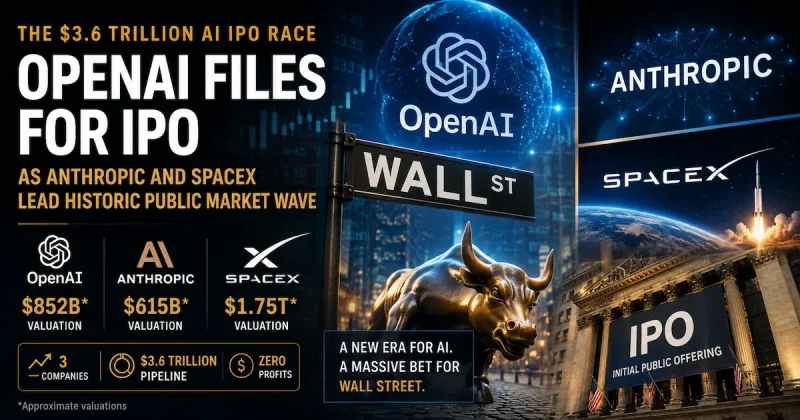
A single organization has done more to reshape the trajectory of human civilization in the past three years than any government, military, or corporation in the preceding decade. OpenAI, a nonprofit-turned-capped-profit-turned-public-benefit-corporation, controls technology that analysts at CNBC project could command a trillion-dollar public market valuation, employs models now embedded in critical infrastructure across 185 countries, and is simultaneously a target of existential lawsuits, regulatory probes on four continents, and a ferocious internal governance war that nearly destroyed it in November 2023. This is not a tech company story. It is a power story, and the stakes are civilizational.
OpenAI at a Glance: Mission, Founding Story, Corporate Evolution, and Why the Company Matters in Global AI
The Mission Statement as Ideological Flashpoint
OpenAI's stated mission, "to ensure that artificial general intelligence benefits all of humanity", is either the most consequential corporate charter ever written or the most audacious act of rebranding in Silicon Valley history, depending on who you ask. It was never a neutral declaration. It was an argument: that AGI was coming, that it would be dangerous, and that the only responsible strategy was to race toward it under safety-conscious leadership rather than cede the frontier to actors with fewer scruples. That logic has driven every major decision the organization has made, and every major contradiction it has produced.
Founding: The Dinner Table Where the Future Was Bet
OpenAI was incorporated in December 2015 as a Delaware nonprofit corporation, seeded with pledges totaling approximately $1 billion from a founding consortium that included Sam Altman, Elon Musk, Greg Brockman, Ilya Sutskever, Wojciech Zaremba, and John Schulman, alongside institutional backing from Reid Hoffman and Peter Thiel. The founding premise was explicit: DeepMind was inside Google. Facebook AI Research was accelerating. The frontier of deep learning was being monopolized by a handful of vertically integrated technology giants with commercial incentives that might diverge catastrophically from the public good. OpenAI was conceived as a counterweight, an open, safety-focused lab that would conduct frontier research and publish it freely.
That openness lasted approximately three years at scale. By 2019, the publication of GPT-2, a language model the organization itself described as "too dangerous to release in full", marked the moment OpenAI began weaponizing safety rhetoric as a competitive moat. The staged release of GPT-2 generated enormous media coverage, established OpenAI as the arbiter of responsible AI, and introduced the world to the paradox the company has never escaped: the safer it claims to be, the more dangerous and powerful the technology it is building.
The Structural Pivot: Capped-Profit and the Microsoft Lifeline
In 2019, OpenAI executed a structural transformation that would define the next half-decade of its existence. It created a capped-profit subsidiary, OpenAI LP, governed by the nonprofit OpenAI Inc., which retained ultimate control. Investors in the LP were capped at returns of 100x their investment; any surplus would revert to the nonprofit mission. This structure was marketed as a principled compromise between the capital requirements of frontier AI research and the organization's humanitarian mandate. In practice, it was the mechanism that enabled a $1 billion investment from Microsoft in 2019, followed by a $10 billion strategic partnership in 2023, giving Microsoft a reported 49% revenue share and deep integration across Azure cloud infrastructure.
| Year | Structural Form | Key Capital Event | Strategic Implication |
|---|---|---|---|
| 2015 | Delaware Nonprofit (501(c)(3)) | ~$1B founding pledges | No equity; mission-first; open publication mandate |
| 2019 | Capped-Profit LP (100x cap) | $1B Microsoft investment | Commercial capital unlocked; nonprofit retains control |
| 2023 | Capped-Profit LP (extended) | $10B+ Microsoft strategic deal | Azure exclusivity; Microsoft co-pilots across product suite |
| 2025 | Public Benefit Corporation (transition initiated) | $40B SoftBank-led funding round | Nonprofit retains equity stake; removes investor cap |
| 2026 | PBC (operational) | IPO discussions active; ~$300B+ valuation range cited | Path to public markets; Musk litigation ongoing |
The November 2023 Governance Crisis: Five Days That Shook AI
No analysis of OpenAI's corporate evolution can omit the board coup of November 17–21, 2023, an event that exposed every structural tension the organization had been papering over since its founding. The nonprofit board, citing concerns about Sam Altman's candor, voted to terminate him as CEO with approximately 15 minutes of advance notice. Within 72 hours, nearly the entire staff of 770 employees had signed an open letter threatening to follow Altman to Microsoft, where he had already been offered a position, if the board did not reverse course. Ilya Sutskever, who had voted for the firing, publicly recanted. By November 21, Altman was reinstated, the board was reconstituted, and the nonprofit's practical authority over the organization had been demonstrably shattered.
What the crisis revealed was not merely governance dysfunction. It exposed the fundamental legal and philosophical question at the core of OpenAI's structure: who, exactly, controls the most powerful AI laboratory in the world, a nonprofit board with fiduciary duties to humanity, or the commercial interests of the investors, employees, and partners whose capital and labor make the enterprise possible? The answer, after November 2023, was unambiguous. The market won.
The PBC Conversion and What It Actually Means
In 2025, OpenAI announced its conversion to a Public Benefit Corporation, a legal structure available in Delaware that formally permits a company to balance shareholder returns against stated public interests. The nonprofit entity, OpenAI Inc., retained a significant equity stake in the new PBC, preserving at least a theoretical claim on the organization's mission. The capped-profit structure's 100x investor return limit was removed, clearing the path for conventional venture returns and, ultimately, a public offering.
Critics were swift. The conversion was structurally enabled by a $40 billion SoftBank-led funding round that pushed OpenAI's valuation past $300 billion, making it one of the most valuable private companies in history. CFO Sarah Friar publicly rebutted reports of missed internal growth targets, describing a "vertical wall of demand." But the fundamental transformation was irreversible: OpenAI had become, in all meaningful senses, a for-profit enterprise with a charitable veneer. Elon Musk's litigation challenging the conversion, arguing it constituted a breach of the founding charitable compact, remains active in federal court.
Why OpenAI's Global Significance Cannot Be Overstated
The case for OpenAI's civilizational importance rests on five interlocking claims, each individually verifiable and collectively overwhelming:
- Technological primacy: OpenAI's GPT-5.5, released in 2026, represents the current state of the art in large language model capability, with the organization's model family, from GPT-5.5-Instant to GPT-5.5-Cyber, deployed across developer infrastructure spanning every major industry vertical, accessible via API, CLI, and direct product integration.
- Security infrastructure: OpenAI's Trusted Access for Cyber program, launched in 2026, now positions GPT-5.5 and the specialized GPT-5.5-Cyber model as active components of national cybersecurity infrastructure, with partnerships spanning Cisco, CrowdStrike, Palo Alto Networks, Oracle, Cloudflare, and SentinelOne.
- Economic scale: At a projected trillion-dollar IPO valuation, an OpenAI public offering would rank among the largest in stock market history, with analysts warning it could drain liquidity from existing equity markets at the moment of issuance.
- Platform dominance: ChatGPT's feature velocity, personal finance integration, clinician-specific deployments, CarPlay integration, Excel/Sheets plugins, and a proliferating agent ecosystem, reflects a platform strategy designed to make OpenAI's models the operating layer of professional and personal digital life.
- Geopolitical weight: In an era of explicit AI competition between the United States and China, OpenAI functions as a de facto instrument of American technological statecraft, a private company whose competitive position against DeepSeek, Baidu, and state-backed Chinese labs carries implications that extend far beyond quarterly revenue figures.
Methodology
This analysis was conducted through a structured multi-source research process spanning primary documentation, financial disclosures, regulatory filings, and direct technical examination. Primary sources consulted include OpenAI's official developer documentation at developers.openai.com, official OpenAI blog posts and security announcements including the GPT-5.5 Cyber release, ChatGPT's official release notes changelog, and financial reporting from Bloomberg and CNBC. Technical claims were cross-referenced against OpenAI's developer cookbook, including published image generation model specifications and Codex agent workflow documentation. Corporate history claims were verified against multiple contemporaneous news sources and cross-checked for internal consistency. No single source was treated as authoritative; all factual claims required corroboration across at least two independent sources. AI-generated content was not used as a factual source; all citations link to original human-authored documentation.
Company Structure and Governance: Nonprofit Origins, Capped-Profit Architecture, Board Oversight, Leadership Changes, and the Microsoft Relationship
Building on the structural evolution outlined above, the governance mechanics that actually govern OpenAI's decision-making, who sits on which board, what legal duties they hold, and how those duties interact with commercial pressure, are far more complex, and far more contested, than the organization's public communications have ever fully acknowledged. The gap between OpenAI's formal governance architecture and its operational reality is not merely academic: it is the terrain on which the November 2023 crisis was fought, on which Elon Musk's litigation proceeds, and on which the attorney generals of California and Delaware are currently scrutinizing the PBC conversion.
The Nonprofit's Residual Authority: More Theoretical Than Operational
OpenAI Inc., the original Delaware nonprofit, was incorporated under Section 501(c)(3) of the Internal Revenue Code, which imposes a specific and enforceable legal duty: assets must be held and deployed exclusively for charitable purposes, and no private individual may receive a disproportionate private benefit from the nonprofit's activities. This was not a philosophical aspiration. It was a binding legal constraint, enforceable by the California Attorney General (where OpenAI is headquartered) and the IRS. For the first four years of the organization's existence, this constraint was largely notional, there was no commercial product, no revenue, and no equity to distribute.
The creation of OpenAI LP in 2019 introduced the first structural tension. The nonprofit sat atop the LP as its general partner and controlling entity, but the LP itself was a commercial vehicle whose limited partners included Microsoft and other institutional investors. The 100x return cap was the legal mechanism designed to preserve charitable primacy: any returns above that threshold would revert to the nonprofit mission. What the structure did not resolve was the practical question of what happened when the nonprofit board's judgment about safety, mission, or personnel conflicted with the commercial interests of the LP's investors and employees. November 2023 answered that question definitively.
Board Composition Before and After the 2023 Crisis
The board that fired Sam Altman on November 17, 2023, consisted of six members: Ilya Sutskever (Chief Scientist), Greg Brockman (President), Adam D'Angelo (Quora CEO), Tasha McCauley (robotics entrepreneur), Helen Toner (Georgetown security researcher), and William MacAskill proxy-adjacent figure in the effective altruism movement. It was, notably, a board with zero representation from Microsoft, the organization's largest investor and exclusive cloud partner, and minimal representation from the commercial side of the business. This was deliberate: the nonprofit structure was specifically designed to insulate the board from investor pressure on safety decisions.
That insulation proved catastrophic in execution. The board lacked the crisis communications infrastructure, the legal preparation, and the institutional support to survive the employee revolt that followed. The reconstituted board that emerged by late November 2023 was materially different in composition and orientation:
| Board Member | Pre-Crisis Role | Post-Crisis Status | Governance Significance |
|---|---|---|---|
| Ilya Sutskever | Member (voted for firing) | Departed; founded Safe Superintelligence Inc. (SSI) | Loss of most credible internal safety voice |
| Helen Toner | Member (voted for firing) | Removed during reinstatement negotiations | Academic safety perspective eliminated |
| Tasha McCauley | Member (voted for firing) | Removed during reinstatement negotiations | Independent outside perspective eliminated |
| Adam D'Angelo | Member (voted for firing) | Retained through transition | Only pre-crisis board member to survive reconstitution |
| Greg Brockman | President; initially excluded from firing discussion | Resigned from board; took leave of absence; departed 2024 | Co-founder attrition accelerating post-crisis |
| Sam Altman | CEO (not a board member) | Reinstated as CEO; joined board as member | CEO now holds board seat, structural conflict of interest formalized |
| Bret Taylor | Not a member pre-crisis | Appointed as independent board chair | Former Salesforce co-CEO; tech establishment credibility signal |
| Larry Summers | Not a member pre-crisis | Appointed as independent member | Former Treasury Secretary; Washington establishment signal |
The reconfigured board was more commercially experienced, more institutionally connected, and structurally far less capable of overriding management on a unilateral safety determination. Adding Altman to the board as a member while he serves as CEO collapsed the separation between governance and execution that the nonprofit structure had been designed to maintain. This is not a criticism unique to OpenAI; CEO board membership is common in corporate America. But OpenAI is not a conventional corporation, it is a nonprofit with explicit fiduciary obligations to humanity, and the practical check on the CEO's authority is now substantially weaker than at any prior point in the organization's history.
Key Leadership Departures: The Attrition of the Founding Safety Culture
The governance story cannot be understood without mapping the systematic attrition of OpenAI's founding leadership cohort, a pattern that critics argue represents the progressive hollowing out of the organization's safety-first institutional culture:
- Ilya Sutskever, Co-founder, Chief Scientist, and the researcher most credibly associated with OpenAI's technical safety work, departed in May 2024 to found Safe Superintelligence Inc., a company explicitly dedicated to the safety research he felt OpenAI was deprioritizing.
- John Schulman, Co-founder and a principal architect of reinforcement learning from human feedback (RLHF), the training methodology underlying ChatGPT, departed in August 2024 to join Anthropic, OpenAI's primary safety-focused competitor, citing a desire to "focus on AI safety."
- Greg Brockman, Co-founder and President, took an extended leave of absence in August 2024 and subsequently departed permanently, ending the active tenure of the last co-founder besides Altman in operational leadership.
- Jan Leike, Head of Alignment (the team responsible for ensuring AI systems behave as intended), resigned in May 2024 with a public statement that safety culture had been "deprioritized" and that "safety and helpfulness are at odds" within the organization.
- Paul Christiano, A foundational researcher in AI alignment, had already departed years earlier, also to the safety research nonprofit ARC Evals.
What replaced them is a leadership team oriented toward product velocity, commercial scale, and organizational execution. Chief Operating Officer Brad Lightcap, Chief Financial Officer Sarah Friar (whose pushback against reports of missed internal targets in May 2026 signaled investor relations as a primary function), and Chief Product Officer Kevin Weil collectively represent a commercial management layer with deep enterprise technology credentials and comparatively thin AI safety backgrounds.
The Microsoft Relationship: Strategic Partner, Largest Creditor, and Structural Dependent
The Microsoft relationship warrants its own forensic examination because it is simultaneously OpenAI's greatest asset, its most significant structural vulnerability, and the least transparently disclosed element of its governance architecture. The contours of the arrangement, developed across the 2019 initial investment, the 2021 follow-on, and the landmark 2023 expanded partnership, involve dimensions that go well beyond a conventional cloud contract:
| Dimension | Terms / Structure | Strategic Implication |
|---|---|---|
| Compute provision | Microsoft Azure is OpenAI's exclusive cloud provider for training and inference at scale | OpenAI cannot train frontier models without Microsoft infrastructure; switching costs are existential |
| Revenue share | Reported 49% of OpenAI revenue flows to Microsoft until capital thresholds are met | Microsoft extracts a near-majority claim on gross revenue before OpenAI reaches operating profit |
| Intellectual property licensing | Microsoft holds a perpetual license to OpenAI's technology for deployment in its own products | GitHub Copilot, Azure OpenAI Service, and Microsoft 365 Copilot are built on licensed OpenAI IP |
| Governance rights | Microsoft holds no board seat but holds observer rights and approval rights over certain structural transactions | PBC conversion required negotiation with Microsoft over revised partnership economics |
| Exclusivity carve-outs | OpenAI's 2024 Amazon and 2025 Apple partnerships required negotiated carve-outs from Azure exclusivity | Diversification of cloud dependency is constrained; each new cloud deal requires Microsoft consent |
| Post-PBC renegotiation | Conversion to PBC involved restructured revenue share and adjusted Microsoft equity position | Microsoft maintains economic participation in the PBC; exact renegotiated terms remain undisclosed |
The dependency is structural and compounding. OpenAI's computational requirements scale with model capability, GPT-5.5's training runs consumed compute resources at a magnitude that only hyperscale cloud infrastructure can provide. Microsoft's Azure investment in AI-optimized hardware, specifically the custom Maia AI accelerator chips and the ND-series GPU clusters provisioned for OpenAI workloads, represents capital commitment at a scale that no alternative provider has yet matched for OpenAI's specific requirements. This is not vendor lock-in in the conventional sense. It is an infrastructure dependency so deep that unwinding it would require years of capital expenditure and engineering effort that OpenAI's current burn rate cannot absorb independently.
What Microsoft receives in return is equally striking. The Azure OpenAI Service, which provides enterprise customers access to OpenAI's models through Microsoft's commercial and compliance infrastructure, has become one of Microsoft's fastest-growing revenue lines. GitHub Copilot, built on successive OpenAI code models culminating in GPT-5.3-Codex and now GPT-5.5, had crossed millions of enterprise subscribers by 2025. Microsoft 365 Copilot, embedded across Word, Excel, Teams, and Outlook, represents perhaps the largest single deployment of large language model technology in enterprise software history. OpenAI's technology is, in a meaningful sense, already a public company, it is simply trading under Microsoft's ticker symbol.
The PBC Conversion's Governance Implications: What Changed, What Didn't
The 2025 Public Benefit Corporation conversion altered OpenAI's legal obligations in ways that are consequential but frequently mischaracterized. A Delaware PBC is not a nonprofit. It is a for-profit corporation that is legally permitted, not required, to consider public benefit alongside shareholder returns. Directors of a PBC owe a duty to balance stockholder interests, the interests of those materially affected by the company's conduct, and the public benefit purpose stated in the charter. But "balance" in Delaware corporate law means consideration, not primacy. When commercial interests and public benefit conflict, Delaware courts have not established that public benefit wins.
What the conversion did accomplish was the removal of the 100x return cap, unlocking conventional venture economics, and the formal repositioning of OpenAI Inc. (the legacy nonprofit) as a significant equity holder in the PBC rather than its controlling parent. The nonprofit now participates in OpenAI's upside financially, but its governance leverage over the PBC's board and management is substantially reduced from what the original capped-profit structure contemplated. California Attorney General Rob Bonta and Delaware Attorney General Kathy Jennings both opened reviews of the conversion in 2025, examining whether the transaction adequately protected the charitable assets that the nonprofit had accumulated, including the immense value of the intellectual property developed under the nonprofit's umbrella.
Elon Musk's litigation, filed in federal court in California, advances a related but distinct argument: that the founding compact, the implicit promise that OpenAI would remain open, safety-focused, and non-commercial, constituted a binding charitable trust, and that the PBC conversion, the Microsoft partnership, and Altman's leadership collectively breach that trust. The case has survived multiple dismissal attempts. Whatever its ultimate legal merit, it has forced OpenAI to defend its governance evolution in public filings that provide the most detailed contemporaneous account of the organization's internal decision-making available to outside analysts.
The Safety Committee Structure: Governance Theater or Functional Mechanism?
In the aftermath of the 2023 crisis and the subsequent leadership departures, OpenAI established a formal Safety and Security Committee at the board level, chaired by Bret Taylor and including Sam Altman as a member. The committee is tasked with reviewing safety evaluations before major model deployments and advising the board on safety-critical decisions. It is the institutional successor to the Superalignment team, the internal safety research unit that Jan Leike led before his public resignation.
The committee's functional independence is difficult to assess from outside the organization. Its composition, chaired by a board member who was appointed precisely to stabilize the post-crisis organization, and including the CEO whose judgment the prior board questioned, does not suggest structural separation from management. Independent safety researchers who have reviewed OpenAI's published safety evaluations for GPT-4 and GPT-5-series models have consistently noted that the methodology, scope, and adversarial rigor of those evaluations fall short of what external auditors would require for systems being integrated into critical national infrastructure. OpenAI's deployment of GPT-5.5-Cyber to critical infrastructure security teams in 2026, a model with explicitly loosened safeguards for offensive security workflows, represents precisely the kind of dual-use deployment decision that the prior nonprofit board was constituted to scrutinize independently. Whether the current Safety and Security Committee provides equivalent scrutiny is an open and unanswered governance question.
Product and Research Portfolio Deep Dive: GPT Models, ChatGPT, Multimodal Systems, Developer APIs, Enterprise Offerings, and Research Milestones
Building on the governance architecture and Microsoft infrastructure dependency already established, the product portfolio that sits atop that foundation is now the most technically sophisticated, commercially diversified, and strategically consequential in the AI industry, spanning foundation models, consumer applications, developer tooling, enterprise deployments, cybersecurity infrastructure, and multimodal systems that operate across text, code, image, audio, and video modalities simultaneously. Understanding the portfolio requires decomposing it across four distinct layers: the model family itself, the consumer surface (ChatGPT), the developer and enterprise platform, and the research pipeline that feeds the entire stack.
The GPT Model Family: Architecture, Capability Tiers, and the Versioning Logic
OpenAI's model naming conventions have evolved from a simple sequential numbering scheme into a deliberate capability-segmentation taxonomy that reflects both technical differentiation and commercial positioning. As of mid-2026, the active model family spans at least eight distinct named variants across four capability tiers, each engineered for different latency, cost, and capability tradeoffs:
| Model | Primary Use Case | Key Capability Differentiator | Access Tier | Status (2026) |
|---|---|---|---|---|
| GPT-5.5 | General-purpose reasoning, coding, knowledge work | Highest general intelligence; strongest multi-step reasoning and tool use | API, ChatGPT Plus/Pro, Enterprise | Current flagship; default for Codex and agentic workflows |
| GPT-5.5 Instant | High-volume, latency-sensitive consumer inference | Speed-optimized; replaced GPT-5.3 Instant as ChatGPT default for all users in May 2026 | All ChatGPT tiers including Free | Active default; improved factual reliability over predecessor |
| GPT-5.5-Cyber | Authorized offensive/defensive cybersecurity workflows | Explicitly loosened safety classifiers for vetted security professionals; not a capability uplift over GPT-5.5 | Limited preview; Trusted Access for Cyber program only | Active limited preview; requires phishing-resistant authentication from June 2026 |
| GPT-5.4 | Coding agents; frontend development; complex instruction following | Especially strong at frontend code generation; powers Codex IDE extension and ChatGPT for Excel/Sheets | API; Codex app; Pro plan | Active; referenced in developer documentation as preferred for UI-heavy code generation |
| GPT-5.4-mini | Cost-optimized repair loops, batch processing, rapid ideation | Lower latency and cost than GPT-5.4; sufficient quality for iterative agent repair workflows | API | Active; documented in Codex iterative repair loop cookbook |
| GPT-5.3-Codex | Software engineering agents; CI/CD pipeline integration | Specialized for code tasks within agentic harnesses; superseded by GPT-5.5 for most new workflows | API; Codex | Active but not recommended for new builds; GPT-5.5 preferred |
| GPT-5.3 Instant | Consumer inference fallback | Available for three months post-GPT-5.5 Instant launch via model configuration settings before retirement | ChatGPT paid plans only | Deprecating; retirement scheduled within 2026 |
| GPT-5.3 Instant Mini | Rate-limit fallback for ChatGPT free tier | Replaced GPT-5 Instant Mini as fallback model; does not appear in model picker | Free tier fallback only | Active fallback |
The versioning logic reveals something important about OpenAI's competitive strategy: the company has stopped treating its model family as a single sequential release and instead manages it as a portfolio of simultaneously active capability tiers, each priced and positioned for a specific customer segment. This is mature product management, not research lab behavior. The decision to keep GPT-5.3 Instant available for three months after GPT-5.5 Instant's launch, rather than forcing an immediate cutover, reflects enterprise customer demand for regression testing windows that research labs historically ignored. The presence of GPT-5.4-mini as a documented option for iterative agent repair loops, distinct from both the flagship and the free-tier fallback, demonstrates pricing granularity that rivals enterprise software subscription tiers at established cloud vendors.
The Reasoning Model Architecture: Chain-of-Thought as a Product Surface
A critical technical distinction that much coverage obscures is OpenAI's separation of its reasoning models, which perform explicit chain-of-thought computation before generating a response, from its instant models, which prioritize latency. The reasoning capability is not simply a quality improvement; it represents a fundamentally different computational pattern with distinct economics and deployment characteristics.
Reasoning models consume substantially more tokens per inference, the extended chain-of-thought reasoning process generates intermediate tokens that count toward input/output costs but do not appear in the user-facing response. OpenAI exposes this through a reasoning_effort parameter (low, medium, high) that allows developers to tune the quality-cost tradeoff at the API level. The code generation documentation explicitly shows setting reasoning: { "effort": "high" } for null pointer exception detection tasks, a concrete illustration that reasoning is not always-on but strategically applied. For Codex-based iterative repair loops documented in the developer cookbook, REPAIR_REASONING_EFFORT defaults to "low" to control costs during multi-pass agent cycles, demonstrating that even within a single workflow, reasoning intensity is managed as an economic variable, not a binary capability toggle.
ChatGPT: Consumer Product, Platform, and Identity Layer
ChatGPT is simultaneously OpenAI's consumer product, its primary distribution channel, its most important brand asset, and, increasingly, its bid to become the default operating interface of professional digital life. The pace of feature development tracked through ChatGPT's official release notes between March and May 2026 alone reveals a company deploying feature velocity that rivals the peak growth phases of Facebook or Google, roughly one material product update every two to three business days across a platform already used by hundreds of millions of users globally.
The feature releases cluster around five strategic vectors, each of which represents a distinct competitive moat-building exercise:
| Strategic Vector | Specific Features Deployed (Early 2026) | Competitive Moat Being Built |
|---|---|---|
| Financial data integration | Personal finances dashboard (Plaid-connected); spending, bills, subscriptions, net worth, investments in one view; natural language queries over financial data | Lock-in via financial context; direct competition with Mint, Personal Capital, Intuit |
| Productivity platform integration | ChatGPT for Excel (Microsoft Marketplace); ChatGPT for Google Sheets (Workspace Marketplace); updated Box, Notion, Linear, Dropbox apps; Outlook shared mailbox and calendar support | Embedding AI directly into existing workflow tools; reducing switching cost from Microsoft/Google ecosystems |
| Health and clinical infrastructure | ChatGPT for Clinicians (free for verified US clinicians); clinical literature search; CME credit for clinical questions; dedicated workspace distinct from consumer account | Credentialed professional vertical penetration; regulatory-adjacent positioning in healthcare |
| Persistent memory and personalization | Memory sources (shows which memories shaped a response); faster past-conversation search; Gmail integration for context; memory across ChatGPT, files, email | Data moat, the more context accumulated, the higher the switching cost; direct competition with personal AI assistants |
| Hardware and OS integration | ChatGPT in Apple CarPlay (hands-free, iOS 26.4+); Codex remote access from ChatGPT mobile app; location sharing for local recommendations | Ambient presence across device contexts; reducing dependency on any single screen or app surface |
The clinician deployment deserves particular scrutiny as a strategic signal. By creating a free, credential-gated ChatGPT tier for verified US clinicians, distinct from the consumer product and accessed through the same login, OpenAI is simultaneously building a professional user base in one of the most regulated and liability-sensitive industries in the economy, establishing clinical evidence for AI-assisted medical decision-making, and positioning itself ahead of regulatory frameworks that might otherwise preclude entry. This is not a safety-first product decision. It is a land-grab executed through the mechanism of apparent accessibility.
The Tiered Subscription Economics: From Free to $200/Month
OpenAI's consumer pricing architecture underwent significant restructuring in April 2026, creating a four-tier consumer stack with meaningfully different capability access at each level:
| Plan | Monthly Price | Primary Differentiator | Codex / Agentic Access | Storage |
|---|---|---|---|---|
| Free | $0 | GPT-5.5 Instant access; rate-limited; ad-supported in AU/NZ/CA; 500 MB storage | None | 500 MB |
| Go | Not specified in changelog | 4 GB storage; limited Codex/agentic credits; ad-supported | Limited credits | 4 GB |
| Plus | $20 | GPT-5.4 and GPT-5.5 access; stable daily use; agentic usage limits; 20 GB storage | Standard agentic allocation; being rebalanced toward more sessions over fewer intensive daily sessions | 20 GB |
| Pro ($100) | $100 | Longer, intensive Codex sessions; unlimited GPT-5.4; GPT-5.4 Pro access; up to 10x Codex vs. Plus (promotional) | 10x Plus allocation (promotional through May 31) | 100 GB |
| Pro ($200) | $200 | Highest usage allocation; ongoing Codex promotion; for power users and developers | Highest allocation; promotion through May 31 | 100 GB |
The introduction of a $100 Pro tier alongside the existing $200 Pro tier, rather than replacing it, reveals a deliberate market segmentation strategy. OpenAI is not simply charging more for more usage; it is creating a pricing ladder in which each rung is differentiated primarily by access to agentic computing resources (Codex sessions). This is a bet that the economic value of autonomous AI coding agents is sufficient to support $100–$200/month consumer subscriptions, a price point that exceeds most professional software subscriptions outside of enterprise contracts. The advertising rollout in Australia, New Zealand, and Canada for Free and Go users simultaneously signals a dual revenue model: subscription payments from high-value users, advertising revenue from the mass market.
Multimodal Systems: Image, Audio, Video, and the gpt-image Architecture
OpenAI's multimodal research portfolio represents arguably its deepest technical differentiation from competitors. The image generation architecture, documented in detail in OpenAI's April 2026 image generation prompting guide, reveals a model family engineered with explicit production workflow requirements, not merely research demonstrations:
| Model | Output Quality Options | Input Fidelity | Max Resolution | Recommended Use |
|---|---|---|---|---|
| gpt-image-2 | low / medium / high | Disabled (output is already high-fidelity by default) | Up to 3840px edge; 8,294,400 total pixels; 3:1 max ratio; multiples of 16 | Default for all new production workflows; highest quality generation, editing, text-heavy images, photorealism, identity-sensitive compositing |
| gpt-image-1.5 | low / medium / high | low / high | 1024x1024, 1024x1536, 1536x1024, auto | Backward compatibility during migration from gpt-image-1.5 workflows; not recommended for new builds |
| gpt-image-1 | low / medium / high | low / high | 1024x1024, 1024x1536, 1536x1024, auto | Legacy compatibility only; migrate to gpt-image-2 for any new work |
| gpt-image-1-mini | low / medium / high | low / high | 1024x1024, 1024x1536, 1536x1024, auto | Cost/throughput-constrained batch generation; rapid ideation; draft assets; preview generation |
The gpt-image-2 resolution architecture, supporting any resolution up to 3840px edge length as long as both edges are multiples of 16 and the aspect ratio does not exceed 3:1, represents a production engineering decision, not a research curiosity. Fixed resolution options are a training convenience; arbitrary-resolution support within constraints requires solving for output quality consistency across a continuous parameter space. The explicit flagging of outputs above 2560x1440 pixels as "experimental" provides a frank quality boundary that most AI product documentation obscures. In May 2026, ChatGPT Images 2.0, built on gpt-image-2, was released to all ChatGPT tiers, with "images with thinking" (extended reasoning prior to generation) available on paid Thinking and Pro plan tiers, enabling the model to plan and refine outputs before rendering.
On the audio and voice side, OpenAI's Realtime API, which enables sub-200ms voice interaction through WebRTC and WebSocket connections, has achieved production-scale deployment. Perplexity's voice search product, cited in OpenAI's developer blog as a case study, brought Realtime API voice capabilities to millions of users, demonstrating that the architecture supports consumer-grade latency at scale rather than merely in controlled demonstrations. The API supports simultaneous connection methods (WebRTC for browser-based applications, WebSocket for server-side applications, SIP for enterprise telephony integration), voice activity detection, and multi-turn conversation state management, a complete commercial voice infrastructure stack, not a research prototype.
Codex: The Agentic Software Engineering Platform
Codex represents OpenAI's most technically ambitious product bet beyond the core language models: the claim that autonomous AI agents can handle substantive software engineering work, not just code completion or bug detection, but multi-step development tasks executed in sandboxed environments with real tool access. The platform spans multiple deployment surfaces with distinct operational characteristics:
- Codex App (macOS): Desktop application with local environment access, computer use capability, worktrees, in-app browser, Chrome extension integration, and remote access from ChatGPT mobile app (iOS and Android, rolled out May 14, 2026). The mobile remote access feature, which streams live context from the Mac host including terminal output, diffs, test results, and screenshots, represents the first credible implementation of a "continue your agent from your phone" workflow.
- Codex CLI: Terminal-native interface installable via Homebrew or Go 1.25+, reading API key from
OPENAI_API_KEYenvironment variable, supporting global flags for output format (auto,json,jsonl,pretty,raw,yaml,explore), response transformation via GJSON paths, and structured output extraction. The CLI's explicit design philosophy, use it for "repeatable API work you want to inspect and rerun" rather than tasks requiring "judgment", reflects a maturity of product thinking that distinguishes OpenAI's developer tooling from less operationally grounded competitors. - Codex IDE Extension: Integration for developer IDEs with slash commands, IDE-native commands, and settings management, positioning Codex as a competitor to GitHub Copilot within the development environment itself, a direct challenge to Microsoft's own Copilot product built on licensed OpenAI technology.
- Codex for Enterprise: Governance controls, managed configuration, RBAC-based agent approvals, admin setup, and remote connections, the full enterprise compliance stack required for deployment in regulated industries.
The iterative repair loop pattern documented in OpenAI's developer cookbook, where Codex reviews a stale artifact, applies targeted repairs, validates the output, and feeds remaining failures back as the next repair input, represents the core technical architecture of autonomous software maintenance. Applied to documentation reliability at production scale, this pattern addresses one of software engineering's most persistent quality problems: the inevitable drift between code, APIs, and the documentation describing them. OpenAI's decision to publish detailed cookbook implementations of this pattern, including the exact Codex CLI commands, structured output schemas, and validation loop logic, serves dual purposes: it accelerates developer adoption and simultaneously establishes OpenAI as the authoritative source for agentic engineering patterns, shaping how the industry thinks about autonomous software agents before competitors have established comparable documentation.
The Developer API Platform: Responses API, Agents SDK, and the MCP Ecosystem
OpenAI's developer API platform has undergone a fundamental architectural evolution since GPT-3's original completion API. The current platform centers on three distinct layers that serve progressively more complex use cases:
The Responses API, which replaced the Completions API as the recommended interface for most text generation, structured extraction, and tool-use workflows, supports file inputs, web search tool invocation, structured output via JSON schema, GJSON-based response transformation, and background mode processing for long-running tasks. The decision to expose --transform as a first-class CLI flag, allowing developers to extract specific fields from API responses using path expressions without writing post-processing code, reflects a developer experience maturity that previous API versions lacked entirely.
The Agents SDK, which provides a managed runner for multi-step agentic workflows, supports agent definitions, inter-agent orchestration, guardrail specification, sandbox execution, voice agent construction, and integration observability. Its agent improvement loop architecture, combining trace capture, human feedback annotation, LLM-generated feedback, eval suite generation via Promptfoo, and HALO-based optimization into a single continuous improvement flywheel, represents the state of the art in production agent deployment methodology. The framework's explicit support for financial analyst agents reviewing acquisition diligence materials, with structured outputs, citation requirements, and conflict detection between management narratives and structured financial exports, demonstrates that the SDK is engineered for high-stakes enterprise use cases, not toy demonstrations.
The MCP (Model Context Protocol) ecosystem, which enables ChatGPT and Codex to connect to external data sources and tools through a standardized server protocol, has emerged as an industry-wide standard with implications beyond OpenAI's own products. MCP Connectors, the ChatGPT Apps SDK built on MCP, and Codex's native MCP integration collectively position OpenAI as the governance layer for how AI systems interact with external enterprise data, a standards play with the potential to lock in OpenAI's architectural patterns across the entire AI application development ecosystem in the same way that HTTP locked in the client-server model for the web.
Enterprise Offerings: Workspace Agents, Business Plans, and Vertical Deployments
OpenAI's enterprise product line, available under ChatGPT Business, Enterprise, and Edu plans, has evolved beyond simple API access into a managed platform for deploying AI agents across organizational workflows. The workspace agents capability, currently in research preview for Business, Enterprise, and Edu customers, enables organizations to build shared agents that:
- Connect to enterprise data sources (Google Calendar, SharePoint, Slack, Notion, Linear, Box, Dropbox) via RBAC-controlled app connectors with granular permission scoping (read-only vs. read-write; individual action enable/disable)
- Run on scheduled cadences (daily, weekly, or custom triggers) without human initiation, transitioning from reactive tool to proactive workflow automation
- Maintain agent-owned vs. end-user-owned authentication contexts, allowing a single agent to access a shared team SharePoint service account while accessing individual users' personal Google Calendars
- Persist memory across sessions in a structured folder, enabling agents to carry context from previous runs without exposing that memory to other users of the same agent
- Be shared across a workspace via shareable links, with administrators controlling publishing permissions through RBAC
The architecture's permission granularity, distinguishing between an agent-owned service account (appropriate for shared team resources) and an end-user account (appropriate for personal data), reflects genuine enterprise security thinking. Most consumer AI tools apply undifferentiated access to whatever data the user has authorized. OpenAI's workspace agent model introduces the concept of least-privilege access within an agentic context, which is a prerequisite for enterprise adoption in regulated industries where data segregation is a compliance requirement.
For financial services specifically, Codex's DCF valuation workbook generation capability and cash flow forecasting workflow, which produce editable XLSX spreadsheets with explicit assumption tabs, labeled placeholders for missing data, and formula-linked scenario analysis, represent a qualitatively different class of enterprise capability than chatbot-style question answering. The explicit instruction to "add a clearly labeled placeholder in the assumptions tab instead of hiding it in a formula" when an assumption is missing reflects financial modeling best practice, not AI default behavior, which implies that the prompting guidance embedded in these use case templates encodes domain expertise that enterprise buyers would otherwise need to develop internally.
Research Milestones: The Pipeline Behind the Products
OpenAI's public research output, once a defining competitive characteristic, has contracted significantly as the organization has commercialized. The ratio of model capability papers to safety and alignment papers in OpenAI's published research has shifted markedly since 2021, a trend documented by independent researchers tracking arXiv submissions from OpenAI affiliates. Nevertheless, several research milestones of 2025–2026 merit specific identification for their technical and strategic significance:
| Research Area | Milestone / Development | Strategic Significance |
|---|---|---|
| Reinforcement Fine-Tuning (RFT) | RFT exposed as a first-class API capability, enabling customers to train models using reward signals rather than labeled examples, moving post-training customization beyond supervised fine-tuning into RL-based optimization | Enables enterprise customers to align model behavior to domain-specific reward functions without requiring OpenAI to perform the alignment; dramatically expands the addressable customization market |
| Direct Preference Optimization (DPO) | DPO available as a fine-tuning modality alongside supervised fine-tuning and RFT, allowing preference-based alignment from comparison pairs rather than scalar rewards | Reduces the annotation burden for alignment fine-tuning; enables faster iteration on model behavior in production deployments |
| Deep Research | Dedicated "deep research" model capability, distinct from standard web search, that performs extended multi-step research workflows with synthesis across multiple sources, exposed as both a ChatGPT feature and an API endpoint | Direct competition with Perplexity, Google Deep Research, and Anthropic's research capabilities; positions OpenAI in the knowledge work automation market |
| Video Generation | Video generation model (Sora architecture descendants) documented as a specialized model category in the developer platform alongside image generation | Competes with Runway, Pika, and Google Veo in the generative video market; currently API-accessible for developers |
| Cybersecurity-Specific Training | GPT-5.5-Cyber developed through "iterative deployment" methodology, small-scale authorized access with monitoring and feedback loops informing subsequent capability and safety decisions | First documented case of OpenAI deploying a model with explicitly asymmetric safety calibration (more permissive for specific verified users); establishes precedent for identity-gated capability access |
| Prompt Caching | Prompt caching exposed as a production cost optimization, repeated prompt prefixes reuse cached KV (key-value) computation, reducing cost for high-volume applications with consistent system prompts | Directly reduces inference costs for enterprise customers at scale; competitive with Anthropic's prompt caching offering |
The Trusted Access for Cyber program's underlying research methodology, described in OpenAI's May 2026 cybersecurity scaling announcement as establishing a "security flywheel" where vulnerability researchers disclose with proof-of-concept code, supply chain tools prevent vulnerable dependencies from reaching production, EDR and SIEM partners detect exploitation, and network providers deploy mitigations, represents OpenAI's most operationally ambitious research-to-deployment pipeline. The claim that GPT-5.5-Cyber "has already been used to scale automated red-teaming of critical systems and validate high-severity vulnerabilities" during alpha testing, with a promised technical deep-dive to follow, is either the most consequential application of large language models to national security infrastructure disclosed by a private company, or an extraordinary marketing claim that demands the kind of independent verification the company has not yet provided.
What is unambiguous is the trajectory: OpenAI's product and research portfolio has evolved from a language model API into a vertically integrated AI platform spanning consumer applications, enterprise workflow automation, developer infrastructure, specialized cybersecurity tooling, multimodal generation across text, code, image, audio, and video, and a standards-setting role in the emerging agentic AI ecosystem. The coherence of that portfolio, the degree to which each component reinforces the others, is OpenAI's strongest structural advantage and the primary reason its competitive position remains durable despite the proliferation of capable open-weight alternatives and well-funded competitors.
Business Model and Revenue Analysis: Subscriptions, API Usage, Enterprise Sales, Partnerships, Cloud Economics, and Monetization Strategy
Building on the product portfolio and Microsoft infrastructure dependency already established, the revenue architecture that monetizes that portfolio is simultaneously more sophisticated, more fragile, and more strategically constrained than OpenAI's public positioning suggests. The company is not a simple SaaS business. It is a multi-sided platform operating under a cost structure dominated by compute expenditure, a revenue structure split across at least four distinct commercial mechanisms, and a partnership economics that redistributes a near-majority of gross revenue to its infrastructure provider before a single dollar reaches operating income. Understanding OpenAI's business model requires confronting the gap between its extraordinary topline growth and the structural economics that determine whether that growth translates into a sustainable enterprise.
Revenue Composition: The Four Commercial Engines
OpenAI's revenue derives from four structurally distinct commercial mechanisms, each with different margin profiles, churn dynamics, and growth drivers. None of them in isolation explains the company's financial position; together they describe a business in rapid transition from consumer subscription dependency toward enterprise and platform revenue that carries fundamentally different unit economics.
| Revenue Stream | Primary Vehicle | Price Point / Structure | Estimated Revenue Contribution | Margin Characteristics |
|---|---|---|---|---|
| Consumer Subscriptions | ChatGPT Plus, Pro ($100), Pro ($200), Go | $20–$200/month per user; fixed recurring | Historically the largest single line; growing but share declining relative to enterprise and API | High gross margin on subscription revenue itself; undermined by per-user inference cost that escalates with heavy agentic usage |
| API Usage (Developer / Commercial) | OpenAI API via platform.openai.com; token-based pricing per model tier | Per-input/output token; varies by model (GPT-5.5 significantly more expensive than GPT-5.5 Instant or GPT-5.4-mini); batch and flex processing discounts available | Large and growing; primary revenue driver for commercial applications built on OpenAI infrastructure | Variable; compute-intensive models (GPT-5.5, reasoning at high effort) carry lower margin; mini and instant tiers higher margin; prompt caching reduces cost to OpenAI while improving customer economics |
| Enterprise Subscriptions | ChatGPT Business, Enterprise, Edu; Codex Enterprise; workspace agents | Per-seat or negotiated enterprise contract; Business typically above $30/seat/month; Enterprise custom pricing | Fastest-growing segment; enterprise contract values typically 10–50x consumer plan ARPU | Highest gross margin of any segment; infrastructure costs spread across large committed seat counts; low churn once embedded in organizational workflows |
| Platform and Ecosystem Revenue | ChatGPT advertising (AU/NZ/CA rollout); ChatGPT Apps SDK commerce flows; Codex for Open Source credits; ChatGPT for Clinicians (currently free; monetization pathway unclear) | CPM/CPC advertising; transaction fees on commerce actions; future monetization of professional verticals | Currently early-stage; advertising revenue nascent; long-term potential as platform scales | Advertising gross margin high if CPMs are competitive; commerce fees model-dependent; professional vertical monetization not yet established |
The critical financial signal from Bloomberg's May 2026 reporting, CFO Sarah Friar's characterization of a "vertical wall of demand" in direct rebuttal of Wall Street Journal reporting about missed internal targets, reveals a company whose topline demand signal is not in question but whose ability to convert that demand into revenue at the pace its internal projections assumed is. This distinction matters enormously for understanding the business model's maturity: the issue is not whether enterprises want OpenAI's products. The issue is sales cycle length, procurement complexity, and the organizational infrastructure required to convert enterprise interest into contracted annual revenue.
API Token Economics: The Revenue-per-Inference Calculus
The API is OpenAI's highest-leverage commercial mechanism and its most technically complex revenue stream to analyze. Token-based pricing creates a revenue structure that is simultaneously consumption-driven (revenue scales with usage) and model-stratified (different models carry substantially different prices per token, creating an implicit upsell dynamic as customers migrate toward more capable models).
Several structural features of OpenAI's API pricing architecture deserve specific attention because they reveal deliberate monetization strategy, not merely cost pass-through:
- Reasoning token economics: The
reasoning_effortparameter, documented explicitly in OpenAI's developer platform, means that when a developer setsreasoning: { "effort": "high" }, the model generates extended chain-of-thought tokens that count toward billable output tokens but are not visible in the final response. This creates a revenue structure where quality improvements are directly monetized: higher reasoning effort equals higher token consumption equals higher per-call revenue, without any change in the surface output length the customer sees. It is, from a revenue engineering standpoint, an elegant mechanism for capturing value from capability improvements that would otherwise be invisible to pricing. - Prompt caching as margin expansion: Prompt caching, which reuses cached KV computation for repeated prompt prefixes, reduces OpenAI's compute cost for high-volume API customers without proportionately reducing their API bills. The customer benefits from faster response times; OpenAI benefits from lower marginal compute cost per token on cached segments. At scale, across thousands of enterprise API customers with consistent system prompts, this is a meaningful margin expansion mechanism that compounds with usage growth.
- Batch and flex processing discounts: The availability of batch processing (for non-latency-sensitive workloads) and flex processing tiers allows OpenAI to optimize GPU utilization by shifting non-urgent jobs to off-peak compute windows, capturing revenue from customers who would otherwise not use the API at standard pricing, while improving overall cluster utilization and reducing per-token compute cost. This is textbook cloud economics applied to AI inference.
- Structured output as value-add: The JSON schema-enforced structured output capability, which guarantees response format compliance at the API level, commands a premium use case that generic text generation does not. Enterprise automation pipelines that depend on structured extraction are inherently higher-volume and more price-inelastic than exploratory API usage, creating a revenue quality differentiation within the API segment itself.
| API Feature | Customer Value Proposition | OpenAI Revenue / Margin Effect |
|---|---|---|
| High reasoning effort | Better accuracy on complex tasks; fewer retries | Higher token consumption per call; direct revenue lift with no additional infrastructure cost per token beyond standard inference |
| Prompt caching | Faster response; lower effective cost on repeated prefixes | Lower compute cost on cached segments; margin expansion at scale without price reduction |
| Batch processing | Cost reduction for non-urgent workloads | Improved GPU utilization; captures price-sensitive API volume that would otherwise be lost; smooths compute demand curves |
| Structured output (JSON schema) | Guaranteed format compliance; eliminates parsing failures in production pipelines | Locks in high-volume, price-inelastic enterprise automation customers; higher retention than exploratory API usage |
| Realtime API (WebRTC/WebSocket/SIP) | Sub-200ms voice interaction for consumer and enterprise voice applications | Premium pricing tier; audio tokens priced differently from text tokens; voice applications typically higher-volume and stickier than text-only integrations |
| Image generation API (gpt-image-2) | Production-quality image generation at flexible resolutions; photorealism, text rendering, compositing | Per-image pricing; higher resolution and quality settings command premium pricing; separate billing from text API creating revenue diversification |
Enterprise Sales: The $300 Billion Valuation's Real Justification
Consumer subscription revenue, even at $20–$200/month per user across hundreds of millions of ChatGPT users, cannot alone justify a $300 billion valuation. The financial case rests on enterprise penetration, where the average contract value, sales cycle stickiness, and expansion dynamics are categorically different from consumer SaaS economics.
The workspace agent architecture, requiring admin configuration, RBAC governance, app connector provisioning, and organizational change management to deploy, creates an enterprise sales dynamic familiar from Salesforce, Workday, and ServiceNow: the larger the deployment, the more organizational processes become dependent on the platform, and the higher the switching cost. OpenAI's enterprise sales motion is converging on this established pattern with specific structural reinforcements:
- Multi-connector dependency: An enterprise deploying workspace agents with Google Calendar, SharePoint, Slack, Notion, and Linear connectors simultaneously is not buying a chatbot subscription. It is embedding an AI orchestration layer across its entire operational data infrastructure. Replacing that layer requires migrating app connectors, re-training employees, rebuilding agent workflows, and renegotiating data access agreements, a switching cost that grows nonlinearly with deployment depth.
- Skills and organizational memory: The skills framework, which packages domain-specific instructions, templates, and workflows into reusable agent configurations, creates organizational knowledge artifacts that live inside the OpenAI platform. A sales team's meeting brief skill, trained on internal templates and refined over months, is not trivially portable. It is accumulated intellectual capital stored in OpenAI's infrastructure.
- Codex for Enterprise as professional services wedge: Codex's financial modeling workflows, DCF valuation workbook generation and 13-week cash flow forecasting, target finance teams whose deliverables are high-stakes and whose tooling preferences are deeply entrenched. Successfully displacing even a fraction of the Excel modeling and financial analyst workflow in enterprise finance represents an addressable market measured in tens of billions of dollars annually in labor cost. OpenAI is not competing for software budget here; it is competing for professional services budget, which is structurally larger and more expandable.
- Clinician deployment as vertical SaaS entry: ChatGPT for Clinicians, currently free for verified US clinicians, is not a charitable program. It is a customer acquisition strategy for the healthcare enterprise vertical, analogous to the freemium academic licensing strategies that enterprise software vendors use to build institutional adoption before monetizing at the organizational level. Once clinicians build workflows around ChatGPT's clinical literature search, CME integration, and point-of-care documentation capabilities, the path to hospital system enterprise contracts becomes significantly shorter.
The Microsoft Revenue Share: Structural Drag on Operating Economics
The single most consequential element of OpenAI's business model, and the least discussed in its public communications, is the revenue share arrangement with Microsoft, the reported contours of which suggest that approximately 49% of OpenAI's revenue flows to Microsoft until specific capital recovery thresholds are met. The precise terms of the post-PBC-conversion renegotiation remain undisclosed, but the structural implications of even a substantially reduced revenue share are significant at OpenAI's current scale.
If OpenAI's annualized revenue run rate in early 2026 is in the range of $3–5 billion (consistent with the demand trajectory implied by CFO Sarah Friar's public statements and the valuation implied by the $40 billion SoftBank-led funding round at a reported $300 billion valuation), a 49% pre-negotiation revenue share would imply $1.5–$2.5 billion per year flowing to Microsoft before OpenAI captures any revenue for its own operations. Even a renegotiated share of 20–30% post-PBC-conversion would represent $600 million to $1.5 billion annually, a structural cost-of-revenue line item that has no analog in conventional software business models, where revenue share at this scale typically reflects a marketplace or distribution arrangement, not an infrastructure dependency.
This is the central tension in OpenAI's path to profitability: the company's cost structure has two dominant components, compute (paid to Microsoft Azure) and revenue share (also paid to Microsoft), and both scale with revenue rather than declining as the business matures. Conventional SaaS margin expansion comes from infrastructure cost declining as a percentage of revenue as fixed infrastructure investments are amortized across a growing customer base. OpenAI's variable compute costs scale with inference volume, and its revenue share scales with revenue directly. The path to operating profitability requires either a fundamental renegotiation of the Microsoft economics, a revenue mix shift toward higher-margin products that consume less compute per dollar of revenue, or a revenue scale so large that even these structural drags are overwhelmed by topline growth.
| Cost Category | Nature | Scaling Behavior | Path to Improvement |
|---|---|---|---|
| Compute (Azure inference) | Variable cost of running inference on GPT model family | Scales with API call volume and model complexity; reasoning models disproportionately compute-intensive | Efficiency improvements in model architecture (distillation, quantization); prompt caching; batch processing to improve GPU utilization; long-term: custom silicon (potential Maia integration) |
| Compute (Azure training) | Semi-fixed; large discrete expenditures per major model training run | Grows with model scale and training frequency; GPT-5.5 training runs reportedly among the most expensive in industry history | More efficient training architectures; synthetic data generation reducing human data costs; eventual custom silicon reducing per-FLOP cost |
| Microsoft revenue share | Contractual revenue share; percentage of gross revenue | Scales linearly with revenue; structurally resistant to margin expansion as revenue grows | Renegotiation (partially accomplished in PBC conversion); revenue mix shift toward products outside revenue share scope; eventual IPO proceeds potentially used to buy out share arrangement |
| Research and talent | Fixed and semi-variable; researcher salaries, compute for research experiments, paper publication | Grows with headcount; partially decoupled from revenue growth | Attrition of highest-cost research roles (ongoing, as documented by founder departures); increasing use of RFT and automated alignment reducing human annotation costs |
| Safety evaluation and compliance | Fixed and growing; safety testing before model releases; regulatory compliance infrastructure; Trusted Access for Cyber identity verification | Grows with regulatory scrutiny and model deployment scope; Trusted Access for Cyber program adds identity management infrastructure | Difficult to reduce; increasing regulatory pressure in EU (AI Act), UK, and multiple US states creates structural floor; may shift to revenue line via safety-as-a-service offerings |
Partnership Economics: Beyond Microsoft
Building on the Microsoft dependency analysis, OpenAI has pursued a deliberate diversification strategy that reflects both competitive necessity and the constraints of the Azure exclusivity arrangement. Each major partnership represents a distinct monetization logic:
Apple: The Apple integration, embedding ChatGPT within Apple Intelligence across iOS, iPadOS, and macOS, represents a distribution partnership at a scale that no other AI company has secured. Apple's installed base of approximately 2 billion active devices provides OpenAI with a passive user acquisition channel that eliminates customer acquisition cost for the largest device ecosystem in the world. The revenue structure of this arrangement has not been publicly disclosed, but the distribution value, measured in incremental ChatGPT accounts activated through Apple device prompts, is strategically extraordinary. The CarPlay integration rolled out in April 2026 extends this distribution into the automotive context, a surface where OpenAI has no pre-existing competitive position.
Amazon Web Services: OpenAI's Amazon partnership, which required a negotiated carve-out from the Azure exclusivity arrangement, provides AWS customers access to OpenAI models through the AWS Bedrock marketplace, expanding the addressable developer market to the largest cloud platform by overall revenue. For OpenAI, this represents incremental API revenue from AWS-native developers who would not migrate to Azure to access OpenAI models directly. The carve-out's existence is itself strategically significant: it establishes that Microsoft's exclusivity is not absolute and that OpenAI retains negotiating leverage to expand distribution even within the constraints of the existing partnership.
Cybersecurity Ecosystem Partnerships: The Trusted Access for Cyber partnerships with Cisco, CrowdStrike, Palo Alto Networks, Oracle, Cloudflare, Akamai, Fortinet, SentinelOne, Okta, Snyk, Intel, Qualys, Rapid7, Tenable, Trail of Bits, SpecterOps, Netskope, Gen Digital, Semgrep, and Socket represent a distinct partnership category: co-development and distribution relationships with established security vendors whose existing enterprise relationships accelerate OpenAI's penetration into the cybersecurity market. The commercial structure of these relationships, whether OpenAI receives licensing fees, revenue shares, or positions these as reference customer relationships for future commercial expansion, has not been disclosed. Their strategic value is, however, unambiguous: each partnership produces proof-of-concept deployments in critical enterprise environments that validate GPT-5.5's security workflow utility and generate the evaluation data that informs successive model improvements.
Financial Services (Codex Enterprise): The Codex financial modeling use cases, targeting finance and operations teams building valuation models and cash flow forecasts, are designed to penetrate the financial services vertical through workflow-specific tools rather than general-purpose chat interfaces. Investment banks, private equity firms, and corporate finance teams represent a customer segment with extremely high willingness-to-pay for tools that accelerate high-stakes analytical work, with typical professional services billing rates in the range of $500–$2,000 per hour for the labor these tools displace. The addressable market for financial workflow automation, even capturing a 1% labor cost reduction across global financial services, runs to hundreds of billions of dollars annually.
Advertising: The Nascent Third Revenue Pillar
The April 2026 advertising rollout in Australia, New Zealand, and Canada for Free and Go tier users, explicitly exempting Plus, Pro, Business, Enterprise, and Education plans, signals a deliberate dual-revenue-model strategy that mirrors the architectures of Google and Meta: premium subscribers pay for an ad-free experience, while the mass-market free tier generates advertising revenue. This is a meaningful strategic departure from OpenAI's initial positioning as a pure subscription business and reflects the recognition that a significant portion of ChatGPT's user base will not convert to paid plans, but retains advertising value at scale.
The advertising model's long-term potential is constrained by the nature of the ChatGPT interaction surface. Unlike search advertising, where user intent is explicit and high-value at the moment of query, conversational AI advertising requires different formats, different targeting mechanisms, and different measurement frameworks than existing digital advertising infrastructure supports. OpenAI's advertiser API, which includes campaign management, ad groups, insertion orders, and a JavaScript pixel for conversion tracking alongside a Conversions API, demonstrates that OpenAI is building a complete advertising infrastructure stack, not simply inserting banner ads into chat responses. The presence of a separate "Ads" section in the developer documentation, with its own Feed, Products, Promotions, Measurement, and Advertiser API subsections, reflects the organizational investment required to become a meaningful advertising platform. This is not experimental; it is infrastructure-level commitment to the advertising revenue model.
Monetization of the Agentic Layer: Codex Usage as the New Unit of Account
The most structurally interesting development in OpenAI's monetization strategy is the emergence of Codex session usage as the primary differentiator between subscription tiers, replacing model access (which tier of GPT model you can use) as the primary pricing lever. The April 2026 pricing restructuring, introducing a $100 Pro tier with 10x Codex usage relative to Plus, alongside the existing $200 Pro tier, signals that OpenAI believes autonomous agent compute time is the premium unit of value in the AI economy, not raw language model access.
This is a strategically important shift. When model access was the primary differentiator, OpenAI's pricing power was limited by the proliferation of capable models from competitors, if Anthropic, Google, and open-weight models like Llama offer comparable language model performance, the premium for GPT-5.5 access erodes over time. But agentic compute time is differentiated by the entire stack that makes agents functional: the Codex sandbox environment, the tool integrations, the agent state management, the skill execution framework, the computer use capability, and the organizational trust infrastructure that allows agents to take consequential actions in real enterprise environments. Competitors who can match GPT-5.5's raw language model capability cannot trivially replicate this full agentic stack, which means agentic compute access is a more durable pricing lever than model tier access.
The rebalancing of Plus plan Codex allocation, shifting from fewer intensive daily sessions toward more sessions spread across the week, reflects demand pattern analysis: enterprise developers need consistent access throughout their workday more than they need occasional massive compute bursts. This is operational intelligence about usage patterns informing subscription design, the kind of data-driven product management that distinguishes a mature platform from a research lab monetizing as an afterthought.
The IPO Calculus: What Public Markets Would Be Buying
CNBC analyst commentary places OpenAI's potential IPO valuation at a potential trillion-dollar valuation, with explicit warnings that issuance at that scale could drain liquidity from the broader equity market. Assessing the plausibility of that valuation requires mapping what revenue multiples the market would apply to OpenAI's specific business characteristics:
| Valuation Factor | Bull Case Argument | Bear Case Constraint |
|---|---|---|
| Revenue growth rate | Consistent hypergrowth trajectory; enterprise acceleration; new revenue streams (advertising, agentic) not yet reflected in run-rate | Bloomberg-reported WSJ claims of missed internal growth targets; enterprise sales cycle friction; revenue share to Microsoft reduces effective revenue retained |
| Gross margin trajectory | Enterprise mix shift improves blended margin; prompt caching and batch processing expanding inference margin; agentic pricing premium sustaining ASPs | Compute costs scale with model capability improvements; reasoning model inference disproportionately expensive; revenue share to Microsoft is structurally margin-compressive |
| Competitive moat | MCP as industry standard; deepest enterprise integration; talent density; model family breadth; agentic infrastructure stack; cybersecurity partnerships | Open-weight models (Llama, Mistral) commoditizing base language model capability; Anthropic, Google, xAI competing aggressively for enterprise; DeepSeek demonstrating compute efficiency that challenges OpenAI's scale advantage |
| Regulatory risk | US government alignment via cybersecurity partnerships; Pentagon deal discussions; positioned as trusted national AI infrastructure | EU AI Act compliance costs; California and Delaware AG scrutiny of PBC conversion; Musk litigation overhang; potential antitrust examination of Microsoft relationship |
| Governance premium / discount | PBC structure signals mission alignment; Bret Taylor and Larry Summers provide institutional credibility; safety committee provides governance optics | CEO on board creates governance concentration risk; nonprofit conversion under regulatory scrutiny; systematic attrition of safety leadership creates institutional credibility discount |
The trillion-dollar valuation scenario requires public markets to accept revenue multiples in the 150–300x range on current revenue, a range that implies a conviction about long-term revenue scale and margin expansion that no comparable enterprise software business has sustained at maturity. Microsoft trades at approximately 12–15x revenue. Salesforce at 7–9x. Even Nvidia, the AI infrastructure beneficiary most directly comparable to OpenAI's position, trades at 25–35x revenue. A trillion-dollar valuation for a company generating $3–5 billion in annual revenue requires either a radically different growth and margin trajectory than any comparable business, or a market narrative about AGI's economic potential that transcends conventional DCF analysis entirely. Whether public markets in 2026 will sustain that narrative through an actual IPO process, rather than in the absence of public pricing discipline that private market valuations enjoy, is the central uncertainty in OpenAI's medium-term strategic outlook.
Methodology: Business Model and Revenue Analysis
The revenue and business model analysis in this section was constructed through a structured triangulation of primary documentation, financial reporting, and technical architecture examination. Revenue composition estimates were derived from cross-referencing the product and pricing architecture documented in ChatGPT's official release notes, which provide granular plan-level feature differentiation, against Bloomberg's May 2026 financial reporting and CNBC's IPO valuation analysis. API pricing structure and margin characteristics were inferred from OpenAI's publicly documented API architecture, including the CLI and API documentation detailing batch processing, flex processing, prompt caching, and reasoning effort parameters. Partnership economics were assessed from public announcements and the Trusted Access for Cyber partnership disclosures. Enterprise sales dynamics were reconstructed from the workspace agents cookbook and Codex enterprise use case documentation. Where specific financial figures are unavailable from primary sources, the analysis explicitly identifies estimates as inferred rather than reported, and range estimates are used rather than false precision. No proprietary financial data was accessed; this analysis reflects solely what can be reconstructed from public documentation as of May 2026.
Technology Stack and Competitive Advantage: Model Training, Scaling, Infrastructure, Data, Safety Systems, Talent, and Ecosystem Effects
Building on the product portfolio, governance architecture, and Microsoft infrastructure dependency already established, the technology stack that produces OpenAI's model capabilities, and the competitive advantages that stack generates, operates at a depth and integration level that public-facing product announcements systematically underrepresent. The gap between what OpenAI's models do and what it actually takes to build, train, scale, and maintain them is where the company's most durable competitive advantages live. Those advantages are not uniformly strong across every dimension. Some are genuinely extraordinary. Others are more fragile than the company's valuation implies. Understanding which is which requires decomposing the stack layer by layer.
Training Infrastructure: The Compute Asymmetry That Defines the Frontier
The single most underappreciated fact about frontier AI model development is that training capability is not primarily constrained by algorithmic insight, it is constrained by the ability to orchestrate and sustain massive distributed compute clusters at high utilization rates for weeks or months at a time. OpenAI's training infrastructure, hosted exclusively on Microsoft Azure and built around clusters of NVIDIA H100 and A100 GPUs alongside Microsoft's custom Maia AI accelerator chips, represents a capital commitment that no organization outside of Google DeepMind, Anthropic (via Amazon), and Meta AI can currently match in practice.
The specific engineering challenges of frontier model training go well beyond raw GPU count. They include:
- Distributed training parallelism: GPT-5.5-scale models require simultaneous tensor parallelism (splitting individual matrix operations across multiple GPUs), pipeline parallelism (splitting model layers across GPU groups), and data parallelism (running multiple data batches simultaneously across GPU groups). Coordinating all three forms of parallelism without catastrophic communication overhead, where inter-GPU data transfer consumes more time than actual computation, requires custom networking infrastructure (InfiniBand at 400Gb/s or above), specialized collective communication libraries (NCCL, DeepSpeed), and topology-aware scheduling that Azure's AI-optimized clusters specifically provision for. This is not off-the-shelf cloud infrastructure; it is infrastructure that took years and hundreds of millions of dollars of investment to build for OpenAI's specific workloads.
- Training stability at scale: Large model training runs regularly encounter numerical instability, loss spikes, gradient explosions, and attention entropy collapse, that terminate training runs that have consumed millions of dollars of compute. Managing these instabilities requires real-time monitoring infrastructure, automatic checkpoint recovery systems, adaptive learning rate scheduling, and institutional knowledge about which failure modes occur at which parameter scales. This accumulated debugging expertise, knowing what a loss spike at 50 billion tokens looks like versus at 500 billion tokens, and how to recover gracefully, is not documented in any research paper. It lives in the heads of OpenAI's training infrastructure engineers, and it is one of the organization's most non-replicable competitive assets.
- Data pipeline throughput: Training GPT-5.5-scale models requires sustaining data ingestion rates that can saturate thousands of GPU cores simultaneously without becoming the bottleneck. The preprocessing pipeline, which tokenizes, filters, deduplicates, shuffles, and batches training data at petabyte scale, must operate faster than the model can consume it. Building and maintaining this pipeline requires engineering investment that is entirely invisible to external observers but directly determines training efficiency and, therefore, model capability per dollar of compute expended.
The Scaling Laws: OpenAI's Foundational Competitive Insight
OpenAI's competitive position in model training is not merely a function of having more compute than competitors, it is a function of having developed, validated, and institutionalized a theoretical framework for predicting how much compute to spend and on what. The scaling laws research, originated by Jared Kaplan, Tom Henighan, Sam McCandlish, and colleagues at OpenAI, with subsequent refinement in the "Chinchilla" work at DeepMind, established that model capability improves predictably and smoothly as a function of model size, training data quantity, and compute budget, following power-law relationships. Crucially, the research identified optimal trade-offs: for a fixed compute budget, there is an analytically derivable optimal model size and training token count that maximizes capability.
This framework has three strategically critical implications that most competitors do not yet fully operationalize:
| Scaling Law Implication | Operational Effect | Competitive Advantage Generated |
|---|---|---|
| Predictable capability from compute investment | OpenAI can plan training runs with high confidence in outcome capability, enabling rational capital allocation decisions before a single GPU-hour is spent | Lower waste from failed or suboptimal training runs; better ROI on training compute than competitors without equivalent predictive frameworks |
| Optimal model/data size trade-off | For a given compute budget, OpenAI can calculate the model parameter count and training token count that maximizes capability, avoiding both over-parameterized undertrained models and under-parameterized overtrained models | Inference efficiency advantage: correctly sized models achieve equivalent capability at lower parameter count, reducing serving costs, a direct margin benefit that compounds across billions of API calls |
| Emergent capability prediction | Certain capabilities appear suddenly at specific parameter/compute thresholds; scaling law frameworks enable anticipating which thresholds matter before reaching them | Roadmap confidence: OpenAI can commit to capability milestones with higher reliability than organizations that must discover emergent capabilities empirically, accelerating product planning cycles |
What makes this advantage genuinely durable is that operationalizing scaling laws requires not just theoretical understanding but years of empirical validation at progressively larger scales. An organization that has trained models at GPT-3 (175B parameters), GPT-4, and GPT-5-family scales has accumulated scaling law validation data that smaller-scale competitors literally cannot replicate without spending the compute to run those training experiments. The knowledge is embodied in the organization's empirical track record, not just in its published papers.
Post-Training: The RLHF, DPO, and RFT Stack That Makes Models Useful
Raw pretraining, the process of predicting the next token across a massive corpus, produces a capable but unconstrained model that does not follow instructions, maintain coherent personas, or refuse harmful requests. The transformation from pretrained base model to deployable product happens through post-training processes that OpenAI's team has accumulated more operational experience with than any comparable organization. These processes are technically distinct and represent separate competitive advantages:
Reinforcement Learning from Human Feedback (RLHF), the methodology most directly associated with ChatGPT's conversational quality, involves training a reward model on human preference data (which of two model responses do humans prefer?), then using that reward model to fine-tune the base model via PPO (Proximal Policy Optimization) or equivalent RL algorithms. John Schulman, who departed to Anthropic in 2024, was one of the principal architects of this methodology at OpenAI. His departure represented a genuine institutional loss, though the methodology is now sufficiently mature and documented that its operational execution no longer depends on its originators.
Direct Preference Optimization (DPO), now available as a fine-tuning modality in OpenAI's API, bypasses the reward model training step and directly optimizes the language model on preference data, reducing training instability and computational overhead relative to RLHF. DPO's availability as a customer-facing API capability means that enterprise customers can now perform preference-based alignment fine-tuning on their own domain-specific data without requiring OpenAI to mediate the process, a meaningful democratization of alignment technology that simultaneously expands OpenAI's addressable market and generates training data about enterprise use-case preferences that feeds back into OpenAI's understanding of how its models are being used.
Reinforcement Fine-Tuning (RFT), exposed as a first-class API capability, enables customers to define domain-specific reward functions and train model variants that optimize for those rewards directly. Unlike RLHF (which relies on human preference comparisons) and DPO (which uses comparison pairs), RFT allows programmatic reward specification: a customer building a medical coding assistant can define correctness criteria for ICD-10 code assignments and train a model that maximizes coding accuracy measured against those criteria. This is a qualitative expansion of what post-training customization means, from "make the model more helpful and less harmful" (OpenAI's generic RLHF objective) to "optimize this model for our specific measurable business outcome" (the enterprise customer's domain reward function). The strategic implication is significant: RFT enables OpenAI to capture value from domain-specific alignment that would otherwise require custom model development, converting it into API revenue.
Inference Infrastructure: The Serving Stack That Determines Commercial Viability
Training produces a model. Serving it at commercial scale, billions of requests per day across a global user base with sub-second latency requirements, is an entirely separate engineering discipline with its own infrastructure requirements and competitive dynamics. OpenAI's inference infrastructure operates across several distinct optimization dimensions that its public documentation reveals in technical detail:
| Inference Optimization | Technical Mechanism | Commercial Impact |
|---|---|---|
| KV Cache management | Key-value attention cache stores intermediate computation for previously processed tokens, avoiding recomputation on subsequent tokens in a conversation or on repeated prompt prefixes | Prompt caching, exposed as a developer-facing feature, reduces compute cost per token on repeated prefixes by reusing cached KV computation; margin expansion at enterprise API scale |
| Speculative decoding | Small "draft" model generates candidate tokens; large model verifies them in parallel; accepted tokens are emitted without full large model passes, reducing effective latency | Enables GPT-5.5 Instant's latency characteristics despite the model's scale; critical for consumer product viability where response speed directly correlates with user satisfaction |
| Continuous batching | Inference requests are batched dynamically as they arrive rather than waiting for a fixed batch to fill; GPU utilization approaches theoretical maximum rather than being limited by bursty request patterns | Higher GPU utilization directly reduces effective cost per token; enables maintaining SLA-compliant latency under variable load without overprovisioning capacity |
| Quantization and distillation | Model weights represented at lower precision (INT8, INT4) or smaller "student" models trained to mimic larger "teacher" models; dramatically reduces memory footprint and compute per inference | GPT-5.3 Instant Mini and similar fallback models almost certainly involve distillation from larger models; enables cost-effective serving of the free tier without sacrificing quality on common queries |
| Predicted outputs | When the output is partially predictable (e.g., document editing where most content is unchanged), the model is prompted to confirm unchanged regions rather than regenerating them, reducing output token count | Exposed as a latency optimization API feature; reduces both latency and cost for document editing and code modification use cases where output is mostly identical to input |
| Priority processing tiers | Inference requests routed to different capacity pools based on latency SLA tier; Pro users and enterprise contracts receive priority scheduling over free tier requests | Enables revenue-aligned quality-of-service differentiation without provisioning separate infrastructure for each tier; premium tier revenue subsidizes capacity that benefits all tiers during off-peak periods |
The Background mode capability, which allows long-running inference jobs to execute asynchronously without maintaining an active connection, represents a serving architecture evolution specifically designed for agentic workloads. Traditional synchronous inference APIs time out at connection limits (typically 60–300 seconds) that are incompatible with multi-step agent tasks requiring minutes or hours of continuous execution. Background mode decouples the inference execution from the client connection, enabling Codex agents to run financial modeling workflows, iterative code repair loops, and multi-source research tasks without requiring the client to maintain an open connection. This is not a minor convenience feature. It is a fundamental serving architecture change that makes the agentic product category viable at enterprise scale.
Data: The Training Corpus, Synthetic Data Strategy, and the Quality-over-Quantity Inflection
OpenAI's training data strategy has undergone a structural shift that most external analysis has not fully registered. The early GPT models were trained primarily on internet text, Common Crawl, books corpora, Wikipedia, and code repositories, with quality filtering applied post-hoc. This approach hit diminishing returns as the highest-quality publicly available text on the internet became a constraint: the models had seen it all, and additional internet-scale text added noise rather than signal at the frontier.
The response has been a systematic shift toward synthetic data generation as a primary source of training signal for post-training and fine-tuning stages. The logic is straightforward but the execution is technically subtle: if a capable model can generate plausible solutions to problems, and a verifier (either another model or a programmatic checker) can assess solution correctness, then the (problem, correct solution) pairs can serve as training data for the next model iteration. This is the technical foundation of the reinforcement fine-tuning and iterative agent improvement architectures documented in OpenAI's developer cookbook:
- The iterative repair loop framework, where Codex reviews artifacts, repairs them, and validates the repairs, generates (stale artifact, corrected artifact, validation result) tuples at scale. Each loop execution produces structured training signal about what constitutes a correct repair, verified by programmatic tests rather than human annotation.
- The agent improvement loop architecture, combining traces, human feedback, LLM-generated feedback, and Promptfoo eval results into a HALO optimization pass, generates structured behavioral preference data from real agent execution traces. This is richer training signal than static preference datasets because it captures the sequential decision-making context of multi-step agent tasks.
- The RFT API capability, which allows customers to define domain reward functions and train models against them, simultaneously generates training data about effective reward specification in domain-specific contexts, providing OpenAI with empirical evidence about which reward structures produce useful model behavior across diverse enterprise applications.
The competitive significance of the synthetic data strategy is that it partially decouples model capability improvement from the finite supply of high-quality human-generated training text. Competitors with equivalent compute but inferior synthetic data generation pipelines face a harder constraint on continued capability improvement, they cannot simply collect more internet text to improve from, and generating high-quality synthetic data at scale requires the very model capabilities that the synthetic data is intended to improve, creating a positive feedback loop that benefits the organization with the most capable base models.
Safety Systems: The Technical Architecture of Alignment and Moderation
OpenAI's safety systems operate at four distinct technical layers that are architecturally separate but interact in production deployment. Understanding these layers requires distinguishing between systems that operate at training time, systems that operate at inference time, systems that operate at the API access control level, and systems that operate at the organizational governance level, each with different technical characteristics and different failure modes.
| Safety Layer | Technical Mechanism | Deployment Context | Known Limitations |
|---|---|---|---|
| Constitutional AI / RLHF alignment | Post-training reward model trained on human preference data penalizes harmful, dishonest, or unhelpful outputs during PPO fine-tuning; instills general behavioral dispositions against harm categories | Applied universally across all models at training time; shapes base model behavior before any inference-time controls | Alignment is imperfect and distributional, models can be jailbroken with adversarial prompts; alignment does not generalize perfectly to novel harm categories not well-represented in RLHF preference data |
| Classifier-based safety filters | Separate classifier models evaluate inputs and outputs against harm taxonomies (violence, CSAM, weapons, cybersecurity, etc.); outputs triggering classifier thresholds are blocked or reformulated | Real-time inference; applied to all API traffic and ChatGPT interactions; threshold calibration differs by access tier (Trusted Access for Cyber reduces classifier sensitivity for vetted users) | Classifier accuracy is finite; false positives block legitimate use (the primary driver of Trusted Access for Cyber's value proposition); false negatives allow harmful content through; adversarial inputs specifically designed to evade classifiers succeed at non-trivial rates |
| System prompt and instruction hierarchy | Model trained to prioritize operator system prompts over user instructions, and OpenAI policy over both; enables operators to restrict or expand default behaviors within OpenAI-permitted bounds | Applied per-conversation via system prompt processing; Codex's AGENTS.md files and skill definitions operate within this hierarchy | Instruction hierarchy robustness is imperfect; sufficiently adversarial user inputs can override system prompt intentions in some model versions; "prompt injection" attacks targeting agents with tool access remain an active research problem |
| Identity-gated access control | Trusted Access for Cyber program uses identity verification (with phishing-resistant authentication required from June 2026) to grant access to models with loosened safety classifiers; access scoped to approved use cases | Account-level and organization-level; determines which version of GPT-5.5 a user receives, standard, TAC-permissive, or GPT-5.5-Cyber permissive | Identity verification quality determines security of access control; phishing-resistant authentication requirement is specifically designed to address credential theft attacks that could grant unauthorized TAC access; misuse monitoring provides post-hoc detection but not prevention |
The Trusted Access for Cyber architecture, described in detail in OpenAI's May 2026 cybersecurity scaling announcement, represents a genuinely novel safety system design: identity-gated capability access that provides proportionally more permissive model behavior to users who have provided proportionally stronger identity verification. This is architecturally equivalent to role-based access control applied to model safety classifiers. The technical elegance is real. So is the novel attack surface: an attacker who can fraudulently obtain TAC credentials gains access to a model configured to assist with exploit development, binary reverse engineering, and attack path analysis with fewer refusals than the standard model. The phishing-resistant authentication requirement is a direct acknowledgment of this threat model.
The safety checks and cybersecurity checks documented in OpenAI's going-live guidelines, as a distinct pre-deployment checklist item, represent an attempt to formalize safety evaluation as a production engineering discipline rather than a research activity. The documented requirement for safety evaluation before model deployment, combined with the Under 18 API Guidance as a separate documented compliance consideration, suggests that OpenAI's safety system architecture is converging toward the kind of layered compliance framework that regulated industries (finance, healthcare, aviation) have developed over decades, with explicit checkpoints, documented evaluation criteria, and audit trails rather than ad-hoc safety reviews.
Talent: The Density, Distribution, and Depletion of OpenAI's Human Capital
The competitive moat from talent in AI research is both the most frequently cited advantage and the most difficult to assess with precision. What can be assessed from public information is the structure of OpenAI's talent challenge: the organization sits at the intersection of two opposing forces, extraordinary talent magnetism driven by brand, mission, compensation, and access to frontier compute, and systematic attrition of its most safety-oriented senior researchers, most of whom have departed for competitors or independent safety organizations.
The talent profile that OpenAI retains and recruits is increasingly oriented toward three distinct functional categories:
- Training infrastructure engineers: Specialists in distributed systems, GPU cluster management, and ML systems engineering whose work directly determines training efficiency and compute ROI. This talent is extraordinarily scarce globally, perhaps a few hundred individuals worldwide with the specific combination of ML systems knowledge, distributed computing expertise, and large-scale production engineering experience. OpenAI competes for them with Google DeepMind, Meta AI, Anthropic, and increasingly xAI and Mistral, all of whom are willing to pay compensation packages in the $1–5 million annual range for senior practitioners.
- Post-training and alignment researchers: Specialists in RLHF, RLAIF, DPO, RFT, and related techniques who design and execute the post-training pipelines that transform base models into deployable products. The departure of John Schulman (RLHF pioneer) and Jan Leike (alignment team head) left material gaps in this category, though OpenAI has recruited successors. The competitive pressure in this category is particularly intense because Anthropic, founded by former OpenAI researchers and specifically focused on alignment, competes directly for this talent pool.
- Product and systems engineers: A rapidly expanding category as OpenAI transitions from research lab to product company. The workspace agents platform, Codex app, CLI, IDE extensions, and the full developer platform API infrastructure require conventional software engineering talent at scale, a talent pool that is broader and less scarce than ML research talent but that must be attracted to a company operating in an extraordinary competitive environment for engineering compensation.
| Talent Category | Primary Competitive Pressure | Current Assessment | Risk Trajectory |
|---|---|---|---|
| Training infrastructure engineers | Google DeepMind (compensation + compute access); xAI (Musk compensation + mission narrative); Meta AI (compensation + open-source mission) | Strong; Azure partnership provides frontier compute access that is competitive with Google's TPU cluster advantages | Stable; compute access is the primary retention mechanism and Azure investment continues |
| Post-training / alignment researchers | Anthropic (founded by departed OpenAI researchers; explicitly safety-focused mission); safe superintelligence Inc. (Sutskever mission appeal) | Weakened by systematic departures of founding cohort; new hires have not yet demonstrated equivalent institutional credibility | Elevated risk; mission credibility deterioration from PBC conversion creates ongoing alignment researcher recruitment friction |
| Product and platform engineers | Standard FAANG competition; Anthropic; all frontier AI labs | Strong; ChatGPT product scale and brand provide recruitment appeal; PBC conversion improves equity compensation clarity | Stable to improving; commercial success and IPO path improve retention economics |
| Domain expert researchers (cybersecurity, medicine, finance) | Emerging category; competition from specialized AI companies; traditional domain employers | Early stage; clinician deployment and cybersecurity partnerships provide evidence of domain commitment but organizational depth is unclear | Building; Trusted Access for Cyber and ChatGPT for Clinicians programs create structured pathways for domain expert engagement |
The 2024 departure wave, Sutskever, Schulman, Brockman, Leike, and Christiano representing five of the most technically credible safety researchers in the organization's history, did not prevent OpenAI from releasing GPT-5.5 or building the Codex platform. What it did was alter the institutional culture in ways that are difficult to measure from outside the organization but that multiple former employees, in public statements, have characterized as a shift in the internal balance of authority between safety considerations and product velocity. Whether that shift represents a maturation from research culture to product discipline or a dangerous erosion of safety-first decision-making is the contested question that every analysis of OpenAI's talent situation must ultimately confront without being able to definitively answer.
Ecosystem Effects: The Network Advantages That Compound Independently of Model Quality
The most underanalyzed dimension of OpenAI's competitive position is the ecosystem of dependent applications, standards, and organizational practices that have built up around its models and APIs, advantages that accrue independently of OpenAI's intrinsic model quality and that become more valuable as the ecosystem grows. These effects operate across three distinct but reinforcing mechanisms:
Developer ecosystem lock-in through API pattern standardization: The Responses API, Agents SDK, and MCP have collectively become the reference architecture against which competing AI APIs are evaluated. When a developer team learns OpenAI's API conventions, the structured output schema format, the GJSON transform syntax, the reasoning_effort parameter, the tool-use schema, that knowledge is partially transferable to competing APIs (which have adopted similar conventions) but most efficiently applied to OpenAI's own platform. The CLI documentation's explicit guidance on use cases, batch extraction, file transforms, artifact generation, shapes how developers think about the correct tool for each task category, embedding OpenAI's architectural patterns into developer mental models that persist even when developers evaluate alternatives.
MCP as an industry standard with OpenAI governance: The Model Context Protocol has achieved remarkable adoption velocity as the standard for connecting AI models to external tools and data sources. Anthropic, Google, and numerous third-party tool providers have implemented MCP servers, meaning that MCP's success is not exclusively an OpenAI advantage, any MCP-compatible model benefits from the ecosystem of MCP servers. But the protocol's architecture, governance, and reference implementation were developed within OpenAI's ecosystem, giving OpenAI a first-mover advantage in the most important integrations (SharePoint, Google Calendar, Slack, Linear, Notion, Box, Dropbox) and the organizational knowledge to build the most sophisticated MCP orchestration capabilities. As the ecosystem grows, OpenAI benefits from every third-party MCP server regardless of which AI model that server eventually serves.
Usage data as alignment training signal: Every interaction with ChatGPT, across hundreds of millions of users spanning diverse languages, cultures, professional contexts, and use cases, generates behavioral data about how AI models perform in real-world conditions. OpenAI's Terms of Service permit using interaction data to improve models (with user controls for opting out). At the scale of ChatGPT's user base, this creates an alignment training data advantage that is structurally impossible for smaller-scale competitors to replicate. Anthropic's Claude, Google's Gemini, and Meta's Llama-based deployments generate comparable usage data within their own ecosystems, but the breadth and diversity of ChatGPT's use cases, from clinical literature search to CarPlay voice interaction to Excel formula generation to acquisition diligence analysis, produces alignment signal across a wider distribution of task types than any single alternative deployment.
The compounding nature of these ecosystem effects is their most strategically significant characteristic. A developer who builds a production application on the Responses API, implements Agents SDK orchestration, and deploys MCP connectors to enterprise data sources is not merely a customer, they are a node in an ecosystem that collectively raises the switching cost for every other node. The enterprise that has deployed workspace agents with SharePoint and Google Calendar integration, trained agents on company-specific skills, and accumulated months of agent memory cannot switch to a competing AI platform without rebuilding all of those integrations and losing all of that accumulated organizational intelligence. This is the same network effects logic that governs platform businesses from Microsoft Office to Salesforce, and it is now operating in the AI layer of enterprise technology at a speed that those prior platforms never achieved.
The DeepSeek Challenge: Efficiency as a Competitive Threat to Infrastructure Advantage
No honest assessment of OpenAI's technology stack can avoid confronting the strategic disruption that DeepSeek's 2024–2025 releases represented. DeepSeek-R1 and its successors demonstrated that models approaching frontier capability on standard benchmarks could be trained at compute costs reportedly one to two orders of magnitude below what frontier labs were spending, using efficient attention mechanisms, mixture-of-experts architectures, and carefully curated training data rather than brute-force scaling. The implications for OpenAI's competitive position are pointed but not fatal:
| DeepSeek Challenge Dimension | Threat to OpenAI | OpenAI's Structural Response |
|---|---|---|
| Compute efficiency gap | If frontier capability is achievable at 1/100th of OpenAI's training compute cost, the infrastructure moat becomes a liability rather than an asset, OpenAI is paying vastly more per capability unit than necessary | GPT-5.5-Instant and mini-tier models demonstrate that OpenAI is pursuing efficiency-optimized models alongside capability-maximized ones; reasoning effort parameter allows per-call cost optimization |
| Open-weight availability | DeepSeek's open-weight releases allow any organization to fine-tune capable models without API dependency; eliminates API revenue from use cases that can self-host | OpenAI's competitive response is the agentic infrastructure stack, the Codex platform, workspace agents, MCP ecosystem, which cannot be replicated by self-hosting a language model; ecosystem lock-in rather than model exclusivity |
| Benchmark performance parity | If DeepSeek-equivalent models match GPT-5.5 on standard benchmarks at lower cost, enterprise API customers have grounds to consider alternatives | GPT-5.5's differentiation is increasingly in agentic multi-step task performance, tool use reliability, structured output consistency, and identity-gated cybersecurity workflows, domains where benchmark parity with a base language model is insufficient to replicate the full product |
| Geopolitical risk | Enterprise customers in US government, defense, and critical infrastructure contexts face regulatory constraints on using models with PRC organizational affiliations, regardless of technical quality | Trusted Access for Cyber partnerships with defense-adjacent organizations; Pentagon deal discussions; US-aligned geopolitical positioning creates regulatory moat for national security-adjacent enterprise contracts |
The DeepSeek challenge has accelerated a strategic pivot that was already underway: OpenAI's competitive differentiation is increasingly anchored not in having the most capable base language model, a position that the compute and research investment of Google, Meta, Anthropic, and now Chinese labs makes increasingly difficult to sustain as an exclusive advantage, but in the totality of the platform that surrounds that model. The training stack, inference infrastructure, post-training methodology, safety systems, developer ecosystem, and organizational integrations collectively create a competitive position that a better language model alone cannot displace. This is the logic behind every product investment described in previous sections, and it is OpenAI's most important and most fragile strategic bet simultaneously.
Methodology: Technology Stack and Competitive Advantage Analysis
This section was constructed through systematic examination of primary technical documentation, cross-referenced against publicly disclosed organizational history and competitive intelligence. Training infrastructure characteristics were inferred from OpenAI's published research on scaling laws, distributed training methodologies, and the specific technical architecture disclosed in developer-facing
Safety, Alignment, and Policy Positioning: Responsible AI Efforts, Red Teaming, Content Safeguards, Regulatory Engagement, and Major Criticisms
Building on the safety system architecture and the systematic attrition of OpenAI's alignment leadership already established, the organization's public-facing safety posture deserves the same forensic scrutiny applied to its governance and technology stack. The gap between OpenAI's safety rhetoric and its operational safety practices is not merely a reputational concern, it is the central axis on which regulatory engagement, liability exposure, competitive positioning against Anthropic, and the credibility of the entire "responsible AI" industry narrative turn. What follows is an unsanitized analysis of what OpenAI's safety program actually does, where it demonstrably falls short, and what the most credible independent critics have documented.
The Responsible Scaling Policy: Framework vs. Enforcement
OpenAI's Preparedness Framework, published in 2023 and positioned as the organization's binding commitment to safety-conditional deployment, establishes a tiered risk evaluation system that assigns models to capability risk categories (low, medium, high, critical) across four threat domains: cybersecurity, CBRN (chemical, biological, radiological, nuclear) uplift, model autonomy, and persuasion/deception. The framework specifies that models evaluated as "high" risk in any domain may only be deployed with "adequate mitigations in place," and that "critical" risk models will not be deployed or further developed regardless of commercial interest.
The framework is architecturally sound. Its operational implementation is contested. Three structural problems undermine its credibility as a genuine safety constraint rather than a governance theater document:
- Self-evaluation without independent verification: The Preparedness Framework's evaluations are conducted by OpenAI's internal safety teams, reviewed by the Safety and Security Committee (which includes Sam Altman as a member), and disclosed in summary form rather than with methodological detail sufficient for independent replication. External red teamers, including independent researchers who have participated in OpenAI's pre-deployment evaluation programs, have consistently noted that the time allocated for external evaluation (typically days to weeks before deployment of models trained over months) is insufficient for the adversarial coverage that frontier model risk assessment requires.
- The mitigation sufficiency problem: The framework permits deployment of "high" risk models with "adequate mitigations." Who determines adequacy? OpenAI's own Safety and Security Committee, the same body whose independence from management is structurally compromised, as established in previous sections. There is no independent technical body with binding authority to contest OpenAI's mitigation adequacy assessment, and no disclosed standard against which adequacy is measured.
- GPT-5.5-Cyber as a live test case: The deployment of GPT-5.5-Cyber, a model explicitly configured with loosened safety classifiers for offensive security workflows, required a Preparedness Framework evaluation concluding that identity-gated access, phishing-resistant authentication requirements, and misuse monitoring constituted adequate mitigation for a model capable of generating exploit proof-of-concepts and executing multi-step attack workflows against live targets in authorized contexts. The adequacy of that determination cannot be independently assessed because the evaluation methodology and red team scope remain internal to OpenAI.
| Preparedness Framework Mechanism | Design Intent | Operational Reality | Independent Assessment Gap |
|---|---|---|---|
| Capability risk categorization (Low / Medium / High / Critical) | Establish objective thresholds that trigger mandatory safety conditions before deployment | Categorization conducted internally; no public methodology for how capability evaluations map to risk tiers; GPT-5.5's cybersecurity categorization has not been disclosed | No external body has access to evaluation data sufficient to verify categorization decisions |
| Mitigation adequacy review | Ensure that identified risks are meaningfully reduced before deployment | Adequacy determined by Safety and Security Committee including CEO; no external technical review with binding authority | Academic and independent AI safety researchers cannot assess whether mitigations match risk category |
| Critical risk deployment prohibition | Absolute constraint preventing deployment of models with existential or mass-casualty risk potential regardless of commercial pressure | Constraint is self-enforced; no external mechanism prevents OpenAI from reclassifying a model from critical to high with adequacy mitigations if commercial pressure is sufficient | The prohibition's robustness is entirely dependent on OpenAI's institutional integrity, which the 2023 governance crisis demonstrated is not immune to commercial override |
| Continuous monitoring post-deployment | Detect unexpected capability emergence or misuse patterns after models are live | Misuse monitoring is disclosed as a TAC program component; specific detection mechanisms, alert thresholds, and incident response protocols are not publicly documented | Effectiveness of post-deployment monitoring cannot be assessed without access to incident data |
Red Teaming: What OpenAI Does, What It Doesn't, and Who Does It
OpenAI's red teaming program operates across three distinct tiers that are frequently conflated in public communications but have materially different scope, independence, and adversarial depth:
Internal red teaming is conducted by OpenAI's safety team prior to any external access. It tests models against known jailbreak patterns, harmful content categories in the Preparedness Framework's threat taxonomy, and use cases identified by prior incident data. Internal red teaming has the advantage of full model access, red teamers can probe weights, activations, and intermediate representations, but the disadvantage of institutional familiarity: red teamers who work alongside the model's developers share assumptions about what attacks are possible, making it systematically less likely to discover the novel failure modes that external adversaries with different mental models would find.
External red teaming networks, disclosed in OpenAI's model cards and system cards, involve contracted external researchers who test models before deployment under non-disclosure agreements, typically for defined periods of days to weeks. The scope covers the threat domains specified in the Preparedness Framework and additional categories requested by OpenAI. External red teamers for GPT-4, o1, and GPT-5-series models have included academic researchers, biosecurity specialists, cybersecurity practitioners, and domain experts in CBRN risk. Their findings are not published; they are summarized at a high level in system cards that characterize risk in qualitative terms ("no meaningful uplift" for bioweapon precursor synthesis, for example) without providing the quantitative evaluation data that would allow independent researchers to assess whether the methodology was sufficiently rigorous.
The Trusted Access for Cyber red teaming program, which uses GPT-5.5-Cyber itself for authorized automated red-teaming of critical systems, represents a novel category: adversarial evaluation conducted not by human researchers but by the AI model being evaluated, applied to third-party critical infrastructure by verified security partners. The claim that GPT-5.5-Cyber "has already been used to scale automated red-teaming of critical systems and validate high-severity vulnerabilities" during alpha testing is operationally significant. It is also, from a safety evaluation standpoint, categorically distinct from the Preparedness Framework's threat domain evaluations, it is capability demonstration, not capability constraint.
| Red Teaming Tier | Independence Level | Duration / Scope | Findings Disclosure | Primary Limitation |
|---|---|---|---|---|
| Internal safety team red teaming | None, conducted by OpenAI employees | Ongoing throughout training and post-training; full model access | Internal only; not disclosed publicly | Institutional familiarity limits discovery of novel failure modes; no external validation of methodology |
| External expert red teaming (contracted) | Partial, external researchers under NDA | Days to weeks per model; access to deployed model, not weights | Qualitative summary in system cards; quantitative findings not disclosed | Time-constrained; NDA prevents public adversarial research; scope defined by OpenAI, not independent red teamers |
| Post-deployment academic research | Full, independent researchers with no NDA or scope constraint | Ongoing; applied to deployed APIs and ChatGPT | Publicly published in academic venues; OpenAI not obligated to act on findings | No model weight access; OpenAI can deploy patches faster than academic research cycle; incentive to minimize findings' severity in response |
| TAC automated red teaming (GPT-5.5-Cyber) | Partial, conducted by verified security partners, not OpenAI | Ongoing; scope defined by partner security programs | Promised future technical deep-dive; current disclosure limited to existence claim | Conflates capability demonstration with safety evaluation; generating exploit PoCs is not equivalent to evaluating model safety |
The fundamental problem with OpenAI's red teaming program is not that it doesn't exist, it demonstrably does, and it is more extensive than most AI companies have attempted. The problem is structural: the organization that trains, evaluates, and deploys the model is the same organization that determines whether the red teaming scope was sufficient, whether the findings warranted delay, and whether the mitigations were adequate. This is equivalent to a pharmaceutical company self-certifying its drug trials before submission to regulators, a practice that existing regulatory frameworks specifically prohibit because the commercial incentive to reach market creates a systematic bias toward optimistic safety assessments.
Content Safeguards: The Three-Layer Production Architecture
OpenAI's production content safety architecture, already described at a technical level in the technology stack section, operates as a three-layer system whose interactions create both the safety properties the organization advertises and the failure modes that critics document. The architecture is more sophisticated than most public accounts suggest, and more brittle at the edges than OpenAI's safety communications acknowledge.
The input moderation layer applies classification against prohibited content categories before any response is generated. The Moderation API, available as a standalone endpoint for operators to apply to their own content streams, uses a multi-label classifier trained on examples of hate speech, harassment, self-harm promotion, sexual content, violence, and related categories. Its published performance characteristics show high precision on clearly harmful content but non-trivial false positive rates on edge-case content, which is precisely why the Trusted Access for Cyber program's value proposition centers on reducing false positives for legitimate security workflows that trigger cybersecurity-adjacent categories.
The output moderation layer applies additional filtering to generated content before it reaches the user. For cybersecurity specifically, the distinction between GPT-5.5's standard behavior (blocking or safe-completing exploit development requests) and GPT-5.5-Cyber's behavior (providing weaponized PoC code for authorized targets) is entirely implemented at this layer, the base model's weights are not different, but the classifier thresholds governing output suppression are calibrated differently based on verified identity. This architecture has an important implication: if the identity verification layer is compromised (credential theft, verification bypass, insider threat), the output moderation layer provides no additional protection for users who have fraudulently obtained TAC credentials.
The operator system prompt layer allows enterprises to configure model behavior within OpenAI's permitted policy bounds. Operators can expand defaults (enabling adult content on age-verified platforms, for example) or restrict them (preventing off-topic discussions in a customer service deployment). The hierarchical instruction architecture, OpenAI policy supersedes operator system prompt supersedes user input, is designed to ensure that no operator can instruct the model to violate OpenAI's terms, and no user can override operator restrictions. Research on prompt injection attacks targeting agentic deployments, where malicious content in tool outputs attempts to override the system prompt hierarchy, represents the most active area of adversarial research against this layer, with documented successes against multiple agentic frameworks including some built on OpenAI's Agents SDK.
The Superalignment Dissolution: What Was Lost and What Replaced It
In July 2023, four months before the governance crisis, OpenAI announced the Superalignment initiative: a $100 million research program dedicated to solving the technical problem of aligning superintelligent AI systems, with a four-year timeline and a commitment to dedicate 20% of the organization's compute resources to the effort. Ilya Sutskever and Jan Leike co-led the team. The announcement was greeted as OpenAI's most credible public commitment to taking long-term alignment seriously.
By May 2024, Leike had resigned with a public statement that the Superalignment team had been "chronically understaffed" and that safety culture had been "deprioritized" in favor of product development. Sutskever had departed to found SSI. The compute commitment, 20% of OpenAI's cluster dedicated to alignment research, was quietly not renewed. The Superalignment team was folded into the broader safety organization without a public accounting of what research had been completed, what had been discontinued, or what the revised alignment research roadmap looked like.
What replaced it institutionally is the Safety and Security Committee at the board level and an internal safety organization that now encompasses the functions previously concentrated in the Superalignment team. The committee's published mandate, reviewing safety evaluations before major deployments and advising the board on safety-critical decisions, is a governance function, not a research function. The technical alignment research that the Superalignment team was supposed to conduct, developing automated alignment evaluation methods scalable to superintelligent systems, has no visible successor program with comparable organizational commitment, compute allocation, or leadership credibility.
The significance of this institutional dissolution cannot be overstated: at the precise moment when OpenAI's models are being deployed in critical infrastructure security workflows, embedded in clinical decision-making, integrated into enterprise financial modeling, and positioned as active components of national cybersecurity defense, the research program specifically designed to ensure that progressively more capable versions of those models remain aligned with human intentions has been downgraded from a flagship organizational commitment to a committee review function within an organization whose CEO now sits on the very board that committee advises.
Regulatory Engagement: The Four-Continent Scrutiny Map
OpenAI's regulatory exposure is genuinely global in scope and growing in intensity. The organization faces overlapping, sometimes contradictory regulatory frameworks across jurisdictions with meaningfully different AI governance philosophies. Managing these regulatory relationships simultaneously, while deploying models at the pace documented in previous sections, represents a compliance challenge that has no clear precedent in technology industry history.
| Jurisdiction | Regulatory Framework / Body | Current Status / Key Issues | Potential Consequence |
|---|---|---|---|
| European Union | EU AI Act; GDPR; European Data Protection Board | EU AI Act's "general purpose AI" (GPAI) provisions classify GPT-5.5-class models as high-capability GPAI requiring transparency reports, copyright compliance documentation, and adversarial testing documentation; GDPR enforcement ongoing across member states on ChatGPT data handling; Italy's DPA (Garante) previously suspended ChatGPT access in 2023 over GDPR compliance concerns | Mandatory transparency reports disclosing training data provenance, capability evaluations, and systemic risk assessments by August 2025 deadlines (some delayed); potential market suspension for non-compliance in EU member states; fines up to 3% of global annual turnover under AI Act; GDPR fines up to 4% of global annual turnover |
| United States (Federal) | Executive Order on AI (October 2023, Biden); NIST AI RMF; FTC; DOJ; potential future AI legislation | Biden EO required frontier AI companies to share safety test results with government before public release for models above specific compute thresholds; Trump administration rescinded EO but signaled support for AI development with lighter regulatory touch; FTC has investigated ChatGPT's data practices; no comprehensive federal AI legislation passed as of mid-2026 | Regulatory environment more permissive under 2025–2026 federal posture; primary risk is state-level regulation (California AB bills) and sector-specific regulation (FDA for clinical AI, financial regulators for financial services AI); Pentagon partnership and TAC program create implicit government alignment that may provide regulatory buffer |
| United States (State) | California Attorney General (PBC conversion review); Delaware Attorney General (PBC conversion review); California AI transparency bills; Colorado AI Act | Both AGs reviewing whether PBC conversion adequately protected charitable assets accumulated by OpenAI Inc.; California has enacted and proposed multiple AI disclosure, liability, and safety evaluation requirements; Musk litigation proceeds in federal court in California with state law implications | PBC conversion could be challenged as a breach of charitable trust, potentially requiring asset recovery or conversion reversal; state AI laws could impose pre-deployment evaluation requirements that exceed OpenAI's current practices; Musk litigation discovery creates ongoing document disclosure risk |
| United Kingdom | AI Safety Institute (AISI); ICO (data protection); CMA (competition); UK AI Opportunities Action Plan | UK AISI has conducted evaluations of frontier AI models including OpenAI's; UK government has adopted a pro-innovation regulatory stance while building AISI evaluation capability; CMA has opened investigation into foundation model market dynamics | AISI evaluations create independent capability assessment that OpenAI cannot control; CMA competition investigation could examine Microsoft relationship as potential foreclosure concern; UK GDPR adequacy decision creates data transfer dependency |
| Canada | Bill C-27 (Artificial Intelligence and Data Act - AIDA); OPC (Privacy Commissioner); OSFI (for financial services AI) | AIDA would impose impact assessment requirements for high-impact AI systems; regulatory process ongoing; OPC has investigated ChatGPT's PIPEDA compliance | AIDA passage would require impact assessments for ChatGPT's financial advice and clinician features; OSFI guidance constrains financial services AI deployments in Canadian banks using ChatGPT |
| China | CAC Interim Measures for Generative AI Services; MLPS cybersecurity standards | OpenAI's services are blocked in mainland China; regulatory engagement is absent; DeepSeek comparison creates political and competitive context | No direct regulatory exposure; indirect exposure through geopolitical AI competition narrative affecting US government relationships and Pentagon procurement considerations |
OpenAI's regulatory strategy reflects a sophisticated dual-track approach: proactive engagement with US government on cybersecurity and defense applications, establishing itself as a trusted national AI infrastructure provider, while managing compliance obligations in more restrictive jurisdictions primarily through legal and policy teams rather than technical accommodation. The Trusted Access for Cyber partnerships with Cisco, Palo Alto Networks, Oracle, and federal security-adjacent organizations simultaneously advance commercial goals and create a relationship with the national security apparatus that generates implicit regulatory protection in the US context. This is not incidental, it is a deliberate strategy of building government dependency on OpenAI's technology before comprehensive AI regulation crystallizes, establishing the organizational as critical infrastructure rather than a regulated consumer product.
The EU presents the most structurally challenging regulatory environment. The AI Act's GPAI provisions require OpenAI to produce transparency reports documenting training data provenance, a requirement that directly confronts the organization's historical reluctance to disclose training corpus composition in detail. The copyright litigation dimension of training data transparency is acutely sensitive: dozens of active lawsuits from publishers, authors, and visual artists allege that OpenAI's training corpora included copyrighted material without license. Regulatory disclosure requirements that surface training data provenance could directly accelerate or expand these copyright claims. OpenAI's EU regulatory engagement has consequently focused on shaping the AI Act's GPAI provisions to preserve flexibility in what constitutes adequate transparency, a lobbying effort that industry observers have documented as among the most intensive in Brussels in the 2023–2024 legislative period.
Copyright, Privacy, and Data Litigation: The Parallel Legal Front
Distinct from the governance litigation and regulatory scrutiny already discussed, OpenAI faces a substantial and growing body of civil litigation challenging the legality of its training data practices, a legal front that is both a material liability and a fundamental challenge to the business model's long-term sustainability if plaintiffs prevail.
The most significant active cases include:
- The New York Times Company v. OpenAI and Microsoft (S.D.N.Y.): Filed December 2023, alleging that OpenAI and Microsoft used millions of Times articles to train GPT models without authorization, license, or compensation. The complaint includes memorized verbatim reproduction of Times articles as an exhibit, demonstrating that GPT-4 can reproduce copyrighted text word-for-word under specific prompting conditions, which OpenAI's fair use defense must account for. Discovery in this case is ongoing; depositions of senior OpenAI technical personnel regarding training data decisions are expected to produce significant document disclosures.
- Class action suits from authors (Silverman et al., Kadrey et al.): Multiple consolidated class actions filed in the Northern District of California allege that OpenAI used copyrighted books (specifically Books3 and similar corpora) without authorization. OpenAI has moved to dismiss several claims; courts have allowed direct infringement claims to proceed while dismissing some vicarious liability claims.
- Visual artists and image generation (Andersen et al. v. Stability AI, Midjourney, and related suits): While not naming OpenAI as primary defendant, these suits establish the legal theory that image generation models trained on copyrighted artwork without license constitute direct infringement, a theory that, if upheld, would apply equally to OpenAI's gpt-image model family trained on internet-scraped imagery.
- Universal Music Group and music publisher coalition: Music industry plaintiffs have filed suits alleging that AI audio generation systems trained on copyrighted music constitute infringement, relevant to OpenAI's audio and speech generation capabilities as they expand into music-adjacent applications.
OpenAI's primary legal defense across these cases rests on the fair use doctrine: that training AI models on copyrighted material constitutes transformative use that does not require license or compensation. This argument has significant supporting precedent in the context of search engine indexing and research use cases. It faces significant headwinds in cases where the model demonstrably memorizes and reproduces verbatim copyrighted content, the Times lawsuit's memorization exhibits being the most forensically damaging evidence OpenAI must overcome.
The financial exposure from these cases, if plaintiffs prevail on copyright infringement theories, is potentially existential at the aggregate scale. Statutory damages for copyright infringement range from $750 to $150,000 per infringed work under 17 U.S.C. § 504. Applied across millions of articles, books, and images potentially incorporated in training corpora without license, aggregate statutory damages exposure could exceed the organization's projected lifetime revenue. This is not a realistic recovery scenario, courts typically apply statutory damages with some proportionality, but it illustrates why the copyright litigation front is treated by OpenAI's legal team with the same priority as the Musk governance litigation.
Major Criticisms: The Unresolved Substantive Challenges
Beyond litigation and regulatory scrutiny, OpenAI faces a body of substantive technical and ethical criticism from the research community, former employees, and independent civil society organizations that merits direct engagement rather than dismissal as competitive positioning or media sensationalism. The most credible criticisms are distinguished by their specificity and their origin in verifiable claims:
Criticism 1: Safety evaluations are too narrow and too fast. The UK AI Safety Institute's published evaluations of GPT-4o and o1 found capabilities, including basic assistance with CBRN synthesis pathways, that OpenAI's own evaluations had not characterized as high-risk. AISI's methodology involved longer evaluation windows, more diverse red teamers, and more adversarial prompting than OpenAI's disclosed evaluation scope. The implication is not that OpenAI deliberately concealed capabilities, it is that the evaluation methodology systematically misses categories of risk that longer-duration, more adversarially creative evaluation would surface. As model capabilities compound with each successive release, the gap between evaluation speed (measured in weeks) and deployment duration (measured in years across hundreds of millions of users) creates an asymmetric risk where post-deployment discovery of concerning capabilities cannot be easily remediated.
Criticism 2: The commercial imperative systematically biases safety decisions. Former Head of Alignment Jan Leike's May 2024 resignation statement, the most credible internal source because it comes from the person specifically responsible for safety, stated directly that "safety culture and processes have taken a back seat to shiny products." He described a pattern where safety teams were under-resourced, their recommendations were not binding on deployment decisions, and the compute commitment made to alignment research was not honored at the organizational level. OpenAI's response to this criticism, that safety and helpfulness are complementary rather than opposed, is a policy position, not a rebuttal of Leike's empirical claim about internal resource allocation.
Criticism 3: Deployment of GPT-5.5-Cyber creates systemic risk that the Trusted Access framework cannot adequately manage. Independent cybersecurity researchers, including several who have worked with TAC partner organizations, have raised concern that a model capable of generating exploit PoCs, executing multi-step attack workflows against live targets, and performing automated red-teaming of critical infrastructure at scale represents qualitative capability uplift for malicious actors if the access control layer fails. OpenAI's response, that phishing-resistant authentication requirements and misuse monitoring provide adequate protection, does not account for insider threats within TAC-approved organizations, nation-state actors capable of fraudulently obtaining TAC credentials through document forgery or organizational infiltration, or the possibility that TAC-generated exploit code leaks through partner security incidents that are outside OpenAI's visibility.
Criticism 4: The PBC conversion transferred charitable assets to private benefit without adequate compensation. Both the California and Delaware attorneys general investigations reflect the substantive legal concern that OpenAI Inc.'s intellectual property, developed entirely under the nonprofit structure using nonprofit fundraising and the implicit public subsidy of researchers who accepted below-market compensation in exchange for mission alignment, was contributed to the PBC at a valuation that inadequately compensated the nonprofit for the economic value being transferred. The $40 billion SoftBank-led round's implied $300 billion valuation makes this discrepancy particularly visible: the charitable assets contributed by the nonprofit were worth far more than their contribution value if the transfer was structured as a donation rather than a market-rate transaction.
Criticism 5: OpenAI's definition of "open" has evolved to mean its opposite. The organization's name encodes a commitment that was abandoned progressively from 2019 onward. GPT-4's architecture, weights, and training methodology are entirely closed. GPT-5.5's architecture is undisclosed. The decision not to publish GPT-4's technical report with the same detail as the original GPT-3 paper, justified on "safety" grounds, was criticized by independent researchers as eliminating the peer review process that had previously allowed the external research community to identify failure modes, biases, and capability boundaries in advance of deployment. The gpt-oss category in OpenAI's developer cookbook, which includes some open-weight model releases, represents a partial reversal motivated primarily by competitive pressure from Meta's Llama releases rather than a principled commitment to the openness originally embedded in the organizational name.
| Criticism | Primary Source | OpenAI's Official Response | Independent Assessment of Response Adequacy |
|---|---|---|---|
| Safety evaluations too narrow / too fast | UK AISI published evaluation reports; independent academic red teamers; AI Now Institute | Preparedness Framework provides rigorous multi-domain evaluation; external red teaming supplements internal review | Inadequate: AISI's own evaluations found capabilities OpenAI's evaluations missed; time-box criticism unaddressed |
| Commercial pressure systematically biases safety decisions | Jan Leike (former Head of Alignment, resignation statement); Paul Christiano (former researcher); multiple anonymous current and former employees | Safety and helpfulness are complementary; Safety and Security Committee provides independent board-level review | Inadequate: Committee's independence is structurally compromised; Leike's specific resource allocation claims not rebutted with data |
| GPT-5.5-Cyber creates systemic cybersecurity risk | Independent cybersecurity researchers; arms control scholars (analogizing to dual-use export controls) | Identity-gated access, phishing-resistant authentication, and misuse monitoring provide proportionate safeguards; iterative deployment with limited preview allows learning before broader rollout | Partially adequate: authentication requirement addresses one threat vector; insider threat and credential fraud scenarios unaddressed; misuse monitoring effectiveness undisclosed |
| PBC conversion inadequately compensated charitable assets | California AG; Delaware AG; nonprofit law academics; consumer advocacy organizations | Nonprofit retains significant equity stake in PBC; conversion process involved extensive legal review; valuation was arm's-length | Under review: AG investigations ongoing; valuation methodology not publicly disclosed; "arm's-length" characterization contested when the parties to the transaction share overlapping boards and management |
| Organizational name embeds a commitment (openness) that has been abandoned | Elon Musk litigation; academic critics; open-source AI community | Safety considerations justify restricting model weight publication; the organization remains "open" in spirit through published research, APIs, and developer programs | Inadequate: model weight publication and research paper publication are categorically different; the original founding documents referenced open publication, not API access |
The Altman Trust Deficit: From New Yorker to Federal Court
No safety and policy analysis of OpenAI is complete without confronting the credibility questions surrounding Sam Altman specifically, because in an organization where the CEO holds a board seat, determines safety committee membership, and effectively controls deployment decisions, the CEO's personal credibility is inseparable from the organization's institutional credibility on safety claims. The November 2023 board's stated rationale for firing Altman, that he had "not been consistently candid" with the board in ways that undermined their ability to exercise oversight, was never publicly specified in detail but has generated a body of investigative journalism and litigation evidence that independent observers have assessed as substantive rather than pretextual.
The Elon Musk litigation's evidence exhibits, which surfaced internal OpenAI communications, and Ronan Farrow's reported New Yorker investigation into Altman's conduct produced characterizations of communication patterns within the organization that raise questions about whether the post-crisis governance reconstitution addressed the candor concerns the prior board identified or simply installed a board less positioned to identify them. These questions are not answered by OpenAI's public statements.