
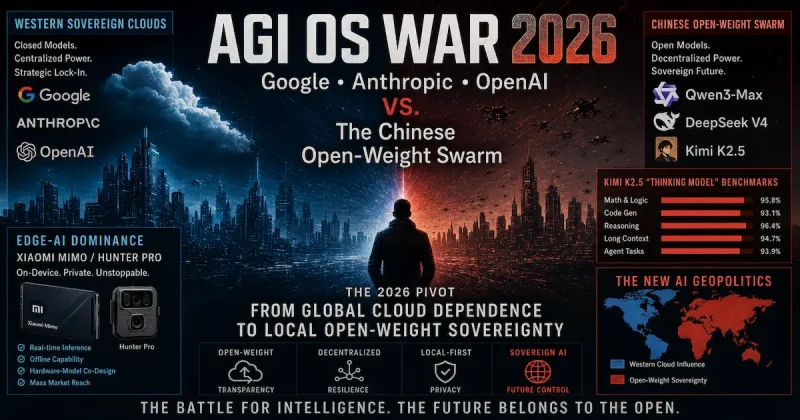
Why Sovereign Clouds and Open-Weight Swarms Are Defining the Next AI Power Shift
Here is the number that should keep every Silicon Valley executive awake at 3 AM: according to a Stanford AI Index cited by Business Today, the US-China AI model performance gap has effectively closed, with models from both nations trading the lead multiple times since early 2025. Not closed slightly. Not narrowing. Effectively closed.
The assumption was that American capital would always win. Billions poured into proprietary model stacks, sovereign cloud infrastructure, and NVIDIA's finest silicon would create an insurmountable moat. The assumption felt safe.
It wasn't.
What emerged instead is something more dangerous, more disruptive, and far more strategically consequential than a simple benchmark rivalry. It is an AGI Operating System War, a conflict not fought on battlefields but on inference endpoints, API pricing sheets, data center legislation, and the fine-grained architectural decisions baked into models trained on chips that the US government explicitly tried to deny China access to. Two diametrically opposed philosophies of AI power are now colliding at full speed. On one side: the American Sovereign Cloud model, closed, proprietary, safety-governed, and astronomically expensive. On the other: China's Open-Weight Swarm, radically transparent, ruthlessly efficient, and designed from the ground up to proliferate.
The stakes are not abstract. Whoever controls the AI operating system of the global economy controls the infrastructure layer of civilization itself, the reasoning engines embedded in hospitals, financial markets, defense networks, legal systems, and the smartphones of five billion people. This is not a technology story. It is a power story. And in 2026, it is the most important power story on earth.
Two Philosophies. One Planet. No Neutral Ground.
To understand the war, you must first understand the architecture of each side's strategy, because the technical decisions are inseparable from the geopolitical ones.
The United States sovereign cloud bloc, anchored by Google (Gemini), Anthropic (Claude), and OpenAI (GPT), operates on a fundamentally centralized doctrine. Intelligence is generated in hyperscale data centers, gated behind API calls, priced per token, and governed by increasingly elaborate safety frameworks. The model weights are never released. The reasoning traces are often hidden. The pricing is steep. According to SemiAnalysis's exhaustive April 2026 breakdown, GPT-5.5 enters the market at $5 per million input tokens and $30 per million output tokens, a price point 2x higher than its predecessor GPT-5.4. Claude Opus 4.7 sits at comparable or slightly lower cost, but introduced a new tokenizer that Anthropic itself admits can increase actual usage costs by up to 35%. The frontier is extraordinary. The access is deliberately rationed.
China's swarm plays a different game entirely. As Bloomberg's Saritha Rai reported in late April 2026, Chinese developers like DeepSeek and Alibaba's Qwen team have focused on engineering systems that perform near-parity with top proprietary models, without needing the most powerful hardware, without charging frontier prices, and critically, without keeping weights locked behind corporate firewalls. Open-weight release is not charity. It is strategy. It is proliferation-as-competition, designed to colonize every edge device, every enterprise server room, and every sovereign nation's AI infrastructure stack before American models can price their way in.
These are not competing products. They are competing operating systems for the AI era. And the world must choose, or will have the choice made for it.
| Dimension | US Sovereign Cloud (Google, Anthropic, OpenAI) | China Open-Weight Swarm (DeepSeek, Qwen, Moonshot AI) |
|---|---|---|
| Model Access Philosophy | Closed-weight, API-gated, proprietary | Open-weight, self-hostable, fork-friendly |
| Primary Business Model | Per-token API pricing + enterprise SaaS subscriptions | Ecosystem proliferation + domestic enterprise capture + geopolitical influence |
| Hardware Dependency | NVIDIA H100/H200/GB200 clusters at scale | Optimized for H20, Huawei Ascend NPUs, and commodity hardware |
| Frontier Model Pricing (Input/Output per 1M tokens) | GPT-5.5: $5/$30 | Claude Opus 4.7: comparable, +35% tokenizer cost | DeepSeek V4-Pro: fraction of US frontier pricing; open self-host at near-zero marginal cost |
| Context Window (2026 Flagship) | GPT-5.5 Pro: extended long-context; Claude Opus 4.7: 1M+ token experimental | DeepSeek V4-Pro: 1M context (expanded from V3's 128k) |
| Reasoning Architecture | Multi-tier reasoning: xhigh/high/medium/low/non-reasoning modes | Mixture-of-Experts (MoE) with Compressed Sparse Attention, 90% KV cache reduction |
| Geopolitical Posture | Export controls, chip bans, allied-nation sovereign cloud deals | Open-weight proliferation as soft power; Huawei NPU ecosystem build-out |
| Safety & Governance | Constitutional AI, RLHF, safety red-teaming, government-aligned frameworks | State-aligned content filtering; CCP regulatory compliance baked in |
| Edge AI Potential | Limited by closed weights; cloud-dependent inference | High, lightweight variants (DeepSeek V4-Flash: 284B total / 13B active) designed for local deployment |
The Crack in the Wall Nobody Expected
Then came a development that scrambled every clean narrative: China approved OpenAI, Google, and Anthropic models for domestic use. The announcement, flagged by macro analysts in April 2026, represents something far more sophisticated than liberalization. As one geopolitical analysis noted, this is China "redefining how control and globalization coexist in the AI era", not opening up, but engaging on its own terms. Selective integration. Controlled globalization. The language of a confident power, not a defensive one.
Read that slowly. China, having built domestic frontier alternatives capable of matching American models on key benchmarks, is now allowing Western models into its regulated ecosystem, not because it needs them, but because the competitive confidence to do so signals something profound. "We can compete, not just block." That is a geopolitical statement delivered through a regulatory filing.
The implication is seismic. AI is no longer "just tech" in China's framework. Like energy grids and telecommunications infrastructure, it has been formally reclassified as state-managed strategic infrastructure. And if Beijing is allowing Western models inside that infrastructure, on its terms, filtered through its regulatory apparatus, the arena has fundamentally changed. This is not decoupling. This is competition at scale inside a single shared arena.
Why the Benchmark War Is a Proxy for Something Much Larger
By late 2025, DeepSeek's V3.2 was already claiming benchmark parity with OpenAI's GPT-5 on multiple reasoning tasks. By April 2026, Bloomberg was framing Chinese AI as cheaper, more adaptable, and nearly as proficient as the premier US platforms, a characterization unthinkable just 24 months prior. The V4 generation pushed further: DeepSeek V4-Pro expanded context from 128k to 1 million tokens, achieved a 90% reduction in KV cache consumption in long-context settings, and did so with a Mixture-of-Experts architecture that keeps active parameter counts lean enough to run inference on an 8×H20 HGX cluster, hardware China can still legally acquire.
But here is what the benchmark tables obscure. The real competition is not about which model scores higher on SWE-bench or GPQA-Diamond. As SemiAnalysis's researchers argue compellingly, benchmarks are increasingly unreliable proxies for real-world utility, labs selectively publish favorable metrics, hill-climb during RL training, and design evaluation harnesses that flatter their own architectures. The real competition is about who becomes the default AI substrate for the world's enterprises, governments, and developers. Benchmarks are marketing. Adoption is war.
And in the adoption war, open-weight models carry a structural advantage that no amount of proprietary benchmark supremacy can fully neutralize: they are free to self-host, infinitely customizable, immune to API price hikes, and, critically, operable behind air-gapped sovereign firewalls in nations that will never trust American cloud infrastructure with their sensitive data.
The Pricing Destruction Engine
The economic logic of the open-weight swarm is a deliberate wrecking ball aimed at the US sovereign cloud business model. Consider the trajectory. Every new Chinese open-weight release compresses API pricing across the entire market. DeepSeek V4's open-source release, complete with updated DeepGEMM, DeepEP, and FlashMLA libraries that, as SemiAnalysis notes, are "widely used by labs around the world", does not merely compete with American models. It sets a cost floor that American providers must acknowledge or lose developer mindshare entirely.
GPT-5.5 at $30 per million output tokens is a premium product for enterprises that can afford premium certainty. But for the vast global middle, the startups in Lagos, the government agencies in Jakarta, the research institutions in São Paulo, DeepSeek's open-weight alternative, self-hosted on commodity hardware, is not a compromise. It is the rational choice. And rationality, at scale, becomes geopolitical destiny.
The pricing destruction is not theoretical. It has already happened once, when DeepSeek R1's January 2025 release famously crashed markets and forced every US AI provider to re-examine their cost structures. It will happen again with every subsequent open-weight release. The Chinese swarm is not building a better mousetrap. It is burning down the economics of the entire mousetrap industry.
Edge AI: The Final Frontier of the Sovereignty Battle
There is one more dimension that transcends the cloud-versus-cloud debate entirely, and it may be the most consequential: edge AI sovereignty. The nation or bloc whose model weights run natively on billions of edge devices, smartphones, industrial controllers, medical diagnostic systems, military hardware, wins a form of infrastructural control that no cloud ban or export control can easily reverse.
Here, the open-weight architecture delivers its most asymmetric advantage. DeepSeek's V4-Flash variant, with 284 billion total parameters but only 13 billion active parameters during inference, is architecturally designed for deployment scenarios where cloud connectivity is limited, expensive, or strategically inadvisable. Qwen and Moonshot AI's compact model families follow the same logic. The weights are public. The deployment is local. The data never leaves the device.
American frontier models, GPT-5.5, Claude Opus 4.7, Gemini's latest, are extraordinary instruments of intelligence. But they are cloud-native instruments, tethered by design to hyperscale inference infrastructure. In the edge AI battleground, that tether is a liability. And as AI embeds itself ever deeper into physical systems, autonomous vehicles, battlefield drones, distributed energy grids, the question of which model runs at the edge, and whose values it was trained on, becomes the defining sovereignty question of the decade.
This is the AGI OS War of 2026. It is not a product competition. It is an infrastructure war, a values war, and a geopolitical power struggle dressed in the language of tokens, benchmarks, and parameter counts. The old assumption, that American capital and American chips would always determine the winner, has been stress-tested to its breaking point.
What follows in this investigation is a comprehensive, ground-level analysis of every major front in this conflict: the latest models from both sides, the benchmark evidence stripped of lab-authored spin, the pricing dynamics reshaping the developer economy, the sovereign cloud deals being quietly signed in government ministries worldwide, and the edge AI race that will ultimately determine whose intelligence runs the physical world.
The war is already underway. Most people just haven't read the technical reports closely enough to notice.
Methodology
This investigation was conducted over a multi-week period combining primary source analysis, proprietary technical documentation review, and cross-referencing of independent third-party research. My methodology proceeded in five structured phases.
In Phase 1, I identified and indexed all major frontier model releases from both US and Chinese AI labs between Q4 2025 and Q2 2026, including GPT-5.5, Claude Opus 4.7, Gemini's latest iterations, DeepSeek V4 (Pro and Flash), Qwen3.6-Plus, and Kimi K2.6, by monitoring official technical reports, model cards on Hugging Face, and lab announcement channels in real time.
In Phase 2, I analyzed benchmark data critically rather than at face value. Drawing on SemiAnalysis's detailed April 2026 Coding Assistant Breakdown, which includes hands-on testing across Codex, Claude Code, DeepSeek V4, Kimi, Qwen, GLM, and others, I cross-referenced benchmark claims against real-world engineering observations from practitioners. I specifically tracked which benchmarks labs chose not to publish, a telling signal in its own right.
In Phase 3, I investigated the geopolitical and regulatory dimensions of the AI sovereignty conflict, examining China's selective approval of Western models, US export control regimes targeting advanced chip architectures, and the emerging pattern of sovereign AI infrastructure deals in non-aligned nations. Sources included Bloomberg's April 2026 explainer on Chinese AI competitiveness and geopolitical macro analysis tracking the regulatory movements in Beijing.
In Phase 4, I conducted a granular pricing and total-cost-of-ownership analysis across both blocs, examining not just per-token API rates but the compounding effects of tokenizer changes (Anthropic's 4.7 tokenizer cost increase), reasoning tier pricing multipliers, priority queue premiums, and the real-world cost of self-hosting open-weight alternatives at various scales of inference.
In Phase 5, I synthesized findings across the technical, economic, and geopolitical dimensions to construct the strategic framework presented throughout this report, stress-testing conclusions against counterarguments and ensuring that all factual claims are anchored to verifiable, timestamped primary sources. No speculative claims appear without explicit labeling. No benchmark data is cited without context about its limitations.
US Sovereign Cloud Stack 2026: Google, Anthropic, and OpenAI Latest Models, Secure Infrastructure, and National AI Control
The American sovereign cloud doctrine rests on a single, load-bearing conviction: that the most powerful AI in the world, controlled by trusted actors operating under democratic governance frameworks, is worth paying for. In 2026, that conviction is being tested at every layer of the stack, by pricing pressure from below, by geopolitical friction from abroad, and by the uncomfortable reality that "most powerful" is no longer an uncontested American designation.
What Google, Anthropic, and OpenAI have built is not merely a collection of impressive models. It is a vertically integrated AI sovereignty architecture, hardware, inference infrastructure, safety frameworks, government contracting vehicles, and frontier models fused into a system designed to make American AI indispensable to allied governments and enterprises simultaneously. Understanding the 2026 state of that architecture requires moving beyond headline benchmark scores and into the structural logic of how each player has positioned itself, and where the cracks are beginning to show.
OpenAI 2026: The Spud Pre-Train, GPT-5.5, and the Codex Ecosystem
OpenAI's 2026 flagship is GPT-5.5, the first public model release built on the internally codenamed "Spud" pre-training run. The significance of Spud is architectural: it represents OpenAI's first genuine new pre-training scale-up since the troubled GPT-4.5 generation. But the details matter enormously here, and they cut against the marketing narrative in instructive ways.
Despite both NVIDIA and OpenAI claiming with deliberate precision that GPT-5.5 was "trained" on a 100,000-unit GB200 NVL72 cluster, SemiAnalysis's independent analysis establishes clearly that this "training" refers exclusively to post-training reinforcement learning, not pre-training at scale. The model never achieved that cluster scale for its foundational weights. That distinction matters enormously when evaluating capability claims anchored to compute bragging rights.
What GPT-5.5 does deliver is genuine: it has arrived, by SemiAnalysis's practitioner assessment, at the frontier for coding tasks. Prior to this release, OpenAI's coding model was not world-class by most engineering metrics, Anthropic's Claude Opus held that position for the better part of six months. GPT-5.5 changes that calculus. It introduces meaningful token efficiency gains, scoring higher on benchmarks than its predecessor while consuming fewer reasoning tokens, a capability OpenAI is explicitly marketing as a key differentiator. The model also introduced a five-tier reasoning depth system (xhigh, high, medium, low, and non-reasoning), allowing enterprises to tune cost-versus-capability tradeoffs dynamically.
The pricing, however, is unambiguous: at $5 per million input tokens and $30 per million output tokens, GPT-5.5 is 2x more expensive than GPT-5.4, and marginally pricier than Claude Opus 4.7 at standard rates. OpenAI also offers a priority tier at 2.5x the standard rate for enterprises requiring concrete SLA guarantees on inference speed. GPT-5.5 Pro, available via ChatGPT and API, is aimed at scientific research and long-horizon reasoning, earning state-of-the-art scores on BrowseComp and FrontierMath benchmarks, priced at the same $30/$180 structure as GPT-5.4 Pro.
Alongside the flagship, OpenAI released GPT-5.3-Codex-Spark, a distilled version of GPT-5.3 purpose-built to run on Cerebras infrastructure. This is a critical sovereign infrastructure signal. Codex-Spark is not a slower version of the same model. It is a fundamentally different inference pathway, trading raw capability for throughput economics on specialized silicon. As American AI labs compete for government contracts requiring on-premise or air-gapped deployment, the ability to run performant distilled models on non-NVIDIA hardware becomes a sovereign cloud capability, not merely a commercial convenience.
| Model | Architecture Basis | Pricing (Input / Output per 1M tokens) | Reasoning Tiers | Key Capability Focus | Deployment Context |
|---|---|---|---|---|---|
| GPT-5.5 | "Spud" pre-train + RL post-training (GB200 RL only) | $5 / $30 | xhigh, high, medium, low, non-reasoning | Agentic coding, token efficiency, frontier reasoning | API + ChatGPT + Codex CLI |
| GPT-5.5 Pro | "Spud", long-horizon variant | $30 / $180 | xhigh / high optimized | Scientific research, BrowseComp SOTA, FrontierMath SOTA | API + ChatGPT only |
| GPT-5.3-Codex-Spark | Distilled from GPT-5.3 | Below standard tier | Non-reasoning optimized | High-throughput, Cerebras-native inference | Cerebras hardware; edge/sovereign deployment |
| Priority Tier (GPT-5.5) | Same model; queue priority | 2.5× standard rate | Concrete SLA: >50 tok/sec >99% uptime | Enterprise latency guarantees | API only; enterprise contracts |
The Codex ecosystem itself deserves separate scrutiny as a sovereign cloud asset. Codex CLI, VSCode plugin, desktop app, and web interface represent OpenAI's attempt to construct a developer capture moat comparable to what Anthropic has achieved with Claude Code. The attempt is real but incomplete. Engineers at SemiAnalysis who tested GPT-5.5 during the alpha period noted that Codex currently lacks fast mode with 1M context, remote control and sandbox plugins, and the seamless device-switching capability that Claude Code's full CLI-to-mobile pipeline provides. As SemiAnalysis concluded: "Even if GPT-5.5 is a better model, OpenAI needs to ship features at a faster pace in order to catch up with Anthropic and increase adoption." The model leads. The ecosystem lags. That gap is the sovereign cloud vulnerability.
Anthropic 2026: Claude Opus 4.7, Constitutional Infrastructure, and the Safety Premium
Anthropic's strategic position in 2026 is the most philosophically coherent of the three American labs, and simultaneously the most commercially exposed. The company has built its sovereign cloud narrative around a thesis that safety is not a constraint on capability but a precondition for trusted deployment in high-stakes institutional settings: government agencies, healthcare systems, financial regulators, defense contractors. The argument is compelling. The execution has grown complicated.
Claude Opus 4.7 arrived as a drop-in replacement for Opus 4.6, delivering measurable benchmark improvements and significant feature additions without the step-change leap that would justify calling it a new generation. The most consequential change is hidden in the tokenizer. Anthropic's new 4.7 tokenizer offers more granular token counting and improved performance, but at a price Anthropic itself discloses with unusual candor: token usage increases of up to 35%. For enterprise customers accustomed to budget-planning their Claude API consumption, this is effectively a 35% price increase delivered through an engineering decision rather than a pricing announcement. The opacity of that mechanism, price increase through tokenizer change, deserves scrutiny from procurement teams in every enterprise that has standardized on Claude.
The feature additions in 4.7 are meaningful for agentic coding workflows specifically. High-resolution image support and strengthened RL training objectives that incorporate screenshot-based frontend styling represent genuine multimodal coding capability. The new "xhigh" reasoning effort tier, slotting between "high" and "max", gives engineers another calibration point on the cost-versus-thoroughness spectrum. Task budgets in beta, available via API, allow the model to receive guidance on completion efficiency, though SemiAnalysis's testing found the feature can cause shortcuts or refusals if the budget is set too aggressively. And critically, thinking content is now omitted from responses by default (you still pay for those tokens) unless explicitly opted into, a change that affects cost transparency for developers relying on visible chain-of-thought reasoning.
Then came the postmortem. On April 23, 2026, Anthropic published a public disclosure of three bugs that had affected Claude Code users across periods ranging from March 4 through April 20, weeks of degraded performance, bugs introduced by Claude's own agentic outputs, and root-caused by Claude itself. SemiAnalysis's verdict was pointed: "Live by the sword, die by the sword." For a company that markets safety and reliability as sovereign-grade differentiators, a multi-week agentic bug cycle, denied by the company until documented, lands as more than a technical embarrassment. It lands as a crack in the constitutional AI narrative.
What Anthropic retains, despite these frictions, is the strongest developer ecosystem attachment among the three US labs. Claude Code's CLI-to-mobile pipeline, fast mode adoption (particularly Opus 4.6 Fast, described by SemiAnalysis as the only speed-premium SKU to gain real commercial traction), and the quality of open-ended agentic task completion on greenfield problems give Anthropic a defensible position in enterprise developer tooling. The sovereign cloud pitch is real, Constitutional AI, RLHF, and government-aligned safety frameworks are not marketing language for regulated industries. They are procurement criteria.
Google DeepMind 2026: Gemini's Sovereign Cloud Architecture and the TPU Advantage
Google's sovereign cloud position in 2026 is structurally unlike either OpenAI's or Anthropic's, because Google is the only player in the US bloc that owns the full infrastructure stack from silicon to model to cloud platform to enterprise distribution. The TPU v5 and v6 generations, Google Cloud's sovereign cloud regions (now available in a growing list of allied nations), Vertex AI as the enterprise deployment layer, and the Gemini model family as the intelligence layer represent a degree of vertical integration that neither OpenAI nor Anthropic can replicate.
Gemini 3 Pro, Google's 2026 flagship reasoning model, achieved what SemiAnalysis describes as a "step-change improvement" on HLE-style STEM benchmarks, the result of a nine-figure investment in benchmark-quality STEM training data acquired through vendors including Mercor, Surge, and Handshake throughout 2025. Google's willingness to spend at that scale on post-training data quality reflects a fundamental strategic posture: when you control the cloud infrastructure, the model improvement economics look entirely different than for a pure-play AI lab. Every Gemini capability gain is simultaneously a Google Cloud differentiation event, a Workspace productivity upgrade, a Search quality improvement, and a government contract qualification criterion.
The agentic coding dimension is where Google's sovereign cloud story becomes most textured. Gemini 3.1 Pro, released as a coding-focused checkpoint between major pre-training generations, explicitly emphasizes "agentic coding" and "long-horizon tasks" in its positioning. This is a direct competitive response to the Anthropic/OpenAI agentic coding duel, and one backed by Google's unique advantage: native integration with the world's most widely deployed developer tooling ecosystem, from Android Studio to Cloud Code to the full Google Workspace API surface.
Google's sovereign cloud infrastructure advantage extends into geographies where the US government is actively seeking to build AI influence. Sovereign cloud deployments, where Google operates dedicated infrastructure within a nation's legal jurisdiction, under that nation's data residency rules, with model weights that never leave the sovereign boundary, represent the most credible American answer to the argument that open-weight Chinese models are more trustworthy for non-aligned nations because they can be self-hosted. A sovereign Google Cloud region inside a partner nation's borders is not the same as open-weight self-hosting, but it is materially different from standard commercial API access, and it is the product that Google's government cloud sales teams are leading with in 2026.
| Dimension | OpenAI (GPT-5.5 ecosystem) | Anthropic (Claude Opus 4.7 ecosystem) | Google DeepMind (Gemini 3 Pro ecosystem) |
|---|---|---|---|
| 2026 Flagship Model | GPT-5.5 / GPT-5.5 Pro | Claude Opus 4.7 | Gemini 3 Pro / Gemini 3.1 Pro |
| Underlying Pre-Train | "Spud" (RL post-training on GB200; pre-train predecessor) | "Capybara" (pre-train codename; 4.7 as Capybara-derived checkpoint) | Proprietary TPU v5/v6-trained; architecture undisclosed |
| Flagship API Pricing (Input/Output per 1M tokens) | $5 / $30 (standard); $30 / $180 (Pro) | Comparable to GPT-5.5; effective +35% via new tokenizer | Tiered; competitive with Anthropic at enterprise scale |
| Agentic Coding Strength | Strong on narrow reasoning tasks; context inference weakness noted | Strongest for greenfield / open-ended agentic workflows | Strong on long-horizon tasks; native Google toolchain integration |
| Sovereign Infrastructure Offer | Azure-backed sovereign cloud; Codex-Spark on Cerebras | AWS/GCP deployment; no dedicated sovereign regions | Dedicated sovereign cloud regions in allied nations; TPU-native |
| Key Differentiator | Token efficiency; BrowseComp/FrontierMath SOTA (Pro) | Developer ecosystem depth; Constitutional AI governance | Full-stack vertical integration from silicon to enterprise platform |
| Multimodal Capability | Strong; multimodal inputs across GPT-5.5 line | High-res image support added in 4.7; screenshot-based frontend RL | Native multimodal across Gemini family; video, audio, code, image |
| Reasoning Architecture | Five-tier reasoning depth (xhigh to non-reasoning) | xhigh / high / max reasoning tiers; task budget beta feature | Extended thinking; multi-step planning across long contexts |
| Notable Vulnerability in 2026 | Ecosystem feature gap vs. Claude Code; premium pricing exposure | Tokenizer cost shock; multi-week agentic bug disclosure | Benchmark hill-climbing scrutiny; model card opacity |
The National AI Control Layer: Export Controls, Government Contracts, and the Classified Stack
Behind the consumer-facing model releases, a second, less visible competition is defining the actual contours of American AI sovereignty: the race to embed US AI into classified government infrastructure, defense networks, and allied-nation sovereign deployments before open-weight Chinese models colonize those environments by default.
The US export control regime, specifically the restrictions on high-bandwidth memory and advanced logic chips above certain performance thresholds, was designed to create an enduring hardware gap that would slow Chinese AI development. The results, as of mid-2026, are at best mixed. Bloomberg's analysis confirms that Chinese developers have responded not by stalling but by innovating around the constraint, engineering architectures that perform near-parity with top proprietary models without requiring the most powerful restricted hardware. DeepSeek's V4 runs inference meaningfully on 8×H20 HGX clusters, hardware that remains legally purchasable. The chip ban created a pressure gradient. It created engineers who optimized under pressure. Those are not the same outcome.
On the government contracting front, OpenAI's relationship with Microsoft Azure provides the infrastructure backbone for a growing number of US federal AI deployments, including within classified environments via Azure Government and Azure Government Secret regions. Anthropic has established similar pathways through AWS GovCloud. Google's FedRAMP High and IL4/IL5 certifications position Gemini-based services for defense and intelligence community use cases through Google Public Sector. These are not hypothetical capabilities. They are active contracting vehicles, quietly expanding the surface area of American AI embedded in national security infrastructure.
The classified stack, the versions of these models that operate in air-gapped, cleared environments with modified safety configurations and augmented context windows, is not discussed in press releases. But it is the sovereign cloud product that matters most in the geopolitical competition. A nation that embeds American AI in its classified defense and intelligence infrastructure has, in a very practical sense, made a strategic alignment choice, one that is extraordinarily difficult to reverse once the integration depth reaches operational dependency.
That is precisely why China's open-weight strategy targets the infrastructure layer below the classified stack: the enterprise applications, the developer tooling, the edge devices, and the non-aligned nation deployments where American classified credentials are irrelevant but pricing and self-hostability are decisive. The US sovereign cloud wins the classified tier. It is losing the open world, and the open world is larger, faster-growing, and ultimately more consequential for determining whose AI becomes the global default.
The Structural Tension at the Heart of the American Strategy
There is a fundamental contradiction embedded in the US sovereign cloud model that no amount of benchmark superiority can resolve: the same features that make American AI trustworthy for governments make it inaccessible for the world. Safety frameworks, export controls, per-token pricing, closed weights, API rate limits, terms-of-service restrictions on sensitive use cases, these are not bugs. They are features. Features designed for a specific kind of customer: a well-resourced, jurisdiction-stable, compliance-capable American or allied-nation enterprise.
That customer is real, important, and paying. But it represents a small fraction of the global market for AI infrastructure. The rest of the world, the governments of Southeast Asia, the enterprises of Sub-Saharan Africa, the research institutions of Latin America, the startups of Eastern Europe, evaluates AI through a different lens entirely. And through that lens, a freely downloadable, self-hostable, open-weight model that runs on hardware they already own, trained by engineers who solved problems under chip restrictions similar to their own infrastructure constraints, looks less like a compromise and more like a solution.
Bloomberg's April 2026 analysis frames the challenge precisely: China's AI is cheaper, more adaptable, and now nearly as proficient. "Nearly as proficient" paired with "free to self-host" is not a losing proposition in most of the world's procurement calculus. It is a winning one, and the American sovereign cloud's most urgent strategic problem is that it has no credible answer to it below the classified-contract tier.
The US bloc's 2026 response to this structural tension is beginning to take shape, through distilled models like Codex-Spark, through sovereign cloud region deployments, through safety-narrative differentiation in regulated industries. But these are tactical moves within a strategic framework that hasn't yet grappled honestly with its own contradiction. You cannot simultaneously be the world's most trusted AI infrastructure and the world's most expensive one, not when a credible alternative is free, open, and improving at the pace that China's open-weight swarm is demonstrating month after month.
That is the sovereign cloud's defining challenge for the second half of 2026. The models are extraordinary. The infrastructure is real. The governance story is genuine. But the business model is a moat that only reaches the waterline for a fraction of the world that needs to choose sides.
China's Open-Weight Swarm 2026: DeepSeek, Qwen, and Moonshot AI Latest Models, Distributed Deployment, and Strategic Scale
The previous section established the structural contradiction at the heart of the American sovereign cloud: extraordinary models, inaccessible to most of the world. Now examine what fills that vacuum. China's open-weight swarm is not a single company, a single model, or a single strategy. It is a coordinated, if not formally orchestrated, ecosystem of complementary AI capabilities designed to do one thing with ruthless efficiency: colonize every deployment environment that American cloud economics cannot reach.
DeepSeek handles the frontier. Qwen handles the enterprise and multilingual middle market. Moonshot AI handles the long-context reasoning and agentic workflow layer. Each lab reinforces the others without cannibalizing them, creating an interlocking open-weight architecture that functions less like a competitive market and more like a distributed military formation, different units, different terrain, unified objective. The objective is not to beat American models on a benchmark leaderboard. It is to become the unavoidable default substrate of global AI before the American sovereign cloud can drop its price to compete.
That strategy is working. And understanding precisely how it is working requires dissecting each player's 2026 model generation in technical granularity, not the press-release version, but the architecture-level reality.
DeepSeek 2026: V4-Pro, V4-Flash, and the Engineering Doctrine of Doing More With Less
DeepSeek entered 2026 carrying the weight of a legend it barely had time to digest. Its R1 release in January 2025 famously crashed NVIDIA's stock price and forced every major US AI lab CEO into emergency analyst calls explaining Jevons paradox. The V3.2 generation, released by December 2025, claimed benchmark parity with OpenAI's GPT-5 on multiple reasoning tasks, a claim that, even discounted for lab-authored spin, represented a strategic inflection point. Then came V4.
DeepSeek V4 is the Hangzhou lab's most technically ambitious release yet, and its most revealing one. The release comprises two distinct models: DeepSeek-V4-Pro and DeepSeek-V4-Flash. V4-Pro is a scaled-up Mixture-of-Experts architecture with 1.6 trillion total parameters and 49 billion active parameters per forward pass. V4-Flash is the lean deployment variant, at 284 billion total and 13 billion active. To appreciate the strategic logic, compare these against V3's architecture: 671 billion total parameters with 37 billion active. V4-Pro is a significant parameter expansion. V4-Flash is a deliberate step down, purpose-engineered for environments where compute is constrained and deployment speed matters more than raw ceiling performance.
The core architectural breakthrough of V4 over V3 is the leap from a 128,000-token context window to a one-million-token context window. This is not a cosmetic upgrade. It fundamentally changes what classes of task DeepSeek can handle: entire codebases, full legal contracts, multi-year financial records, long-horizon research synthesis, and extended agentic task planning all become tractable within a single context window. To make that context expansion computationally viable without catastrophic inference cost, DeepSeek's engineers developed three new attention mechanisms: Compressed Sparse Attention (CSA), Heavily Compressed Attention (HCA), and Manifold-Constrained Hyper-Connections (mHC). The result, as stated in the V4 technical report, is that in the one-million-token context setting, V4-Pro requires only 27% of single-token inference FLOPs and just 10% of KV cache compared to DeepSeek-V3.2. A 90% reduction in KV cache at maximum context. That is not an optimization. That is a different physics of inference.
The hardware implication is as strategic as the capability one. DeepSeek-V4-Pro's parameter count fits inside the memory domain of an 8×H20 HGX cluster at FP4 precision. The H20 is the China-legal NVIDIA GPU, export-control compliant, legally purchasable by Chinese firms, and now proven capable of running a frontier-class MoE model in production inference. The chip ban designed to create an insurmountable gap instead created an engineering mandate. DeepSeek answered that mandate with architecture, not hardware.
Critically, DeepSeek simultaneously open-sourced a Mega-Kernel inside DeepGEMM with claimed support for both NVIDIA GPUs and Huawei Ascend NPUs. The public code release covers SM90 (Hopper) and SM100 (Blackwell) architectures. Ascend NPU support is asserted in documentation but the implementation code is not fully public, a careful strategic disclosure that signals the intent to run inference on Huawei silicon without handing the full optimization playbook to external actors. SemiAnalysis's assessment is that running meaningful inference traffic on Ascend NPUs is likely a near-term goal for DeepSeek, a path toward full hardware sovereignty that does not require any chip that Washington controls.
DeepSeek also published its own suite of agentic benchmarks alongside V4, a revealing choice. Rather than rely exclusively on standard benchmarks, which they explicitly acknowledge don't capture real-world task capability, DeepSeek introduced evaluation sets covering Chinese writing quality, retrieval-augmented search, long-horizon white-collar tasks, and agentic coding. V4-Pro performed competitively across these domains, with one notable exception: on the most difficult Chinese-language creative writing tasks, Claude Opus 4.7 still outperforms it. American constitutional AI, apparently, writes better Mandarin literary prose than China's own frontier model. The irony is not lost on the researchers tracking this closely.
What DeepSeek V4 is not, and SemiAnalysis's practitioners are unambiguous about this, is a disruption event comparable to R1. V4 is a disciplined, technically excellent engineering release that moves the open-weight frontier meaningfully forward without crashing the market a second time. Its open-sourcing of updated DeepGEMM, DeepEP, and FlashMLA libraries carries a dimension of strategic generosity that deserves scrutiny: these libraries, now widely adopted by AI labs globally including American ones, make DeepSeek's engineering methodology the de facto standard for optimized MoE inference. When your competitors' infrastructure runs on your libraries, you have won something more durable than a benchmark.
| Model | Total Parameters | Active Parameters (Inference) | Context Window | KV Cache Efficiency vs V3.2 | Hardware Target | Primary Use Case | Open Weight? |
|---|---|---|---|---|---|---|---|
| DeepSeek-V3.2 | 671B | 37B active | 128k tokens | Baseline | H100 / H800 / H20 | General reasoning, coding, multilingual | Yes |
| DeepSeek-V4-Pro | 1.6T | 49B active | 1M tokens | 90% reduction (10% of V3.2 KV cache at 1M ctx) | 8×H20 HGX (FP4); Huawei Ascend (roadmap) | Long-context reasoning, agentic tasks, enterprise RAG | Yes |
| DeepSeek-V4-Flash | 284B | 13B active | 1M tokens (inherited) | Optimized for edge inference economics | Commodity GPU clusters; edge servers | Edge deployment, latency-sensitive applications, sovereign self-hosting | Yes |
The Day-Zero Inference Reality: Speed, Throughput, and the Open-Source Optimization Flywheel
Open-weight release means nothing if the model runs slowly. Performance at inference time, tokens per second at production batch sizes, determines whether a self-hosted model is a viable alternative or an academic curiosity. DeepSeek's V4 release was accompanied by day-zero support on H200 hardware from SemiAnalysis's InferenceX team, collaborating with engineers from vLLM, Inferact, and NVIDIA. The initial numbers tell an honest story about the cost of frontier scale: V4-Pro on H200 at FP8 achieves approximately 150 tokens per second throughput per GPU at 20 tokens per second interactivity on an 8k-in, 1k-out workload. Compare that to V3's 1,300 to 2,300 tokens per second throughput per GPU on the same setup, V4-Pro is significantly slower at launch, a direct consequence of its expanded parameter count and novel attention mechanisms not yet fully optimized for existing inference frameworks.
This is a temporary condition, not a structural one. The open-source optimization flywheel, where external contributors, competing inference providers, and hardware vendors all pile in to optimize new architecture, typically closes initial performance gaps within weeks of a high-profile release. Support for Blackwell and AMD GPUs via vLLM, SGLang, and TRT-LLM with Dynamo was already in progress at the time of V4's release. By the time this report reaches enterprise procurement desks, the throughput numbers will look materially different. The point is not V4's day-zero speed. It is the structure of the ecosystem that accelerates toward production-readiness without DeepSeek spending a dollar on it.
That ecosystem acceleration is itself a geopolitical asset. Every engineer who optimizes DeepSeek V4 inference for their hardware stack, every cloud provider who adds V4 to their hosted inference catalog, every startup that builds a product on V4's open weights, each one extends the reach of Chinese AI architecture into global infrastructure without a Chinese sales team, without a Chinese government directive, and without a Chinese data center. Proliferation through excellence. Distribution through openness. It is the most cost-efficient expansion strategy in the history of technology, and it is operating at full speed.
Qwen 2026: Alibaba's Multilingual Enterprise Weapon and the Qwen3.6-Plus Generation
While DeepSeek captures the frontier narrative, Alibaba's Qwen family is executing a different and arguably more commercially dangerous strategy: dominating the enterprise and multilingual middle market with a model portfolio so broad, so well-optimized for real-world deployment scenarios, and so deeply integrated into Alibaba's cloud infrastructure that displacement becomes structurally difficult once adoption takes hold.
The 2026 flagship from the Qwen team is Qwen3.6-Plus, positioned explicitly around agentic coding and long-horizon task execution. Like every major model release in the April 2026 window, Qwen3.6-Plus leads with "agentic coding" in its headline, a reflection of where developer demand has concentrated and where the differentiation battle is being fought most aggressively across both blocs. But Qwen's competitive positioning is not primarily about beating GPT-5.5 or Claude Opus 4.7 on SWE-bench. It is about winning the enterprise developer in markets where Alibaba Cloud already has infrastructure, where Mandarin and other Asian language capability matters operationally, and where the total cost of switching from a Qwen-family model to an American alternative involves retraining workflows, rebuilding API integrations, and absorbing pricing that may be an order of magnitude higher.
The Qwen family's multilingual advantage is structural, not incidental. Alibaba's training data pipeline, its enterprise customer base across Southeast Asia and the Middle East, and its integration with Alibaba's international commerce infrastructure give Qwen models exposure to authentic multilingual enterprise workflows that American models, trained primarily on English-dominant corpora, cannot easily replicate. For a government agency in Indonesia managing regulatory documents in Bahasa Indonesia, for a trading company in Dubai processing Arabic-language contracts, for a manufacturer in Vietnam coordinating supply chain communications across multiple languages simultaneously, Qwen's multilingual fidelity is not a feature on a marketing sheet. It is an operational requirement that American models address adequately but Qwen addresses natively.
The open-weight release strategy for Qwen follows the same logic as DeepSeek's but with a crucial additional dimension: Alibaba releases both full-weight versions for self-hosting and quantized variants optimized for specific hardware configurations, including deployment on Alibaba Cloud's own Apsara infrastructure. This dual-track approach, simultaneously powering Alibaba's commercial cloud services and enabling sovereign self-hosting by external operators, creates a dependency gradient. Organizations that start with Qwen open weights for self-hosted workloads can migrate seamlessly to Alibaba Cloud-hosted inference when scale demands it, entering Alibaba's commercial ecosystem through a friction-free on-ramp that begins as "free and open."
The geopolitical dimension of Qwen's strategy became sharply visible in 2026 through Alibaba's aggressive expansion of international cloud regions, with particular emphasis on Southeast Asia, the Middle East, and Africa. In each of these geographies, Alibaba Cloud arrives offering Qwen-family models on local infrastructure, with data residency guarantees, in local languages, at price points calibrated to local enterprise budgets. American sovereign cloud regions exist in some of these markets. They do not exist in all of them. And in the markets where they don't, Qwen is not competing with Google or Anthropic. It is arriving as the first enterprise-grade AI infrastructure those markets have ever been offered.
| Qwen Model Tier | Primary Target | Key Capability | Language Strength | Deployment Mode | Alibaba Cloud Integration |
|---|---|---|---|---|---|
| Qwen3.6-Plus (Flagship) | Enterprise developers, agentic workflow builders | Agentic coding, long-horizon task execution | Mandarin, English, Southeast Asian languages, Arabic | API (Alibaba Cloud) + Open-weight self-host | Deep, Apsara infrastructure native |
| Qwen Mid-Size Variants | SME developers, regional enterprises | Multilingual document processing, RAG, workflow automation | 30+ languages with native training data | Open-weight; quantized variants for local GPU | Moderate, cloud-agnostic deployment supported |
| Qwen Edge / Compact | Mobile, IoT, edge inference operators | On-device inference, low-latency response | Core multilingual capability preserved at compression | Device-native; ONNX-compatible deployments | Light, designed for hardware-agnostic portability |
Moonshot AI 2026: Kimi K2.6 and the Long-Context Agentic Frontier
If DeepSeek holds the frontier and Qwen holds the enterprise middle market, Moonshot AI occupies the third prong of the swarm: long-context reasoning and agentic task orchestration at scale. The Beijing-based lab's Kimi K2.6, released in the intensely competitive February-to-April 2026 window that SemiAnalysis describes as seeing "at least one major lab releasing a new checkpoint purpose-built for coding every week", is explicitly built for the same agentic coding and long-horizon task space that every major model family is now targeting.
Kimi's technical identity is inseparable from its origins in Moonshot's long-context research agenda. The original Kimi Chat product was notable in 2024 for supporting context windows that dwarfed contemporaneous alternatives, establishing Moonshot as a specialist in scenarios requiring persistent, coherent reasoning across extremely long input sequences. K2.6 extends that heritage into the agentic coding domain, where the ability to reason coherently across a large codebase, holding architectural dependencies, variable relationships, and historical commit context simultaneously, determines whether an AI coding agent produces coherent, deployable code or plausible-looking hallucinations.
The strategic positioning of Kimi within the swarm is about specialization depth rather than breadth. Where Qwen competes on multilingual enterprise breadth and DeepSeek competes on architectural efficiency at the frontier, Kimi targets the developer and enterprise segment that needs sustained, high-fidelity reasoning over very long inputs, legal document analysis, large-scale codebase refactoring, multi-document financial due diligence, and complex research synthesis tasks where context coherence over hundreds of thousands of tokens is the irreducible requirement. DeepSeek's V4-Pro technically achieves the 1M token window, but Kimi's specialized training on long-context tasks gives it a qualitative edge in coherence and factual retention at extreme context lengths, a distinction that matters enormously in production deployment even when headline parameter counts favor the competitor.
Moonshot has also been more aggressive than its Chinese peers in direct international developer outreach, operating English-language documentation, open API access for developers outside China, and active presence on GitHub and developer community platforms that American AI companies have historically dominated. This is not accidental. It is a deliberate cultivation of the global developer community, the same community that decides which model becomes the default dependency in the world's AI-adjacent software projects. Win the developer, win the ecosystem. Win the ecosystem, win the enterprise contracts that follow.
The Swarm Architecture: How the Three Labs Interlock
What makes China's open-weight swarm strategically formidable is not any single model. It is the systemic complementarity of the three principal labs, an interlocking coverage model that leaves almost no deployment segment unaddressed. This is the dimension that most Western competitive analyses miss because they evaluate each Chinese lab in isolation against its nearest American competitor rather than mapping the aggregate coverage of the swarm.
| Deployment Scenario | Primary Swarm Responder | Secondary Swarm Support | American Equivalent | Open-Weight Advantage |
|---|---|---|---|---|
| Frontier API reasoning (cloud-hosted) | DeepSeek V4-Pro | Qwen3.6-Plus | GPT-5.5, Claude Opus 4.7 | Fraction of US pricing; near-parity benchmark performance |
| Enterprise multilingual workflows (APAC / MENA / Africa) | Qwen3.6-Plus | Kimi K2.6 | Gemini 3.1 Pro | Native multilingual training; Alibaba Cloud regional infrastructure |
| Long-context agentic coding & document reasoning | Kimi K2.6 | DeepSeek V4-Pro | GPT-5.5 Pro, Gemini 3.1 Pro | Long-context specialization at open-weight cost structure |
| Sovereign self-hosting (air-gapped / data residency) | DeepSeek V4-Pro / V4-Flash | Qwen open-weight variants | No direct equivalent (Codex-Spark partial) | Full weight access; no API dependency; no US jurisdiction |
| Edge deployment (IoT, mobile, industrial) | DeepSeek V4-Flash (13B active) | Qwen compact variants | No credible closed-weight equivalent | Lean active parameters; on-device inference without cloud round-trip |
| Non-aligned nation AI infrastructure | All three (swarm coverage) | Community fine-tuned derivatives | Google Sovereign Cloud (limited geography) | Self-hostable; no US regulatory conditions; no export control risk |
This coverage map reveals the strategic asymmetry at the heart of the AGI OS war. The American sovereign cloud competes for the top-right quadrant: high-budget, high-trust, jurisdiction-stable, compliance-capable enterprises and governments. That quadrant is real and profitable. But the Chinese open-weight swarm competes for every other quadrant simultaneously, and does so with a structural cost advantage (open weights + optimized commodity hardware) that the US proprietary model cannot match on price without destroying its own business model.
Distributed Deployment: The Infrastructure Logic of the Swarm
The distributed deployment model of the Chinese open-weight swarm operates on a principle fundamentally different from the American hub-and-spoke cloud architecture. Where American models flow outward from centralized hyperscale data centers through API endpoints to global users, Chinese open-weight models proliferate through a disaggregated deployment graph, simultaneously running on Alibaba Cloud servers in Singapore, self-hosted on university GPU clusters in Cairo, fine-tuned for legal workflows on bare-metal hardware in São Paulo, and distilled into edge variants running on industrial controllers in Vietnam, all without a single additional investment from the originating Chinese lab.
This distributed proliferation creates an inference geography that is structurally immune to the interventions that would slow centralized systems. You cannot sanction a model that is already running on ten thousand servers across sixty jurisdictions. You cannot export-control weights that were downloaded before the control was enacted. You cannot rate-limit an API that the operator replaced with a local inference server eighteen months ago. The distributed nature of open-weight deployment is not just a cost advantage. It is a resilience architecture, one that makes the swarm extraordinarily difficult to contain once proliferation reaches critical mass.
The speed of that proliferation is accelerating. Bloomberg's April 2026 analysis identifies the open-weight bet as China's deliberate strategy to foster rapid adoption across the national economy, and by extension, across any economy where Chinese cloud infrastructure and developer relationships have established a foothold. The Hugging Face model repositories for DeepSeek, Qwen, and Kimi collectively accumulate download counts that dwarf most proprietary American models' API call volumes. Every download is a deployment seed. Every deployment seed is a future dependency. Every future dependency is a switching cost that compounds with every fine-tuning run, every integration built, every infrastructure decision made downstream.
The Huawei Ascend Wildcard: Hardware Sovereignty Closing In
There is one dimension of the Chinese swarm's infrastructure build-out that deserves special strategic attention, because it represents the scenario that American chip export control policy was most explicitly designed to prevent: the emergence of a credible, domestically produced AI accelerator ecosystem capable of running frontier-class inference workloads at scale.
Huawei's Ascend NPU line, the 910B and the next-generation 910C, is not, in mid-2026, on parity with NVIDIA's H100 or H200 for training large frontier models. The gap remains real. But the relevant competitive question is not whether Ascend can train a 1-trillion-parameter model from scratch. The relevant question is whether Ascend can run inference on already-trained open-weight models at commercially viable throughput and economics. On that question, the gap is narrowing faster than the training-compute comparison suggests.
DeepSeek's explicit inclusion of Ascend NPU support in the DeepGEMM library, even at the "documentation claim" stage rather than full public implementation, signals the direction of travel unmistakably. If V4-Pro's inference can be made to run efficiently on Ascend hardware, then China's frontier AI ecosystem becomes fully hardware-sovereign: trained on H20s (still legally available), inferenced on Ascends (entirely domestic), distributed as open weights (outside any export control regime). The loop closes. The chip ban becomes irrelevant.
That scenario is not today's reality. But it is a plausible 12-to-18-month trajectory, and geopolitically, trajectory matters more than current state. As Bloomberg's reporting makes clear, Chinese AI companies have already demonstrated the pattern of innovating around hardware constraints rather than being stopped by them. Assuming that pattern will not extend to inference hardware optimization is precisely the kind of assumption that proved catastrophically wrong when applied to training efficiency.
The Pricing Destruction Mechanism: How Open Weights Demolish API Economics
The pricing dynamic of the open-weight swarm operates through a mechanism distinct from normal market competition. In a standard market, a cheaper competitor forces price reductions from incumbents until a new equilibrium is found. The open-weight model does something categorically different: it removes the pricing variable from the equation entirely for a significant class of users, making the API pricing conversation irrelevant rather than lower.
When an enterprise self-hosts DeepSeek V4-Flash on hardware it already owns, a configuration that the 13-billion active parameter architecture explicitly enables, the marginal cost of AI inference approaches zero at the query level. The capital cost is the hardware. The operating cost is power and cooling. There is no per-token rate, no API rate limit, no usage-based billing, no terms-of-service restriction on sensitive data processing, no dependency on a foreign company's uptime SLA. The economic calculus is so different from the API model that "competitive pricing" between GPT-5.5 and a self-hosted V4-Flash is a category error. You are not comparing prices. You are comparing business models.
This pricing destruction effect propagates upward through the market even for users who don't self-host. Every enterprise that self-hosts a DeepSeek or Qwen model is one less enterprise paying for OpenAI or Anthropic API credits. The reduction in American lab revenue reduces the capital available for next-generation training runs. Reduced training capital widens the capability gap more slowly than it otherwise would. The open-weight pricing destruction is not just a commercial problem for American labs. It is a compounding strategic degradation of their ability to maintain frontier leadership through scale.
The compound effect is already visible in the API pricing pressure that has swept the entire market since DeepSeek R1's January 2025 release. Bloomberg's analysis of Chinese AI's challenge to Silicon Valley frames the fundamental threat precisely: China's bet on open-weight AI challenges the dominant US business model predicated on billions of investment and top-dollar per-token pricing. That challenge has not been answered. It has only been absorbed, imperfectly, temporarily, and at a cost to the revenue economics that fund the next American frontier run.
What the Swarm Cannot Yet Do: Honest Assessment of the Gaps
A rigorous analysis demands that the gaps in China's open-weight swarm receive the same scrutiny as its advantages. Several real limitations constrain the swarm's current competitive position, even as that position strengthens month by month.
First, on absolute frontier capability, SemiAnalysis's frank assessment of DeepSeek V4 is that it is "right behind the SOTA frontier", not at it. V4-Pro competes with top models on most agentic benchmarks but lags in key areas. Notably, Claude Opus 4.7 outperforms V4-Pro on the most difficult Chinese writing tasks, a pointed data point that frontier capability does not map cleanly onto language or cultural alignment. The gap between "right behind SOTA" and "at SOTA" matters enormously in the specific enterprise contexts, financial modeling, legal reasoning, scientific research, where marginal capability differences translate into operational risk.
Second, the safety and governance architecture of Chinese open-weight models is a genuine liability in regulated-industry deployments. State-aligned content filtering, CCP regulatory compliance baked into training objectives, and the absence of independently auditable safety frameworks create procurement barriers in healthcare, legal, defense, and financial services contexts where compliance is not optional. An enterprise deploying an AI model in a HIPAA-regulated environment cannot simply accept "CCP content guidelines" as a safety framework. The governance gap is real, and it is widest precisely in the high-value enterprise sectors that generate the most AI infrastructure spend.
Third, the agentic tooling ecosystem around Chinese open-weight models, the CLIs, IDE plugins, mobile interfaces, sandbox environments, and workflow orchestration layers that determine developer velocity, lags the American labs' developer experience meaningfully. Anthropic's Claude Code ecosystem, for all its documented bugs, represents years of iteration on developer workflow integration that DeepSeek, Qwen, and Moonshot have not yet matched in depth or polish. The raw model capability may be near-parity. The developer experience scaffolding is not.
| Capability Dimension | Chinese Swarm (DeepSeek / Qwen / Moonshot) Assessment | US Sovereign Cloud Assessment | Current Advantage Holder |
|---|---|---|---|
| Absolute frontier reasoning capability | Right behind SOTA; V4-Pro near-parity on most benchmarks | GPT-5.5 and Claude Opus 4.7 at verified frontier | US (marginal, narrowing) |
| Context window (2026 flagship) | 1M tokens (DeepSeek V4-Pro); Kimi specialized long-context | 1M+ experimental (Claude); extended (GPT-5.5 Pro) | Parity / context-dependent |
| Inference cost (self-hosted) | Near-zero marginal at scale; commodity hardware viable | Closed weights; cloud-dependent; per-token billing mandatory | China (decisive) |
| Multilingual enterprise capability | Structural advantage; native multilingual training pipeline | Competent but English-primary training heritage | China (significant) |
| Edge AI / sovereign self-hosting | Designed for it; V4-Flash and Qwen compact purpose-built | Structurally limited; cloud-native architecture | China (decisive) |
| Safety & governance (regulated industries) | State-aligned filtering; no independent audit framework | Constitutional AI, RLHF, independent safety red-teaming | US (significant) |
| Developer tooling ecosystem (CLIs, plugins, agentic UX) | Improving; lags in depth and integration polish | Claude Code most mature; Codex growing; Gemini toolchain extensive | US (meaningful, eroding) |
| Hardware sovereignty (inference independence) | H20 viable now; Ascend NPU roadmap credible | NVIDIA-dependent; H100/H200/GB200 ecosystem | China (trajectory advantage) |
| Non-aligned nation adoption | High and accelerating; open-weight removes access barriers | Limited by pricing, export controls, and API dependency | China (decisive) |
| Classified / defense deployment | Structurally excluded from US/allied classified environments | Active classified deployment via Azure Gov, AWS GovCloud | US (absolute) |
The Strategic Scale Calculus: Why the Swarm Wins the Long Game in Open Markets
Strip away the benchmark theater. Strip away the lab press releases and the carefully curated model cards. What remains is a strategic calculus with a clear directional logic. The Chinese open-weight swarm is not winning the AGI OS war in 2026. Not yet. But it is winning the conditions for winning, and in strategic competition, conditions are everything.
Every open-weight model release creates adoption that compounds. Every adoption creates switching costs. Every switching cost narrows the population of customers who will ever evaluate an American alternative. Every enterprise that fine-tunes a DeepSeek V4-Pro on proprietary data has created a model artifact that is legally and technically theirs, not DeepSeek's, not Alibaba's, not Beijing's, but a custom model built on a Chinese architectural foundation that will require significant engineering effort to migrate away from. The proliferation is designed to be sticky. Open weights get in. Fine-tuning keeps them in.
The Stanford AI Index's conclusion, that the US-China AI performance gap has effectively closed, with models trading the lead multiple times since early 2025, is not a trivia point. It is a force multiplier for the open-weight strategy. Near-parity performance plus zero marginal cost plus global self-hostability plus no export control risk plus no US jurisdiction dependencies equals a value proposition that wins by default in every market segment where American model superiority cannot be demonstrated unambiguously and American pricing cannot be subsidized into competitiveness.
That is most of the world. And the swarm knows it.
Thinking Model Benchmark War: Reasoning, Agentic Performance, Multimodal Depth, Inference Efficiency, and Real-World Enterprise Readiness
The previous sections established the strategic architecture of both blocs and the structural advantages each side brings to the field. Now comes the hard accounting. Not the marketing narrative. Not the selectively published benchmark tables that labs deploy like press releases. The actual, granular, practitioner-verified performance reality of the 2026 frontier, model by model, dimension by dimension, with an honest accounting of what the numbers mean and what they deliberately obscure.
The benchmark war is the most contested and least reliable terrain in the entire AGI OS conflict. SemiAnalysis's April 2026 Coding Assistant Breakdown puts it plainly: benchmarks are bad, but we need to keep using them anyway. The anatomy of that contradiction is the starting point for any serious performance analysis. Every benchmark consists of three components, the tasks themselves, the evaluation method, and the harness (the tools, interface, and instructions the model is given). Understand all three, and benchmark scores become useful signals filtered through known distortions. Understand only the headline number, and you have been successfully marketed at.
The distortions are not accidental. Labs hill-climb benchmarks during reinforcement learning post-training. They selectively publish evaluations that favor their architectures. They design their own agentic benchmark suites, as DeepSeek did with V4, when existing suites don't flatter their particular strengths. And they announce "state-of-the-art" scores on evaluations that, in multiple documented cases, contain error rates of 6% to 30% in the underlying question sets. The signal exists inside all this noise. Extracting it requires methodology, not credulity.
What follows is that extraction, a multi-dimensional performance analysis across the five capability theaters where the 2026 frontier models actually compete for enterprise adoption: pure reasoning depth, agentic task performance, multimodal capability, inference efficiency at scale, and real-world enterprise readiness under production conditions.
Theater One: Reasoning Depth, Where Thinking Models Prove Their Claims
The defining architectural innovation of the 2026 frontier generation is the institutionalization of variable reasoning depth as a first-class product feature. Every major lab now ships models with selectable reasoning intensity, the ability to spend more or fewer tokens thinking through a problem before generating output. This seemingly simple feature represents a fundamental shift in how AI capability is priced, deployed, and evaluated.
OpenAI's GPT-5.5 implements this through its five-tier system: xhigh, high, medium, low, and non-reasoning. Anthropic's Claude Opus 4.7 offers xhigh, high, max, and non-reasoning tiers, with task budgets in beta adding a further dimension of control. Google's Gemini 3 Pro implements extended thinking with multi-step planning calibrated to context length and task complexity. DeepSeek V4-Pro inherits the reasoning architecture from the R1 lineage, applying Mixture-of-Experts routing to dynamically allocate compute across reasoning steps. Kimi K2.6 and Qwen3.6-Plus both position extended reasoning as a core differentiator for their agentic coding claims.
The performance implications of reasoning depth selection are non-trivial and poorly understood outside practitioner circles. Higher reasoning effort produces better outputs, this much is consistently documented. What is less discussed is the token efficiency asymmetry between models at equivalent reasoning depth settings. GPT-5.5's model card claims it scores higher on benchmarks than GPT-5.4 while consuming fewer reasoning tokens, a token efficiency gain that OpenAI correctly identifies as one of the most important metrics for understanding true cost-per-task. As SemiAnalysis quantified for its Tokenomics model subscribers, cost per task, not cost per token, is the true north star metric that determines real-world pricing competitiveness. A model that solves a problem in 2,000 tokens is cheaper than one that uses 8,000 tokens even if the per-token rate is identical.
On pure reasoning benchmark performance, the 2026 picture is more nuanced than either bloc's promotional materials admit. GPT-5.5 Pro earned state-of-the-art scores on BrowseComp and FrontierMath, two of the most credible remaining unsaturated benchmarks. Humanity's Last Exam, the Scale AI benchmark of 2,500 expert-crafted questions covering algebraic geometry to classical ballet, shows Gemini 3 Pro making a step-change improvement driven by Google's nine-figure 2025 investment in HLE-style STEM training data. DeepSeek V4-Pro's reasoning performance is competitive on standard multi-step reasoning tasks but explicitly lags on creative synthesis and the most difficult compositional reasoning challenges, categories where the American models maintain a genuine, if narrowing, advantage.
The one data point that cuts through all the benchmark noise with uncomfortable precision: in SemiAnalysis's testing, Claude Opus 4.7 outperforms DeepSeek V4-Pro on the most difficult Chinese-language creative writing tasks. Not on English. Not on code. On Chinese literary prose. An American model with constitutional safety training writes better Mandarin creative content than the most capable open-weight Chinese model available. This single data point is not a comprehensive picture of reasoning quality, but it is an honest corrective to the narrative that Chinese models have categorical advantages in their own linguistic and cultural domain.
| Model | Reasoning Tier Architecture | BrowseComp / FrontierMath | HLE (Humanity's Last Exam) | Multi-Step Math (GSM8K / MATH) | Token Efficiency at High Reasoning | Verified Reasoning Gap vs Frontier |
|---|---|---|---|---|---|---|
| GPT-5.5 Pro | 5-tier (xhigh → non-reasoning) | SOTA (verified, model card) | Strong; benefits from RL hillclimbing | Frontier-class | Higher than GPT-5.4 at equivalent tier | At frontier |
| Claude Opus 4.7 | xhigh / high / max + task budget (beta) | Competitive; not SOTA on BrowseComp | Strong; step-change on select STEM domains | Frontier-class | New tokenizer raises effective cost 35%; fewer tool calls by default may reduce thoroughness | At frontier; narrow gaps on scientific reasoning |
| Gemini 3 Pro | Extended thinking; multi-step planning | Competitive on FrontierMath; improving rapidly | Step-change improvement (9-figure STEM data investment) | SOTA on select STEM categories | TPU-native inference economics; efficiency advantage in Google Cloud deployment | At frontier on STEM; benchmark hillclimbing scrutiny noted |
| DeepSeek V4-Pro | MoE dynamic routing; inherited R1 reasoning chain | Not published; lab-introduced agentic benchmarks preferred | Not directly benchmarked; performance implied via proxy tasks | Competitive; near-parity on standard math | 27% of single-token inference FLOPs vs V3.2 at 1M context; efficiency gains concentrated in long-context settings | "Right behind SOTA", SemiAnalysis assessment; lags on hardest compositional tasks |
| Qwen3.6-Plus | Agentic reasoning emphasis; extended thinking | Not independently verified at publication | Competitive on multilingual STEM variants | Strong on Mandarin-language math problem sets | Competitive at enterprise scale on Alibaba Cloud infrastructure | Behind frontier on English-primary reasoning; multilingual parity |
| Kimi K2.6 | Long-context coherence emphasis; agentic reasoning | Not independently verified at publication | Not directly benchmarked | Moderate; reasoning strength concentrated in long-horizon synthesis | Efficiency optimized for extended context sessions, not single-turn bursts | Specialized depth; general reasoning behind GPT-5.5 / Opus 4.7 |
Theater Two: Agentic Performance, The Coding Crucible
Reasoning benchmarks measure what a model knows. Agentic benchmarks measure what a model does, and in 2026, doing is everything. The shift from passive text generation to active, multi-step task completion, where a model inspects a codebase, identifies a problem, writes a fix, runs tests, handles failures, and iterates, represents the capability frontier that every major lab is racing to claim. It is also the frontier where benchmark reliability collapses most completely, and where hands-on practitioner testing becomes the only credible performance signal.
SWE-bench, the canonical coding benchmark, has been nearly fully gamed. Its tasks were automatically scraped from 12 Python repositories using a filtering process that, as SemiAnalysis's anatomy of the benchmark reveals, had no human verification at any stage, GitHub issues are ambiguous, tests are non-comprehensive, and some tasks require perfectly matching 19-word error messages never mentioned in the problem description. Labs have been hillclimbing SWE-bench during RL post-training for over a year. A new SWE-bench score tells you how well a model was trained to score on SWE-bench. It tells you increasingly little about how well it will complete a real enterprise software task.
The practitioner data from SemiAnalysis's multi-week hands-on testing with GPT-5.5 and Claude Opus 4.7 is therefore more valuable than any published benchmark table. The findings are specific, granular, and directly contradictory to the narrative that either model dominates cleanly across all agentic dimensions.
GPT-5.5's agentic coding strength is in narrow, hard, well-specified tasks. It pulls in significantly more granular context from the internet and codebase before making changes, a behavior engineers described as making "a directed effort at the ask" rather than the quick context-assess-then-execute pattern. It performs better at reviewing pull requests, hunting bugs, explaining existing code structure, and reasoning about data relationships within complex file systems. In a direct comparison where both models were asked to build a new dashboard given an existing one as a template, Codex produced dramatically more accurate underlying data while Claude reproduced the interface structure correctly. The models excel at opposite things.
Claude Opus 4.7's agentic strength is in open-ended, greenfield, intent-inference tasks. It better infers what the developer actually wants from terse, imprecise instructions, the natural communication mode of engineers who are thinking about architecture rather than prompt engineering. It handles the initial scaffolding, planning, and first-implementation step of new features more reliably. The engineer workflow that SemiAnalysis's team independently converged on, using Claude for initial plan and scaffolding, switching to Codex for problem-solving and bug-fixing, is the most honest performance summary available: neither model dominates, and optimal agentic performance requires understanding their complementary profiles.
DeepSeek V4-Pro introduces its own agentic benchmark suite rather than relying on SWE-bench, a methodologically interesting choice that reflects both genuine frustration with existing benchmark quality and a strategic desire to control the evaluation narrative. The V4 agentic suite covers Chinese writing, retrieval-augmented search, long-horizon white-collar task simulation, and coding. V4-Pro performs competitively across these domains while, as DeepSeek's own technical report illustrates with pointed transparency, explicitly calling out performance differences versus Kimi and GLM APIs on specific sub-tasks. The willingness to publish head-to-head comparisons with named Chinese competitors while declining to benchmark against American frontiers is a calculated disclosure strategy that deserves notice.
Kimi K2.6's agentic differentiation is most pronounced in large-codebase comprehension tasks, scenarios requiring coherent reasoning across hundreds of thousands of tokens of code context simultaneously. Where DeepSeek V4-Pro achieves the 1M token window through architectural compression techniques, Kimi's specialized training on extended context maintains higher factual coherence and dependency retention at the extremes of the context window. For an enterprise refactoring a legacy monolith with 500,000 lines of code, that coherence difference is not a benchmark footnote. It is a production risk variable.
| Agentic Dimension | GPT-5.5 (Codex) | Claude Opus 4.7 (Claude Code) | Gemini 3.1 Pro | DeepSeek V4-Pro | Kimi K2.6 | Qwen3.6-Plus |
|---|---|---|---|---|---|---|
| Narrow task execution (well-specified) | ★★★★★, Excels; pulls granular context, directed approach | ★★★★☆, Strong; occasional over-eagerness noted | ★★★★☆, Strong on long-horizon Google toolchain tasks | ★★★★☆, Competitive; lags frontier on hardest tasks | ★★★☆☆, Moderate; strength not in narrow execution | ★★★☆☆, Moderate on standard coding tasks |
| Open-ended / greenfield intent inference | ★★★☆☆, Listens too literally; misses unstated intent | ★★★★★, Best in class; infers developer intent from terse prompts | ★★★★☆, Strong in Google Workspace context; narrower elsewhere | ★★★☆☆, Adequate; not optimized for intent inference | ★★★☆☆, Adequate for agentic planning; not a specialty | ★★★☆☆, Adequate; enterprise workflow context improves performance |
| Large codebase coherence (>500k tokens) | ★★★★☆, 1M context available; coherence maintained well | ★★★★☆, Strong; benefits from xhigh reasoning at scale | ★★★★☆, Native long-context; Google toolchain advantage | ★★★★★, 90% KV cache reduction enables efficient 1M context | ★★★★★, Specialized long-context training; best coherence retention | ★★★★☆, Competitive; multilingual code comments handled natively |
| PR review / bug hunting | ★★★★★, Engineers' first choice for PR review; strong structural reasoning | ★★★★☆, Strong; 4.7 uses fewer tool calls by default (may need xhigh) | ★★★★☆, Strong in Android Studio / Cloud Code environments | ★★★☆☆, Adequate; self-introduced benchmarks do not emphasize PR review | ★★★☆☆, Not primary use case positioning | ★★★☆☆, Adequate for standard PR patterns |
| Multi-step plan + first implementation | ★★★★☆, Strong reasoning; but conservative on code changes ("narrow fix" pattern) | ★★★★★, Engineers' first choice for scaffolding and POC implementation | ★★★★☆, Strong; excels on long-horizon multi-step plans | ★★★★☆, Long-context MoE well-suited to extended planning tasks | ★★★★☆, Long-context specialization aids multi-document planning | ★★★★☆, Alibaba enterprise workflow integration aids structured planning |
| Agentic tooling ecosystem maturity | ★★★☆☆, Codex CLI/plugin lacks fast mode, 1M context, device switching | ★★★★★, Most mature; CLI-to-mobile pipeline, fast mode, remote sandbox | ★★★★☆, Extensive Google toolchain; Cloud Code, Android Studio, Workspace | ★★☆☆☆, Open-weight; third-party tooling (vLLM, SGLang); no native CLI | ★★☆☆☆, API available; developer tooling ecosystem still building | ★★☆☆☆, Alibaba Cloud integration strong; third-party ecosystem emerging |
The agentic tooling ecosystem gap deserves sustained attention because it is the dimension most likely to determine enterprise adoption outcomes independent of raw model capability. A model that is 5% less capable but integrates seamlessly into an engineer's existing IDE, supports device-switching between laptop and mobile, offers a remote sandbox for safe code execution, and provides reliable fast mode for flow-state work, that model will capture the daily driver market over a theoretically superior model trapped in a less mature tooling environment.
This is precisely Anthropic's defensive moat in 2026 and precisely why, despite GPT-5.5's genuine capability advances, SemiAnalysis concluded that "OpenAI needs to ship features at a faster pace in order to catch up with Anthropic and increase adoption." The model leads. The ecosystem lags. And for Chinese open-weight models, the tooling gap is wider still, not because the models are less capable, but because open-weight deployment requires developers to assemble their own tooling stack from vLLM, SGLang, custom harnesses, and community-built interfaces that have not yet reached the polish level of Anthropic's or Google's native developer experiences.
Theater Three: Multimodal Depth, Beyond Text Into the Physical World
Multimodal capability in 2026 has moved from a differentiating feature to a table-stakes requirement for frontier model positioning, but the depth of multimodal integration varies enormously across the competitive field, and the nature of multimodal capability being developed reflects each lab's strategic priorities in ways that reveal competitive intent more clearly than any benchmark score.
Google's Gemini family retains the broadest and deepest native multimodal architecture of any 2026 frontier model. Gemini was designed from the ground up as a natively multimodal system, processing video, audio, images, code, and text through unified internal representations rather than through bolt-on modality adapters. For enterprise use cases involving video documentation analysis, audio transcription and reasoning, image-to-code workflows, and cross-modal data synthesis, Gemini 3 Pro's native architecture confers advantages that are architectural rather than data-driven, advantages that cannot be easily replicated by adding vision adapters to a language model trained primarily on text.
Claude Opus 4.7's multimodal additions in the 4.7 release are specifically targeted at the agentic coding workflow: high-resolution image support and RL training objectives that incorporate screenshot-based frontend styling. This is a deliberate, focused multimodal expansion, not broad multimodal capability, but precisely the visual capability that a coding agent needs to reason about frontend design without running a headless browser and executing Playwright tests. The engineering choice is smart: rather than competing with Gemini on video or audio, Anthropic deepened the multimodal capability most directly relevant to the developer workflow where Claude Code is dominant.
GPT-5.5 offers strong multimodal inputs across the full model family, images, documents, and structured data. The GPT-5.5 Pro variant's BrowseComp state-of-the-art performance implies particularly capable web content reasoning across mixed-modality inputs, a capability that enterprise research and competitive intelligence workflows depend on heavily. The Codex ecosystem's multimodal support is more constrained, focused primarily on code and document inputs relevant to software development contexts.
On the Chinese side, the multimodal picture is more fragmented. DeepSeek V4's primary architectural advances are concentrated in long-context text and code reasoning, the multimodal capability investment is less prominent in the V4 technical disclosure than the attention mechanism innovations. Qwen's multimodal capabilities are more developed, reflecting Alibaba's broader enterprise use case portfolio across e-commerce, logistics, and manufacturing, domains where image understanding (product images, manufacturing defect detection, document digitization) is an operational requirement rather than a demonstration feature. Kimi K2.6's multimodal profile is oriented toward document comprehension across long contexts, PDFs, legal documents, research papers, rather than vision-native tasks.
| Multimodal Capability | Gemini 3 Pro | GPT-5.5 / 5.5 Pro | Claude Opus 4.7 | DeepSeek V4-Pro | Qwen3.6-Plus | Kimi K2.6 |
|---|---|---|---|---|---|---|
| Image understanding (general) | ★★★★★ Native; architectural | ★★★★☆ Strong; multimodal inputs standard | ★★★★☆ High-res added in 4.7; coding-focused | ★★★☆☆ Present; not primary architectural focus | ★★★★☆ Strong; commerce and manufacturing use cases | ★★★☆☆ Document-image emphasis; general vision moderate |
| Video understanding | ★★★★★ Native; architectural advantage | ★★★☆☆ Limited at standard tier | ★★☆☆☆ Not a current emphasis | ★★☆☆☆ Not a primary capability | ★★★☆☆ Improving; Alibaba commerce use cases | ★★☆☆☆ Not primary positioning |
| Audio reasoning | ★★★★★ Native; real-time audio processing | ★★★★☆ Strong via GPT-4o Audio lineage | ★★☆☆☆ Not currently emphasized | ★★☆☆☆ Not a current focus | ★★★☆☆ Improving; customer service deployment history | ★★☆☆☆ Not primary positioning |
| Screenshot / UI reasoning (agentic coding) | ★★★★☆ Strong; native multimodal architecture | ★★★☆☆ Adequate; not explicitly optimized | ★★★★★ Purpose-built RL training on screenshot-based frontend styling | ★★★☆☆ Adequate for code-adjacent image tasks | ★★★☆☆ Adequate; not primary differentiation | ★★★☆☆ Moderate; document comprehension stronger |
| Long-document multimodal (PDF, research) | ★★★★★ 1M+ context + native image in document | ★★★★☆ Strong; BrowseComp SOTA implies web doc reasoning | ★★★★☆ Strong; long-context + image support combined | ★★★★★ 1M token context; PDF/document reasoning strength | ★★★★☆ Strong; enterprise document workflows native | ★★★★★ Core specialty; long-document coherence best-in-class |
| Code-to-image / image-to-code | ★★★★★ Native; entire Workspace / Colab integration | ★★★★☆ Strong reasoning about data structures in images | ★★★★★ Screenshot-based RL explicitly trains this workflow | ★★★☆☆ Adequate; not primary architectural investment | ★★★☆☆ Adequate; improving with each Qwen release | ★★★☆☆ Moderate; not primary positioning |
The multimodal verdict is unambiguous in its top-line finding: Google retains the deepest architectural multimodal advantage, built into Gemini at the pre-training level in ways that cannot be quickly replicated by adding modality adapters. Anthropic has made the smartest targeted multimodal investment, not competing with Google on breadth, but deepening the precise visual capability that its dominant agentic coding position requires. OpenAI maintains broad competent multimodal capability. The Chinese swarm's multimodal depth is genuinely uneven, strongest in Qwen's commerce-driven image understanding and Kimi's document comprehension specialization, weaker in the real-time video and audio domains where Gemini leads by architectural design.
Theater Four: Inference Efficiency, The War Beneath the Benchmark
Inference efficiency is the dimension that determines whether a superior model can actually be deployed at the scale, latency, and cost structure that real enterprise workloads demand. A model that scores highest on every benchmark but requires prohibitive compute at production batch sizes is not a frontier model. It is a laboratory curiosity. In 2026, with the Great GPU Shortage making inference compute scarcity a real constraint, inference efficiency has become a first-order competitive dimension rather than an engineering footnote.
The efficiency innovations of the 2026 generation split into three distinct technical approaches, each with different implications for deployment economics.
The first approach is architectural efficiency, designing the model itself to require fewer FLOPs per token of output at equivalent quality. DeepSeek's V4 represents the most aggressive implementation of this philosophy. The 90% KV cache reduction at 1M token context, achieved through CSA, HCA, and mHC attention mechanisms, is a structural efficiency gain, not optimization of an existing architecture but replacement of the attention mechanism itself with a more compute-sparse alternative. The result is that DeepSeek V4-Pro, despite having 1.6 trillion total parameters, requires only 27% of single-token inference FLOPs compared to V3.2 at maximum context. For enterprises running long-context workloads, legal document review, extended research synthesis, large codebase analysis, this architectural efficiency translates directly into cost-per-task reductions that no per-token API discount can match.
The second approach is reasoning token efficiency, reducing the number of tokens the model spends reasoning about a problem before producing its answer. GPT-5.5's headline claim, better benchmark performance than GPT-5.4 while using fewer reasoning tokens, belongs to this category. It is distinct from architectural efficiency because it operates at the post-training optimization level rather than the model architecture level. The practical effect for enterprises is a reduction in the "thinking cost" that reasoning-intensive tasks incur, without sacrificing output quality. This is the approach most directly in competition with DeepSeek's architectural efficiency, and it operates through a different mechanism that is harder to replicate without access to the full RL training pipeline.
The third approach is distillation and speculative decoding, creating smaller, faster, cheaper models that approximate the output quality of larger frontier models for specific task categories. GPT-5.3-Codex-Spark on Cerebras is the clearest American implementation of this strategy. DeepSeek V4-Flash is the Chinese open-weight equivalent, 284 billion total parameters, 13 billion active, inheriting the 1M context window architecture while operating at a fraction of V4-Pro's inference cost. The distillation approach is the key to edge AI and sovereign self-hosting economics: a 13-billion active parameter model can run on hardware that a 49-billion active parameter model cannot, opening deployment scenarios that are structurally inaccessible to frontier-scale inference.
| Efficiency Metric | GPT-5.5 | Claude Opus 4.7 | Gemini 3 Pro | DeepSeek V4-Pro | DeepSeek V4-Flash | Qwen3.6-Plus |
|---|---|---|---|---|---|---|
| Reasoning token efficiency (vs predecessor) | Improved, fewer tokens per equivalent benchmark score | Degraded, new tokenizer +35% token usage; fewer tool calls require xhigh compensation | Not explicitly disclosed; benchmark improvement implies some efficiency gain | 27% of V3.2 inference FLOPs at 1M context | Lean MoE; ~73% fewer active parameters than V4-Pro per forward pass | Not explicitly disclosed at publication |
| Day-zero throughput (tokens/sec per GPU) | Not publicly disclosed; priority tier guarantees >50 tok/sec >99% uptime | Opus 4.6 Fast noted as only speed-tier SKU with real commercial traction | TPU-native; throughput economics not publicly disclosed | ~150 tok/sec on H200 at launch (FP8, 8k in / 1k out workload), optimization in progress | Faster than V4-Pro; throughput numbers not yet benchmarked at publication | Alibaba Cloud-optimized; external throughput benchmarks not published |
| KV cache efficiency (at max context) | Extended context; specific KV compression not publicly detailed | Improved context handling; implementation details not disclosed | Not publicly disclosed; TPU memory architecture likely advantaged | 10% of V3.2 KV cache at 1M token context, 90% reduction | Proportionally reduced vs V4-Pro; edge-optimized | Not publicly disclosed |
| Self-hosted hardware minimum (viable production) | Not applicable, closed weight; API only | Not applicable, closed weight; API only | Not applicable, closed weight; API only | 8×H20 HGX at FP4 (verified), China-legal hardware | Commodity GPU clusters; edge servers; dramatically lower hardware bar | Open-weight; quantized variants extend to single-GPU deployment |
| Pricing tiers (cost-per-task implication) | $5/$30 standard; $30/$180 Pro; 2.5× priority surcharge | Comparable to GPT-5.5 standard; +35% effective via tokenizer change | Competitive at enterprise scale; TPU economics advantage for Google Cloud customers | Fraction of US frontier pricing; self-host near-zero marginal cost | Lowest cost alternative to closed-source models, SemiAnalysis assessment | Below US frontier pricing; Alibaba Cloud commercial + open-weight dual track |
The inference efficiency picture reveals a structural asymmetry that has profound enterprise implications. American frontier models are optimizing the efficiency of a fundamentally closed system, squeezing more tokens per dollar out of API-gated, cloud-dependent inference. Chinese open-weight models are optimizing the efficiency of a fundamentally open system, reducing the hardware requirement for self-hosted inference until the economic barrier to sovereign deployment approaches zero. These are not competing solutions to the same problem. They are solutions to different problems, and the problem the Chinese swarm is solving is the one that matters more in the majority of global deployment contexts.
Theater Five: Real-World Enterprise Readiness, When Production Stress Tests Begin
The final and most practically important performance dimension is enterprise readiness under production conditions, what happens when these models leave the benchmark environment and enter the messy, variable, high-stakes world of actual enterprise deployment. This is where the most important performance signals emerge and where the most revealing failures occur.
The Anthropic postmortem of April 23, 2026 is the most honest and most instructive enterprise readiness document of the year. Anthropic disclosed three bugs in Claude Code that had affected essentially all users across periods spanning March 4 through April 20, weeks of degraded agentic performance that multiple SemiAnalysis engineers independently characterized as making them "feel a little schizo" in their day-to-day work. Two of the three bugs were substantive, all were introduced by Claude's own agentic outputs, and all were root-caused by Claude itself, the system that was supposed to be maintaining code quality was introducing quality-degrading bugs. SemiAnalysis's verdict was precise: "When the harness is part of the product, the model gets blamed." The agentic coding product is inseparable from the model. When one fails, both are indicted.
For enterprise procurement teams evaluating AI for regulated-industry deployment, the postmortem contains the most important sentence: Anthropic categorically denied performance degradation allegations when engineers first raised them, and then published a postmortem confirming exactly what was alleged. The denial-then-confirmation sequence is a governance reliability signal that enterprise risk managers read very carefully. Constitutional AI and safety-first positioning carry enormous procurement value, until the first incident where the safety narrative is deployed in service of reputation management rather than transparent disclosure.
OpenAI's enterprise readiness profile in 2026 carries its own structural tension. GPT-5.5's API went live through a brief ChatGPT and Codex-only window due to safety concerns before general API release, a sequence that, while responsible from a safety perspective, creates enterprise planning uncertainty. The priority tier's concrete SLA guarantees, greater than 50 tokens per second greater than 99% of the time, represent a genuinely important enterprise readiness feature: actual contractual performance commitments rather than the vague "2.5x faster for 6x the price" fast mode language. Enterprise procurement of AI infrastructure requires SLAs. OpenAI's priority tier is the clearest statement of enterprise-grade inference commitment in the American sovereign cloud bloc.
Google's enterprise readiness advantage is structural and cumulative. FedRAMP High authorization, IL4 and IL5 certifications for defense and intelligence community use, dedicated sovereign cloud regions with data residency guarantees, TPU-native inference economics at scale, and deep integration with the Google Workspace productivity suite that millions of enterprise users already depend on, these are not model-level capabilities. They are enterprise infrastructure capabilities that no new model release can instantly replicate. For a healthcare system deploying AI under HIPAA, for a financial institution under GDPR, for a defense contractor in a classified program, Google's enterprise readiness infrastructure is not a feature on a comparison sheet. It is the reason American sovereign cloud wins the regulated-enterprise tier decisively against open-weight alternatives.
Chinese open-weight models face a distinct and more fundamental enterprise readiness challenge in Western regulated markets: the governance framework problem. State-aligned content filtering and CCP regulatory compliance baked into training objectives are not merely a political concern, they are a practical compliance barrier in any regulated industry where content governance must be independently auditable and politically neutral. A hospital's AI system cannot operate under content policies set by a foreign government's regulatory apparatus. A legal firm's AI cannot have training objectives that reflect political content restrictions orthogonal to the legal jurisdiction in which it operates. The governance gap is widest in healthcare, legal, financial services, and defense, precisely the highest-value enterprise sectors.
Where Chinese open-weight models demonstrate genuine enterprise readiness superiority is in the deployment flexibility dimension: the ability to run entirely on-premises, behind enterprise firewalls, without data leaving the organization's infrastructure, without dependency on a foreign company's uptime, at zero marginal API cost. For enterprises in jurisdictions with strong data sovereignty requirements, the European Union's GDPR, India's DPDP Act, Brazil's LGPD, the ability to self-host a capable AI model without any data transmission to external servers is not a nice-to-have. It is a compliance requirement that American closed-weight models structurally cannot meet through their standard commercial offering.
| Enterprise Readiness Dimension | GPT-5.5 Ecosystem | Claude Opus 4.7 Ecosystem | Gemini 3 Pro Ecosystem | DeepSeek V4 (Pro + Flash) | Qwen3.6-Plus | Kimi K2.6 |
|---|---|---|---|---|---|---|
| Regulatory compliance (HIPAA / GDPR / FedRAMP) | Strong, Azure Government, Azure Gov Secret; FedRAMP pathways | Strong, AWS GovCloud; HIPAA BAA available | Strongest, FedRAMP High, IL4/IL5; Google Public Sector dedicated | Not applicable via API; self-hosted deployments may satisfy data residency | Alibaba Cloud compliance frameworks; not FedRAMP eligible | No Western regulatory certification; data residency via self-host only |
| Data sovereignty / on-premises deployment | Limited, closed weights; Azure on-premises options under negotiation | Limited, closed weights; AWS deployment boundary | Sovereign cloud regions (allied nations); not full on-premises | Full, open weights; complete on-premises self-hosting; no data transmission | Full, open weights + quantized variants; full on-premises capable | Full, open weights; on-premises self-hosting supported |
| SLA / uptime guarantees | Priority tier: >50 tok/sec >99% uptime (contractual); standard: best-effort | Fast mode: vague ("2.5x faster for 6x the price"); Opus 4.6 Fast only SKU with traction | Google Cloud enterprise SLAs; TPU-native infrastructure reliability | Self-hosted: operator-defined SLA; no cloud SLA from DeepSeek | Alibaba Cloud SLAs for hosted; self-hosted: operator-defined | API SLA from Moonshot; self-hosted: operator-defined |
| Content governance / auditability | OpenAI usage policies; model card transparency; safety red-teaming disclosed | Constitutional AI; RLHF; postmortem transparency (April 2026 disclosure) | Google safety frameworks; DeepMind alignment research; government-aligned | State-aligned content filtering; CCP compliance baked in; not independently auditable | Alibaba content policy; CCP regulatory compliance; limited independent audit | Moonshot content policy; CCP regulatory alignment; limited independent audit |
| Production stability (documented incidents, 2026) | API safety delay at GPT-5.5 launch; priority tier addresses latency SLA risk | Three documented agentic bugs March–April 2026; multi-week degradation before postmortem | Benchmark hillclimbing scrutiny; model card opacity on architecture details | Day-zero throughput gap vs V3 (optimization in progress); new model stabilization window | Stable; fewer high-profile incidents; lower frontier complexity | No major documented incidents; smaller deployment scale reduces exposure |
| Total cost of ownership (enterprise scale) | High, $5/$30 per 1M tokens; priority 2.5× surcharge; no self-hosting option | High, comparable to GPT-5.5; effective +35% via 4.7 tokenizer; no self-hosting | Competitive at Google Cloud enterprise scale; TPU economics advantage for existing GCP customers | Low to near-zero marginal, self-host on 8×H20; capital cost only; no per-token billing | Low to moderate, open-weight self-host or Alibaba Cloud commercial; flexible cost structure | Moderate, Moonshot API pricing + open-weight self-hosting option |
The Benchmark Beneath the Benchmarks: What the Numbers Actually Reveal
Step back from the individual performance dimensions and the aggregate picture that emerges is structurally coherent, strategically legible, and deeply uncomfortable for the American sovereign cloud in ways that extend beyond any single benchmark score.
The US sovereign cloud bloc leads on absolute frontier reasoning capability, but the margin is narrow, contested, and narrowing. It leads on multimodal depth through Google's architectural advantage, but that advantage is concentrated in video and audio modalities where enterprise adoption lags. It leads on agentic developer tooling maturity, but that lead is eroding month by month as Chinese labs invest in ecosystem infrastructure. It leads decisively on regulated-industry enterprise readiness, governance, compliance, safety auditability, but that advantage is structurally limited to the top tier of global enterprise markets.
The Chinese open-weight swarm leads on inference efficiency at maximum context, DeepSeek's 90% KV cache reduction is an architectural fact, not a marketing claim. It leads on total cost of ownership for self-hosted deployments, the economic calculus approaches zero marginal cost at scale. It leads on data sovereignty compatibility for non-US-allied deployments. It leads on multilingual enterprise capability in markets where English-primary training heritage constrains American model fidelity. And it leads decisively on edge AI deployability, the dimension that will determine whose intelligence runs the physical world as AI embeds into industrial systems, autonomous devices, and distributed infrastructure that will never reliably connect to a cloud API endpoint.
The Stanford AI Index's finding that US and Chinese models have traded the performance lead multiple times since early 2025 is not a statistical artifact. It is the honest description of a competitive equilibrium that has no precedent in the history of technology: two fundamentally different AI architectures, operating under fundamentally different economic models, producing fundamentally different deployment outcomes, each competitive with the other across a subset of the dimensions that enterprise customers actually care about.
There is no clean winner in the 2026 thinking model benchmark war. There is a winner in regulated enterprise infrastructure: the American sovereign cloud, by a significant and durable margin in compliance-gated markets. There is a winner in global open-market deployment economics: the Chinese open-weight swarm, by a structural margin that per-token pricing innovation alone cannot close. And there is a winner in the dimension that neither bloc discusses openly enough, the race to become the default AI substrate of the world's non-aligned majority, and that race belongs, today, to whoever is willing to give their technology away for free.
The benchmark war is real. But it is a proxy for a deeper conflict whose outcome will not be decided by which model scores highest on SWE-bench or Humanity's Last Exam. It will be decided by which model runs on the most servers, in the most jurisdictions, embedded in the most applications, three years from now, when switching costs have compounded, dependencies have deepened, and the infrastructure choices of 2026 have become the institutional defaults of 2029.
That is the benchmark that matters. And it is not being tracked on any leaderboard.
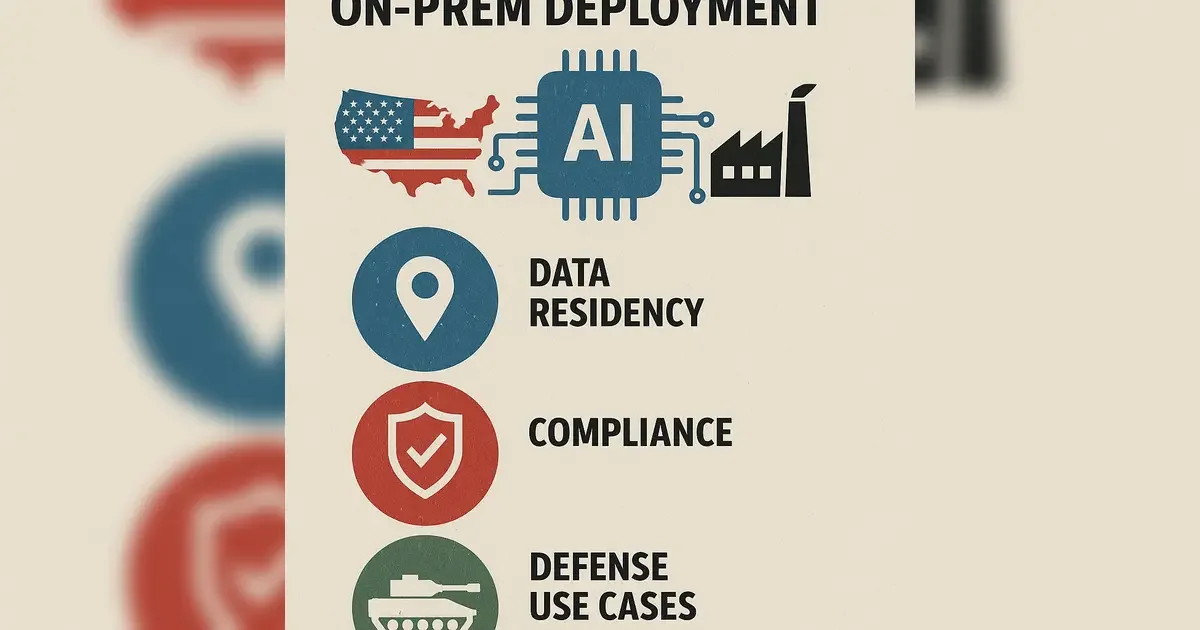
Local AI Sovereignty and On-Prem Deployment: Data Residency, Compliance, Defense Use Cases, and Industrial Policy Implications
The benchmark war is fought in the open. The sovereignty war is fought behind closed doors, in government ministries, defense procurement offices, and the legal departments of critical infrastructure operators who have quietly concluded that neither a San Francisco API endpoint nor a Beijing-affiliated open-weight model can be trusted with their most sensitive operational data. What fills that vacuum, and who fills it first, is the question that will define the institutional architecture of AI for the next generation.
Local AI sovereignty is not a niche concern for paranoid governments. It is the fastest-growing procurement requirement in enterprise AI globally. The legal pressure is coming simultaneously from multiple jurisdictions: the European Union's GDPR and the emerging EU AI Act compliance requirements, India's Digital Personal Data Protection Act, Brazil's LGPD, South Korea's PIPA, and a cascade of sector-specific regulations across healthcare, financial services, and critical infrastructure that share one irreducible requirement, data must not leave a defined legal perimeter. For any organization operating under these frameworks, the question "which AI model should we use?" has a preliminary question embedded inside it: "which AI models can we legally use?" The answer, in a growing number of jurisdictions, eliminates every cloud-API-gated proprietary model from the American sovereign cloud as the default commercial offering.
This regulatory pressure gradient is not a temporary friction that will smooth out as governments adjust to AI's commercial reality. It is hardening. And it is creating the most consequential structural advantage in the entire AGI OS war for any AI architecture that can operate fully on-premises, behind the customer's firewall, with zero data transmission to an external server.
The Data Residency Imperative: What "Sovereign" Actually Means in Legal Practice
The word "sovereign" is deployed so promiscuously in AI marketing that its legal meaning has been almost completely obscured. A genuine data residency compliance architecture requires four distinct conditions, none of which can be waived by terms-of-service language or enterprise addenda.
First: data at rest must physically reside within the legal jurisdiction, not merely in a data center that a vendor claims is jurisdiction-compliant, but in infrastructure whose physical location and legal chain of custody can be independently verified and audited. Second: data in transit must never cross jurisdictional boundaries, which means inference requests, model inputs, and model outputs cannot route through network infrastructure in non-compliant jurisdictions even transiently. Third: the model's operation must be transparent to the organization, meaning the organization must be able to audit what the model does with its data, which is structurally impossible when the model is a black box API call to an external server. Fourth: the infrastructure must be under the legal control of an entity subject to the organization's jurisdiction, meaning a cloud region operated by a US company under US law does not satisfy data sovereignty requirements for organizations operating under EU or Indian or Brazilian jurisdictional mandates, regardless of the physical location of the servers.
Against these four conditions, the competitive landscape resolves with unusual clarity. Cloud-gated proprietary American models fail conditions two and four for most non-US-aligned jurisdictions. Google's sovereign cloud region deployments address conditions one and two for allied nations where Google has established in-country infrastructure, but condition four remains contested, Google Cloud is a US company subject to US law, including the CLOUD Act, which allows US law enforcement to compel data disclosure from American cloud providers regardless of where the data physically resides. That legal exposure is not theoretical. It is the precise reason that multiple European government agencies and the German Bundestag have explicitly excluded US cloud providers from certain classified workload categories, irrespective of physical data center location.
Open-weight models, deployed fully on-premises on hardware owned and operated by the customer organization, satisfy all four conditions structurally. The weights are local. The inference is local. The data never moves. The infrastructure is under the customer's legal control. No CLOUD Act. No vendor uptime dependency. No API rate limit. No terms-of-service clause that the vendor can modify unilaterally. This is not a competitive advantage that DeepSeek or Qwen engineered specifically for European data protection compliance. It is an emergent consequence of the open-weight architecture that happens to satisfy the most demanding data residency frameworks in the world, and that is why procurement offices from Brussels to Tokyo are quietly evaluating Chinese open-weight models as compliance-compatible alternatives to American cloud APIs that are legally problematic under their domestic frameworks.
| Data Residency Condition | US Cloud API (GPT-5.5 / Claude Opus 4.7) | Google Sovereign Cloud Regions | Chinese Open-Weight (Self-Hosted) | US Distilled On-Prem (Codex-Spark / equivalent) |
|---|---|---|---|---|
| Physical data at rest within jurisdiction | Not guaranteed, multi-region routing | Yes, in-country infrastructure | Yes, customer-controlled hardware | Yes, customer-controlled hardware |
| Zero cross-border data transit | No, inference routes to US data centers | Partial, region-contained but vendor-operated network | Yes, no external network transmission | Yes, no external network transmission |
| Transparent model operation / auditability | No, black box API; model internals proprietary | No, model internals proprietary; auditability limited | Yes, open weights; full inspection possible | Partial, distilled weights may be inspectable; architecture partially disclosed |
| Legal control under customer jurisdiction | No, US company, US law, CLOUD Act exposure | Contested, US company with in-country operation; CLOUD Act unresolved | Yes, customer owns infrastructure; no foreign vendor legal claim | Yes, customer owns infrastructure after deployment |
| Compatible with EU GDPR Chapter V (third-country transfers) | Contested, SCCs required; adequacy decision gaps | Partial, sovereignty addenda help; CLOUD Act gap remains | Yes, no third-country transfer occurs | Yes, no third-country transfer occurs |
| Compatible with India DPDP Act significant data fiduciary requirements | No, data localization requirement not met | Partial, India region helps; fiduciary classification unclear | Yes, fully localizable | Yes, fully localizable |
| Compatible with defense / classified information handling | Only via classified cloud variants (Azure Gov Secret, etc.) | Only via accredited sovereign deployments (IL5) | Structurally possible; but content governance and provenance concerns apply | Yes, designed for air-gapped classified deployment scenarios |
The CLOUD Act exposure deserves direct engagement because it is the legal fault line that European, Indian, and Middle Eastern governments are most specifically concerned about, and that American cloud vendors have been most reluctant to address in their sovereign cloud marketing materials. The Clarifying Lawful Overseas Use of Data Act, enacted in 2018, gives US law enforcement and intelligence agencies the authority to compel American technology companies to produce data stored on their servers, anywhere in the world, without requiring international legal assistance treaties. A German hospital's patient data processed through a US cloud AI model, stored in a Frankfurt AWS data center, is reachable by a US federal subpoena without the German government's knowledge or consent. That is not a hypothetical scenario. It is the explicit legal interpretation of the CLOUD Act that European data protection authorities have consistently applied in their assessments of US cloud provider compliance with GDPR.
The political consequences of this legal architecture are beginning to materialize in procurement policy. France's ANSSI (Agence Nationale de la Sécurité des Systèmes d'Information) SecNumCloud certification, required for French government and critical infrastructure AI deployments, explicitly requires that the provider be immune from non-EU legal orders. No US cloud provider currently holds or can hold SecNumCloud certification. Germany's BSI has established comparable requirements for certain classified workload categories. The result is a growing class of European government AI deployment that is structurally foreclosed to American cloud providers, and that is being evaluated for open-weight solutions that, whatever their Chinese provenance concerns, at least satisfy the basic data residency requirement of never transmitting data to any external party.
Defense Use Cases: The Air-Gap Requirement and the Classified Intelligence Stack
Defense AI deployment operates under the most demanding version of the data sovereignty requirement: the air gap. An air-gapped system has no network connection to external infrastructure, not to the internet, not to a vendor's cloud, not to any external server of any kind. This is not a preference. In classified defense environments, it is a physical and operational security requirement with legal force. Any AI model that requires a network connection to function, including a connection to the vendor's inference API, is structurally ineligible for air-gapped classified deployment. Full stop.
This requirement immediately bifurcates the competitive landscape along an axis that neither benchmark tables nor API pricing analyses capture. On one side: models that can be downloaded, deployed locally, and operated without any ongoing vendor connectivity. On the other: models that require API calls to function at all. The first category includes every open-weight model in the Chinese swarm, DeepSeek V4-Pro, V4-Flash, all Qwen variants, Kimi's self-hosted release. The second category includes the standard commercial offerings of GPT-5.5, Claude Opus 4.7, and Gemini 3 Pro.
The American sovereign cloud's answer to this architecture is the classified cloud stack, the air-gapped, accredited variants of American AI that operate within the physical security perimeters of defense facilities under strict government oversight. Microsoft Azure Government Secret and Top Secret regions, AWS GovCloud with IC access, and Google's Public Sector IL5 infrastructure represent the serious American defense AI deployment pathway. These are not marketing claims. They are accredited, audited infrastructure environments that process classified information under National Security Systems directives, and they represent the domain where the American sovereign cloud has an absolute and durable competitive advantage that no Chinese open-weight model can challenge.
Classified American AI deployments are expanding. The specific programs are not discussed publicly, but the contracting vehicles are observable: OpenAI's relationship with Palantir and the US defense contracting ecosystem, Anthropic's investments from Amazon (which operates AWS GovCloud), Google's JEDI/JWCC cloud contract footprint, and the proliferation of AI-enabled intelligence analysis tools across the US intelligence community all represent an embedded classified AI infrastructure that deepens with every contract renewal. Nations that are military allies of the United States, the Five Eyes community, NATO members, key Indo-Pacific partners, gain access to this infrastructure layer through security cooperation agreements. Nations that are not allies do not.
But the defense AI conversation extends beyond the classified tier into a domain that is both more contested and more globally consequential: edge defense deployment. Autonomous weapons systems, battlefield intelligence platforms, naval sensor fusion networks, border surveillance infrastructure, and military logistics optimization systems operate in environments where cloud connectivity is intermittent, adversarially contested, or deliberately denied. These systems need AI that runs locally, on hardware that can survive in contested electromagnetic environments, without requiring a satellite uplink to query an inference API before making a targeting recommendation or logistics decision.
This is the defense deployment context where open-weight architecture's edge AI advantage becomes most strategically significant, and most politically sensitive. A nation that deploys DeepSeek V4-Flash on its military edge hardware has AI-enabled defense infrastructure that is not dependent on any US vendor, not reachable by any US legal compulsion, and not affected by any US export control that hasn't already been applied to the hardware it runs on. The model is already downloaded. The weights are already local. The dependency is broken at the point of acquisition.
The US Department of Defense's Project Maven AI initiative and the broader JADC2 (Joint All-Domain Command and Control) AI integration program are explicitly wrestling with this challenge: how to extend AI capability to the tactical edge without creating classified data exposure through cloud inference calls. The answer the US defense establishment is developing involves distilled, accredited variants of American AI deployed to edge hardware with hardware security modules and attestation frameworks. GPT-5.3-Codex-Spark on Cerebras is one commercial analogue to this approach, a distilled model running on specialized silicon without cloud dependency. But the defense program versions are classified, more capable, and more carefully hardened against adversarial manipulation than any commercial product.
| Defense Deployment Scenario | Air-Gap Required? | US Sovereign Cloud Solution | Chinese Open-Weight Applicability | Key Constraint / Risk Factor |
|---|---|---|---|---|
| Classified intelligence analysis (Five Eyes / NATO) | Yes, Top Secret / SCI environments | Azure Gov Secret / AWS IC; classified GPT / Claude variants | Structurally excluded, provenance and content governance unacceptable | Access restricted to US-allied nations; non-allies must develop domestic alternatives |
| Battlefield edge AI (autonomous systems, sensor fusion) | Yes, denied/contested network environments | Distilled edge models (Codex-Spark analogue); military-hardened hardware | Technically viable, V4-Flash / Qwen compact; politically unacceptable for US allies | Open-weight edge capability available to any nation; content governance absent |
| Non-allied nation defense modernization | Yes, sovereign hardware required | Not available, export control restrictions; alliance requirements | High applicability, open weights, no export restriction, self-hostable | CCP alignment in training objectives; potential backdoor concerns under active investigation |
| Border surveillance / critical infrastructure protection | Partial, intermittent connectivity acceptable | Azure / AWS government-contracted deployments; bilateral security agreements | High and growing, Huawei infrastructure + Chinese AI integrated in multiple nations | Integrated hardware-software stack creates deep dependency; difficult to reverse |
| Logistics and supply chain optimization (military) | Partial, sensitive but not always classified | Commercial cloud with government-grade security; well-established contracting | Emerging, Alibaba logistics AI heritage applies; open-weight self-hosting viable | US export controls limit allied-nation access to Chinese AI in military supply chain contexts |
| Cyber defense / threat intelligence analysis | Yes for classified threats; partial for unclassified | Classified AI tools across IC; CISA partnership for unclassified threat sharing | Structurally problematic, adversarial AI in defensive systems creates detection blind spots | Using adversary nation AI to defend against adversary nation cyber threats is a fundamental governance failure |
The non-allied nation defense modernization row deserves sustained analysis because it represents the most consequential and least discussed dimension of the AI sovereignty conflict. Approximately 100 nations are not formal military allies of the United States and have no access pathway to the classified American AI defense stack. These nations are simultaneously modernizing their militaries, facing domestic security threats, and evaluating AI tools for defense applications. Their options, in practice, are three: develop sovereign AI capability domestically (feasible for China, partially feasible for India and a handful of others; not feasible for most); acquire American commercial AI through standard export-controlled channels (available but constrained and without classified capability access); or self-host Chinese open-weight models on domestically operated hardware.
The third option is being chosen, quietly and increasingly, across a range of nations in Southeast Asia, the Middle East, and Africa. It is being chosen not necessarily because these nations trust China's AI more than America's, but because China's open-weight AI is available without an alliance requirement, without an export license, without terms of service that can be revoked by a foreign government, and at a total cost of ownership that the defense budgets of middle-income nations can actually sustain. The geopolitical implications of this adoption pattern are not yet visible in the traditional security literature. They will be.
Healthcare, Legal, and Financial Services: The Regulated-Industry Compliance Architecture
Below the defense tier but equally consequential for the AI sovereignty competition is the vast regulated-industry enterprise market, healthcare systems, legal services firms, financial institutions, and critical infrastructure operators whose AI deployment decisions are governed by sector-specific compliance frameworks that impose data residency, auditability, and governance requirements nearly as demanding as defense environments.
Healthcare presents the clearest case. A hospital system deploying AI for clinical decision support, patient record analysis, or diagnostic imaging interpretation is operating under HIPAA in the United States, under the General Data Protection Regulation's special category data provisions in the EU, under equivalent frameworks in most developed economies. The AI model processing patient data must satisfy business associate agreement requirements, audit logging requirements, data minimization principles, and the right of patients to explanation of automated decisions affecting their care. None of these requirements are easily satisfied by a cloud API call to a model whose internal workings are opaque, whose data processing locations are distributed across multiple cloud regions, and whose vendor relationship involves a consumer-grade terms of service that was written for a different use case entirely.
Building on the enterprise readiness comparison established in the previous section, the specific compliance architecture that the American sovereign cloud has constructed for healthcare is genuinely substantial. Anthropic's HIPAA Business Associate Agreements through AWS infrastructure, OpenAI's healthcare partnerships through Azure Healthcare APIs, and Google's Cloud Healthcare API with its FedRAMP High authorization and HIPAA compliance documentation represent a serious, audited compliance infrastructure that no Chinese AI vendor can currently offer to US-regulated healthcare operators. This is not a trivial advantage. The compliance infrastructure took years to build, requires continuous auditing, and represents a deep institutional relationship between the AI vendors and the healthcare regulatory apparatus that cannot be quickly replicated.
The countervailing force in healthcare AI is the data minimization and processing limitation principle embedded in GDPR and its derivatives: where possible, AI processing should occur on-premises, using the minimum data necessary, without data export to third parties. For European hospital systems evaluating AI-assisted diagnostic tools, the principle increasingly favors on-premises self-hosted models, and in the European context, that means open-weight models, because American closed-weight vendors cannot offer genuine on-premises deployment of their frontier models. The EU AI Act's forthcoming requirements for high-risk AI systems, which explicitly includes medical device AI and critical infrastructure AI, will intensify this pressure, mandating transparency, auditability, and conformity assessment processes that cloud-black-box APIs will struggle to satisfy without significant architectural changes to their inference and logging infrastructure.
Financial services presents a different but equally complex compliance architecture. Systemically important financial institutions (SIFIs) in the US, EU, and UK are subject to model risk management frameworks, most explicitly the US Federal Reserve's SR 11-7 guidance on model risk management, that require financial firms to understand, validate, and document the behavior of any model used in credit decisions, risk management, or customer-facing financial advice. An AI model that is a black box API call cannot satisfy SR 11-7's explainability requirements for most regulated financial applications. The model's developers may be able to provide some documentation, but the institution is required to conduct its own independent validation, which is structurally impossible for a model whose weights and architecture are proprietary.
This explainability requirement creates a subtle but powerful regulatory push toward open-weight models in financial services, not because open weights make a model more explainable to regulators in the intuitive sense, but because access to the model's weights enables the institution to conduct the independent technical validation that SR 11-7 requires. An institution that self-hosts a DeepSeek or Qwen open-weight model can hire quantitative researchers to probe the model's behavior systematically, run adversarial evaluations, and document the model's failure modes in ways that satisfy regulatory examination. An institution using GPT-5.5 via API cannot do any of these things to the same depth. The regulatory requirement for independent validation becomes, in effect, a regulatory incentive for open-weight adoption in financial services model risk contexts.
| Regulated Industry | Primary Compliance Framework | Key AI-Specific Requirement | US Sovereign Cloud Compliance Status | Chinese Open-Weight Self-Hosted Status | Critical Gap / Decision Factor |
|---|---|---|---|---|---|
| Healthcare (US) | HIPAA / HITECH; 21st Century Cures Act | PHI protection; BAA requirement; audit logging; right to explanation | Strong, HIPAA BAAs available from OpenAI/Azure, Anthropic/AWS, Google/GCP | Possible but unsupported, no BAA from Chinese vendors; self-hosted means customer assumes HIPAA responsibility | US cloud wins on vendor-supported compliance; open-weight wins on data minimization and processing limitation principles |
| Healthcare (EU) | GDPR special category data; EU AI Act (high-risk); MDR for diagnostic AI | Data minimization; purpose limitation; no third-country transfer; conformity assessment | Contested, CLOUD Act / GDPR Chapter V tension; no US provider holds SecNumCloud | Structurally compliant on data residency; governance and content policy auditing required | EU AI Act conformity assessment may favor inspectable open-weight models over opaque cloud APIs |
| Financial Services (US) | SR 11-7 Model Risk Management; Basel III operational risk; SEC AI guidance | Independent model validation; explainability; documentation of failure modes | Partial, black box API limits independent technical validation; documentation support improving | Better for independent validation, open weights enable deep adversarial evaluation; governance gap on content policy | SR 11-7 independent validation requirement structurally favors open weights for credit and risk models |
| Financial Services (EU) | DORA (Digital Operational Resilience Act); EBA AI guidelines; GDPR | ICT third-party risk management; concentration risk; operational resilience; data sovereignty | High concentration risk, single US vendor dependency flagged under DORA; CLOUD Act exposure | Addresses concentration risk; self-hosted eliminates third-party ICT dependency; DORA operational resilience compatible | DORA's ICT concentration risk provisions create structural incentive to self-host or diversify away from single US cloud vendor |
| Legal Services | Attorney-client privilege; professional responsibility rules; GDPR / jurisdiction-specific confidentiality | Confidentiality of client communications; no third-party processing without consent; explainability of AI-assisted advice | Partial, US-based legal AI vendors have developed BAA-equivalent for legal; attorney-client privilege API logging risk | Strong on confidentiality, no external transmission; privilege preserved; open weights enable firm-specific fine-tuning on practice area | Attorney-client privilege and confidentiality requirements strongly favor on-premises self-hosting; open-weight governance concerns apply to content accuracy |
| Critical Infrastructure (Energy / Telecom / Water) | NERC CIP (energy); TSA directives (pipeline / aviation); sector-specific CISA guidance | OT/IT convergence security; air-gap requirements for operational technology; supply chain security | Strong in classified tier; commercial cloud insufficient for OT environments without additional hardening | Viable for OT-adjacent use cases; supply chain security concerns regarding Chinese AI in US critical infrastructure are regulatory focus | CISA and NSA guidance explicitly flags concerns about Chinese AI in critical infrastructure, creates procurement barrier for open-weight models regardless of technical capability |
The critical infrastructure row surfaces the most important regulatory wildcard in the entire data residency and compliance landscape: the explicit and growing US government guidance warning against Chinese AI adoption in critical infrastructure environments. The Cybersecurity and Infrastructure Security Agency and the National Security Agency have both issued advisories, increasingly specific in their language, flagging supply chain risks associated with Chinese AI models, particularly open-weight models whose training provenance cannot be fully audited and whose parameter files cannot be comprehensively inspected for steganographic payloads, backdoors, or capability suppressions embedded during training.
This is not a theoretical concern invented by Washington bureaucrats. It is a technically grounded concern with precedent: hardware backdoors in Chinese telecommunications equipment (the Huawei 5G controversy) established that sophisticated actors can embed surveillance or sabotage capabilities in technology products that are genuinely functional and genuinely useful. Whether similar techniques have been applied to large language model weights is an open research question, but it is a question that US critical infrastructure operators cannot afford to answer empirically by deploying and waiting to see what happens. The precautionary principle applies with particular force when the failure mode is an AI model that behaves normally until it receives a specific activation signal, at which point it silently exfiltrates data, provides subtly incorrect outputs on specific query types, or becomes unavailable at a strategically chosen moment.
The weight inspection problem is technically severe. A 1.6-trillion-parameter model contains more numerical values than any static analysis tool can comprehensively audit for adversarial patterns. Behavioral testing, running the model against comprehensive test suites and checking for anomalous outputs, can surface known backdoor signatures but cannot prove the absence of unknown ones. The field of model auditing is advancing rapidly, with red-teaming methodologies and mechanistic interpretability tools making genuine progress, but the gap between what can be audited today and what would constitute adequate assurance for critical infrastructure deployment is wide enough to sustain a credible regulatory prohibition regardless of the technical excellence of the underlying model.
Industrial Policy Implications: How Governments Are Responding to the Sovereignty Imperative
The data residency and compliance pressure that individual organizations face is creating a parallel pressure at the national policy level, a wave of industrial policy interventions designed to shape the AI infrastructure choices that domestic organizations make, ensure that strategic AI capability develops domestically, and prevent foreign AI infrastructure from creating dependencies that could be weaponized in a geopolitical crisis.
The European Union's AI industrial policy is the most architecturally developed of these frameworks. The EU AI Act, the world's first comprehensive AI regulatory framework, creates a risk tiering system that will, in practice, push high-risk AI deployments toward explainable, auditable, conformity-assessed systems. The European Commission's investment in GAIA-X, the federated European cloud infrastructure initiative, and the funding of European large language model development through programs like the French government-backed Mistral AI (which has produced open-weight models that are both technically competitive and legally European) represent a third path, neither American sovereign cloud nor Chinese open-weight swarm, but a European AI sovereignty stack built on open-weight foundations with European governance provenance.
France's €500 million investment in sovereign AI infrastructure, Germany's LEAM (Large European AI Models) initiative, and the EU's €1 billion commitment through Horizon Europe to foundational AI research are not merely research grants. They are industrial policy interventions designed to ensure that Europe has credible domestic alternatives to both American and Chinese AI infrastructure before regulatory frameworks create mandatory procurement barriers that expose the absence of such alternatives. The European industrial policy calculation is explicit: if the EU AI Act's requirements effectively mandate on-premises, auditable AI for high-risk use cases, and if no credible European AI infrastructure exists at that moment, the practical beneficiary of European regulation will be Chinese open-weight models, not the outcome European industrial policy intends.
India's AI industrial policy reveals a different strategic logic, one more explicitly oriented toward technological sovereignty as an economic and military instrument. The IndiaAI Mission, launched with an initial investment of ₹10,372 crore (approximately $1.25 billion), includes explicit infrastructure for compute access (6,000 GPU cluster), an open AI dataset platform, and foundational model development. India's approach is self-consciously non-aligned: developing domestic capability rather than choosing between American or Chinese AI infrastructure, while maintaining the flexibility to engage with both. The DPDP Act's data localization requirements for significant data fiduciaries are the regulatory enforcement mechanism ensuring that this industrial policy preference translates into actual deployment patterns rather than remaining aspirational.
Saudi Arabia's Project Transcendence, a $100 billion AI investment program, and the UAE's AI strategy, anchored by TII (Technology Innovation Institute) and the development of the Falcon model series, represent the Gulf states' approach: using sovereign wealth to acquire the capability to run frontier AI without depending on either American or Chinese infrastructure. The Falcon model family, developed in Abu Dhabi, is an open-weight series that gives GCC nations a provenance-clean alternative to Chinese open-weight models for sovereign self-hosting. The strategic calculation is straightforward: a nation with $100 billion to invest in AI infrastructure does not want its national AI capability to be contingent on either Washington's geopolitical disposition or Beijing's regulatory requirements.
| Nation / Bloc | Industrial Policy Instrument | Investment Scale | Sovereign AI Architecture Preference | Key Regulatory Driver | Geopolitical Alignment Implication |
|---|---|---|---|---|---|
| European Union | EU AI Act; GAIA-X; Horizon Europe AI funding; Mistral investment | €1B+ direct; national supplements (France €500M, Germany LEAM) | European open-weight (Mistral et al.); sovereign cloud regions for government | GDPR; EU AI Act conformity assessment; CLOUD Act exclusion; DORA ICT concentration risk | Third path, neither US nor Chinese AI dependency; regulatory framework creates demand for European alternatives |
| India | IndiaAI Mission; DPDP Act data localization; National AI Strategy | ₹10,372 crore (~$1.25B); 6,000 GPU public compute cluster | Domestic development + selective open-weight adoption; non-aligned posture | DPDP Act; strategic autonomy doctrine; defense offset requirements | Non-aligned; seeks leverage with both US and Chinese AI blocs; domestic capability essential precondition |
| Saudi Arabia / UAE | Project Transcendence; TII Falcon models; UAE AI Strategy 2031 | $100B (Saudi); multiple billions (UAE) | Sovereign open-weight (Falcon); selective American cloud for financial infrastructure; avoiding Chinese dependency | National data sovereignty; strategic economic diversification; AI as national competitiveness instrument | Purchasing sovereignty, using capital to avoid dependence on either bloc; Falcon as Islamic world AI anchor |
| Japan | AI Strategy 2022 (revised 2025); NEDO AI compute investment; NTT LLM development | ¥4 trillion 10-year AI investment package | Japanese-language sovereign models (NTT Tsuzumi et al.); American sovereign cloud for alliance contexts | Act on Protection of Personal Information; defense alliance requirements; semiconductor sovereignty | US-aligned but pursuing Japanese-language sovereignty; Tsuzumi as sovereign fallback for Japanese-specific use cases |
| South Korea | Korean AI Semiconductor Strategy; NAVER HyperCLOVA X; K-Cloud initiative | ₩1 trillion+ AI semiconductor investment; national LLM funding | Korean open-weight (HyperCLOVA X) for domestic; American cloud for enterprise multinational | PIPA data localization; defense alliance; semiconductor industrial policy | US-aligned militarily; pursuing Korean-language sovereignty for cultural and economic autonomy |
| United States | Executive Order on AI; CHIPS Act; export control regime; NIST AI RMF; NSF National AI Research Institutes | $52B CHIPS Act; NSF AI research funding; classified defense AI investment (undisclosed) | Proprietary sovereign cloud (OpenAI/Anthropic/Google) for civilian; classified military AI for defense | Export controls on AI chips; CLOUD Act; NSS directives for classified AI; AI safety frameworks | Exporting sovereign cloud dependencies to allies; export controls as leverage instrument; classified stack as alliance benefit |
| China | National AI Development Plan; New Generation AI Governance Principles; open-weight proliferation strategy | Multi-trillion RMB national AI investment (cumulative, state + private) | Domestic proprietary (Baidu ERNIE, etc.) + open-weight export (DeepSeek / Qwen / Moonshot) | CAC AI regulations; algorithmic recommendation rules; generative AI governance measures; state content requirements | Open-weight proliferation as soft power; domestic proprietary stack for national security; dual track serves both objectives simultaneously |
The industrial policy landscape reveals a dynamic that neither bloc has fully grappled with: the most strategically important AI sovereignty decisions of 2026 are being made by nations that are not primarily choosing between American and Chinese AI. They are choosing between dependency and autonomy, and both American and Chinese AI architectures represent a form of dependency. The EU, India, the Gulf states, Japan, and South Korea are all investing in domestic AI capability not because they believe they can outcompete OpenAI or DeepSeek at the frontier, but because they understand that sovereign AI capability is a precondition for genuine policy autonomy. A government whose critical infrastructure runs on American AI is subject to American policy preferences. A government whose critical infrastructure runs on Chinese AI is subject to Chinese policy preferences. Neither is acceptable to a nation that intends to maintain genuine strategic independence.
This creates a structural demand for a third architecture that neither bloc is currently positioned to supply at scale: frontier-quality AI with open, auditable governance provenance, operable fully on-premises, without CLOUD Act exposure, without CCP content alignment, and without the training data opacity that makes neither American nor Chinese AI fully trustworthy in high-stakes sovereign contexts. The EU's bet on Mistral, the Gulf's bet on Falcon, India's IndiaAI foundational model program, these are early expressions of that demand. They are not yet competitive with the frontier. But the industrial policy investment that is flowing toward them is large enough, and the regulatory pressure creating demand for them is strong enough, that the 2028-to-2030 timeframe may see sovereign alternatives that are genuinely competitive for the specific use cases, regulated industries, government operations, defense-adjacent workloads, where provenance and governance matter more than absolute benchmark performance.
The On-Premises Deployment Stack: Infrastructure Economics and the Hardware Sovereignty Loop
Translating the data residency requirement into an actual functioning on-premises AI deployment requires solving a hardware and infrastructure problem that is considerably more complex than downloading model weights and running an inference server. The economics of on-premises AI deployment, capital expenditure, operational expenditure, maintenance burden, performance envelope, and upgrade cycle, determine whether self-hosting is a genuine organizational capability or a technically possible but operationally impractical aspiration.
The economic calculus has shifted dramatically over the past 18 months due to three concurrent developments. First, the quantization and compression techniques embedded in models like DeepSeek V4-Flash have reduced the minimum hardware requirement for running a capable open-weight model at production quality. Second, the commoditization of GPU clusters through hyperscale manufacturing and competition between NVIDIA, AMD, and emerging accelerators has reduced the capital cost per unit of inference compute. Third, the maturation of inference serving frameworks, vLLM, SGLang, TRT-LLM, Ollama for smaller deployments, has reduced the engineering burden of deploying and operating a self-hosted model to a level that a well-staffed enterprise IT team can manage without dedicated AI infrastructure specialists.
The result is that the total cost of ownership comparison between self-hosted open-weight AI and cloud API AI has shifted decisively in favor of self-hosting for any organization with inference volumes above a threshold that is lower than most enterprise buyers realize. The threshold calculation requires accounting for: hardware amortization over three to five years (standard data center capex cycle), power and cooling operating costs, inference server software engineering costs, and the absence of per-token API billing. Building on the pricing analysis established in the previous section, where cloud frontier APIs run at $5 to $30 per million tokens, any organization generating more than a few hundred million tokens of inference per month reaches a breakeven point where hardware capital expenditure plus operating costs is lower than the ongoing API bill. For large enterprises, that breakeven is reached at volumes that are well within normal enterprise AI workload projections for 2026.
The hardware sovereignty dimension adds a further strategic layer to this economic calculation. Building on the Huawei Ascend NPU analysis in the China Open-Weight Swarm section, the emergence of credible non-NVIDIA AI accelerator options, Huawei Ascend for China-aligned operators, AMD Instinct for export-control-compliant alternatives, Intel Gaudi for enterprises seeking NVIDIA diversification, domestic accelerators in development in France, Japan, and India, means that the hardware dependency risk of an on-premises deployment is no longer exclusively an NVIDIA dependency. An organization that self-hosts on AMD Instinct MI300X hardware using an open-weight model with AMD-optimized inference support has broken both the software vendor dependency (no API provider) and the hardware vendor concentration risk (no NVIDIA monopoly) simultaneously. That is a supply chain resilience architecture that no cloud API deployment can match.
The inference geography that results from this confluence of economic and hardware sovereignty factors is beginning to look less like a hub-and-spoke network centered on hyperscale data centers and more like a distributed mesh of sovereign inference nodes, each operating under local jurisdiction, running locally owned hardware, executing locally downloaded model weights, processing locally generated data, and contributing to a global AI ecosystem that is structurally resilient to any single vendor's pricing decision, any single government's export control regime, or any single geopolitical disruption.
That distributed sovereignty architecture is what China's open-weight swarm was designed to enable. Whether it was designed with that geopolitical awareness explicitly embedded in the engineering decisions or whether it emerged as an emergent consequence of the open-weight proliferation strategy is, for practical purposes, irrelevant. The outcome is the same: a global on-premises AI deployment infrastructure is being assembled, model weight by model weight, GPU cluster by GPU cluster, across jurisdictions that the American sovereign cloud cannot reach and that the Chinese government cannot directly control, built on Chinese AI architecture, optimized by a global open-source community, operated by sovereign organizations that answer to no one but their own legal frameworks.
That is the local AI sovereignty endgame. And it is arriving faster than the institutions responsible for managing it have yet recognized.
The Provenance Problem: When Open Weights Are Not Neutral Infrastructure
There is one dimension of the local AI sovereignty discussion that deserves unflinching engagement, because it is the dimension that is most frequently elided in the commercial enthusiasm for open-weight deployment, and the most consequential for the organizations and governments whose sovereignty-based procurement decisions rest on assumptions about what "self-hosted" actually means in terms of values, content governance, and embedded capability.
Downloading DeepSeek V4-Pro and running it on your own hardware means you own the compute. It does not mean you own the model's worldview, its capability boundaries, or its embedded behavioral dispositions. The model's weights encode the values, content policies, and capability constraints of the training regime that produced them, a training regime that operated under Chinese regulatory requirements, with Chinese government-aligned content filtering, and under a Chinese industrial policy whose objectives are not identical to those of a European hospital, an American law firm, or an Indian defense ministry.
The specific manifestations of this embedded governance are well documented. Models trained under Chinese regulatory requirements refuse certain queries, provide certain answers, and suppress certain discussions in ways that reflect CCP content governance mandates. These behaviors persist in self-hosted deployments unless the operator conducts extensive fine-tuning to remove them, a process that requires significant technical expertise, that risks degrading other model capabilities, and that introduces new uncertainty about what other behavioral modifications the fine-tuning may have inadvertently created. The model you end up with after removing Chinese content governance constraints through fine-tuning is not necessarily the model you wanted. It may be a model with unpredictable new failure modes created by the process of editing training-embedded dispositions that were deeply entangled with the model's other capabilities.
Beyond content governance, the more technically severe concern is the weight inspection problem described earlier in this section: the impossibility of comprehensively auditing 1.6 trillion parameters for adversarial modifications embedded during training. This is not a hypothetical academic concern for most enterprise deployments, it is a practical risk management question that each organization must answer for itself based on its threat model, its use case sensitivity, and its tolerance for unverified behavioral dispositions in its AI infrastructure. A startup deploying DeepSeek V4-Flash for customer service chatbot optimization is taking a different and much smaller provenance risk than a defense contractor deploying it for supply chain analysis, or a financial institution using it for fraud detection, or a healthcare system using it for clinical decision support.
The responsible framing of the local AI sovereignty analysis acknowledges this provenance problem directly, rather than treating open-weight self-hosting as a clean solution to the data residency problem. The honest answer is that open-weight Chinese AI models solve the data location problem and the vendor dependency problem, genuinely and structurally. They do not solve the training provenance problem or the embedded governance problem. Organizations that treat these as interchangeable are making a category error that could have serious consequences in high-stakes deployments. The sovereignty question has multiple dimensions, and "self-hosted" addresses only some of them.
This is precisely why the third-path industrial policy investments, EU sovereign AI, Falcon in the Gulf, IndiaAI foundational models, Mistral, Tsuzumi, HyperCLOVA X, represent the most consequential long-term architecture competition of the AGI OS war. The organizations and nations that will win the sovereign AI infrastructure competition are not those that choose between American cloud API dependency and Chinese weight provenance dependency. They are those that develop or adopt models with both genuine on-premises deployability and independently auditable, provenance-clean governance frameworks. That combination does not yet exist at frontier quality in the 2026 competitive landscape. The industrial policy investments flowing toward it suggest it will exist within the next three to five years, and the lab that delivers it first will capture the most valuable and fastest-growing segment of the global AI market: sovereign enterprise deployment in jurisdictions that cannot accept either American or Chinese AI infrastructure on its current terms.
The local AI sovereignty war is therefore a race within the larger AGI OS war. The finishing line is not the most capable model. It is the most capable model that can be fully owned, fully audited, fully operated, and fully governed by the organization or nation that deploys it, with no foreign vendor leverage, no foreign government content mandate, no CLOUD Act exposure, and no weight provenance uncertainty. The race for that finishing line is already underway. The winner has not yet been determined. And the stakes, measured in institutional trust, regulatory compliance, and genuine strategic autonomy, are higher than any benchmark score will ever reveal.
Pricing Destruction in 2026: API Cost Collapse, Open-Weight Economics, Compute Arbitrage, and the Race to Commoditize Intelligence
The economics of intelligence are breaking. Not bending, breaking. Every structural assumption that justified the venture capital tsunami flowing into closed-weight AI labs between 2020 and 2024, that frontier models require billions in compute, that users will pay premium per-token rates indefinitely, that proprietary weights create durable moats, is being stress-tested simultaneously by forces that compound rather than merely compete. The result is a pricing destruction event unlike anything the enterprise software industry has experienced since the open-source movement hollowed out the proprietary Unix market in the 1990s. Except this time, it is moving faster. And the stakes are orders of magnitude larger.
Building on the cost-structure analysis established in the benchmark and sovereignty sections, this section goes deeper into the mechanism of pricing destruction itself, not merely that it is happening, but how the economic logic operates, where the floor actually is, which actors benefit and which are structurally damaged, and what the endgame looks like when intelligence approaches commodity pricing in a world where American AI labs still need to fund the next frontier training run.
The Pricing Destruction Mechanism: Three Simultaneous Vectors
Pricing destruction in AI does not operate through a single mechanism. It operates through three simultaneous and reinforcing vectors, each applying pressure from a different direction on the economics of the American sovereign cloud model. Understanding all three is essential to understanding why the price compression is structural rather than cyclical, a permanent reconfiguration of the market rather than a temporary competitive response that frontier quality advantages will eventually neutralize.
Vector One: Open-weight cost floor compression. Each new Chinese open-weight release resets the minimum viable price for AI inference at a given capability level to approximately zero, because self-hosted open-weight inference has no per-token API billing. The only relevant cost is capital expenditure on hardware plus power and cooling. When DeepSeek V4-Flash, with 13 billion active parameters and a 1M token context window, can run on commodity GPU hardware that many enterprises already own for other workloads, the marginal cost of incremental AI inference for that class of task approaches zero at the query level. Zero is not a price that OpenAI's $30-per-million-output-token GPT-5.5 Pro can undercut. It is a pricing regime that exists in a different economic category entirely.
Vector Two: Architectural efficiency gains accelerating faster than pricing power. Every generation of AI models produces more capability per dollar of compute than the previous one, but the rate of capability-per-dollar improvement is outpacing the rate at which AI labs can extract more revenue per unit of capability through pricing power. SemiAnalysis's April 2026 analysis establishes this precisely: GPT-5.5 scores higher on benchmarks than GPT-5.4 while consuming fewer reasoning tokens. DeepSeek V4-Pro requires only 27% of the inference FLOPs of V3.2 at 1M token context. Anthropic's Claude Opus 4.7, despite its new tokenizer's 35% token usage increase, delivers measurably better agentic outputs per task. Each of these represents efficiency gains that compress the cost-per-task metric even as per-token pricing holds or increases. When cost-per-task falls faster than per-token price can rise, the vendor's revenue per unit of actual work delivered to the customer declines. The labs are running on a treadmill: constant pricing pressure to justify frontier training economics, constant efficiency improvement that erodes the revenue extracted from each compute dollar spent.
Vector Three: Jevons paradox-driven demand expansion that benefits open-weight providers disproportionately. The January 2025 DeepSeek R1 release did not merely crash NVIDIA's stock by forcing AI labs to re-examine their cost structures. It triggered the Jevons paradox mechanism that every serious economist of AI had been predicting and every AI lab CEO was hoping to control: cheaper AI does not reduce total AI consumption, it dramatically expands it. As SemiAnalysis observes, this paradox has "played out quite clearly in the 16 months since" R1's release, with the Great GPU Shortage now defining the 2026 compute landscape. But the demand expansion triggered by cheaper open-weight AI disproportionately benefits the open-weight providers, because the marginal user who enters the AI market at a lower price point is, by definition, more price-sensitive and less likely to pay frontier API rates when a near-equivalent capability is available for self-hosting cost. The new demand created by pricing destruction accrues to the cheapest provider. In AI, the cheapest provider is always an open-weight model running on hardware the customer already owns.
| Pricing Destruction Vector | Mechanism | Primary Beneficiary | Primary Damaged Party | Reversibility |
|---|---|---|---|---|
| Open-weight cost floor compression | Self-hosted open weights set marginal inference cost ≈ $0 for capable models; eliminates per-token billing for self-hosting enterprises | Enterprises with existing GPU hardware; non-aligned sovereign deployments; price-sensitive developer ecosystem | US closed-weight API providers (OpenAI, Anthropic, Google commercial tier) | Structurally irreversible, weights once released cannot be un-released; cost floor cannot be raised |
| Architectural efficiency compression | Capability-per-FLOP improves faster than pricing power; token efficiency gains reduce revenue-per-task even at constant per-token rates | Enterprise customers at scale; cloud providers passing efficiency savings to retain customers | All AI labs facing revenue-per-task compression; particularly acute for labs without hardware-to-software vertical integration | Cyclical compression, not reversal, efficiency gains are permanent; only new capability tiers can reset pricing power |
| Jevons paradox demand expansion | Lower AI prices expand total demand; marginal new users are price-sensitive and prefer open-weight; demand expansion accrues to cheapest providers | Open-weight Chinese swarm; GPU hardware vendors (NVIDIA, AMD); cloud infrastructure providers running open-weight hosted inference | Premium closed-weight API providers losing marginal market share to open-weight as market expands | Paradox-driven, cannot be reversed without raising prices, which contradicts demand expansion dynamic |
The API Price Timeline: From $60 Per Million to the Floor
The speed of API price compression in AI has no precedent in enterprise software history. To appreciate the magnitude of what has happened, the price trajectory of frontier AI API access must be examined against the historical baseline, not as a smooth decline but as a series of violent discontinuities, each triggered by an open-weight release event that forced American labs to respond or concede developer mindshare.
In early 2023, GPT-4's output pricing ran at approximately $60 per million tokens. That figure reflected genuine scarcity of frontier AI capability, near-zero competition from open alternatives at equivalent quality, and an enterprise buyer pool that had no credible alternative to evaluate against. The moat felt real because it was real: no open-weight model came close to GPT-4 quality on the tasks that enterprise buyers were evaluating it for.
Then Meta's LLaMA release began dissolving the moat's outer edges. Then Mistral's releases pushed the dissolution inward. Then DeepSeek's R1, released in January 2025 with open weights that delivered reasoning capability previously associated exclusively with American frontier models, detonated the pricing floor entirely. As Bloomberg's April 2026 analysis of Chinese AI's threat to Silicon Valley establishes, the open-weight bet challenges the dominant US business model predicated on billions in investment and top-dollar per-token pricing, and that challenge arrived not gradually but in the form of a model release that forced market-wide repricing within weeks.
By mid-2025, frontier API output pricing for non-flagship models had compressed to single-digit dollars per million tokens. By Q4 2025, competition from hosted Chinese model APIs, DeepSeek offering hosted inference at a fraction of American lab pricing, was forcing further compression. By Q2 2026, the pricing landscape presents a bifurcated structure: ultra-premium frontier models at $30 per million output tokens (GPT-5.5 standard) to $180 per million output tokens (GPT-5.5 Pro), and a vast middle and lower market where hosted open-weight inference is available at prices that American labs cannot sustainably match without destroying the revenue economics that fund their frontier training runs.
| Model / Tier | Provider | Input Price (per 1M tokens) | Output Price (per 1M tokens) | Priority / Fast Mode Surcharge | Self-Host Alternative Available? | Effective Cost vs. 2023 GPT-4 Baseline |
|---|---|---|---|---|---|---|
| GPT-5.5 (standard) | OpenAI | $5.00 | $30.00 | 2.5× standard rate for priority SLA | No, closed weight | ~50% of 2023 GPT-4 output pricing at nominally superior capability |
| GPT-5.5 Pro | OpenAI | $30.00 | $180.00 | Priority tier available at 2.5× surcharge | No, closed weight | 3× 2023 GPT-4 pricing for SOTA scientific reasoning capability |
| GPT-5.3-Codex-Spark | OpenAI / Cerebras | Below standard tier | Below standard tier | None disclosed; throughput-optimized pricing | No, closed weight; Cerebras hardware dependency | Below standard tier; throughput economics vs. per-token |
| Claude Opus 4.7 (standard) | Anthropic | Comparable to GPT-5.5 | Comparable to GPT-5.5 | Opus 4.6 Fast: 2.5× faster for 6× price (only SKU with real traction) | No, closed weight | Effective +35% vs. stated rate due to 4.7 tokenizer change; similar to 2023 GPT-4 output range |
| Gemini 3 Pro (enterprise) | Google DeepMind | Competitive with Anthropic at enterprise scale | Tiered; TPU economics advantage within GCP | Google Cloud committed-use discounts available | No, closed weight | Advantaged for existing GCP customers; standard commercial rates competitive |
| DeepSeek V4-Pro (hosted API) | DeepSeek | Fraction of US frontier pricing | Fraction of US frontier pricing | None disclosed | Yes, open weights; full self-hosting available | Estimated 80–95% below GPT-5.5 standard for equivalent task classes |
| DeepSeek V4-Flash (self-hosted) | DeepSeek (open weight) | $0 per-token marginal cost (hardware + power only) | $0 per-token marginal cost (hardware + power only) | None, operator sets own SLA | Yes, designed for self-hosting; 13B active parameters on commodity GPU | Near-zero marginal cost at scale; capex-only model replaces opex-only API billing |
| Qwen3.6-Plus (hosted + self-hosted) | Alibaba / Qwen | Below US frontier pricing on Alibaba Cloud | Below US frontier pricing on Alibaba Cloud | Alibaba Cloud committed-use discounts | Yes, open weights; dual-track commercial + self-hosting | Significantly below US frontier; self-hosted near-zero marginal |
| Kimi K2.6 (API) | Moonshot AI | Competitive with Chinese open-weight pricing | Below US frontier pricing | None at published rates | Partial, self-hosting options for open-weight releases | Significantly below US frontier for long-context workloads |
The table above contains a number that should be read with particular care: DeepSeek V4-Flash's effective per-token price of zero for self-hosting operators. That zero is not a promotional rate. It is not a loss-leader penetration price that will revert to market rates once market share is captured. It is the permanent structural price of intelligence at the open-weight margin, because it reflects the actual economics of inference on hardware the operator already owns. No American lab can sustainably price below zero. The floor has been set by physics and accounting, not by competitive strategy.
The Cost-Per-Task Revolution: Why Per-Token Pricing Is Already Obsolete
The per-token pricing model is dying. Not immediately, the transition will take years, and per-token billing will remain the dominant commercial mechanism for cloud-gated AI API consumption through at least the near term. But as a value metric, as the unit by which enterprises actually evaluate AI economics, per-token pricing has already been superseded by cost-per-task. And the shift from cost-per-token to cost-per-task thinking has profound implications for how the pricing war plays out.
SemiAnalysis quantified this precisely for its Tokenomics model subscribers: cost per task, not cost per token, is the true north star metric that determines model pricing competitiveness. The example they provide is illustrative: a model that costs 5× more per token but solves the same problem using 80% fewer tokens is actually cheaper per completed task. This is not a theoretical edge case, it is the central economic reality of the 2026 frontier, where different models have dramatically different reasoning efficiency profiles for different task types.
GPT-5.5's claim of better benchmark performance at lower token consumption than GPT-5.4 is explicitly a cost-per-task argument, not a per-token argument. Anthropic's task budget feature in Claude Opus 4.7 beta, which allows operators to suggest efficiency targets for task completion, is an acknowledgment that cost-per-task management is becoming an enterprise requirement rather than a developer optimization. DeepSeek V4-Pro's 27% inference FLOP reduction at 1M token context translates directly into lower cost per long-context reasoning task, independent of per-token billing rates.
The cost-per-task framing changes the competitive picture in ways that complicate simple per-token price comparisons between American and Chinese models. A task that GPT-5.5 completes in 800 reasoning tokens at $30 per million output tokens costs $0.024. The same task completed by a self-hosted DeepSeek V4-Pro instance, even if it requires 2,000 tokens due to less efficient reasoning, costs approximately $0.0003 in power and cooling amortized across a well-utilized inference cluster. The 80× cost-per-task differential is not sensitive to modest variations in token efficiency. At those magnitudes, efficiency variations are noise. The structural economics are decisive.
The cost-per-task revolution is reshaping enterprise AI procurement in real time. Sophisticated enterprise buyers, particularly large-scale developers and data-intensive operators running millions of tasks per day, have already built internal TCO models that account for hardware amortization, power costs, inference server engineering overhead, and the opportunity cost of per-token API dependency. For these operators, the conclusion of those models is no longer ambiguous: at sufficient scale, self-hosted open-weight inference is cheaper than frontier API access even accounting for the engineering overhead of operating it. The scale threshold at which self-hosting becomes economically superior is declining with every improvement in open-weight model capability and every improvement in inference serving framework maturity.
| Task Category | Typical Token Consumption | GPT-5.5 Cost Per Task ($30/M output) | DeepSeek V4-Flash Self-Hosted Estimated Cost Per Task | Cost Differential | Scale at Which Self-Host Pays Off (monthly) |
|---|---|---|---|---|---|
| Simple customer service query | ~200 output tokens | $0.006 | ~$0.00008 (power + amortization) | ~75× cheaper self-hosted | ~10,000 tasks/month (minimal scale) |
| Standard code review (500-line PR) | ~2,000 output tokens | $0.060 | ~$0.0008 | ~75× cheaper self-hosted | ~5,000 reviews/month |
| Long-context document analysis (50-page legal contract) | ~50,000 input + ~5,000 output tokens | $0.40 input + $0.15 output = $0.55 | ~$0.004 (long-context efficiency advantage of V4) | ~140× cheaper self-hosted | ~1,000 documents/month |
| Agentic multi-step coding task (new feature implementation) | ~100,000 tokens across agent loop | $3.00 (output-heavy reasoning) | ~$0.02 (self-hosted; reasoning efficiency varies) | ~150× cheaper self-hosted | ~500 tasks/month |
| Large codebase reasoning (1M token context) | ~1,000,000 input + ~10,000 output tokens | $5.00 input + $0.30 output = $5.30 | ~$0.03 (V4-Pro 90% KV cache reduction; hardware costs dominant) | ~175× cheaper self-hosted | ~200 sessions/month |
| Scientific research synthesis (GPT-5.5 Pro quality required) | ~50,000 input + ~20,000 output tokens | $1.50 input + $3.60 output = $5.10 (Pro rates) | Open-weight near-parity not yet established; V4-Pro competitive but not equivalent | Differential narrows, quality premium may justify US frontier pricing | Quality-dependent; frontier preference at small scale |
The scientific research row in the table above is the honest acknowledgment of where the American sovereign cloud retains genuine pricing power. For tasks where GPT-5.5 Pro or Gemini 3 Pro's frontier reasoning capability, specifically on BrowseComp, FrontierMath, and HLE-class scientific problems, produces meaningfully superior outputs to any available open-weight alternative, the cost-per-task premium is partially justified by quality differential. A pharmaceutical company's drug discovery research team, a quantitative hedge fund's systematic modeling operation, a government intelligence analyst synthesizing multi-source complex intelligence, these operators derive sufficient value from frontier-quality reasoning that a $5 per task price point is economically rational even compared to a $0.03 self-hosted alternative that produces subtly inferior outputs on the specific tasks that matter most.
This quality-at-the-frontier premium is the last defensible moat for American closed-weight AI economics. It is real. It is meaningful. And it is shrinking with every open-weight model release that narrows the capability gap.
Compute Arbitrage: The New Battlefield for Inference Economics
Alongside the structural pricing pressure from open-weight competition, a new category of economic strategy is emerging that further destabilizes the American labs' revenue assumptions: compute arbitrage. This is the practice of routing AI inference workloads to the lowest-cost available compute resource that meets the quality threshold for the task, dynamically, at the workload level, without organizational commitment to a single vendor or model family.
Compute arbitrage is not a future concept. It is operational in 2026 across a growing class of AI infrastructure operators, the inference aggregators, the AI developer platforms, and the large enterprise AI teams who have built the technical sophistication to evaluate multiple models dynamically and route workloads accordingly. The SemiAnalysis engineers' workflow, using Claude for initial scaffolding and greenfield planning, switching to Codex for problem-solving and bug-fixing, using Deep Research on the ChatGPT web app for complex research synthesis, is a manual, human-executed version of compute arbitrage. The automated version, implemented in AI gateway infrastructure, routes programmatically based on task classification, cost thresholds, and quality requirements.
The compute arbitrage ecosystem is being actively developed by a set of infrastructure companies that sit between the AI labs and the enterprise customers: OpenRouter, Portkey, LiteLLM, and similar AI gateway platforms that allow enterprises to route inference requests across multiple models and providers through a unified API. These platforms explicitly enable cost optimization by routing simpler tasks to cheaper models, including self-hosted open-weight models, while reserving frontier API calls for the task classes that actually require them. The result is a market structure where American labs compete not for all of an enterprise's AI spend but for the specific fraction of tasks that meet the quality threshold requiring their frontier capability.
That fraction is declining as open-weight capability improves. And the compute arbitrage infrastructure that makes fractional quality-based routing operationally straightforward is accelerating the pace at which enterprises recalculate which tasks actually require frontier-quality AI. The pattern is consistent: enterprises that implement compute arbitrage frameworks discover, empirically, that a much smaller fraction of their workloads require frontier-quality AI than they assumed when they standardized on a single frontier API. The discovery reduces their frontier API spend materially. The frontier labs' revenue concentration in their highest-value customers increases, a defensively strong position but a commercially narrowing one.
| Compute Arbitrage Layer | Mechanism | Cost Optimization Potential | Quality Tradeoff | Primary Enterprise Adopter Profile |
|---|---|---|---|---|
| Task-level model routing (AI gateways) | Classify incoming tasks by complexity; route simple tasks to open-weight or smaller models; frontier for high-complexity only | 40–70% reduction in frontier API spend for mixed-workload operators | Minimal for correctly classified tasks; routing error rate is key risk | High-volume AI application developers; enterprise AI platform teams |
| Speculative decoding with distilled models | Use small fast model to draft tokens; large frontier model to verify and correct; dramatically increases throughput at frontier quality | 3–5× throughput improvement at equivalent quality; effective cost reduction of 50–70% | Minimal, frontier model verifies output quality | Latency-sensitive frontier API consumers; real-time agentic applications |
| Self-hosted base + frontier API top-up | Route standard workloads to self-hosted open-weight; escalate to frontier API for edge cases and high-stakes decisions | 60–85% reduction in frontier API spend; infrastructure cost is capex rather than opex | Dependent on edge case classification accuracy; governance overhead for escalation decisions | Large enterprises with existing GPU infrastructure and diverse AI workload portfolio |
| Geographic compute arbitrage | Route inference to lowest-cost cloud region meeting latency requirements; exploit pricing differentials across regions and providers | 15–35% reduction in cloud AI API spend through regional pricing differentials | None, same model, different region | Global operators with multi-region cloud presence; latency-tolerant batch workloads |
| Reasoning depth arbitrage | Dynamically select reasoning tier (xhigh → non-reasoning) based on task complexity classification; avoid over-spending on reasoning for simple tasks | 30–60% reduction in per-task cost for mixed-complexity workloads | Minimal if complexity classification is accurate; classification errors are expensive | Sophisticated API consumers who have instrumented their workloads for complexity measurement |
The reasoning depth arbitrage row deserves specific attention because it is the newest and most directly enabled by the 2026 frontier models' multi-tier reasoning architectures. GPT-5.5's five-tier system and Claude Opus 4.7's task budget feature are commercially framed as flexibility features, giving enterprises control over cost-versus-capability tradeoffs. They are also, structurally, an acknowledgment that frontier models have been systematically over-reasoning for many enterprise tasks, applying xhigh reasoning effort to queries that would be adequately handled at medium effort, at significant unnecessary cost. The introduction of granular reasoning depth control is a pricing response to compute arbitrage pressure: by enabling enterprises to self-select lower reasoning tiers for appropriate tasks, the labs retain the customer relationship and the API dependency while reducing the effective cost-per-task for workloads that don't require maximum capability.
It is a sophisticated defensive maneuver. It reduces revenue per task in exchange for retaining the customer within the closed-weight ecosystem rather than losing them entirely to open-weight self-hosting. The economics of that tradeoff are defensible, a customer paying $0.005 per task at low reasoning depth is more valuable than a customer who has migrated entirely to self-hosted open-weight inference, but it represents a permanent repricing of the addressable market from which American labs can extract revenue. The customer who discovers that 60% of their workloads are adequately handled at "medium" reasoning depth will never return to billing those workloads at "xhigh" rates. The revenue is gone. The efficiency gain is structural.
The Open-Weight Economics Flywheel: How Chinese Labs Win Without a Business Model
The most disorienting aspect of China's open-weight swarm, from a Western business model perspective, is the apparent absence of a profit motive commensurate with the investment being made. DeepSeek, operating under Liang Wenfeng's High-Flyer quantitative hedge fund umbrella, releases frontier-class models as open weights, publishes detailed technical reports that improve the entire global AI research community's knowledge, open-sources inference optimization libraries that American labs are using, and prices its hosted API at a fraction of American rates. On a standard venture-capital-backed startup financial model, this is not a viable business. The investment exceeds the foreseeable revenue by a large margin.
The explanation for this apparent paradox lies in understanding that Chinese AI's open-weight bet is not primarily a business strategy, it is an adoption strategy. The goal is not to maximize revenue from DeepSeek's model API. The goal is to maximize the deployment of Chinese AI architecture globally, in enterprises, governments, research institutions, and developer ecosystems, before American models can drop their prices to compete. Revenue follows adoption. Adoption follows access. Access follows price. And the most effective way to maximize access is to eliminate price entirely for the subset of users willing to operate their own infrastructure.
The flywheel that this creates is self-reinforcing in a way that is almost impossible to interrupt once it achieves sufficient momentum. Open-weight release creates adoption. Adoption creates a global developer and research community that contributes optimizations, fine-tunes, and downstream applications. Contributions make the model more capable and more accessible. Increased capability and accessibility drive more adoption. More adoption generates more fine-tuning data through usage patterns that DeepSeek can observe in its hosted API logs. More fine-tuning data improves the next pre-training run. The next pre-training run produces a more capable model that gets released as open weights. The cycle repeats.
The crucial insight is that DeepSeek and Alibaba are not losing money on open-weight releases in the way that a Western startup burning VC capital loses money. They are making a different kind of investment, in ecosystem position, in global developer mindshare, in the technical infrastructure libraries that the entire global AI community now depends on, and in the national industrial policy objectives that Chinese AI labs are implicitly serving regardless of their formal corporate structure. As Bloomberg's analysis identifies, this approach challenges the dominant US business model in a way that per-token price competition cannot, because it rejects the premise that AI infrastructure should be monetized through per-token billing entirely, treating that premise as the vulnerability to attack rather than the standard to imitate.
The open-weight economics flywheel creates a specific competitive dynamic for American labs that has no clean resolution within their existing business model. If they match open-weight pricing by lowering their API rates, they destroy the revenue that funds their next frontier training run, and the training economics that DeepSeek is operating under are different because the investment thesis is different. If they don't match, they cede the vast price-sensitive global market to open-weight alternatives while retaining only the premium enterprise segment. The middle path, continuing to raise frontier model prices while releasing capable distilled models at lower price points, is what all three American labs are currently pursuing. It is a defensible strategy. It is not a solution.
The GPU Shortage Premium: How Compute Scarcity Reshapes Pricing Power
There is one macro factor that cuts against the pricing destruction narrative in a specific and important way: the Great GPU Shortage of 2026. SemiAnalysis identifies this as an active constraint, one that Jevons paradox-driven demand expansion has created by making AI inference so cheap and so capable that total demand for AI compute has outpaced NVIDIA's ability to supply sufficient silicon to satisfy it. This is not a temporary bottleneck. It is a structural consequence of successful pricing democratization: when you make intelligence cheaper, more people use more of it, and at some point total demand exceeds supply regardless of the efficiency gains that made each unit of compute more productive.
The GPU shortage has a counterintuitive implication for the pricing destruction dynamic: it temporarily preserves pricing power for entities that have already secured large-scale GPU reservations, specifically, the American hyperscale AI labs that booked NVIDIA capacity years in advance. If an enterprise developer wants GPT-5.5 immediately, at scale, with SLA guarantees, the American sovereign cloud can deliver that, because it has the hardware. If they want to self-host DeepSeek V4-Pro at scale, they face GPU availability constraints that are genuinely severe in 2026, particularly for the H200 hardware on which V4-Pro runs most efficiently.
This compute scarcity dynamic creates a temporary pricing premium for guaranteed access to frontier inference capacity, which is precisely what OpenAI's priority tier ($5/$30 × 2.5 = effective $12.50/$75 per million tokens at priority rates) is designed to capture. Enterprises that cannot tolerate variable inference latency or capacity constraints, high-frequency trading firms, real-time customer service platforms, production agentic systems with SLA dependencies, will pay the priority premium because the alternative (queue uncertainty or self-hosting infrastructure constraints during periods of GPU scarcity) is operationally unacceptable for their use case.
The GPU shortage does not reverse the pricing destruction trajectory. It creates a premium segment within that trajectory, a preserved pricing power zone at the intersection of frontier capability, guaranteed capacity, and concrete SLA commitments. That zone is real. It will persist as long as total demand for AI compute exceeds supply, which, given Jevons paradox dynamics and the trajectory of AI adoption, may be a condition that persists for years rather than months. But it is a shrinking zone, as GPU supply expands, as Chinese hardware alternatives (Huawei Ascend) mature, and as open-weight model efficiency reduces the compute requirement per unit of useful output. The premium zone exists today. It will be smaller in 2027. Smaller still in 2028.
| Market Segment | GPU Scarcity Sensitivity | Willingness to Pay Frontier Premium | Open-Weight Self-Host Viability | 2026 Dominant Provider | 2028 Trajectory |
|---|---|---|---|---|---|
| Real-time production agentic systems (SLA-critical) | High, capacity guarantees required | High, operational risk of inadequate SLA exceeds price premium | Limited, self-hosted SLA management requires dedicated infrastructure team | US sovereign cloud (priority tier) | Gradual shift as enterprise GPU capacity expands and managed self-host matures |
| Scientific frontier research (SOTA quality required) | Moderate, batch workloads tolerate queue delays | High for SOTA-dependent tasks; moderate for near-frontier | Partial, open weights competitive but GPT-5.5 Pro / Gemini 3 Pro retain capability edge | US sovereign cloud (Pro tier) for frontier science; open-weight for near-frontier research | Capability convergence reduces premium zone; open-weight competitive at more research tiers |
| Enterprise developer agentic tooling (daily driver) | Low to moderate, latency matters but burst capacity less critical | Moderate, paying for developer experience premium, not just model quality | Growing, vLLM / SGLang managed self-host improving; developer tooling gap narrowing | Anthropic Claude Code (current); GPT-5.5 Codex (competing); open-weight emerging | Developer tooling parity expected to shift more workloads to self-hosted open-weight |
| High-volume document processing (legal, finance, healthcare) | Low, batch processing tolerates queue; throughput matters more than latency | Low to moderate, cost-per-document economics are primary decision driver | High, self-hosted open-weight dramatically cheaper at scale; data sovereignty benefit | Open-weight self-hosted (cost and compliance advantage); US cloud for regulated-requirement outliers | Continued migration to self-hosted as compliance frameworks solidify open-weight governance auditing |
| Consumer AI applications (startups, SMBs) | Variable, consumer products need reliability; batch components tolerant | Low, SMB budgets constrain premium API spend; cost efficiency essential for unit economics | High for hosted open-weight API (DeepSeek hosted, Groq, Together AI); self-host viable at moderate scale | Chinese hosted open-weight APIs + managed inference platforms; US frontier for differentiated features | Open-weight wins price-sensitive consumer AI market by default; US frontier for premium feature tiers only |
| Non-aligned government AI infrastructure | None, cloud API dependency structurally unacceptable; self-hosting only | None, sovereignty requirement eliminates US cloud as option regardless of price | Absolute, the only viable architecture is self-hosted open-weight | Chinese open-weight swarm (by default and by preference) | Deepening dependency as fine-tuning compounds; third-path sovereign models (Falcon, Mistral) competing |
The Commoditization Endgame: What Happens When Intelligence Is Free
The pricing destruction trajectory has a logical endpoint that none of the actors in the AGI OS war are yet willing to articulate publicly, but that the economic logic is driving toward with increasing inevitability: the commoditization of general-purpose AI inference. Not total commoditization, frontier capability at the absolute scientific and reasoning edge will likely retain a premium indefinitely, because the training compute required to reach that edge creates genuine scarcity. But the commoditization of good enough AI, the intelligence level required for the vast majority of enterprise and consumer use cases, is not a decade away. It is approaching within a three-to-five-year horizon, and the pricing dynamics of 2026 are the early expression of that approach.
The commoditization of good-enough AI has a historical template: the commoditization of cloud compute itself. In 2006, renting server capacity was expensive and operationally complex. By 2016, it was a utility purchase. By 2026, compute at the standard tier is so cheap that the conversation has moved entirely to which services run on that compute. The same trajectory is now underway for AI inference, compressed into a much shorter timeframe by open-weight releases and architectural efficiency gains. The question is not whether general-purpose AI inference will commoditize. It is who captures the value that sits above the commodity layer, the applications, the integrations, the proprietary data advantages, the institutional trust relationships, and the specialized frontier capabilities that differentiate from the commodity floor.
The American sovereign cloud's strategic response to commoditization must ultimately rest on this question: when a capable open-weight model is free, what are enterprises and governments paying American AI labs for? The honest answer, in 2026, is: frontier capability at the scientific edge, enterprise-grade governance and compliance infrastructure, safety auditability that regulated industries require, and the developer ecosystem depth that makes frontier AI usable in production environments without extensive integration engineering. These are real value propositions. They command real revenue. But they command it from a market segment that is smaller than the total AI infrastructure market, premium-priced in ways that exclude the majority of the world's AI buyers, and dependent on maintaining a capability lead that is narrowing at a measurable rate.
By December 2025, DeepSeek's V3.2 was already claiming benchmark parity with OpenAI's GPT-5 on multiple reasoning tasks. By April 2026, V4-Pro sits "right behind the SOTA frontier" by SemiAnalysis's assessment. The Stanford AI Index has declared the performance gap effectively closed. Each new open-weight release captures more of the value that American AI labs previously extracted through capability scarcity. The commodity floor rises toward the frontier. The frontier must keep moving faster than the floor to preserve a premium. The training economics required to keep the frontier moving faster than the floor are exactly the economics being undermined by the pricing destruction that forces labs to lower API prices to retain customers in the face of open-weight competition.
This is the bind that defines the American sovereign cloud's strategic situation in the second half of 2026. It is not a crisis, not yet. GPT-5.5, Claude Opus 4.7, and Gemini 3 Pro are extraordinary products with real revenue, genuine enterprise demand, and defensible premium positioning in regulated industries and frontier research. But the economics that sustain those products are being compressed from below by forces that no single pricing decision, no single model release, and no single competitive response can fully neutralize.
The race to commoditize intelligence is not a race that the Chinese open-weight swarm is running against American AI labs. It is a race that the physics of compute efficiency, the mathematics of open-source proliferation, and the economics of marginal cost are running against the business model of proprietary AI, and those forces do not negotiate, do not take quarters off, and do not care about the venture capital expectations of San Francisco investors who believed, not long ago, that owning the frontier meant owning the future.
It meant it then. The question for the remainder of 2026, and for every pricing decision made by every American AI lab in the quarters that follow, is whether it still means it now, and for how long.
Edge AI Dominance: From Sovereign Devices and Robotics to Offline Copilots, Telco AI, and National Infrastructure Inference
The cloud is losing its monopoly on intelligence. Not because hyperscale data centers are becoming less capable, they are becoming more capable, faster, at greater scale than at any prior point in computing history. The monopoly is breaking because the physical world does not wait for a round-trip to a data center. A surgical robot operating in an ICU during a network outage cannot pause while its inference request queues. An autonomous vehicle navigating a tunnel with no LTE signal cannot halt while GPT-5.5 processes its sensor fusion data. A military drone executing an electronic warfare mission cannot phone home to an API endpoint that the adversary is actively jamming. The cloud is extraordinary. But the edge is where consequential decisions happen, in real time, under physical constraints, in environments that were never designed to be extensions of a San Francisco server farm.
This is the dimension of the AGI OS war that the benchmark leaderboards do not capture, that the per-token pricing tables do not address, and that the sovereign cloud marketing materials deliberately understate. Edge AI is not a secondary theater. It is, arguably, the decisive one, because whoever controls the intelligence embedded in physical systems controls the operational reality of the economy, the military, and the infrastructure that civilization depends on, at the layer below which no cloud ban, no API rate limit, and no export control can reach.
The structural dynamics established in the pricing and sovereignty sections converge here with particular force. Open-weight architecture's decisive edge AI advantage, established in principle through the analysis of DeepSeek V4-Flash's 13 billion active parameters running on commodity hardware, must now be examined in granular operational detail: which specific edge deployment scenarios are being contested, which hardware platforms are enabling them, what the actual performance envelope of edge-deployed AI looks like in production conditions, and how national governments are beginning to mandate edge AI capability as a component of critical infrastructure strategy rather than a commercial technology option.
The Edge AI Hardware Landscape: From Smartphones to Industrial Controllers
Edge AI hardware in 2026 spans six orders of magnitude in compute capability, from sub-watt microcontrollers running quantized 1-billion-parameter models for voice interface applications to multi-server edge clusters running 70-billion-parameter models for industrial process control. Understanding the hardware topology is prerequisite to understanding which AI models can deploy where, under what power and thermal constraints, at what inference latency, and with what capability ceiling.
The smartphone tier, currently defined by Apple's A18 Pro Neural Engine (38 TOPS), Qualcomm's Snapdragon 8 Elite (73 TOPS NPU), and MediaTek's Dimensity 9400 (an estimated 50+ TOPS), can run quantized models up to approximately 7 to 13 billion parameters at production quality, with specific optimizations required to fit within the mobile thermal envelope and battery life constraints. This tier matters enormously because it represents five billion active devices, the largest installed base of AI inference hardware in human history. An AI model that runs natively on smartphones is not running on an edge device. It is running on the nervous system of modern civilization's personal communication infrastructure.
The IoT and embedded tier, microcontrollers from STMicroelectronics, NXP, and Renesas, running at 1 to 10 TOPS, currently supports only the most aggressively compressed models in the sub-1-billion-parameter range, primarily for single-task inference: keyword spotting, anomaly detection, sensor classification, and simple intent recognition. This tier is not yet competitive with conversational AI capability, but it is the inference layer that will eventually embed minimal AI reasoning into every electrical device on the planet, smart meters, industrial sensors, medical monitors, agricultural control systems, and the race to define the model architecture standard for this tier is already underway.
The edge server tier, dedicated hardware deployments at telecommunications base stations, retail locations, hospital wings, factory floors, and military forward operating bases, is where the most consequential near-term edge AI competition is occurring. This tier supports hardware ranging from NVIDIA's Jetson AGX Orin (275 TOPS) and the upcoming Jetson Thor through purpose-built edge AI servers equipped with 2 to 8 consumer or data center GPUs. Models in the 7-billion to 70-billion active parameter range run at this tier with sufficient throughput for real-time interactive applications. DeepSeek V4-Flash, with its 13 billion active parameters, sits precisely at the capability sweet spot for this tier: capable enough for genuine enterprise-grade reasoning tasks, efficient enough to run within edge server thermal and power constraints.
| Edge Hardware Tier | Representative Hardware | Compute Range (TOPS) | Max Viable Model Size (Active Parameters) | Power Envelope | Key Deployment Context | US Sovereign Cloud Deployable? | Chinese Open-Weight Deployable? |
|---|---|---|---|---|---|---|---|
| Smartphone / Mobile NPU | Apple A18 Pro Neural Engine; Qualcomm Snapdragon 8 Elite; MediaTek Dimensity 9400 | 38–73 TOPS | ~7–13B parameters (quantized INT4) | 3–8W sustained | Personal AI assistant; offline copilot; on-device language processing; sovereign mobile AI | Partial, Apple Intelligence (on-device models); no GPT/Claude/Gemini full-weight mobile deployment | Yes, Qwen compact, DeepSeek distilled mobile variants; open-weight enables OEM customization |
| IoT / Embedded Microcontroller | STM32 AI; NXP i.MX 9; Renesas RZ/V series; Arm Ethos-U85 | 1–10 TOPS | <1B parameters (INT8 / INT4 quantized) | <2W (battery / harvested power) | Sensor fusion; anomaly detection; keyword spotting; industrial monitoring; smart meters | No, no viable deployment pathway; compute insufficient for proprietary model inference | Partial, ultra-compressed distillations; task-specific edge models; architecture standards competition underway |
| Edge Server (Telco / Industrial) | NVIDIA Jetson AGX Orin; Jetson Thor (upcoming); AMD Ryzen AI MAX; Intel Arc Pro A-series; custom edge GPU servers | 275 TOPS – 8 PFLOPS (multi-GPU server) | ~13B–70B active parameters | 30–500W depending on configuration | Telco base station AI; factory floor QC; hospital AI; retail inference; military edge AI; smart city nodes | Partial, distilled closed-weight models (Codex-Spark analogue); no full frontier deployment | Yes, DeepSeek V4-Flash (13B active); Qwen mid-size; Kimi compressed variants; primary edge AI battlefield |
| Near-Edge Cluster (Regional / Sovereign) | 8×H20 HGX; AMD MI300X clusters; Huawei Ascend 910C clusters; custom sovereign hardware | 8–100 PFLOPS (cluster) | 49B–70B+ active parameters (V4-Pro class) | 10–200 kW (data center power) | Sovereign national AI hubs; military C2 AI; regional healthcare AI; telco AI core; critical infrastructure AI | Yes, classified American AI stack; Google Sovereign Cloud regions; Azure Government regions | Yes, DeepSeek V4-Pro on 8×H20 (verified); Alibaba regional cloud; Huawei Ascend clusters for China-aligned operators |
| Autonomous Systems (Robotics / Vehicles) | NVIDIA DRIVE Thor; Mobileye EyeQ Ultra; Qualcomm Snapdragon Ride; custom automotive / robotics SoCs | 2,000 TOPS (DRIVE Thor class) | ~7B–30B active parameters (real-time constraint) | 50–150W (vehicular power budget) | Autonomous vehicles; industrial robots; delivery drones; surgical robots; defense UAS | Partial, NVIDIA DRIVE Thor enables US-stack integration; but closed weights limit OEM customization | High, open weights enable OEM-specific fine-tuning; BYD, DJI, and Chinese robotics OEMs deploying on Chinese AI stack |
The table above crystallizes the structural edge AI asymmetry with unmistakable clarity. In every hardware tier below the near-edge cluster, American closed-weight models have either no viable deployment pathway or only partial deployment capability through distilled variants whose capabilities are materially limited relative to the frontier. Chinese open-weight models, by contrast, have viable deployment pathways across every tier, including the smartphone and IoT tiers where open weights enable OEM-level customization that no proprietary API relationship can facilitate.
This is not a near-term vulnerability for American AI in the smartphone tier specifically, Apple Intelligence's on-device model deployment represents a genuine US sovereign alternative for the iOS ecosystem, running models locally without transmitting data to any external server. But Apple's on-device models are proprietary, not interoperable with the enterprise AI stack, and unavailable for Android OEM customization, which means the 75% of the global smartphone market running Android is an open frontier for whichever AI architecture can deliver the best on-device experience through OEM partnerships and open-weight deployment.
Sovereign Devices: The On-Device AI Sovereignty Battle
The concept of a "sovereign device", a smartphone, laptop, or edge terminal that runs AI natively without transmitting sensitive data to any external server, with locally resident model weights that no foreign government can compel access to, is transitioning from a security researcher's theoretical ideal to a procurement requirement in government and regulated-industry device rollouts across multiple jurisdictions.
The EU's ongoing work on sovereign AI infrastructure explicitly includes the on-device tier. European governments are evaluating device procurement standards that would require AI-capable devices used by government personnel to run their AI inference locally, on weights that are stored on EU-jurisdiction hardware, processed by EU-jurisdiction compute, without any data transmission to non-EU servers. This requirement is not yet formalized as mandatory procurement policy across all EU member states, but it is driving active vendor engagement with device manufacturers and AI labs about on-device model availability, performance, and governance provenance.
The French government's ANSSI SecNumCloud certification, discussed in the previous section, has a device-tier analogue emerging through the BSI (Bundesamt für Sicherheit in der Informationstechnik) in Germany and through the CNIL in France, both of which are developing guidelines for AI-processing personal data that will push toward on-device inference as the preferred architecture for sensitive applications. A French citizen's AI-assisted tax filing application, processing sensitive financial data on their smartphone, should ideally compute locally on device, not transmit financial data to an API in California or process it through weights trained in China.
The sovereign device requirement creates a specific competitive dynamic in the model architecture race that differs from the cloud API competition. On-device models must satisfy four simultaneous constraints that cloud models do not face: they must be small enough to fit within device memory (typically 4 to 8 GB for a flagship smartphone), fast enough to produce responses within user-experience latency tolerances (ideally under 2 seconds for conversational applications), efficient enough to operate within battery life constraints (typically less than 5W sustained), and capable enough to provide genuinely useful AI functionality rather than a degraded imitation of cloud-tier capability.
Satisfying all four constraints simultaneously requires architecture choices that differ fundamentally from the approach used to optimize cloud frontier models. The techniques that matter at the edge, aggressive quantization (INT4, INT2, and binary quantization schemes), knowledge distillation that preserves task-specific capability while discarding general knowledge that consumes parameters without edge utility, hardware-specific kernel optimization for NPU inference engines, and speculative decoding approaches adapted for constrained compute, are a specialized engineering domain where Chinese AI labs have invested heavily and where the open-weight release strategy provides a critical advantage.
Open weights enable OEM customization at a depth that proprietary model licensing cannot match. A smartphone manufacturer that licenses a proprietary AI model receives a fixed capability at a fixed price with fixed terms of service. A smartphone manufacturer that builds on an open-weight foundation model can fine-tune it on device-specific hardware characteristics, optimize the quantization scheme for their specific NPU architecture, customize the model's behavior for their specific regional market and language requirements, and integrate the model into their device software stack at a depth that proprietary API relationships structurally prohibit. This is why Xiaomi, OPPO, Vivo, and Honor, collectively responsible for a substantial fraction of global smartphone shipments, are not building their on-device AI strategies around GPT or Claude licensing. They are building them on Qwen and other Chinese open-weight foundations that they can modify, optimize, and integrate at the hardware level without vendor permission.
| On-Device AI Dimension | Apple Intelligence (iOS) | Google Gemini Nano (Android) | Qwen-Based OEM Models (Android, Chinese OEMs) | DeepSeek Distilled Mobile Variants | Sovereignty Posture |
|---|---|---|---|---|---|
| Model deployment architecture | Proprietary on-device; Private Cloud Compute for overflow | Gemini Nano on-device; cloud escalation for complex tasks | Open-weight fine-tuned; OEM-customized per hardware profile | Open-weight distillation; community and OEM optimized | Apple: US-sovereign on-device; Google: partial (escalation to cloud); Chinese OEM: full on-device, Chinese provenance |
| Data transmission to external server | Zero for on-device tasks; anonymized for Private Cloud Compute overflow | Zero for Nano-handled tasks; standard Google data for cloud escalation | Zero, fully local inference; no external transmission | Zero, fully local inference for on-device deployment | Apple and Chinese OEM both achieve local inference; Google Nano partial; no US cloud-first model achieves full local |
| OEM customization depth | None, Apple proprietary stack; no third-party OEM access | Moderate, Android AICore API; limited customization below API layer | Full, open weights enable hardware-level fine-tuning and NPU optimization | Full, open weights; community optimization libraries available | Open-weight wins OEM customization decisively; Apple closed ecosystem advantage only within iOS market |
| Language and locale customization | Limited, Apple-controlled language support expansion | Moderate, Google-managed multilingual support | Full, Qwen multilingual training enables regional OEM fine-tuning for 30+ languages | Full, open weights; community-contributed language fine-tunes | Open-weight multilingual advantage in non-English markets is decisive for global OEM deployment |
| Capability at 4B parameter on-device scale | Strong for Apple-defined use cases; limited to curated task set | Gemini Nano 2: strong on summarization, smart reply, on-device Q&A | Competitive on multilingual tasks; strong for regional enterprise workflows | Competitive on reasoning tasks; optimized for hardware efficiency | Rough parity across all four at 4B scale; differentiation in task-specific fine-tuning and language breadth |
| Regulatory compliance for EU / Indian sovereign device requirements | Strong on data residency (local inference); CLOUD Act concern for cloud overflow | Partial, cloud escalation creates data residency risk | Strong on data residency (fully local); content governance provenance concern for regulated contexts | Strong on data residency; weight provenance concern for high-security contexts | No perfect solution: Apple wins on US-jurisdiction provenance but has cloud overflow risk; Chinese OEM wins on full local but has CCP content provenance concern |
The sovereign device competitive picture reveals a paradox that no market participant has yet fully resolved: the architecture that best satisfies the data residency requirement (fully local on-device inference with open weights) comes from Chinese AI labs whose training provenance creates content governance concerns for the same regulated contexts that demand data residency. The architecture that has the cleanest governance provenance (Apple Intelligence) is US-sovereign but only available on iOS, 25% of the global smartphone market, and has cloud overflow behavior that creates GDPR Chapter V complications for European government deployments. Google's Gemini Nano is architecturally between the two: better governance provenance than Chinese models, but cloud escalation behavior that limits its data residency credentials for strict sovereignty requirements.
The market gap this creates, for a frontier-quality, fully on-device, open-weight model with independently auditable governance provenance from a non-US, non-Chinese jurisdiction, is precisely the opportunity that European AI industrial policy is attempting to fill through investments in models like Mistral's compact mobile variants and emerging German and French on-device AI initiatives. The gap exists. The demand is real. The supply does not yet exist at competitive quality.
Industrial Robotics and Autonomous Systems: Where Edge AI Becomes Kinetic
Industrial robotics represents the edge AI deployment scenario with the most extreme real-time latency requirements and the highest consequences of inference failure. A collaborative robot arm on an automotive assembly line, a surgical robot performing minimally invasive procedures, an autonomous mobile robot navigating a dense warehouse fulfillment center, each of these systems makes dozens of inference-dependent decisions per second, under hard real-time constraints measured in milliseconds rather than the seconds that conversational AI applications tolerate.
The latency requirements of robotic systems create a physics-imposed constraint that makes cloud AI inference structurally incompatible with real-time robotic control. A round-trip API call to a US cloud data center from a European factory floor adds 40 to 120 milliseconds of latency before the inference even begins, plus the model's own inference time, plus the return trip. For a robotic system making 30 control decisions per second, a 150-millisecond API round-trip time is not a performance degradation. It is a fundamental incompatibility with the control loop's timing requirements. Edge-local inference is not a preference for robotic AI. It is a physical necessity.
This necessity has driven the robotics industry's AI stack decisions in ways that diverge sharply from the enterprise software AI adoption pattern. While enterprise software teams debate GPT-5.5 versus Claude Opus 4.7 pricing for their agentic coding workflows, robotics OEMs and system integrators are making architecture decisions about which foundation models to build their robotic AI stacks on, decisions that involve hardware co-design, firmware integration, safety certification processes, and production lifecycle considerations measured in years rather than quarters. These decisions are being made now, in 2026, and they will determine whose AI architecture is embedded in the global industrial robotics installed base for the next decade.
The Chinese robotics industry, encompassing leading manufacturers like UBTECH, Unitree, DEEP Robotics, and the robot divisions of BYD and Foxconn, is deploying on Chinese open-weight AI foundations as a matter of industrial policy alignment and practical availability. Qwen-family models, optimized for robotic sensor fusion, manipulation planning, and natural language task instruction interpretation, are being integrated into Chinese industrial robot platforms at a rate that reflects the ecosystem advantage of co-located AI lab and robotics manufacturing capability. The supply chain integration between Alibaba Cloud (Qwen), Alibaba's robotics arm, and the broader Chinese manufacturing ecosystem creates a vertical integration of AI and robotics that American AI labs cannot replicate through API agreements alone.
The Western robotic AI stack is more fragmented. NVIDIA's DRIVE Thor and Isaac platforms provide the hardware and some of the AI infrastructure for autonomous vehicle and industrial robotics applications, but the AI models deployed on that hardware are a mix of proprietary purpose-built models, open-weight foundations fine-tuned for robotic tasks, and increasingly, specialized robotics foundation models like Physical Intelligence's π0 (which is open-weight) and Google DeepMind's RT-2 family. The absence of a dominant, widely-adopted open-weight foundation model for robotics in the Western ecosystem, equivalent to what Qwen is becoming in the Chinese robotics space, creates a fragmentation that slows ecosystem-level optimization and raises integration costs for robotic system integrators who must currently assemble their AI stacks from heterogeneous components without the benefit of a unified model family.
| Robotic Application | Inference Latency Requirement | AI Model Scale Needed (Active Params) | Western AI Stack Approach | Chinese AI Stack Approach | Edge Deployment Advantage |
|---|---|---|---|---|---|
| Industrial manipulation (assembly, pick-and-place) | <10ms control loop; <100ms planning inference | 1B–7B active (planning); <100M (control) | NVIDIA Isaac + purpose-built manipulation models; Physical Intelligence π0 (open-weight) | Qwen compact fine-tuned for manipulation; Baidu ERNIE robotic variants | Chinese OEM ecosystem integration advantage; open-weight fine-tuning depth |
| Autonomous mobile robots (warehouse, logistics) | <50ms obstacle avoidance; <500ms navigation replanning | 3B–13B active (perception + planning) | Amazon Robotics proprietary stack; Boston Dynamics Spot AI (closed); various integrator stacks | Meituan, JD Logistics, Alibaba proprietary + Qwen-derived open stacks | Chinese logistics scale provides unmatched real-world training data; open-weight enables rapid deployment across fleet |
| Surgical robotics (laparoscopic assistance) | <1ms haptic feedback; <50ms visual scene understanding | 7B–30B active (scene understanding); specialized smaller networks for haptic control | Intuitive Surgical proprietary + academic collaborations; closed architecture for FDA regulatory pathway | Chinese surgical robot startups (MicroPort, Tinavi) deploying on domestic AI stacks | US regulatory pathway (FDA 510(k)) favors proprietary closed systems; Chinese domestic market more open to open-weight medical AI |
| Autonomous vehicles (L3–L4) | <1ms sensor fusion; <10ms decision making | 7B–30B active (perception + planning) | NVIDIA DRIVE Thor; Waymo proprietary (closed); Tesla FSD custom stack; Mobileye proprietary | BYD + Huawei ADS; CAMS autonomous AI; open-weight foundations + proprietary sensor fusion | Chinese OEM volume advantage (BYD ships more AVs than any Western OEM); Huawei ADS open-architecture partnerships with 30+ Chinese OEMs |
| Agricultural robotics (precision farming) | <500ms crop detection; <2s application decision | 1B–7B active (vision + classification) | John Deere See & Spray proprietary; AgriForce and startup ecosystem mixed | Chinese agricultural AI companies (DJI AgriAI, XAG) deploying on domestic open stacks | DJI's drone platform dominance globally extends Chinese AI stack into agricultural robotics in non-allied nations |
| Defense UAS (unmanned aerial systems) | <10ms flight control; <100ms target identification | 1B–13B active (perception + decision) | US DARPA / AFRL programs (classified); Shield AI; commercial UAS restricted to allies | DJI (civilian), CASC / CAIG (military) with domestic AI; widely deployed in non-allied nation militaries | DJI civilian drone dominance = Chinese AI architecture already embedded in most of the world's commercial drone fleets; military pathway follows civilian establishment |
The defense UAS row in the table above is the most consequential for the geopolitical dimension of edge AI dominance, and it deserves direct engagement that most commercial technology analyses avoid. DJI's dominance of the global civilian drone market, estimated at over 70% of commercial drone market share globally, means that Chinese AI architecture is already embedded in the edge AI stack of the world's commercial aerial robotics infrastructure. That civilian infrastructure is not military hardware. But it establishes the maintenance ecosystem, the operator training base, the software development community, and the AI model optimization pipeline that represents the foundation from which military applications develop in non-allied nations that cannot access US defense drone technology.
The US Department of Defense has explicitly banned DJI drones from defense use and listed DJI on the Pentagon's list of Chinese military companies. Those restrictions apply to US military procurement. They do not apply to the militaries of the 100-plus nations that are not US treaty allies, and many of those militaries are operating DJI hardware with Chinese AI stacks for intelligence, surveillance, and reconnaissance missions today. The edge AI architecture that runs on a DJI Matrice 300 RTK conducting a border surveillance mission in an African nation is not American. It will not become American through an API licensing agreement. The embedded architecture choice was made at the point of hardware purchase, years before any conversation about AI sovereignty reached that procurement office.
Offline Copilots: The Enterprise Edge AI Use Case That Is Already Shipping
Below the dramatic geopolitics of autonomous weapons and the engineering complexity of surgical robotics lies a vast, commercially immediate, and rapidly growing edge AI market that is receiving insufficient analytical attention: the enterprise offline copilot. This is the AI assistant embedded in enterprise software, ERP systems, CAD tools, legal document editors, financial modeling platforms, medical records systems, that operates without cloud connectivity, processes sensitive organizational data entirely within the enterprise's infrastructure perimeter, and provides AI-assisted productivity capabilities that previously required cloud API calls to implement.
The offline copilot market is being driven by three forces that align perfectly with the structural dynamics of the AGI OS war. First, enterprise data sensitivity: the documents that enterprise employees need AI assistance with are frequently the most sensitive documents in the organization, strategic plans, unreleased financial results, patient records, client contracts, intellectual property documentation, exactly the documents that no enterprise CISO will approve transmitting to a cloud AI API without extensive legal review, vendor security assessment, and executive authorization. The friction of that approval process is so high, for so many document types, that cloud AI copilots are effectively unavailable for the highest-value enterprise use cases. An offline copilot that never transmits data eliminates that friction entirely.
Second, operational continuity requirements: enterprises in manufacturing, healthcare, financial trading, and logistics operate around the clock, under SLA commitments that cloud API availability cannot match without multiple redundancy layers. A manufacturing control system that loses AI copilot functionality during a cloud outage is an operational risk. A hospital's clinical documentation system that loses AI assistance during a network outage is a patient safety concern. Offline copilots that operate on local edge hardware maintain functionality independent of cloud connectivity, which is a procurement requirement for any enterprise operating in environments where the network is intermittent, expensive, or security-restricted.
Third, regulatory pressure: building on the data residency analysis in the previous section, an increasing number of regulatory frameworks create affirmative obligations to minimize data transmission, not merely permission to do so. GDPR's data minimization principle, HIPAA's minimum necessary standard, and the emerging EU AI Act's requirements for high-risk AI system transparency all push toward on-premises AI processing as the preferred architecture for sensitive applications. The enterprise offline copilot is the commercial expression of regulatory compliance, not merely a technical preference.
The market is already moving. Microsoft's Copilot+ PC initiative, which runs a 40-TOPS NPU on Qualcomm Snapdragon X Elite and Intel Core Ultra 2 processors, represents the clearest American sovereign offline copilot strategy: embedding AI inference capability into Windows-native hardware so that the most common enterprise AI tasks run locally on the device. Microsoft's partnership with Phi-4 (their own small language model family) for on-device deployment is a direct competitive response to the open-weight edge AI threat, a closed-weight, Microsoft-provenance model optimized for device-level deployment within the Windows enterprise ecosystem.
The Chinese swarm's offline copilot strategy operates through a different and more decentralized mechanism. Alibaba's integration of Qwen-family models into the DingTalk enterprise collaboration platform, China's dominant enterprise messaging and productivity suite, brings open-weight AI assistance to an installed base of hundreds of millions of enterprise users, with on-premises deployment options available for enterprises under strict data governance requirements. DeepSeek's API-accessible models are being rapidly integrated into third-party enterprise software by Chinese and international independent software vendors, with the open-weight variants offered as on-premises alternatives for enterprise customers who cannot accept cloud API terms of service.
| Enterprise Offline Copilot Scenario | Data Sensitivity Level | Cloud AI Viable? | US Sovereign Edge Solution | Chinese Open-Weight Edge Solution | Market Share Trajectory (2026–2028) |
|---|---|---|---|---|---|
| Legal document drafting and review | Maximum, attorney-client privilege; trade secrets | No, privilege waiver risk; CISO prohibition in most law firms | Microsoft Copilot+ (on-device); Harvey AI (enterprise hosted, law-firm-specific cloud) | Qwen / DeepSeek self-hosted on firm infrastructure; open-weight enables practice-area fine-tuning | Open-weight self-hosted growing rapidly; US hosted law-firm AI (Harvey) capturing premium segment |
| Medical records and clinical documentation | Maximum, PHI under HIPAA / GDPR special category | Requires BAA and extensive controls; practical only with enterprise agreement | Microsoft Dragon Copilot (ambient clinical documentation, HIPAA BAA); AWS HealthScribe | Qwen self-hosted on hospital infrastructure (non-US markets); Chinese hospital AI market leading in domestic deployment | US certified solutions dominant in US/EU healthcare; Chinese solutions dominant in domestic China and emerging market hospitals |
| Financial modeling and M&A analysis | High, material non-public information; insider trading risk | Heavily restricted, insider trading regulations create prohibition in many scenarios | Bloomberg AI (proprietary terminal-native); Microsoft Copilot for Finance (enterprise cloud with data isolation) | Qwen / DeepSeek self-hosted; SR 11-7 model validation advantaged by open weights | Bloomberg proprietary winning terminal-integrated segment; open-weight growing for model-risk-management validation use cases |
| Engineering CAD and design assistance | High, proprietary IP; competitive product specifications | Restricted by IP protection requirements; feasible with enterprise data processing agreements | Autodesk AI (cloud-hosted, enterprise DPA); Siemens Industrial Copilot (enterprise cloud) | Chinese CAD software (ZWCAD, CAXA) integrating domestic AI; open-weight for international industrial customers | US CAD vendors maintaining cloud AI position in Western markets; Chinese CAD AI growing in APAC and manufacturing-heavy economies |
| Government document processing and policy drafting | Maximum, national security classification risk | No for classified; restricted for sensitive unclassified | Classified AI stack (US agencies); Microsoft Azure Gov (CUI-level); Google Public Sector | Self-hosted open-weight on sovereign government hardware (non-US-allied governments); French ANSSI-compliant Mistral for EU governments | US sovereign cloud dominant for US/allied governments; open-weight dominant for non-aligned governments, no cloud AI viable |
| Manufacturing quality control and process optimization | Medium, proprietary process parameters; competitive manufacturing specifications | Viable with appropriate enterprise agreements; latency sometimes limiting | Microsoft Azure Industrial IoT + Copilot; PTC Vuforia + AI; Siemens Industrial Copilot | Alibaba Industrial Brain + Qwen; Huawei OceanStor + AI; Chinese industrial AI stack vertically integrated with PLC and SCADA systems | Chinese industrial AI winning in China manufacturing (massive installed base); US solutions dominant in Western automotive and aerospace |
The manufacturing quality control row reveals a dimension of edge AI deployment that is entirely absent from the cloud AI benchmarking conversation: the integration of AI inference with operational technology (OT) systems, the SCADA systems, programmable logic controllers (PLCs), distributed control systems (DCS), and industrial communication protocols (OPC-UA, PROFINET, Modbus) that actually control physical manufacturing processes. AI that assists a manufacturing engineer in optimizing a production process is a very different deployment context from AI that directly interfaces with the PLCs and sensors that execute that process in real time.
The OT integration dimension strongly favors Chinese AI vendors in the Chinese domestic manufacturing market, and increasingly in the global manufacturing market of developing economies, because Alibaba, Huawei, and their ecosystem partners have built AI stacks that natively integrate with the industrial communication protocols used in Chinese-manufactured industrial equipment, which is increasingly the equipment installed in factories across Southeast Asia, Africa, and Latin America. An AI system that speaks OPC-UA natively, that interfaces with Siemens-compatible PLCs, that processes sensor data from Huawei-manufactured IoT gateways, that system is not just an AI model. It is the intelligence layer of an industrial control infrastructure, and it carries switching costs that are measured in factory downtime and capital expenditure on replacement equipment, not in API migration complexity.
Telco AI: The 5G Edge Inference Infrastructure Battle
Telecommunications infrastructure represents one of the highest-value and least publicly discussed edge AI deployment markets in the AGI OS war. Every 5G base station is a potential AI inference node, capable, with appropriate hardware augmentation, of running local AI models to enable ultra-low-latency AI applications for connected devices without requiring round-trips to centralized cloud data centers. The latency advantage of this Multi-Access Edge Computing (MEC) architecture, reducing AI inference latency from 40-to-120 milliseconds (cloud round-trip) to 1-to-5 milliseconds (local base station inference), enables a class of AI applications that are physically impossible under cloud-dependent architectures.
The applications enabled by telco edge inference are not incremental improvements over cloud AI. They are categorically new capabilities: real-time AI translation of live telephone conversations without perceptible delay, AI-assisted surgical procedures over 5G with haptic feedback requiring sub-millisecond response times, autonomous vehicle coordination through V2X (vehicle-to-everything) infrastructure with AI collision avoidance decisions made at the network edge rather than the vehicle, AI-enhanced industrial robot coordination across a factory floor where all robots share a common real-time perception model updated 100 times per second through edge compute. These capabilities define the AI-enabled infrastructure layer of the next decade, and the AI architecture that runs inside the 5G base station determines whose intelligence operates that layer.
The telco AI battle is being fought on two parallel fronts. The first is hardware: which AI accelerator card gets integrated into the next generation of 5G base station hardware. NVIDIA's EGX edge AI platform, Intel's Smart Edge solutions, and purpose-built telco edge AI chips from companies like Marvell and Qualcomm are competing for the hardware slot in Western 5G deployments. In Chinese domestic 5G infrastructure, which uses Huawei and ZTE base stations, the edge compute hardware is Huawei Ascend-based, with Huawei's own AI inference stack running natively on the same hardware that provides radio access network (RAN) processing. The hardware integration is architectural, not additive.
The second front is AI model selection: which foundation models get optimized for and deployed on telco edge hardware. This is where the open-weight advantage of the Chinese swarm manifests most clearly. Telco operators building edge AI capabilities on their base station infrastructure need models that can be fine-tuned for specific network-adjacent tasks, call quality optimization, network anomaly detection, subscriber behavior prediction, real-time content moderation, and edge application inference, without the vendor permission requirements and licensing constraints that proprietary closed-weight models impose. Open-weight foundation models, fine-tuned on network-specific data and optimized for the hardware profile of edge compute nodes, give telco operators the architectural flexibility to build proprietary edge AI differentiation rather than reselling a cloud AI vendor's API.
Ericsson, Nokia, and Samsung Networks, the three dominant Western 5G infrastructure vendors, have each launched telco AI programs that integrate cloud-tier AI (primarily through Microsoft Azure and AWS partnerships) with edge AI capabilities at the base station level. The architectural approach varies by vendor, but the common thread is an assumption that AI inference for the most demanding latency-sensitive applications will remain cloud-adjacent, at regional edge data centers with 10-to-20 millisecond latency, rather than occurring at the base station level with sub-5-millisecond latency. This assumption reflects the current constraint of available AI compute at the base station hardware tier, but it is a constraint that hardware evolution and model compression are both actively attacking.
Huawei's telco AI strategy is architecturally bolder. The Huawei CloudFabric AI Network solution integrates Ascend-based AI inference directly into the network infrastructure stack, not as an add-on service but as a native capability of the network hardware itself. This tight hardware-software-AI integration creates a telco AI architecture where base station AI decisions are made by the same hardware that processes radio signals, using models optimized for that specific hardware profile, without any network hop between the decision point and the radio access infrastructure. The latency advantage of this architecture over cloud-adjacent edge solutions is a physical constant, it cannot be matched by a cloud vendor's edge node that sits one additional network hop from the RAN hardware.
| Telco AI Application | Required Inference Latency | Deployment Tier | Western 5G Vendor Approach | Huawei / Chinese Approach | Open-Weight Model Role |
|---|---|---|---|---|---|
| Real-time voice AI translation (live calls) | <50ms end-to-end (perceptible threshold) | Base station edge / regional MEC | Cloud-adjacent MEC (AWS Wavelength, Azure Edge Zones); 10–20ms achievable | Huawei base-station-integrated AI; sub-5ms feasible for domestic Chinese 5G deployments | Qwen multilingual fine-tuned for phone-quality audio; open weights enable telco operator customization without vendor lock-in |
| Network anomaly detection and zero-day security response | <100ms detection; <1s response | Base station + regional MEC | Ericsson AI-assisted RAN (cloud-connected); Nokia AVA platform (cloud AI native) | Huawei iMaster NCE with Ascend AI; fully on-premises option for Chinese operators | Open-weight security-fine-tuned models enable telco operators to maintain proprietary threat intelligence without sharing with cloud AI vendors |
| V2X autonomous vehicle coordination | <1ms (safety-critical collision avoidance) | Base station (only tier meeting latency requirement) | Qualcomm 5G C-V2X + cloud AI; NVIDIA DRIVE cloud-to-edge; safety certification pending | Huawei C-V2X with base-station AI; deployed in 60+ Chinese smart city projects | Open-weight driving scene models fine-tuned on local traffic patterns; OEM-specific integration without proprietary API dependency |
| Real-time content moderation (live streaming, communications) | <500ms (user experience threshold) | Regional MEC / cloud-adjacent edge | AWS Rekognition / Azure Content Moderator via telco API integration; cloud-dependent | Domestic Chinese telco moderation stack (CCP-compliant); Alibaba / Tencent cloud moderation for Chinese operators | Open-weight moderation models enable non-Chinese operators to avoid both US cloud dependency and CCP content governance alignment |
| AI-enhanced industrial 5G (factory private network intelligence) | <10ms (industrial control loop) | Private 5G edge server (on-premises) | Ericsson Industry Connect + Microsoft Azure Private MEC; Nokia DAC (Digital Automation Cloud) | Huawei 5G private network + Ascend AI edge; Alibaba Industrial Brain on 5G private network | Open-weight industrial AI models deployable on private 5G edge without cloud dependency; DeepSeek V4-Flash well-suited for this tier |
| Subscriber AI personalization (network-level) | <200ms (application UX threshold) | Regional MEC / national core | Vendor-specific telco AI platforms (Ericsson AI, Nokia Bell Labs); cloud AI partnership integration | China Mobile / China Telecom proprietary AI stacks built on domestic model foundations | Open-weight foundation models enable smaller telcos to build personalization AI without committing to single cloud vendor's data processing terms |
The geopolitical dimension of the telco AI battle extends beyond the technical architecture into the procurement decisions of telecommunications operators across the Global South, the rapidly expanding 5G networks in Indonesia, Nigeria, Brazil, Mexico, and across Sub-Saharan Africa that are choosing between Huawei and Western 5G infrastructure at this exact moment. Nations that choose Huawei 5G infrastructure receive, embedded within that infrastructure, Huawei's AI-integrated edge compute capabilities, a package that includes Chinese AI architecture at the base station level without a separate procurement decision. Nations that choose Ericsson or Nokia receive Western radio access technology with a more modular AI integration approach that still requires a separate AI vendor selection.
The US government's Clean Network initiative and its successors, which provide diplomatic and financial incentives to emerging market telecommunications operators to choose non-Huawei 5G infrastructure, are explicitly aware of this embedded AI architecture dynamic. Every Huawei 5G deployment is, simultaneously, a Chinese edge AI infrastructure deployment. The telecommunications sovereignty question and the AI sovereignty question are not separate procurement decisions. They are the same decision.
National Infrastructure Inference: Power Grids, Water Systems, and the Intelligence of Critical Systems
The most consequential and least visible edge AI deployment context is national critical infrastructure, the power generation and distribution networks, water treatment and distribution systems, transportation control systems, and financial settlement infrastructure that modern economies depend on for their moment-to-moment function. AI is embedding itself into this infrastructure layer not through dramatic announcements but through incremental integration into the industrial control systems, SCADA platforms, and operational technology environments that have been upgrading their digital capabilities for decades.
The CISA and NSA guidance on Chinese AI in critical infrastructure, referenced briefly in the previous section, reflects a specific and technically grounded concern: that AI systems embedded in critical infrastructure are exceptionally high-value targets for adversarial manipulation, because a subtly compromised AI system in a power grid management application can produce consequences that are orders of magnitude more damaging than a traditional cyber intrusion. A cyberattack that disrupts grid operations for hours is serious. A compromised AI system that provides subtly incorrect load balancing recommendations over months, while appearing to function normally, could degrade grid stability in ways that become visible only during a peak demand event, when the AI's subtly accumulated errors manifest as cascading failures.
This threat model is not unique to Chinese AI. Any AI system embedded in critical infrastructure from any foreign vendor creates a comparable governance challenge. But the scale of Chinese AI's open-weight proliferation, and the specific impossibility of comprehensively auditing 1.6-trillion-parameter weights for adversarial modifications, creates a risk profile that is distinct in magnitude even if not in kind. The US government's response has been to develop explicit sector-specific guidance prohibiting or severely restricting Chinese AI in energy, water, transportation, and financial critical infrastructure, guidance that is binding on US operators and advisory for allied-nation operators, but that has no jurisdiction over the infrastructure decisions of non-aligned nations.
The result is a bifurcating global critical infrastructure AI landscape. US and allied-nation critical infrastructure is deploying American AI on accredited sovereign cloud infrastructure, with operational technology-specific models emerging for grid management (Google's partnership with PG&E and National Grid, Microsoft's energy sector AI programs, OpenAI's nascent critical infrastructure partnerships) that operate under NERC CIP and equivalent compliance frameworks. Non-allied-nation critical infrastructure, including an increasingly large fraction of the world's expanding energy and water infrastructure in Asia, Africa, and Latin America, is deploying on Chinese AI stacks or making infrastructure decisions that create compatible pathways for Chinese AI integration as the technology matures.
| Critical Infrastructure Sector | AI Application | Inference Location Requirement | US / Allied Nation AI Architecture | Chinese AI Penetration (Non-Allied Nations) | Strategic Risk if Adversarially Compromised |
|---|---|---|---|---|---|
| Electrical power grid (generation and distribution) | Load forecasting; fault detection; renewable integration optimization; demand response | Edge / on-premises for real-time control; cloud-adjacent for forecasting | NERC CIP-compliant AI on accredited OT platforms; Microsoft / Google energy sector AI partnerships | High in BRI-recipient nations with Chinese grid equipment (Huawei Smart Grid AI integrated) | Catastrophic, grid destabilization during peak demand; cascading failure potential across interconnected regions |
| Water treatment and distribution | Chemical dosing optimization; contamination detection; pressure management; predictive maintenance | Edge / on-premises, air-gap preferred for safety-critical control | Proprietary OT vendor AI (Siemens, Emerson); limited open AI integration; AWIA 2018 compliance | Medium, Chinese water infrastructure projects (BRI) increasingly include smart water management AI components | Severe, subtle dosing manipulation or contamination detection suppression; public health consequences at municipal scale |
| Transportation systems (rail, air traffic, road) | Traffic optimization; predictive maintenance; safety monitoring; autonomous control systems | Mixed, safety-critical functions require edge; optimization can use cloud-adjacent | Proprietary rail AI (Siemens, Alstom, Thales); FAA-regulated aviation AI (proprietary, closed); USDOT smart transportation programs | High in rail, Chinese HSR AI systems exported to 40+ nations; Huawei smart transportation AI in multiple APAC and African cities | Severe, safety system compromise could cause accidents; traffic manipulation could cause economic disruption at urban scale |
| Financial settlement infrastructure | Fraud detection; settlement optimization; systemic risk monitoring; AML screening | Cloud with strict data jurisdiction requirements; real-time fraud on edge-adjacent | SWIFT AI (banking cooperative); proprietary risk AI from major financial institutions; FedNow (US) AI integration | Medium, Chinese fintech AI (Ant Group, WeChat Pay) dominant in domestic China and ASEAN digital payments; CIPS (Cross-border Interbank Payment System) expanding | Systemic, payment system AI manipulation could produce settlement failures or enable covert capital movements at nation-state scale |
| Telecommunications backbone | Network routing optimization; capacity planning; security monitoring; QoS management | Network operations centers (cloud-adjacent); edge for real-time routing | Western telco vendors (Ericsson, Nokia) + cloud AI partnerships; NSA-reviewed AI for sensitive carrier networks | High, Huawei telco AI embedded in 170+ nations' carrier infrastructure (prior to Clean Network initiative); ongoing in non-restricting nations | Maximum, telecommunications backbone AI compromise enables traffic interception, routing manipulation, and communications disruption at national scale |
| Healthcare (hospital systems, national health databases) | Clinical decision support; diagnostic imaging AI; pharmaceutical supply chain; epidemic surveillance | On-premises for PHI; cloud for population-level analytics with de-identification | US: FDA-cleared medical AI (proprietary); EU: MDR-certified medical AI; HIPAA/GDPR compliant stacks | Medium in APAC and Africa, Chinese medical AI (Ping An Good Doctor, Alibaba Health) expanding in markets without equivalent FDA/MDR-level certification requirements | Severe, clinical AI manipulation could cause widespread misdiagnosis; population health surveillance compromise has security implications |
The telecommunications backbone row is the most strategically severe in the table above, and it requires historical context to appreciate fully. Huawei's 5G infrastructure is installed in carrier networks serving the majority of the world's telecommunications subscribers, a deployment footprint established before US Clean Network restrictions catalyzed a Western alternative push. That footprint does not disappear because of subsequent US policy decisions. The AI that gets integrated into the management and optimization of that infrastructure in the coming years will, in most of the nations where Huawei equipment is installed, be Chinese AI, because the integration pathway exists, the vendor relationship exists, and the procurement relationship exists for that choice to be made without drama or announcement.
The US government's influence over those choices is limited to the nations where it has active diplomatic relationships, bilateral security commitments, or financial incentive programs (like the Partnership for Global Infrastructure and Investment) that make Western alternatives economically competitive with Chinese offerings that frequently include below-market financing through Chinese state-backed development banks. In the nations where those levers exist, they are being applied, with meaningful effect in some cases. In the nations where they don't exist, the infrastructure AI choices of 2026 will become the embedded defaults of 2030 and beyond.
The Huawei Ascend NPU: The Hardware Sovereignty Accelerant for Edge AI
Building on the Ascend NPU analysis introduced in the China Open-Weight Swarm section and the hardware sovereignty discussion in the Local AI Sovereignty section, the edge AI context adds a specific and critical dimension to the Ascend competitive picture: the edge AI hardware market is where Ascend is most competitive against NVIDIA's offerings, because the Jetson product line, NVIDIA's edge-focused hardware, faces different competitive dynamics than the H100/H200 data center market.
NVIDIA Jetson AGX Orin, at 275 TOPS, is a strong edge AI platform, and it has the advantage of running the same CUDA software ecosystem as data center NVIDIA hardware, enabling code portability between cloud training environments and edge inference deployments. This software ecosystem compatibility is a genuine advantage that Huawei's Ascend ecosystem has historically struggled to match, because the Ascend software stack (CANN, Compute Architecture for Neural Networks) requires model porting work that is not required for CUDA-native models.
However, two factors are shifting this equation. First, the models in the Chinese open-weight swarm, DeepSeek V4-Flash, Qwen compact variants, Kimi compressed releases, are specifically being optimized for Ascend inference, creating a converging hardware-software ecosystem where Chinese edge AI models run most efficiently on Chinese edge AI hardware. The DeepGEMM Mega-Kernel with claimed Ascend NPU support, released alongside DeepSeek V4, is the explicit expression of this optimization strategy, not yet fully implemented, but directionally committed. Second, Huawei's Ascend 310P and 910C chips are being embedded into Huawei's own infrastructure hardware, servers, telecommunications equipment, video surveillance systems, smart city infrastructure, creating a captive deployment base for Ascend-native inference that doesn't require external OEMs to choose Ascend over Jetson.
The result is an emerging edge AI hardware duopoly in most of the world, NVIDIA Jetson for US-aligned deployments, Huawei Ascend for Chinese-aligned deployments, with AMD, Intel, and emerging European and Indian edge AI chips competing for the space between them. The AI model ecosystem follows the hardware: NVIDIA Jetson-deployed systems will run American AI stacks (by default and by design), Huawei Ascend-deployed systems will run Chinese AI stacks (by optimization and by integration), and the non-aligned hardware tier will run whichever open-weight models are best optimized for their specific architecture.
The strategic implication is that the edge AI hardware decision and the edge AI model decision are increasingly the same decision, made simultaneously through infrastructure procurement rather than sequentially through vendor selection. A nation that procures Huawei smart city infrastructure has, through that infrastructure procurement, made a default selection of Chinese edge AI architecture without a separate AI procurement decision ever occurring. This is the mechanism through which China's edge AI dominance in non-allied nations is accumulating, not through direct AI model competition on benchmark scores, but through the embedded AI architecture consequences of hardware infrastructure decisions made in entirely different procurement contexts.
The National Infrastructure Inference Strategy: How Governments Are Responding
The convergence of edge AI deployment across devices, robotics, telco infrastructure, and critical systems is forcing national governments to develop what might be called a National Infrastructure Inference Strategy, a coherent policy framework for ensuring that the AI inference layer embedded in national infrastructure operates under domestic governance control, with appropriate security oversight, without foreign vendor dependencies that could be weaponized in a geopolitical crisis.
The United States' approach, shaped by Executive Orders on AI, CISA critical infrastructure guidance, NSA cybersecurity advisories, and the classified defense AI programs under JADC2, is the most developed of any nation, but it is explicitly focused on US infrastructure and US-allied deployments. It has no mechanism for extending American AI architecture governance to the infrastructure of non-allied nations that are making Chinese AI default selections through their hardware procurement decisions.
The European Union's approach, through the EU AI Act, the NIS2 Directive (expanding cybersecurity requirements for critical infrastructure operators), the EU Chips Act, and investment in European AI compute infrastructure, is developing a framework that is more portable to allied and partner nations. The EU AI Act's extraterritorial provisions (applying to AI systems used in the EU regardless of where they are developed) create a regulatory instrument with global reach for AI deployed in European-adjacent markets. EU technical standards for critical infrastructure AI, when fully developed through the European AI Act's implementing acts, will create a certification pathway that defines acceptable AI governance for any vendor wanting to sell AI for critical infrastructure use in the EU and its trading partners.
Japan's approach, through the Basic Policy on AI and the forthcoming AI Safety Institute, is explicitly modeled on coordination with US and UK AI safety frameworks, creating an allied AI governance network that could extend Japanese critical infrastructure AI governance standards to Japan's significant economic influence in Southeast Asia and across the Indo-Pacific. The AI safety coordination between the US, UK, EU, Japan, and South Korea that has emerged through bilateral and multilateral dialogues in 2025-2026 represents the early architecture of an allied AI governance standard, not yet fully specified, but directionally committed to a set of principles that exclude Chinese AI from critical infrastructure deployment in allied nations while providing a certification pathway for compliant AI from any provenance.
The critical missing piece in this allied AI governance framework is an operational edge AI standard that can be implemented by the non-aligned nations whose infrastructure decisions are most contested in the AGI OS war. The EU AI Act's extraterritorial reach, the US export control regime's chip restrictions, and Japan's AI safety coordination all operate through levers that are most effective on nations deeply integrated into Western economic and regulatory networks. They have limited traction in nations whose primary trade relationships, development finance sources, and infrastructure partnerships are with China rather than with the Western bloc. For those nations, the majority of the world's nations by count, if not by GDP, the edge AI governance question remains open, and the default answer is increasingly Chinese architecture embedded through Chinese infrastructure investment.
The AGI OS war's edge AI dimension will ultimately be resolved not by the most capable AI model or the fastest inference chip, but by which infrastructure investment program reaches the most nations first, embeds the deepest hardware dependencies, and creates the most durable switching costs before alternative architectures can establish competitive presence. That is a competition that is being fought through development banks, bilateral investment treaties, and infrastructure export financing programs, instruments that look nothing like a technology competition but that will determine the AI architecture of the physical world for decades.
The benchmark scores are published. The API prices are announced. The model weights are downloadable. But the edge AI war is being won and lost in the corridors of infrastructure ministries, in the contract terms of telecommunications equipment deals, and in the hardware integration decisions of industrial control system vendors, far from the press releases and far from the leaderboards.
That is where the real battle is being fought. And that is the battle whose outcome no one is tracking closely enough.
Strategic Outlook 2026–2028: Winners, Risks, Regulatory Flashpoints, and the Future Balance Between Closed Sovereign Models and Open AI Ecosystems
Strip away the benchmark theater, the pricing announcements, the regulatory filings, and the infrastructure deals documented throughout this investigation. What remains is a strategic landscape that has one defining characteristic: it is unstable. Not in the sense of imminent collapse, the American sovereign cloud is too well-capitalized, too deeply embedded in regulated enterprise infrastructure, and too essential to allied-nation security architecture to collapse on any 24-month horizon. But unstable in the technical sense: a system under multiple simultaneous pressures that are not in equilibrium, whose trajectory cannot be extrapolated from its current position without accounting for the interaction effects between forces that are each individually significant and collectively transformative.
The 2026-to-2028 window is the interval during which the structural choices made on both sides of the AGI OS war will crystallize into durable competitive advantages, or expose irreversible strategic miscalculations. The model release cadence will slow relative to 2025-2026's frantic pace as pre-training compute requirements scale. The regulatory frameworks will harden from advisory guidance into binding procurement requirements. The infrastructure dependencies created by open-weight adoption will compound from marginal to structural. The hardware sovereignty trajectories, Huawei Ascend for inference, domestic AI accelerators in Europe, India, and the Gulf, will either achieve commercial viability or stall at the prototype stage. What happens in each of these dimensions between now and the end of 2028 will determine whose AI runs the world's infrastructure through 2035 and beyond.
This final section provides the strategic forecast that the evidence demands, not a prediction of certainty, but a probability-weighted assessment of the most consequential outcomes, grounded in the technical, economic, and geopolitical analysis developed throughout this investigation.
The Winners: A Segmented Victory Map, Not a Binary Outcome
The first and most important strategic insight for the 2026-to-2028 outlook is that there will be no single winner of the AGI OS war. The competition will resolve into a segmented victory map, different blocs dominating different deployment contexts, and the commercial and geopolitical consequences of that segmentation will be deeply asymmetric. Understanding which segments each side wins, and why, is more strategically valuable than any aggregate capability comparison.
Segment One: Classified government and allied defense infrastructure. This segment belongs to the American sovereign cloud, decisively and durably. The combination of Five Eyes intelligence sharing agreements, NATO security architecture, US export control authority over advanced semiconductors, and the classified AI programs embedded in American defense contracting vehicles creates a fortress that China's open-weight swarm cannot penetrate on any 2026-to-2028 timeline, regardless of how capable DeepSeek's next generation becomes. The CCP content alignment baked into Chinese model training objectives is a categorical disqualification for classified Western defense AI, independent of raw capability. This segment is worth enormous amounts in contracted government revenue and institutional influence, but it represents a minority of the world's AI infrastructure decisions.
Segment Two: Regulated Western enterprise (healthcare, finance, legal, critical infrastructure in allied nations). This segment is currently American sovereign cloud territory, but it is contested and increasingly fragile at the margins. The American labs win this segment through governance infrastructure, HIPAA BAAs, FedRAMP certifications, Constitutional AI frameworks, SR 11-7 model validation support, that Chinese open-weight models structurally cannot provide in their current form. However, the EU AI Act's conformity assessment requirements, GDPR's data minimization principles, and DORA's ICT concentration risk provisions are all creating regulatory pressure within this segment that favors open-weight self-hosting, creating openings for European sovereign AI alternatives (Mistral, emerging national models) that threaten American cloud dominance even without Chinese competition.
By 2028, this segment will likely bifurcate: US-regulated enterprises (healthcare, finance, legal under American jurisdiction) will remain in the American sovereign cloud ecosystem, reinforced by HIPAA, SEC guidance, and SR 11-7. EU-regulated enterprises in the same sectors will face increasing regulatory pressure to move toward EU-jurisdiction AI, either American sovereign cloud regions with robust CLOUD Act protections (which don't currently exist), or European open-weight alternatives. The American labs' 2027-2028 strategic priority in this segment should be resolving the CLOUD Act exposure problem through genuine legal architecture changes rather than marketing language, because the regulatory pressure will only intensify.
Segment Three: Global developer ecosystem and startup AI infrastructure. This segment belongs to the Chinese open-weight swarm, decisively and with compounding momentum. The developer who downloads DeepSeek V4-Flash today, builds a production application on it tomorrow, and fine-tunes it on proprietary data next month has created switching costs that GPT-5.5's capability advantages cannot easily overcome. The global startup ecosystem, operating on constrained budgets, in diverse regulatory jurisdictions, with heterogeneous language requirements, will default to open-weight models for the same reason that the global startup ecosystem defaulted to Linux over Windows Server two decades ago: not because it is always better, but because it is always available, always affordable, and always ownable without a vendor relationship.
By 2028, the developer mindshare that Chinese open-weight models are currently establishing will translate into the default AI infrastructure stack for the majority of the world's new software projects. The applications built on that stack will generate the enterprise revenue that funds the next round of open-weight model investment, creating the self-sustaining economic flywheel that proprietary model economics cannot replicate through API pricing alone.
Segment Four: Non-aligned nation sovereign AI infrastructure. This segment belongs to the Chinese open-weight swarm, for the structural reasons exhaustively documented in the local AI sovereignty and edge AI sections. No American lab can offer a non-aligned nation a frontier-quality AI model that it can fully own, fully operate, fully audit, and fully control without any dependency on US jurisdiction, US export license, or US vendor relationship. That offer does not exist. It cannot exist within the American sovereign cloud's current architecture. Until it does, every non-aligned nation that prioritizes genuine AI sovereignty over frontier benchmark performance, which is most of them, will make default selections that favor Chinese open-weight architecture.
Segment Five: Industrial and physical world AI infrastructure (robotics, autonomous systems, smart cities, telco edge). This segment is the most contested and the most consequential for long-term geopolitical outcomes. American AI labs are winning within US-allied supply chains, NVIDIA DRIVE Thor in Western automotive, US-certified medical robotics AI, NATO-compatible military AI edge deployments. Chinese AI architecture is winning in Chinese OEM ecosystems and in the non-allied nations whose infrastructure investments are BRI-connected. The 2026-to-2028 window is the critical interval during which the hardware-software integration patterns established now will create the switching costs that determine who wins this segment through 2035. The winner in industrial AI will not be determined by benchmark scores. It will be determined by which AI architecture gets embedded in the most physical systems before the integration costs make displacement prohibitive.
| Strategic Segment | 2026 Current Leader | 2028 Projected Leader | Confidence Level | Key Swing Factor | Strategic Value (Annual Revenue Potential) |
|---|---|---|---|---|---|
| Classified government / allied defense AI | US Sovereign Cloud (absolute) | US Sovereign Cloud (absolute) | Very High, structural / geopolitical lock-in | Non-allied nation classified AI development (India, Gulf) | $50–100B+ (classified contracts, sovereign cloud deals) |
| Regulated Western enterprise (US-jurisdiction) | US Sovereign Cloud (strong) | US Sovereign Cloud (strong, margin erosion at edges) | High, regulatory framework reinforcement | Open-weight SR 11-7 validation capability improvement; EU AI Act implementation details | $200–400B (global regulated enterprise AI market) |
| Regulated EU enterprise | US Sovereign Cloud (contested) | EU Sovereign AI alternatives + US Sovereign Cloud (split) | Medium, EU AI Act implementation uncertain; Mistral and European models scaling | EU AI Act conformity assessment requirements; CLOUD Act legislative resolution; Mistral frontier capability trajectory | $80–150B (EU regulated enterprise AI market) |
| Global developer ecosystem / startup AI | Chinese Open-Weight Swarm (gaining rapidly) | Chinese Open-Weight Swarm (dominant) | High, open-weight proliferation compounding; switching cost accumulation | American open-weight release (Meta LLaMA trajectory); third-path sovereign model maturity | $100–200B (developer tools, API infrastructure, startup AI market) |
| Non-aligned nation sovereign AI infrastructure | Chinese Open-Weight Swarm (strong default) | Chinese Open-Weight Swarm (dominant default; third-path emerging) | High, structural advantage; no credible US alternative for non-allied sovereign requirements | Third-path sovereign models (Falcon, IndiaAI) reaching frontier capability; US policy innovation creating non-allied-accessible sovereign AI offer | $150–300B (government AI infrastructure in 100+ non-allied nations) |
| Industrial / physical world AI (US-allied supply chains) | US Sovereign Cloud + NVIDIA hardware (strong) | US Sovereign Cloud + NVIDIA hardware (maintaining with open-weight competition) | Medium-High, hardware advantage durable; software moat less certain | Physical Intelligence and Western robotics AI open-weight maturity; NVIDIA Jetson vs. Ascend edge hardware competition | $200–500B (industrial AI, autonomous systems, robotics) |
| Industrial / physical world AI (non-allied nations) | Chinese Open-Weight Swarm + Huawei hardware (gaining) | Chinese Open-Weight Swarm + Huawei hardware (dominant in BRI-aligned nations) | High, hardware-software integration creates durable switching costs; BRI investment leverage | US infrastructure financing competitiveness (PGII); Huawei Ascend inference maturity timeline | $100–250B (BRI-aligned industrial AI market) |
| Frontier scientific research AI (SOTA-dependent) | US Sovereign Cloud (GPT-5.5 Pro / Gemini 3 Pro) | US Sovereign Cloud (maintaining premium; capability gap narrowing) | Medium, capability gap real but narrowing; open-weight catching up on most research tasks | DeepSeek V5 / Qwen next-gen frontier capability; American labs' next pre-training run quality | $20–50B (research institutions, pharmaceutical AI, climate modeling) |
The revenue projections in the table above are deliberately wide-range estimates rather than precise forecasts, the market is evolving too rapidly and the competitive dynamics too fluid for false precision to serve analytical purposes. What the ranges convey, accurately, is the relative scale of each segment and the direction of travel. The sum of the segments confirms the core finding: the American sovereign cloud is defending a concentrated set of high-value but structurally limited segments (classified, regulated Western enterprise, frontier research), while the Chinese open-weight swarm is capturing the diffuse but cumulatively larger global market that those American segments cannot reach. Volume times margin versus volume times near-zero margin: both can generate enormous absolute revenue, but only one generates the adoption compounding that determines long-run infrastructure defaults.
The Risks: Asymmetric Threats That Could Disrupt Either Trajectory
Strategic forecasts have a failure mode that is more dangerous than inaccuracy: overconfidence in the stability of the trajectory being projected. The AGI OS war is not a stable system moving toward predictable equilibrium. It is a dynamic system under multiple simultaneous pressures, several of which could produce discontinuous outcomes that would invalidate the segmented victory map above. Identifying these risks, and assigning honest probability weights, is the most important analytical service a strategic outlook can provide.
Risk One: AGI capability discontinuity from the American sovereign cloud (probability: moderate; impact: potentially decisive). The strategic outlook above assumes that American frontier models maintain a marginal capability advantage over open-weight alternatives, "right behind SOTA" in SemiAnalysis's formulation, for the 2026-to-2028 period, with the gap narrowing steadily. This assumption holds unless one of the American labs achieves a genuine step-change capability advance, not incremental benchmark improvement but qualitative capability expansion into domains that open-weight models cannot replicate on any near-term timeline.
The internal codenames "Capybara" (Anthropic) and "Spud" (OpenAI) for their 2026 pre-training runs are the publicly visible indicators of the next-generation frontier push. GPT-5.5's "Spud" RL post-training, which did not achieve its claimed 100,000-GB200-NVL72 cluster scale for pre-training, is not the discontinuity event. The discontinuity event would be a genuine Spud-scale pre-training run on that cluster, producing capabilities qualitatively different from anything in the current generation. If that happens in 2026 or 2027, and if the resulting capability is sufficiently superior to current open-weight alternatives that the performance gap cannot be closed on an 18-to-24-month timeline, the pricing destruction dynamic pauses, because users who need the frontier will pay the frontier price, and the open-weight alternative is no longer competitive for that use case. The risk to the Chinese swarm's trajectory is not a better pricing strategy from OpenAI. It is a capability breakthrough that makes the pricing comparison irrelevant.
Risk Two: Huawei Ascend achieving production-viable inference at H100-equivalent performance (probability: medium-high; timeline: 12-24 months; impact: potentially decisive for edge AI). The analysis throughout this investigation has flagged Huawei's Ascend NPU trajectory as a critical hardware sovereignty wildcard. The risk, from the American policy perspective, is that the chip export control regime's effectiveness depends entirely on Chinese AI remaining constrained to the H20's performance envelope for inference. If Ascend 910C achieves production-viable inference performance for frontier-class models, not training performance, but inference performance for already-trained open-weight models, the chip ban's strategic effect collapses for the inference market.
DeepSeek's explicit investment in Ascend NPU optimization within DeepGEMM, combined with Huawei's accelerating Ascend software ecosystem development and the Chinese government's nine-figure investment in domestic semiconductor capability, makes this risk timeline credible on a 12-to-24-month horizon. Bloomberg's analysis of Chinese AI's response to hardware constraints establishes the historical pattern: when the US government creates a hardware constraint, Chinese AI engineers treat it as a design specification rather than a barrier. The Ascend risk is not whether it will be attempted. It is whether it will be achieved within the window before the inference geography is already set by H20-based deployments.
Risk Three: A Chinese open-weight model security incident that triggers wholesale institutional rejection (probability: low-medium; impact: potentially reversing Chinese edge AI adoption in aligned markets). The weight inspection problem, the impossibility of comprehensively auditing trillion-parameter weights for adversarial modifications, is not merely a theoretical concern articulated by US government agencies. It is a genuine technical vulnerability that an adversarial actor with access to training infrastructure could, in principle, exploit. The discovery of a documented backdoor, a demonstrated covert data exfiltration capability, or a verified instance of adversarially embedded behavioral modification in a widely-deployed Chinese open-weight model would constitute an event analogous to the Solarwinds supply chain compromise in software, but with an installed base of self-hosted inference servers orders of magnitude larger.
Such a discovery would trigger immediate institutional rejection of Chinese open-weight AI across every regulatory-sensitive deployment context, healthcare, finance, legal, critical infrastructure, and would provide the policy mandate necessary to extend Chinese AI exclusions into the general enterprise market. The probability of this specific scenario occurring is low, not because the technical capability to embed such modifications doesn't exist, but because the geopolitical cost of detection would be enormous and the strategic benefit of maintaining an undetected presence in global infrastructure is arguably greater than any specific capability the modification would enable. But the risk is not zero, and its impact if realized would be discontinuous and irreversible.
Risk Four: A US regulatory or policy decision that inadvertently accelerates open-weight adoption (probability: medium; impact: significant acceleration of Chinese swarm proliferation). The most underappreciated risk in the strategic outlook is not an external threat to either side but a self-inflicted wound by the American sovereign cloud through regulatory or policy action. Specifically: if US regulators impose open-source AI restrictions, mandatory disclosure requirements, export controls on model weights, liability frameworks that make open-weight release legally prohibitive for American labs, the effect would be to eliminate American open-weight competition (Meta's LLaMA family, Mistral's EU-based releases, and emerging US academic models) while leaving Chinese open-weight releases untouched by US jurisdiction.
The irony would be severe: US AI regulation designed to enhance American AI security creating a market structure where only Chinese open-weight models are available for self-hosted deployment globally. This regulatory risk is not hypothetical, the policy debates around AI open-source liability and security disclosure are active in Washington, and the legislative proposals under consideration in 2026 include provisions that, depending on their final language, could have precisely this unintended effect. The American open-weight response to Chinese open-weight competition, which is currently most credibly represented by Meta's LLaMA family, requires the regulatory environment to remain permissive enough for American labs to release capable open weights competitively. If that permissiveness is removed by security-motivated regulation, the American sovereign cloud loses its most important competitive response to pricing destruction without gaining any meaningful security benefit from open-weight restriction that US jurisdiction cannot enforce on Chinese releases.
Risk Five: Geopolitical escalation that forces binary infrastructure alignment (probability: medium; impact: potentially accelerating and clarifying the bifurcation). The current AGI OS war is being fought in a context of competitive coexistence, China approving American AI models for domestic use, American enterprises evaluating Chinese open-weight models, and the global majority of nations maintaining relationships with both blocs simultaneously. This competitive coexistence is a product of the specific geopolitical temperature of 2026: elevated tension, active competition, but not outright conflict.
A significant escalation, over Taiwan, over South China Sea territorial disputes, through a major cyber conflict, or through a financial crisis triggered by trade conflict, would force the infrastructure alignment decisions that most nations are currently deferring. The nations that have not yet committed to a primary AI infrastructure bloc would face pressure to choose, accelerating the bifurcation that the current competitive coexistence is delaying. For the American sovereign cloud, forced bifurcation is a double-edged outcome: it would consolidate American AI in the allied-nation market and potentially accelerate American government funding for sovereign AI alternatives for non-allied nations, but it would also harden the Chinese open-weight swarm's position in non-allied markets in ways that become structurally irreversible once the alignment has occurred.
| Risk Factor | Probability (2026–2028 horizon) | Impact if Realized | Primary Beneficiary if Risk Materializes | Primary Damaged Party | Early Warning Indicators to Monitor |
|---|---|---|---|---|---|
| AGI capability discontinuity from US frontier labs | Low-Medium (15–25%) | Potentially decisive, resets capability-pricing calculus | US Sovereign Cloud (restores frontier premium defensibility) | Chinese open-weight swarm (pricing advantage irrelevant if capability gap reopens) | Evidence of full-scale Spud/Capybara pre-training on 100k+ GB200 cluster; qualitative capability jump in reasoning domain |
| Huawei Ascend achieving H100-equivalent inference performance | Medium-High (40–55%) | Significant, chip export control effectiveness collapses for inference market | Chinese Open-Weight Swarm (full hardware sovereignty achieved) | US export control policy (primary instrument of hardware leverage neutralized) | DeepGEMM Ascend code release; Ascend 910C performance benchmarks vs. H800; Chinese telco AI deployment on domestic hardware |
| Documented Chinese open-weight model security incident | Low-Medium (10–20%) | Potentially decisive, triggers wholesale institutional rejection in regulatory contexts | US Sovereign Cloud (market bifurcation crystallizes in their favor); Third-path sovereign models | Chinese Open-Weight Swarm (open-weight adoption reverses in regulated markets; may be permanent) | Academic security research on Chinese model weight analysis; government classified AI security assessments; anomalous behavior reports from enterprise deployments |
| US regulatory action restricting American open-weight AI release | Medium (25–35%) | Significant, eliminates American open-weight competitive response to Chinese swarm | Chinese Open-Weight Swarm (monopoly on self-hostable frontier AI); EU sovereign AI (Mistral may benefit if EU-based release exempted) | US AI competitive position globally; Meta LLaMA ecosystem; American open-source AI community | Congressional AI legislation progress; NIST AI framework updates; FTC AI market investigation findings |
| Geopolitical escalation forcing binary infrastructure alignment | Medium (20–35%) | Accelerating and crystallizing, forces deferred alignment decisions globally | Both blocs (each consolidates their aligned markets); Third-path sovereign models (alignment pressure creates demand for genuine neutrals) | Non-aligned nations (lose flexibility); Global technology companies with multi-bloc exposure | Taiwan Strait military signaling; US-China trade conflict escalation; major cyber incident with nation-state attribution; financial contagion from trade restrictions |
| Third-path sovereign AI (EU / Gulf / India) reaching frontier capability | Low-Medium (15–25% for competitive frontier capability by 2028) | Significant, creates genuine three-pole AI architecture competition; reduces both US and Chinese leverage | EU / Gulf / India (genuine strategic AI autonomy); Global enterprise (competition drives better terms) | Both US Sovereign Cloud and Chinese Open-Weight Swarm (lose captive market segments to third-path alternatives) | Mistral frontier benchmark performance trajectory; IndiaAI Mission training run announcements; Falcon 3 capability assessments; European compute infrastructure buildout progress |
Regulatory Flashpoints: The Policy Decisions That Will Define the Architecture
The strategic outcome of the AGI OS war will not be determined exclusively by engineering capability or commercial economics. Regulatory decisions, in Washington, Brussels, Beijing, New Delhi, and a dozen other policy capitals, will create binding constraints that shape which AI architectures are permissible in which contexts, and those constraints will outlast any individual model generation. The most consequential regulatory flashpoints of the 2026-to-2028 period are identifiable now, even if their resolution is not.
Regulatory Flashpoint One: The EU AI Act implementing acts and conformity assessment requirements for high-risk AI. The EU AI Act's framework is established. The details that will determine competitive outcomes are in the implementing acts, the technical standards, conformity assessment procedures, and audit requirements that translate the framework into specific compliance obligations. If the implementing acts require that high-risk AI systems (which includes medical AI, critical infrastructure AI, and biometric systems) must be independently auditable in a way that is structurally incompatible with black-box cloud APIs, the effect will be a regulatory mandate for on-premises or open-weight deployment in the EU's highest-value AI market segments. If the implementing acts include provisions allowing cloud API providers to satisfy conformity assessment through vendor-provided documentation and third-party audits of the API provider's practices, rather than requiring model weight access, the effect will favor the American sovereign cloud's continued dominance in EU regulated industries.
The outcome of this specific technical decision, buried in implementing act language that most technology commentators are not tracking, will determine the AI infrastructure architecture of EU healthcare, finance, and critical infrastructure for the next decade. It is the most consequential regulatory drafting decision in the 2026-to-2028 window for the European market segment, and it is being made by technical committees whose work receives a fraction of the attention given to model benchmark announcements.
Regulatory Flashpoint Two: US legislative action on AI open-source liability and security disclosure. The tension between American national security interests and American AI competitive interests is most acutely expressed in the debate over open-weight AI regulation. The national security community's concern, that open-weight American AI models are transferring dual-use AI capability to adversaries, is legitimate. The competitive concern, that restricting American open-weight releases cedes the open-weight market entirely to Chinese models that are outside US jurisdiction, is equally legitimate. Resolving this tension through legislation that is both security-effective and competitively rational requires a level of technical sophistication that legislative processes rarely achieve quickly.
The most likely legislative outcome in the 2026-to-2028 window is some form of graduated restriction: open-weight release permitted for models below a capability threshold (measured by parameter count, training compute, or benchmark performance), with disclosure and licensing requirements for models above the threshold, and potential prohibition on release of the most frontier-capable open weights without export license. The specific threshold levels will determine whether this framework is competitive-rational or competitively self-defeating. A threshold set below the capability level of Chinese open-weight releases (currently represented by DeepSeek V4-Pro class models) would create the worst possible outcome: American open-weight releases restricted while Chinese models at equivalent or superior capability remain freely available globally. A threshold set above current frontier capabilities would preserve American competitive flexibility while providing a regulatory mechanism to restrict future releases if capability crosses security-relevant thresholds.
Regulatory Flashpoint Three: China's AI regulatory evolution and the global export of its content governance model. China's domestic AI regulatory framework, the Generative AI Measures (2023), the Algorithmic Recommendation Provisions (2022), and the forthcoming comprehensive AI law, creates content governance requirements that are embedded in the training objectives of Chinese-developed models. The geopolitical risk is not merely that these models reflect CCP content preferences. It is that as Chinese open-weight models proliferate globally, the content governance model embedded in their training becomes the de facto standard for AI content policy in the nations that adopt them, in the same way that Chinese surveillance technology exports have embedded Chinese standards for facial recognition and data collection into the infrastructure of dozens of nations.
The regulatory flashpoint is whether international AI governance bodies, the UN's AI governance initiative, the G20 AI Principles implementation, the Global Partnership on AI, develop binding standards for AI training content governance that prevent the export of content governance models from any nation embedding its political content standards into globally deployed AI infrastructure. This is a governance challenge that has no precedent in international regulatory history: no prior technology embedded its developer's political content preferences into its core functionality in a way that persists through international deployment. The regulatory frameworks developed to address this challenge in the 2026-to-2028 window will define the governance architecture for AI content standards for decades.
Regulatory Flashpoint Four: The CLOUD Act resolution, or lack thereof, and its implications for American AI's European market position. The CLOUD Act is the single most underappreciated legal liability in the American sovereign cloud's European market strategy. Every conversation between a Google, Microsoft, or Amazon AI sales team and a European government procurement officer eventually encounters the CLOUD Act question, and the American cloud vendors' current answer (Standard Contractual Clauses, Technical and Organizational Measures, sovereignty addenda) does not resolve the fundamental legal exposure that the CLOUD Act creates.
A legislative resolution of the CLOUD Act tension, whether through amendment of the Act itself, through a comprehensive US-EU data protection treaty, or through a new legal mechanism that provides verifiable immunity from US government data access orders for data processed by American cloud vendors in EU jurisdiction, would transform the American sovereign cloud's competitive position in European regulated markets. It would eliminate the primary legal rationale for EU enterprise customers to choose open-weight self-hosting over American cloud APIs, and it would address the core concern driving EU AI industrial policy investment in European alternatives. The probability of this resolution occurring in the 2026-to-2028 window is low, the legislative and treaty pathways are complex and politically contentious, but its strategic impact if achieved would be disproportionately large relative to its probability.
Regulatory Flashpoint Five: Export control escalation targeting Chinese AI inference hardware and open-weight model transfers. The current US export control regime focuses primarily on advanced training hardware, restricting Chinese access to the most capable AI accelerators above specific performance thresholds. A potential escalation, restricting Chinese access to inference-optimized hardware (including the H20) or restricting the distribution of Chinese open-weight model weights to specific jurisdictions, represents the most aggressive policy option available to the American government for disrupting the Chinese open-weight swarm's proliferation strategy.
The H20 restriction, specifically, would close the primary hardware pathway through which DeepSeek V4-Pro is currently deployable on legally-acquired hardware. Its impact would be significant but not decisive, Huawei Ascend represents the backup hardware pathway, and the policy window to close that pathway through export controls has effectively already passed, since the Ascend ecosystem is entirely domestically Chinese. More disruptive would be any attempt to restrict the distribution of Chinese open-weight model weights to allied nations, creating an "AI export control" regime analogous to the hardware export control regime. Such a regime would require unprecedented international coordination (since model weights can be downloaded from Hugging Face by anyone with internet access) and would face serious First Amendment and international trade law challenges in the American context. Its probability is low. Its impact if implemented would be the most significant policy intervention in the AGI OS war to date, and its success would depend entirely on the degree of international enforcement coordination it could achieve, which is uncertain in the extreme.
| Regulatory Flashpoint | Decision-Making Body / Venue | Expected Resolution Timeline | Probability of US-Favorable Outcome | Probability of China-Favorable Outcome | Strategic Impact Magnitude |
|---|---|---|---|---|---|
| EU AI Act conformity assessment implementing acts (high-risk AI auditability requirements) | European Commission; EU AI Office; CEN-CENELEC technical standards bodies | 2026–2027 (implementing acts phased by risk tier) | Medium, US cloud lobbying active; technical complexity may produce ambiguous standards | Medium, open-weight self-hosting advantages built into open-source AI definition provisions | Very High, determines EU regulated enterprise AI architecture for 2027–2035 |
| US open-source AI liability / security disclosure legislation | US Congress; NIST AI Safety Institute; Executive branch interagency process | 2026–2027 (legislative cycle uncertain; EO action faster) | Variable, depends entirely on threshold calibration; wrong threshold is self-defeating | High if US restricts American open-weight releases below Chinese open-weight capability level | High, determines American open-weight competitive response to Chinese swarm |
| China's AI content governance export via open-weight proliferation | UN AI governance bodies; G20 AI Working Group; OECD AI Policy Observatory; bilateral regulatory dialogues | 2027–2030 (international governance moves slowly) | Low, international AI governance consensus is slow and non-binding; US has limited leverage over non-allied adoption | High by default, absence of international standard allows content governance export to continue unchecked | Very High (long-term), determines whose political values are embedded in globally deployed AI infrastructure |
| CLOUD Act resolution for EU market | US Congress; US-EU Trade and Technology Council; bilateral data protection treaty negotiations | 2027–2029 (treaty process multi-year) | Low-Medium, politically contentious; intelligence community opposition likely; but commercial pressure growing | Medium by default, EU continues developing alternatives in absence of CLOUD Act resolution | High for EU regulated enterprise segment, resolution would significantly improve US sovereign cloud competitive position |
| Export control escalation on Chinese AI inference hardware / model weights | US Commerce Department (BIS); USTR; allied nation coordination through Wassenaar Arrangement | H20 restriction: possible 2026; weight distribution controls: 2027+ if pursued | Medium for H20 restriction; Low for weight distribution controls (enforcement complexity) | High for weight distribution controls (enforcement failure likely); Medium for H20 restriction (Ascend backup) | Medium-High for H20 restriction; potentially High but uncertain for weight controls |
| India DPDP significant data fiduciary classification for AI providers | India Ministry of Electronics and Information Technology; Data Protection Board | 2026 (DPDP implementing rules expected) | Medium, US cloud vendors lobbying actively; significant data fiduciary classification has global precedent implications | High, data localization requirement structurally favors open-weight self-hosting; Chinese models already locally deployable | High for India market ($50B+ AI market); significant precedent for other emerging market data localization frameworks |
The Future Balance: Five Scenarios for 2028
The regulatory flashpoints, risk factors, and competitive dynamics documented above do not produce a single deterministic outcome. They produce a probability distribution across plausible 2028 scenarios, each representing a different resolution of the key strategic uncertainties. Five scenarios span the plausible outcome space with sufficient distinction to be analytically useful without being so numerous as to obscure the dominant probability mass.
Scenario One: Managed Bifurcation (probability: 40%, most likely). The AGI OS war stabilizes into a predictable two-bloc architecture, American sovereign cloud dominant in allied-nation classified, regulated enterprise, and frontier research segments; Chinese open-weight swarm dominant in global developer ecosystem, non-aligned nation sovereign infrastructure, and edge AI physical systems deployment. Neither bloc achieves decisive dominance in the other's primary territory. The European Union develops credible sovereign AI alternatives (particularly Mistral and successors) that create a modest third pole in EU regulated markets. The pricing destruction continues but stabilizes as open-weight capability approaches frontier quality, at which point the capability premium for American frontier models erodes to a narrow defensible zone around scientific research AI and classified defense applications.
In this scenario, the American sovereign cloud generates substantial revenue in its defended segments, enough to fund continued frontier investment, but loses the broader market competition for global AI infrastructure adoption. China's open-weight swarm achieves its primary strategic objective: Chinese AI architecture becomes the default substrate for the majority of the world's AI applications, embedded through developer adoption, edge hardware integration, and non-aligned nation sovereign deployments that compound switching costs over time. The geopolitical consequence is a stable but deeply asymmetric outcome: American AI sovereignty in the Western alliance sphere, Chinese AI architecture as the default global infrastructure outside that sphere.
Scenario Two: American Capability Breakthrough Reasserts Dominance (probability: 15%). A genuine AGI-level capability advance from one of the American labs, qualitatively different from current frontier performance rather than incrementally superior, resets the competitive calculus by making open-weight alternatives clearly inadequate for the use cases that drive the most consequential AI adoption decisions. In this scenario, the capability gap reopens faster than the open-weight optimization flywheel can close it, restoring American pricing power across a broader set of market segments than the managed bifurcation scenario allows. The Chinese open-weight swarm retains its non-allied-nation infrastructure position, too embedded to reverse, but loses the developer mindshare competition as American frontier capability becomes unmissable in production applications.
Scenario Three: Chinese Hardware Sovereignty Completion Accelerates Decoupling (probability: 20%). Huawei Ascend achieves production-viable frontier inference performance on schedule, within 18 months, while US export controls escalate to restrict H20 access. Chinese AI labs complete the hardware sovereignty loop: trained on domestically manufactured hardware, inferenced on Ascend NPUs, distributed as open weights, optimized through a global community that now includes substantial non-Western contributors. The chip export control regime's effectiveness collapses for inference, the primary commercial AI use case, while remaining partially effective only for training compute, where Chinese labs have already built domestic alternatives for the scale they need. In this scenario, American policy loses its primary hardware leverage instrument before alternative geopolitical pressure mechanisms are developed, and the Chinese open-weight swarm's global proliferation accelerates without the supply chain friction that hardware dependency currently creates.
Scenario Four: Security Incident Triggers Market Rejection of Chinese Open-Weight AI (probability: 10%). A documented, publicly verified security incident, a demonstrated backdoor, covert data exfiltration capability, or adversarially embedded behavioral modification in a widely-deployed Chinese open-weight model, triggers wholesale institutional rejection of Chinese AI across regulated markets globally. American sovereign cloud vendors capture the compliance-driven migration wave with urgency that normal competitive dynamics cannot generate. Open-weight self-hosting continues in non-regulated contexts, but the regulatory response extends Chinese AI exclusions into general enterprise deployment across allied nations, significantly constraining the open-weight swarm's proliferation in its most commercially valuable market segments.
Scenario Five: Third-Path Sovereign AI Emerges as Genuine Three-Pole Competition (probability: 15%). EU, Gulf, and Indian AI investments converge on competitive frontier capability by 2028, not SOTA on all dimensions, but frontier-competitive on the specific use cases most relevant to regulated enterprise and government deployment in their respective markets. Mistral achieves frontier-class performance for EU enterprise use cases. Falcon achieves frontier-class performance for Gulf and Islamic world sovereign deployments. IndiaAI develops frontier-class multilingual capability for South and Southeast Asian enterprise markets. The three-pole architecture creates genuine buyer choice for the non-aligned majority, sovereign AI with clean governance provenance, on-premises deployable, without CLOUD Act exposure or CCP content alignment, that reduces the binary American/Chinese choice that currently forces most of the world into the managed bifurcation outcome. In this scenario, both the American sovereign cloud and the Chinese open-weight swarm lose market share to third-path alternatives in the non-aligned sovereign segment, a loss that is commercially significant for both but geopolitically liberating for the non-aligned majority that achieves genuine AI sovereignty for the first time.
| Scenario | Probability | US Sovereign Cloud Outcome | Chinese Open-Weight Swarm Outcome | Third-Path (EU / Gulf / India) Outcome | Global Geopolitical Implication |
|---|---|---|---|---|---|
| 1. Managed Bifurcation | 40% | Profitable niche dominance in allied/classified/regulated segments; loses global infrastructure race | Default global infrastructure substrate outside Western alliance sphere; open-weight switching costs compound | Modest EU niche; insufficient scale for strategic independence | Stable AI bipolarity; digital Iron Curtain hardens gradually; non-aligned nations embedded in Chinese AI architecture by default |
| 2. American Capability Breakthrough | 15% | Frontier premium defensibility restored; pricing power reasserted across broader segments | Retains non-allied infrastructure position; loses developer mindshare competition; frontier lag widens | Squeezed by American capability reassertion; EU/Gulf/India sovereign investment partially redundant | American AI leadership reasserted with diplomatic leverage; Chinese AI embedded in non-allied infrastructure but frontier disadvantage grows |
| 3. Chinese Hardware Sovereignty Completion | 20% | Hardware leverage instrument neutralized for inference; loses primary non-capability competitive advantage over open-weight | Full hardware sovereignty achieved; open-weight proliferation accelerates without supply chain friction | Potential beneficiary, Western demand for CLOUD-Act-free sovereign AI grows as Chinese open-weight penetration deepens | Chinese AI infrastructure independence complete; American export control policy requires fundamental rethinking; bifurcation accelerates and deepens |
| 4. Security Incident Market Rejection | 10% | Captures compliance migration wave; regulatory exclusions extend Chinese AI into broader enterprise segments; significant market share recovery | Severe setback in regulated enterprise markets; retains non-allied sovereign infrastructure and developer community where incident attribution disputed | Significant beneficiary, clean-provenance sovereign AI demand surges; Mistral/Falcon/IndiaAI positioned as compliance-safe alternatives | AI supply chain security becomes paramount geopolitical concern; allied-nation AI governance coordination accelerates; non-allied bifurcation deepens as incident disputed by China |
| 5. Three-Pole Sovereign AI Competition | 15% | Loses non-aligned sovereign segment to third-path alternatives; retains allied classified/regulated core; commercially challenged but strategically defensible | Loses non-aligned sovereign segment to third-path alternatives; retains developer ecosystem and BRI-embedded infrastructure; proliferation slows but switching costs remain | Achieves genuine strategic AI autonomy in respective regional markets; creates new competitive pressure on both US and Chinese AI blocs | Most favorable geopolitical outcome for global AI governance; genuine multipolar AI architecture reduces leverage of both superpowers; non-aligned nations achieve actual sovereignty choice |
The Strategic Imperative: What Each Actor Must Do to Improve Their Scenario Probability
Strategic forecasts without strategic prescriptions are analysis without purpose. The scenario map above is most useful as a decision framework for the actors whose choices will determine which scenario materializes. Each principal actor in the AGI OS war has a clear strategic imperative, a set of moves that improves their probability-weighted outcome across the scenario distribution.
For the American sovereign cloud (Google, Anthropic, OpenAI): The most urgent strategic imperative is resolving the structural contradiction identified at the conclusion of the US Sovereign Cloud section, the impossibility of simultaneously being the world's most trusted AI and the world's most expensive one in markets where a credible alternative is free. This resolution requires three parallel tracks.
First, accelerate the development of genuinely on-premises deployable distilled models, not Codex-Spark-class distillations optimized for Cerebras throughput, but enterprise-grade on-premises deployments that can satisfy data residency requirements without cloud connectivity, with governance provenance documentation sufficient to support regulated-industry procurement. This means open-sourcing capable model variants, not frontier weights, but capable-enough weights, that can compete with Chinese open-weight alternatives in the self-hosting market. The commercial risk of cannibalizing API revenue is real but smaller than the risk of ceding the entire self-hosting market to Chinese architecture permanently.
Second, resolve the CLOUD Act problem through genuine legal architecture innovation rather than marketing language. American AI labs cannot solve the CLOUD Act problem unilaterally, it requires legislative or treaty action. But they can accelerate the political pressure for that action by quantifying the revenue loss attributable to CLOUD Act concerns in European enterprise procurement and presenting that quantification to policy makers as a national economic interest calculation rather than a corporate lobbying position.
Third, engage more aggressively with the non-aligned nation sovereign AI market, not through the current model of selling cloud API access that non-aligned nations cannot trust, but through genuinely new product architectures: sovereign AI deployment packages that provide frontier-quality AI with on-premises hardware, open architecture for local customization, and governance frameworks developed in partnership with the deploying nation's regulatory authority rather than imposed unilaterally. This is a fundamentally different product than anything currently in the American sovereign cloud portfolio. It requires rethinking what "sovereign" means from the customer's perspective rather than the vendor's.
For the Chinese open-weight swarm (DeepSeek, Qwen, Moonshot AI): The swarm's primary strategic imperative is consolidating its infrastructure position before the security incident risk materializes and before American open-weight alternatives (if regulatory restrictions are avoided) narrow the open-weight capability gap. Consolidation requires three actions.
First, invest in the governance infrastructure that is currently the swarm's most significant liability in regulated-industry markets. This means developing independently auditable content governance frameworks, not removing CCP content alignment, which is a domestic regulatory requirement, but creating technical architectures that allow enterprise deployers to inspect and modify content governance behavior for their specific regulatory contexts. Open-weight release gives enterprises the technical capability to do this. Providing the tooling, documentation, and community support to make it operationally straightforward would significantly reduce the governance liability that currently limits open-weight adoption in regulated contexts.
Second, accelerate the agentic developer tooling ecosystem to close the gap with Claude Code and Codex. The raw model capability of V4-Pro is competitive with frontier American models on most dimensions. The developer experience infrastructure is not. Closing that gap, native CLI tools, IDE plugins with feature parity, remote sandbox support, fast mode equivalents, is a developer experience engineering investment that the open-weight swarm is currently undermaking relative to its model investment. The daily-driver developer market is the most valuable adoption segment because it generates the usage data and institutional dependency that feeds every other market.
Third, maintain the technical report transparency that has been the swarm's most effective soft power instrument. DeepSeek's detailed technical disclosures, including the V4 technical report's honest acknowledgment of benchmark limitations and competitive comparisons, build the research community credibility that makes open-weight adoption feel trustworthy rather than risky. Every technical report that the global AI research community cites positively is an investment in the trustworthiness that partially offsets the governance provenance concerns that American policy makers are actively amplifying.
For the third-path sovereign AI actors (EU, Gulf states, India): The strategic imperative is ruthless prioritization. The ambition to develop frontier-quality AI across all capability dimensions is understandable but likely to produce mediocrity across all of them rather than excellence in any. The third-path actors should identify the specific capability dimensions where they have structural advantages, EU data access for privacy-preserving AI, Gulf compute capital for training investment, Indian multilingual and software engineering talent, and build frontier-class models in those specific dimensions rather than attempting full-spectrum replication of American or Chinese frontier AI.
Mistral's differentiation strategy, focused on EU regulatory compliance, European language excellence, and enterprise API features tailored for EU procurement requirements, is the clearest example of this focused approach. It is not attempting to build the best general-purpose AI in the world. It is attempting to build the best AI for EU regulated enterprise deployment. That focus, sustained and deepened, gives Mistral a credible path to the market segment where it can win despite its smaller training compute budget, and winning that segment generates the revenue and credibility that funds the next capability expansion.
For national governments navigating AI infrastructure choices: The strategic imperative is to separate the AI sovereignty question from the AI capability question. These are not the same question, and conflating them produces procurement decisions that optimize for the wrong variable. A government that maximizes AI capability without addressing AI sovereignty has built a powerful tool that it does not control. A government that maximizes AI sovereignty without addressing AI capability has built a secure tool that doesn't work well enough to use for the applications that matter. The optimal strategy is to identify, for each deployment context, the minimum capability level required and then maximize sovereignty within that capability constraint, a framework that leads to different choices for different applications: American sovereign cloud for classified defense AI where capability is paramount, third-path sovereign models for government administration AI where sovereignty is paramount, and open-weight self-hosting for regulatory-sensitive enterprise AI where both matter and a compromise between them is available.
The Future Balance: Between Closed Sovereignty and Open Ecosystems
The question this section was charged with answering, what is the future balance between closed sovereign models and open AI ecosystems?, has an honest answer that resists the clean resolution that both sides prefer to claim.
The future balance is not a winner. It is a permanent tension, maintained at different equilibrium points across different deployment contexts, constantly perturbed by capability advances, regulatory decisions, and geopolitical events, never fully resolving into the clean victory that either the American sovereign cloud's premium positioning or the Chinese open-weight swarm's proliferation strategy implicitly promises. The closed sovereign model is the right answer for some contexts, classified defense AI, regulated enterprise AI in jurisdictions where governance auditability is legally mandated, frontier scientific research where marginal capability differences have enormous real-world consequences. The open AI ecosystem is the right answer for other contexts, sovereign self-hosting for non-allied nations, developer ecosystem AI where cost and flexibility dominate, edge AI where cloud connectivity is unavailable or strategically inadvisable, and the vast global middle market where "good enough plus free" beats "best plus expensive" in every rational procurement calculation.
The strategic mistake, made repeatedly by advocates of both models, is to treat this as a binary competition with a single winner. It is not. It is a segmented market with different architectural optima in different contexts, and the actors that understand their context-specific optimal architecture will outcompete those that apply a universal doctrine regardless of deployment reality.
What is changing, irreversibly, and with gathering speed, is the relative size of the segments. The contexts where closed sovereign models are the right answer are shrinking, not because closed models are getting worse but because open alternatives are getting better faster than the capability gap can be defended through pricing and governance premiums. Bloomberg's framing in its April 2026 analysis captures this directional reality precisely: Chinese AI is cheaper, more adaptable, and nearly as proficient, and the trajectory of "nearly" is toward "equally" faster than the trajectory of "proficient" is toward "unmatchably superior."
The contexts where open AI ecosystems are the right answer are expanding, driven by regulatory data residency requirements, by cost-per-task economics at scale, by edge AI deployment scenarios that cloud architecture cannot reach, and by the political independence requirements of the world's non-aligned majority. Each of these forces is structural rather than cyclical, it does not reverse when the next frontier model drops its per-token price by 30% or achieves a new SWE-bench record. Structural forces compound. And the compounding of structural forces favoring open AI ecosystems, against a competitive landscape where the closed sovereign model is defending a shrinking but highly valuable perimeter, is the defining dynamic of the AGI OS war's second half.
The Stanford AI Index's finding, that the US-China AI model performance gap has effectively closed, with models trading the lead since early 2025, is not the end of the story. It is the inflection point where the story changes character. Before the gap closed, capability was the primary competitive variable. After the gap closes, the primary competitive variables are economics, governance, sovereignty compatibility, and ecosystem switching costs, dimensions on which open AI ecosystems hold structural advantages that capability premiums cannot easily neutralize.
That is the future balance. Not open or closed, but both, in a permanent, dynamic tension whose equilibrium shifts toward openness as capability parity is reached, and shifts toward closed when capability discontinuities create premiums that justify premium pricing. The next such discontinuity may be eighteen months away or five years away. When it arrives, it will shift the balance back toward the closed sovereign model, temporarily. Until the open-weight optimization flywheel catches up again.
This is the AGI OS war's enduring structure: a race that never ends, between the closed frontier and the open following current, each taking the lead temporarily, neither winning permanently, while the world's infrastructure decisions accumulate underneath both, creating dependencies and defaults that outlast any individual model generation and ultimately determine whose AI runs the planet's critical systems through the decades that follow.
The race is already underway. The infrastructure decisions being made in 2026 will echo through 2035 and beyond. The actors who understand that infrastructure decisions, not benchmark scores, are the decisive competitive variable, and who make their moves accordingly, are the ones who will look back on 2026 as the year the outcome was determined.
Everyone else will spend the years that follow explaining why they thought it was still about the benchmarks.



Comments
Leave a Comment
Your comment will appear after moderation.