
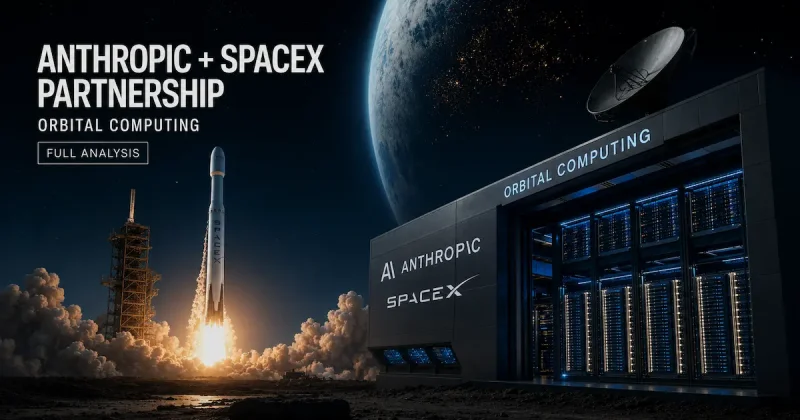
On May 6, 2026, two of the most consequential technology organizations on the planet quietly rewired the future of artificial intelligence. Anthropic, the safety-focused AI lab behind Claude, and SpaceX, the rocket company that has already made low-Earth orbit its industrial backyard, announced a multi-layered compute partnership that begins on the ground but reaches, with striking ambition, all the way into space. This is not a routine cloud-capacity deal. It is a strategic signal that the terrestrial power grid, and the land beneath our feet, may no longer be adequate to sustain the next generation of AI. If the orbital computing vision succeeds, the satellites above your head will soon be doing your AI's thinking.
What the Anthropic–SpaceX Partnership Actually Is
The deal, announced officially by Anthropic on May 6, 2026, has two distinct and critically different layers. The first is immediate and concrete: Anthropic has agreed to purchase the entirety of the compute capacity at SpaceX's Colossus 1 terrestrial data center in Memphis, Tennessee. That facility hosts more than 220,000 NVIDIA GPUs, including dense deployments of H100, H200, and next-generation GB200 accelerators, representing over 300 megawatts of raw computing power. That capacity is coming online within weeks of the announcement, directly relieving the severe compute bottlenecks that have frustrated Anthropic's Pro and Max plan subscribers for months.
The second layer is where the partnership becomes genuinely historic. According to SpaceNews, Anthropic has formally expressed interest in partnering with SpaceX to develop multiple gigawatts of orbital AI compute capacity, compute infrastructure delivered not by ground-based server farms, but by satellites operating in low-Earth orbit, powered by near-constant solar energy. The orbital component has no confirmed timeline, no public price tag, and no engineering specification yet released. But its inclusion in the announcement is itself the story.
Why This Partnership Is Happening Right Now
The timing is not accidental. As Ars Technica reported from Anthropic's Code with Claude developer conference, CEO Dario Amodei revealed that Anthropic has been growing at an annualized rate of 80 times last year's levels through Q1 2026, an acceleration so extreme that it blew past every internal projection the company had built. Anthropic had planned for growth of up to 10x. The actual figure was eight times that. The result was a company structurally unable to serve its own customers.
The crisis was felt viscerally by developers. Usage limits during peak hours, throttled Claude Code access, and an outage pattern that became a meme across Hacker News and Reddit threads all pointed to the same underlying constraint: there simply was not enough compute to meet demand. The SpaceX deal is the most dramatic in a series of emergency capacity expansions Anthropic has executed, including:
- A 5 gigawatt agreement with Amazon, including nearly 1 GW of new capacity by end of 2026
- A 5 GW agreement with Google and Broadcom, coming online from 2027
- A strategic partnership with Microsoft and NVIDIA including $30 billion of Azure capacity
- A $50 billion investment in American AI infrastructure with Fluidstack
- And now, the SpaceX Colossus 1 deal, the fastest-to-deploy of all
Meanwhile, SpaceX had its own motivations. In a landmark FCC filing on January 30, 2026, SpaceX proposed a constellation of up to one million orbital data center satellites, a system designed to harvest near-constant solar power in low-Earth orbit and convert it into AI compute at scales the terrestrial grid cannot match. The Anthropic deal is the first public confirmation that SpaceX intends to offer that orbital capacity to external customers, not just to xAI and Tesla. It validates the commercial rationale for an audacious infrastructure bet.
The Key Questions Shaping Industry Attention
The partnership has electrified observers across the AI, space, and infrastructure investment communities, but it has done so while leaving fundamental questions unanswered. Industry analysts, engineers, and investors are circling the same set of unresolved tensions:
| Question | What We Know | What Remains Unresolved |
|---|---|---|
| When will orbital compute actually be available? | SpaceX filed FCC plans in January 2026; Anthropic has expressed interest | No deployment timeline, cost estimate, or engineering specification has been released publicly |
| Can the engineering challenges be overcome? | SpaceX acknowledges "if engineering challenges can be overcome" in its own announcement | Thermal management, power routing, latency, and on-orbit servicing remain open problems |
| Who else will have access to SpaceX orbital compute? | Anthropic is the first external customer confirmed; Blue Origin and Starcloud are building competing systems | Pricing models, access agreements, and exclusivity terms are undisclosed |
| What does the Musk–Anthropic relationship mean politically? | Musk publicly criticized Anthropic in February 2026, then reversed course after meeting with Anthropic's team in the lead-up to the deal | The long-term stability of the relationship, given Musk's competing xAI venture, is uncertain |
| Is demand for AI compute sustainable enough to justify orbital infrastructure? | Founders Fund partner Delian Asparouhov noted concerns about a potential AI bubble even as he acknowledged improving launch economics | Whether AI compute demand grows at the rate needed to justify a million-satellite constellation is deeply uncertain |
Why the Stakes Are Higher Than They Appear
Strip away the satellite drama and the Musk-Amodei optics, and what remains is a structural argument about the limits of Earth. SpaceX has stated plainly that "the compute required to train and operate the next generation of AI systems is outpacing what terrestrial power, land, and cooling can deliver on the timelines that matter." That is not marketing language. It is an engineering thesis that an increasing number of serious technologists are beginning to accept as plausible, if not inevitable. The Anthropic partnership is the first time a leading AI lab has formally aligned itself with that thesis, making this deal a bellwether for how the entire industry may approach infrastructure over the coming decade.
What follows in this analysis examines the Colossus 1 terrestrial deal in detail, the orbital computing vision and its engineering realities, the competitive landscape emerging around SpaceX, the political complexity of the Musk-Anthropic relationship, and the broader implications for AI infrastructure investment. The partnership, in every meaningful sense, has only just begun.
Strategic Rationale Behind Anthropic and SpaceX Working Together
At first glance, the pairing of a safety-focused AI laboratory and a rocket company seems like an unlikely alliance of convenience, a compute-hungry startup opportunistically lashing itself to the most ambitious infrastructure builder on Earth. Look closer, and the strategic logic runs considerably deeper. The Anthropic–SpaceX partnership is not merely a data center rental agreement dressed up in orbital ambitions. It reflects converging commercial pressures, shared infrastructure dependencies, and a shared belief, increasingly difficult to dismiss, that the physical constraints of terrestrial computing will define the ceiling on what AI can become.
The Compute Crisis Driving Anthropic's Urgency
To understand why Anthropic moved toward SpaceX, it is necessary to understand what Anthropic's CEO Dario Amodei described at the Code with Claude developer conference on May 6, 2026. Speaking on stage in San Francisco, Amodei explained that through the first quarter of 2026, Anthropic was growing at an annualized rate of 80 times the prior year's levels in both revenue and usage. The company had planned for growth of up to a factor of ten. Instead, it found itself in a category the CEO described with striking specificity: "This is the first year that we have grown faster than the exponential."
That statement encapsulates the compute crisis facing frontier AI labs. The models are improving, the use cases are multiplying, and multi-agent workflows, where multiple AI instances collaborate on long-horizon tasks, are dramatically more compute-intensive than the single-turn chat interactions that defined the prior generation of AI products. Anthropic's own announcement of the SpaceX deal frames it explicitly in terms of capacity: the company needed more megawatts, more GPUs, and more throughput than its existing infrastructure agreements could deliver on acceptable timelines.
The deals Anthropic had already signed, up to 5 gigawatts with Amazon, a 5 GW agreement with Google and Broadcom, a $30 billion Microsoft-NVIDIA Azure partnership, and a $50 billion Fluidstack infrastructure commitment, are staggering in their own right. Yet even this portfolio of agreements was not moving fast enough. The SpaceX deal, which gives Anthropic immediate access to the full capacity of the Colossus 1 data center in Memphis, more than 300 megawatts and over 220,000 NVIDIA GPUs, was attractive precisely because it was deployable within the month, not within years. For a company growing faster than its own projections, time compression in infrastructure access is not a luxury. It is an existential operational priority.
Why SpaceX, and Why Now
SpaceX brings to this partnership something that Amazon, Google, Microsoft, and Fluidstack cannot: a credible, if still speculative, pathway to compute that exists entirely outside Earth's physical constraints. SpaceX filed plans with the Federal Communications Commission in late January 2026 for an orbital data center constellation of up to one million satellites operating in low Earth orbit, designed to draw continuous solar power and offload computing workloads from a terrestrial grid that AI demand is straining to its limits.
The argument SpaceX makes is straightforward in principle: solar power in low Earth orbit is effectively unlimited, land is not a constraint, and cooling, one of the most intractable engineering challenges for terrestrial hyperscale data centers, can be managed radiatively in the thermal environment of space. According to SpaceNews, SpaceX stated that "if engineering challenges can be overcome, space-based compute offers near-limitless sustainable power with less impact on Earth", a careful hedge that nonetheless signals a genuine long-term strategic commitment.
For Anthropic, the orbital interest is not merely aspirational signaling. It represents a hedge against a scenario, increasingly plausible given current trajectory, where terrestrial compute capacity simply cannot scale at the rate AI capability demands. By expressing formal interest in "multiple gigawatts of orbital AI compute capacity" as part of the SpaceX agreement, Anthropic is positioning itself at the front of a queue that does not yet exist, in a market that has no established pricing, no deployment timeline, and no proven engineering solution. That is precisely what early-stage strategic positioning looks like.
AI Safety and the Infrastructure Independence Thesis
There is a subtler dimension to this partnership that deserves examination and rarely receives it: the relationship between compute sovereignty and AI safety. Anthropic is, by self-description and institutional design, an AI safety company. Its leadership, drawn heavily from the original OpenAI research team, has built the organization around the premise that the development of highly capable AI systems carries catastrophic risks if not managed with extraordinary care. The company's Responsible Scaling Policy, its Constitutional AI methodology, and the architecture of Claude's values training all reflect this orientation.
In that context, the question of who controls the physical infrastructure on which frontier AI runs is not merely a commercial question. It is a safety-relevant question. An AI lab whose inference capacity is entirely dependent on a small number of hyperscale cloud providers faces a structural vulnerability: if those providers impose constraints on usage, alter pricing dramatically, experience geopolitical disruption, or make infrastructure decisions misaligned with the lab's safety commitments, the lab's ability to operate responsibly is compromised.
Anthropic's aggressive diversification of compute suppliers, spanning Amazon, Google, Microsoft, Fluidstack, and now SpaceX, reflects a deliberate strategy to avoid single-point dependencies in its infrastructure stack. The SpaceX deal, particularly the orbital dimension, extends this logic further: into a domain where no regulatory body currently governs AI compute operations, where physical access cannot easily be restricted by terrestrial governments, and where the infrastructure itself is vertically integrated with the launch provider in a way that no ground-based arrangement can replicate.
This is not to suggest that orbital data centers are an AI safety strategy in any conventional sense. But the infrastructure independence argument, the notion that a safety-focused AI lab benefits from controlling or having guaranteed access to diverse and redundant compute, is a coherent rationale for the partnership that goes beyond simple megawatt procurement.
Edge Inference and the Case for Distributed Orbital Compute
A second technical rationale concerns the emerging architecture of AI deployment. The dominant model of AI inference today is highly centralized: a user query travels from a device to a data center, is processed by a large model running on thousands of GPUs, and a response is returned. This architecture works well for current use cases but has structural limitations as AI agents become more autonomous, more persistent, and more geographically distributed.
Consider the use cases that are beginning to emerge in industrial AI deployment: autonomous systems operating in remote environments, AI-driven infrastructure management in locations with poor terrestrial connectivity, persistent agentic workflows that must run continuously without dependence on a single data center's uptime, and, most ambitiously, AI systems deployed in space itself, supporting autonomous spacecraft operations, lunar resource extraction, or deep-space communications relay.
Delian Asparouhov of Founders Fund, speaking at a SpaceNews orbital data centers event in Washington, D.C. on April 30, 2026, pointed specifically to autonomous lunar ice mines as an example of infrastructure that would benefit enormously from nearby orbital compute, real-time data processing and operational decision-making that cannot tolerate the latency of routing through Earth-based data centers. Founders Fund, notably, is an early investor in both SpaceX and Anthropic, giving it a dual-sided view of where this market is heading.
For Anthropic, orbital compute is not yet relevant to its current product stack. Claude Code, Claude Pro, and Claude's enterprise APIs all run on terrestrial infrastructure and will for the foreseeable future. But the company's research roadmap, which includes increasingly capable agentic systems, longer-horizon reasoning models, and applications in regulated and safety-critical industries, creates a plausible future need for computing infrastructure that is globally distributed, low-latency, and not dependent on terrestrial grid availability. Orbital data centers, if the engineering can be made to work, address all three requirements simultaneously.
SpaceX's Commercial Logic: The First External Customer
From SpaceX's perspective, the Anthropic deal serves a different but equally important strategic function. As SpaceNews reported, the Anthropic agreement is the first sign that SpaceX is willing to offer its orbital data center to external customers, not merely to xAI, the Elon Musk-founded AI company that merged with SpaceX in February 2, 2026, or to Tesla's autonomous driving and robotics operations.
That distinction matters enormously. SpaceX's credibility as an orbital compute provider, and its ability to justify the capital expenditure required for a million-satellite constellation, a chip fabrication plant it calls Terafab, and the continued development of Starship as a mass-to-orbit delivery vehicle, depends on demonstrating that the market for orbital compute extends beyond Musk's own portfolio of companies. Signing Anthropic, one of the two or three most credible and well-capitalized AI laboratories in the world, as the first external orbital compute customer is a powerful proof of concept, even if the actual orbital capacity does not yet exist.
SpaceX has stated its competitive position with characteristic directness: "SpaceX is the only organization with the launch cadence, mass-to-orbit economics and constellation operations experience to make orbital compute a near-term engineering program rather than a research concept." That claim is not entirely modest, but it is not entirely unfounded either. Competitors including Starcloud, which raised $170 million in March 2026 for a constellation of up to 88,000 satellites, and Blue Origin, which filed plans in March for up to 51,600 orbital data center satellites under the name Project Sunrise, are pursuing the same market without SpaceX's manufacturing scale, launch economics, or operational track record.
The Commercial Logic of Orbital Computing: A Framework
| Strategic Dimension | Anthropic's Interest | SpaceX's Interest | Shared Benefit |
|---|---|---|---|
| Immediate compute capacity | Access to 300+ MW and 220,000+ NVIDIA GPUs at Colossus 1 within weeks, directly addressing Claude usage limit bottlenecks | Revenue generation from underutilized data center capacity; validates commercial demand | Near-term cash flow and capacity relief on both sides |
| Infrastructure diversification | Reduces single-provider dependency across Amazon, Google, Microsoft, Fluidstack, and SpaceX | Establishes SpaceX as a compute supplier independent of its own AI ventures | Resilience against supply chain disruptions, pricing shocks, or geopolitical constraints |
| Orbital compute positioning | Secures priority access to multi-gigawatt orbital capacity before a competitive market forms | Gains first external anchor customer to validate the commercial case for orbital data centers | Mutual first-mover advantage in a market that does not yet formally exist |
| AI safety and compute sovereignty | Orbital infrastructure creates a compute layer that is structurally independent of terrestrial regulatory and grid constraints | Positions SpaceX as indispensable infrastructure for the AI industry's most safety-conscious actors | Reputational alignment: SpaceX gains credibility with safety-focused AI community; Anthropic gains infrastructure independence |
| Agentic and autonomous AI workloads | Future Claude agents operating in space, remote, or latency-sensitive environments will require distributed inference capacity | Creates sustained long-term demand for orbital compute from AI's most capability-intensive use cases | A roadmap where AI capability and space infrastructure evolve in lockstep, each enabling the other |
| Political and regulatory environment | Demonstrated alignment with American AI infrastructure investment; international data residency compliance through distributed capacity | Strengthens SpaceX's position as a national AI infrastructure provider ahead of its anticipated IPO | Favorable regulatory positioning for both companies as AI infrastructure becomes a matter of national policy |
The Musk Reversal and What It Signals
No analysis of the strategic rationale for this partnership is complete without confronting the political awkwardness at its center. In February 2026, Elon Musk publicly declared on X that "Anthropic hates Western Civilization," amplifying what Ars Technica described as a false tweet from a Trump administration official about Anthropic's practices. Three months later, Musk was describing time spent with senior Anthropic team members and concluding that "no one set off my evil detector."
The reversal is jarring in its speed, but it is commercially coherent. SpaceX needs external AI customers to justify its orbital compute ambitions. Anthropic needs compute capacity that its existing hyperscaler agreements cannot deliver quickly enough. The commercial logic was, apparently, sufficient to override ideological differences that had been loudly proclaimed in public only weeks before the deal was signed. What this tells observers about the long-term stability of the relationship, particularly given that xAI, Musk's own AI venture, is now merged with SpaceX and in direct competition with Anthropic's Claude products, remains one of the most genuinely uncertain variables in this partnership's future.
A Convergence of Structural Forces
Ultimately, what brought Anthropic and SpaceX together is not a shared vision or a personal relationship or a strategic master plan drawn up in a boardroom. It is the convergence of three structural forces that are reshaping the economics of intelligence at civilizational scale.
- AI compute demand is growing faster than terrestrial infrastructure can be built. The power grid, the land, the cooling capacity, and the semiconductor supply chain are all constrained in ways that cannot be resolved on the timescales that AI capability growth demands.
- Launch costs have fallen far enough to make space-based infrastructure economically plausible, if not yet proven. SpaceX's own cost curves, driven by Starlink manufacturing and Falcon 9 reusability, have moved the orbital data center concept from science fiction to a legitimate engineering program with a serious business case.
- The AI industry's most capable actors are beginning to think in decade-long infrastructure timescales. The agreements Anthropic has signed, spanning Amazon, Google, Microsoft, Fluidstack, and now SpaceX, with combined capacity commitments measured in gigawatts and tens of billions of dollars, reflect a company that understands its infrastructure decisions today will determine its competitive position five to ten years from now.
The Anthropic–SpaceX partnership, in this light, is not an anomaly. It is an early signal of where the AI infrastructure industry is heading: off the ground, into orbit, and into a new era of computing whose physical boundaries may ultimately be set not by the limits of the Earth, but by the limits of human ingenuity in engineering systems that work reliably in the harsh environment of space.
What Orbital Computing Means in Practice
The phrase "orbital computing" appears frequently in SpaceX filings, Anthropic press releases, and investor commentary, but it risks becoming an abstraction, a compelling vision that obscures the engineering complexity required to make it real. Understanding what orbital computing actually means in practice, at the level of data flows, latency curves, power budgets, and architecture tradeoffs, is essential to evaluating whether the Anthropic–SpaceX partnership represents a genuine technological inflection point or an ambitious but premature bet on infrastructure that remains years from operational viability.
On-Orbit Data Processing: Moving Intelligence Closer to the Source
The most immediate and technically tractable application of orbital computing is not AI model training or large-scale inference, it is on-orbit data processing, the practice of analyzing and filtering raw satellite sensor data before it is downlinked to Earth. This problem is older than the current AI boom, and it is acute: modern Earth observation satellites generate data volumes that far exceed the downlink capacity of their ground station networks. A hyperspectral imaging satellite, for example, may generate hundreds of gigabits per pass, of which only a small fraction can be transmitted to the ground in real time.
Conventional solutions involve onboard compression, selective downlinking of pre-flagged regions of interest, and batched transmission during ground station contact windows. All of these are workarounds for a fundamental mismatch between sensor capability and communication bandwidth. On-orbit computing addresses this mismatch directly: by placing sufficient processing power on the satellite itself, raw sensor data can be analyzed, classified, and reduced to actionable outputs before any downlink occurs. The satellite transmits conclusions rather than raw observations, a change order of magnitude more efficient in bandwidth terms.
The practical implications are significant. A constellation equipped with on-orbit inference capability could detect wildfires, maritime vessel anomalies, agricultural stress indicators, or infrastructure changes in near-real time, without the latency introduced by ground-based processing pipelines. SpaceNews reporting on the broader orbital data center opportunity noted that investor interest is already shifting toward ventures that could be enabled by this infrastructure, including autonomous systems that would require nearby computing capacity to operate continuously without waiting for ground-station contact windows.
Low-Latency Satellite Intelligence: The Orbital Edge Computing Model
A second practical application of orbital computing draws on the logic of terrestrial edge computing: placing processing resources physically close to where data is generated or consumed in order to reduce round-trip latency and reliance on centralized infrastructure. In the orbital context, this means equipping satellites with sufficient onboard compute to handle time-sensitive inference tasks that cannot tolerate the latency of a round-trip to a ground-based data center.
Consider the latency arithmetic. A request that travels from a satellite sensor to a ground station, through a terrestrial network to a hyperscaler data center, through an inference pipeline, and back to the satellite involves multiple communication hops, each contributing latency. For applications where the satellite itself must make decisions, autonomous rendezvous and proximity operations, real-time targeting for defense applications, or dynamic network routing within a large constellation, this round-trip latency is operationally unacceptable. On-orbit processing eliminates it entirely for the most time-critical decisions, reserving the ground-uplink path for tasks where latency is less critical.
SpaceX's FCC filing for its proposed million-satellite orbital data center constellation emphasized intersatellite optical links as the primary communications backbone, which is architecturally significant. Optical intersatellite links, already deployed in operational Starlink satellites, enable data to be routed across the constellation at the speed of light through vacuum, faster than fiber-optic cables on Earth, where light travels roughly 31% more slowly through glass than through vacuum. This means a constellation with dense optical mesh networking can, for certain global routing scenarios, provide lower latency than terrestrial fiber infrastructure. Adding inference capability at the nodes of this mesh creates a distributed computing fabric with genuinely novel latency characteristics.
Bandwidth Reduction: The Economic Case for Space-Based Preprocessing
One of the strongest near-term economic arguments for orbital computing is bandwidth cost reduction. Ground station capacity and spectrum allocation are scarce resources with real prices. Every bit downlinked from a satellite has a cost, in spectrum usage, in ground station time, in backhaul bandwidth. If onboard processing can reduce the volume of data requiring downlink by an order of magnitude, the economic savings can be substantial, particularly at constellation scale.
This logic applies not only to Earth observation but to any application where satellites generate more data than they can economically transmit. A constellation of orbital data center satellites processing AI workloads for third-party customers, the model Anthropic has expressed interest in exploring with SpaceX, faces the challenge of delivering compute results to customers on the ground. If those results are large (as they would be for large language model outputs or high-dimensional inference tasks), the downlink bandwidth requirement could become a significant operational constraint and cost driver.
The architectural response to this challenge is to design orbital computing workloads around tasks where the output is dramatically smaller than the input, where the satellite receives a query, performs computation on locally stored model weights or data, and returns a compact result. This is precisely the profile of many AI inference tasks: a user sends a prompt (small), the model performs inference against billions of parameters (large computation, performed locally), and returns a text or data output (small). The data economics of this model are favorable for orbital deployment in ways that, say, video streaming or bulk data transfer are not.
Earth Observation Analytics: The Most Mature Orbital Computing Use Case
Among all the practical applications of orbital computing, Earth observation analytics is the most mature and the closest to commercial deployment at scale. A growing number of companies are already flying satellites with meaningful onboard processing capability, and the market for near-real-time Earth intelligence is well-established across defense, agriculture, climate monitoring, insurance, and financial services sectors.
The integration of AI inference capability into Earth observation satellites represents a qualitative leap in what these systems can deliver. Traditional Earth observation provides images; AI-enabled Earth observation provides answers. The distinction matters enormously for operational users. A defense customer does not want terabytes of synthetic aperture radar data requiring hours of analyst time, they want an alert when a specific category of activity is detected at a specific location, delivered within minutes of the satellite pass. An agricultural customer does not want raw multispectral imagery, they want a field-by-field assessment of crop health, irrigation requirements, and yield projections, updated weekly across millions of hectares.
Delivering these outcomes from orbit requires inference capability on the satellite, trained models optimized for the relevant detection tasks, and downlink architecture designed for low-latency result delivery rather than raw data bulk transfer. These are solvable engineering problems, and several companies, including those in the Starcloud ecosystem that SpaceNews reported on in its orbital data center coverage, are building toward exactly this capability.
Possible Architecture Models: How Orbital AI Infrastructure Could Be Structured
There is no single architecture for orbital computing, the term encompasses a spectrum of possible designs, each with different tradeoffs in terms of capability, cost, latency, and operational complexity. The following table outlines the principal architecture models under consideration, ranging from the near-term and technically proven to the speculative and long-horizon:
| Architecture Model | Description | Primary Use Cases | Key Advantages | Key Challenges | Readiness Level |
|---|---|---|---|---|---|
| Edge-Enhanced LEO Satellites | Existing satellite form factors (100–500 kg) augmented with AI accelerator chips (e.g., NVIDIA Jetson-class or custom ASICs) for onboard inference | Earth observation analytics, real-time anomaly detection, constellation routing optimization | Near-term deployable; fits within existing launch and form factor constraints; builds on proven satellite platforms | Limited power budget constrains chip performance; thermal management in vacuum is challenging; radiation hardening adds cost and reduces performance | Early commercial deployment (2025–2027) |
| Dedicated Orbital Data Center Satellites | Large specialized satellites (1,000+ kg) designed primarily as compute platforms, with solar arrays sized for sustained high-power GPU operation and optical downlinks for result delivery | AI inference-as-a-service for third-party customers, large-scale Earth monitoring, sovereign compute for nations without terrestrial data center access | Dramatically more compute per satellite; near-constant solar power in high inclination orbits; no terrestrial land, water, or grid constraints | Requires Starship-class launch economics to be cost-competitive; thermal management of high-TDP chips in vacuum is an unsolved engineering problem at scale; radiation effects on consumer-grade GPU silicon are severe | Engineering development phase (2026–2030) |
| Distributed Mesh Compute Constellation | Large constellation (tens of thousands to millions of satellites) where each node has modest compute, but aggregate capacity across the mesh is massive; workloads are distributed across nodes via optical intersatellite links | Training of very large AI models using distributed compute; serving global inference demand with geographically load-balanced capacity; applications requiring global simultaneous coverage | Aggregate compute at civilizational scale; inherent redundancy; no single point of failure; can harness total solar flux unavailable to any terrestrial system | Requires solving distributed training across high-latency, intermittent links; coordination overhead at million-node scale is unprecedented; regulatory complexity across jurisdictions; collision risk and orbital debris at constellation scale | Speculative / long-horizon (2030–2040+) |
| Hybrid Terrestrial-Orbital Model | Orbital satellites handle latency-sensitive edge inference and data preprocessing; terrestrial data centers handle training, large-batch inference, and storage; Starlink provides the downlink layer connecting the two tiers | Most commercial AI applications; provides burst capacity from orbit when terrestrial capacity is constrained; enables global coverage for applications requiring it | Commercially deployable near-term using existing infrastructure; orbital layer adds value without requiring full replacement of terrestrial stack; aligns with Anthropic's stated interest in orbital capacity as a supplement to existing agreements | Architecture complexity of managing two-tier hybrid system; downlink latency and bandwidth remain constraints; pricing and SLA structures for orbital compute tier are undefined | Early planning / pilot programs (2026–2029) |
| Cislunar and Deep Space Compute Nodes | Computing infrastructure placed at gravitationally stable points (Earth-Moon L1/L2) or in lunar orbit to support future human and robotic operations beyond LEO | Autonomous lunar resource extraction, deep space mission support, long-term off-Earth civilization infrastructure | Enables fully autonomous operations beyond communication latency constraints from Earth; logical extension of orbital compute infrastructure as human presence expands | Extremely long development timeline; power, thermal, and radiation challenges are more severe than LEO; no near-term commercial demand driver; requires lunar launch and logistics infrastructure not yet in place | Conceptual / visionary (2035+) |
The Thermal and Radiation Problem: The Central Engineering Challenge
Any honest analysis of orbital computing must confront the engineering challenge that dominates all others: heat dissipation and radiation tolerance. On Earth, data centers cool their processors by moving air or liquid across heat sinks, transferring thermal energy to the surrounding environment. In the vacuum of space, convective and conductive cooling are largely unavailable. The only mechanism for shedding heat is radiation, infrared emission from surfaces facing away from the Sun, which is orders of magnitude less efficient than the liquid cooling systems used in modern GPU clusters.
High-performance AI accelerators like NVIDIA's H100 and GB200 have thermal design power ratings of 350 to 1,000 watts per chip. A cluster of 1,000 such chips, a modest inference cluster by hyperscaler standards, generates 350 kilowatts to 1 megawatt of waste heat that must be radiated into space. The radiator area required to dissipate this heat passively in LEO is substantial, adding mass and surface area that must be launched, deployed, and maintained. This is one reason SpaceX's FCC filing emphasized operation at sun-synchronous altitudes where satellites remain in near-constant sunlight, the power generation problem is more tractable there, but the thermal problem does not become easier.
Radiation is the second major challenge. Consumer-grade silicon, including the GPU silicon that powers virtually all current AI training and inference infrastructure, is not designed for the ionizing radiation environment of LEO, let alone higher orbits. Single-event upsets, bit flips caused by cosmic rays or trapped radiation belt particles, can corrupt computation silently or cause system crashes. Radiation-hardened processor designs exist, but they operate at significantly lower clock speeds and performance levels than their commercial counterparts, and they are produced in much smaller volumes at much higher costs. The gap between the performance of radiation-hardened compute and the performance needed for competitive AI workloads is one of the most significant unresolved technical barriers to orbital computing at scale.
Power Generation at Orbital Scale: The One Clear Advantage
Against these challenges, orbital computing does possess one genuinely compelling physical advantage: access to solar power at intensities unavailable on Earth, without the intermittency that makes terrestrial solar power dependent on battery storage or grid backup. A satellite in a high sun-synchronous orbit receives solar irradiance of approximately 1,361 watts per square meter, continuously, without atmospheric attenuation, weather interference, or nighttime gaps. This is roughly 40% more than the peak irradiance available at Earth's surface under ideal conditions, and it is available 24 hours a day.
SpaceX's FCC filing cited this advantage explicitly, arguing that orbital data centers could "harness near-constant solar power with little operating or maintenance cost" and projecting that, within a few years, "the lowest cost to generate AI compute will be in space." This is a bold claim, and it depends on solving the thermal dissipation problem, power that cannot be shed as waste heat cannot be usefully consumed, but the underlying physics of the power generation advantage is sound. For a civilization whose AI infrastructure is straining terrestrial electrical grids and creating political resistance from communities unwilling to accept the land use and energy consumption of large data centers, the appeal of essentially unlimited clean power in orbit is not merely rhetorical.
The Bandwidth Economics of Result Delivery
A final practical consideration that is underappreciated in most orbital computing discussions is the cost and architecture of delivering results from orbit to customers on the ground. Compute capacity in orbit is only valuable if results can be returned to users with acceptable latency and at acceptable cost. For the hybrid terrestrial-orbital model that most closely describes Anthropic's expressed interest in SpaceX's orbital infrastructure, this means designing AI workloads to fit the downlink budget.
Starlink's existing consumer and enterprise terminals provide downlink speeds of hundreds of megabits per second for individual users, but serving millions of simultaneous Claude users from orbital compute nodes would require aggregate downlink capacity orders of magnitude beyond what current Starlink gateway infrastructure supports. SpaceX's optical intersatellite link network partially addresses this by routing traffic across the constellation to ground stations with high-bandwidth gateway links, but the total system throughput for customer-facing AI inference remains a design constraint that has not been publicly addressed in any detail.
The practical resolution is likely a tiered architecture in which orbital compute handles tasks where its advantages, power availability, solar irradiance, absence of terrestrial grid constraints, are greatest, while terrestrial data centers continue to handle the majority of latency-sensitive, high-bandwidth customer interactions. The orbital layer functions as a compute reservoir that can be tapped to relieve terrestrial capacity pressure, not as a wholesale replacement for ground-based infrastructure. This is consistent with how Anthropic's official announcement framed the orbital component, as an expression of interest in "multiple gigawatts of orbital AI compute capacity" alongside, not instead of, its much larger terrestrial agreements with Amazon, Google, Microsoft, and Fluidstack.
Technical and Operational Analysis: From Launch Systems to Orbital AI Deployment
The partnership between Anthropic and SpaceX, particularly its orbital computing dimension, sits at the intersection of some of the most demanding engineering challenges humanity has yet attempted to commercialize at scale. Understanding what it would actually take to deploy gigawatts of AI compute capacity in orbit, and to run Anthropic's Claude models on that infrastructure, requires examining each layer of the technical stack with precision. The gap between the ambition articulated in press releases and the engineering reality of orbital computing is wide, and the path between them runs through unsolved or only partially solved problems in launch economics, satellite platform design, radiation tolerance, thermal management, cybersecurity, and ground-to-orbit data architecture.
Launch System Economics and Manifest Constraints
The foundational enabler of any orbital data center program is launch cost and cadence. SpaceX's FCC filing for up to one million orbital data center satellites is predicated explicitly on Starship as the primary launch vehicle, and Starship's economics are the linchpin of the entire business case. The logic is straightforward: current Falcon 9 launch economics, even at SpaceX's negotiated internal rates, cannot deliver the mass-to-orbit required to deploy a constellation of meaningful compute density at a cost that makes orbital AI competitive with terrestrial alternatives. Starship changes this calculus, in theory.
SpaceX has publicly targeted a Starship payload-to-low-Earth-orbit figure exceeding 100 metric tons per flight in fully reusable configuration, and internal projections suggest per-kilogram launch costs potentially dropping below $100 at scale. For context, a single NVIDIA H100 GPU module with associated networking, power conditioning, and chassis hardware weighs on the order of 10 to 15 kilograms. At $100 per kilogram, the launch cost contribution per GPU becomes relatively modest relative to the GPU's purchase price and operational value, a fundamental inversion of the historical economics that made orbital computing impractical.
However, Starship's operational cadence as of mid-2026 remains in development. The vehicle has demonstrated orbital flight capability but has not yet achieved the rapid, fully reusable turnaround that underpins the cost projections. SpaceX's argument that it is "the only organization with the launch cadence, mass-to-orbit economics and constellation operations experience to make orbital compute a near-term engineering program rather than a research concept" is credible as a competitive positioning statement, but it embeds an assumption about Starship's maturation timeline that remains unverified. Any slippage in Starship's reusability program directly translates into slippage in the orbital computing deployment schedule.
Satellite Platform Architecture for AI Workloads
Designing satellites to serve as AI compute nodes presents engineering challenges that are qualitatively different from those involved in designing communication or Earth observation satellites. The key distinction is power density and thermal load. A communications satellite dissipates relatively modest waste heat per unit of payload mass. An AI compute satellite, by contrast, is essentially a flying data center, a system whose primary function is to consume electrical power, perform arithmetic, and reject waste heat, all in a vacuum environment where convective cooling is impossible.
The thermal management problem is the most immediate physical constraint. On Earth, data centers are cooled using air handling, chilled water loops, and increasingly, direct liquid cooling applied to GPU packages. In orbit, the only available heat rejection mechanism is thermal radiation, governed by the Stefan-Boltzmann law. The radiating area required to reject a given amount of waste heat scales with the fourth root of the temperature differential, which means that for practical spacecraft temperatures, enormous radiator areas are needed to reject the kilowatts to megawatts of heat that a meaningful GPU cluster would generate.
SpaceX's satellite design for the orbital data center constellation has not been publicly detailed at the component level, but the physics dictates a spacecraft architecture dominated by deployable radiator panels, likely orders of magnitude larger in area than the solar array panels generating the power being dissipated. This creates structural, mass, and orbital drag challenges, particularly at the lower altitudes in SpaceX's proposed 500-to-2,000-kilometer range, where residual atmospheric drag on large flat surfaces can meaningfully perturb orbits and require propulsive station-keeping that consumes finite propellant reserves.
Radiation Hardening and GPU Reliability in the Space Environment
Commercial AI accelerators, NVIDIA H100s, H200s, GB200s, and their successors, are designed and manufactured for terrestrial data centers. They are fabricated on cutting-edge silicon process nodes optimized for performance per watt, not for tolerance to the ionizing radiation environment of low Earth orbit. This creates a critical reliability challenge for orbital AI compute that is distinct from anything faced by terrestrial deployments.
In LEO, satellites pass repeatedly through the South Atlantic Anomaly, where trapped proton flux is elevated, and are intermittently exposed to solar energetic particle events. Ionizing radiation causes two categories of damage to semiconductor devices: total ionizing dose effects, which degrade transistor characteristics over time and accumulate irreversibly, and single-event effects, which include single-event upsets, bit flips in memory or logic, and more destructive single-event latchup or burnout events that can permanently damage devices.
Radiation-hardened processors exist and are used in military and scientific satellites, but they are manufactured on older process nodes with significant performance penalties relative to commercial AI accelerators. An H100 delivers roughly 3,958 TFLOPS of FP8 tensor performance. Radiation-hardened processors currently available commercially deliver orders of magnitude less compute performance per unit and are priced commensurately higher. The commercial space industry has increasingly adopted COTS (commercial off-the-shelf) electronics with radiation testing and selective shielding as a cost-performance tradeoff, and SpaceX has done exactly this with its Starlink constellation's avionics.
The critical question for orbital AI compute is whether COTS GPU hardware can be made sufficiently reliable in the orbital radiation environment through shielding, redundancy, error-correcting memory, and fault-tolerant software architectures, or whether the single-event upset and latchup rates in commercial GPU silicon will produce error rates that degrade AI inference quality to unacceptable levels. This question does not yet have a public, validated answer, and it represents one of the deepest technical uncertainties in the Anthropic-SpaceX orbital computing vision.
| Technical Challenge | Terrestrial Data Center | Orbital Data Center (LEO) | Maturity of Solution |
|---|---|---|---|
| Thermal Management | Air/liquid cooling, chilled water loops | Deployable radiative panels only; no convection | Unproven at AI compute density |
| Radiation Tolerance | Not a concern | TID accumulation, SEUs, latchup risk on COTS GPUs | Partial mitigation via shielding and ECC; full solution unvalidated |
| Power Supply | Grid connection, UPS, diesel backup | Solar arrays; eclipse interruptions at low altitude | Proven for comms payloads; unproven at AI power densities |
| Cooling Per GPU | ~300–700 W/GPU; liquid or air cooled | Must be fully radiated; radiator mass scales linearly | Research phase; no orbital GPU cluster demonstrated |
| Downlink Bandwidth | Terabit-scale local interconnects | Limited by optical intersatellite links and gateway capacity | Partially solved via Starlink V2 optical mesh |
| Cybersecurity | Physical access controls, standard IT security | RF uplink attack surface; supply chain for COTS hardware | Evolving; no orbital AI-specific standards exist |
| AI Model Deployment | Standard container/cluster orchestration | Delayed update cycles; no real-time patching during eclipse | Requires new software architecture; not yet developed |
| Hardware Serviceability | Hot-swap components; on-site technicians | No in-orbit servicing; full satellite replacement required | Planned via high-cadence Starship re-deployment |
AI Model Deployment Constraints in an Orbital Environment
Running Claude or any other large language model on orbital hardware introduces software-layer constraints that are as significant as the hardware challenges. Modern AI model deployment relies on continuous software updates, model weight patches, safety fine-tunes, system prompt updates, and inference engine optimizations are pushed to terrestrial data center nodes in near-real time via high-bandwidth internal networks. An orbital compute node operating in LEO is visible to any given ground station for intervals of only a few minutes per pass, introducing inherent discontinuity in the software update pipeline.
For a model like Claude, which Anthropic updates regularly for safety and capability improvements, the inability to push updates to orbital nodes in real time creates a model versioning and safety assurance problem. A satellite running a version of Claude that is three software generations old, because uplink opportunities were insufficient to complete the weight transfer of a multi-hundred-gigabyte model update, is running inference on potentially deprecated safety configurations. For a company as focused on AI safety as Anthropic, this is not an academic concern. It represents a fundamental architectural tension between the orbital deployment model and Anthropic's core operational requirements.
The practical resolution likely involves treating orbital nodes as running frozen model weights for extended periods, with full model updates pushed during scheduled high-bandwidth ground station contact windows. This implies a tiered deployment architecture in which safety-critical updates are either pushed urgently via dedicated high-bandwidth uplinks or result in temporary suspension of orbital inference until update completion can be confirmed. Neither approach is trivial to implement, and neither has precedent in existing orbital computing programs.
Cybersecurity in the Orbital Computing Attack Surface
Orbital data centers introduce a cybersecurity attack surface with no close terrestrial analog. A ground-based data center can be physically secured, its network ingress points hardened and monitored, and its hardware supply chain audited through established enterprise security frameworks. An orbital data center satellite communicates with the ground via radio frequency and optical links, interfaces that are inherently more accessible to adversarial actors than physically secured fiber connections.
The RF uplink to an orbital compute satellite represents a potential command injection vector. If an adversary can spoof or compromise the satellite's command and telemetry link, they may be able to interfere with compute operations, corrupt model weights stored in on-board memory, or exfiltrate inference results intended for legitimate customers. SpaceX has demonstrated sophisticated encryption and authentication on Starlink's command links, but Starlink's operational security model is designed around communications payload protection, the threat model for a satellite running customer AI workloads handling proprietary enterprise data is more complex and demanding.
The supply chain dimension is equally concerning. COTS GPU hardware sourced for orbital deployment passes through a manufacturing and integration supply chain that is significantly less controlled than the supply chains for radiation-hardened military satellites. Hardware implants, firmware vulnerabilities, and manufacturing-stage compromises are difficult to detect in advanced semiconductor packages and represent a latent risk in any program that sources commercial GPU silicon at scale.
No orbital AI compute-specific cybersecurity standards or certification frameworks currently exist. The establishment of such frameworks will be a prerequisite for regulated-industry customers, precisely the financial services, healthcare, and government enterprise customers that Anthropic explicitly identified as requiring in-region infrastructure for data residency compliance, to rely on orbital compute nodes for sensitive workloads.
Power Limits and the Solar-to-Compute Efficiency Chain
SpaceX's orbital data center vision is built on the premise that near-constant solar power in LEO provides an essentially unlimited and environmentally clean power source for AI compute. The physics is directionally correct, solar irradiance in LEO averages approximately 1,361 watts per square meter, compared to roughly 200 to 250 watts per square meter available to ground-mounted solar panels averaged across day-night and weather cycles in temperate latitudes. But the chain from solar irradiance to useful AI compute throughput involves multiple efficiency stages, each of which imposes losses.
Current space-grade solar cell efficiencies range from approximately 29 to 34 percent for high-performance multi-junction cells, compared to roughly 20 to 24 percent for terrestrial commercial silicon panels. Power conditioning, distribution, and battery charging losses in a satellite power system typically consume an additional 10 to 20 percent of generated power. The GPU compute hardware itself operates at fixed power envelopes that cannot be exceeded without triggering thermal shutdown, and in orbit, the thermal ceiling is set by the radiator area, not by the cooling system's active capacity as on Earth.
The net result is that a satellite's usable AI compute power is bounded by the minimum of three independent constraints: the solar array area and efficiency (power generation), the radiator area and temperature (heat rejection), and the GPU hardware's own thermal and power specifications. Optimizing this three-way constraint simultaneously, while also minimizing satellite mass and maximizing the ratio of compute hardware to structural and bus hardware, is an extremely demanding systems engineering problem. SpaceX has not publicly disclosed its proposed satellite design parameters, and until it does, external assessment of the realistic power-to-compute density of its orbital data center satellites remains speculative.
Ground-to-Orbit Integration and Operational Architecture
Perhaps the least-discussed technical challenge in the Anthropic-SpaceX orbital computing partnership is the software and network architecture required to integrate orbital compute nodes into a coherent AI inference infrastructure alongside Anthropic's terrestrial deployments. As SpaceNews reported, the near-term component of the deal involves Anthropic purchasing all capacity at SpaceX's Colossus 1 terrestrial data center, a conventional, well-understood deployment. The orbital dimension is described as an "expressed interest" in developing "multiple gigawatts of orbital AI compute capacity," with no timeline, cost, or technical specifications disclosed.
For the orbital component to function as a seamless extension of Anthropic's inference infrastructure, the following integration problems must be solved. First, a workload orchestration layer must be able to route inference requests to either terrestrial or orbital compute nodes based on latency, bandwidth, and availability constraints, with failover logic that handles the intermittent connectivity inherent in a satellite constellation. Second, a model synchronization pipeline must ensure that model weights and safety configurations deployed on orbital nodes are consistent with those running on terrestrial nodes, subject to the update latency constraints described above. Third, a telemetry and monitoring system must provide Anthropic's operations team with visibility into the health and performance of orbital compute nodes, enabling rapid response to hardware failures that cannot be remediated by dispatching a technician.
None of these integration layers exist today in any form that could be applied to orbital AI compute. Building them will require collaboration between Anthropic's AI infrastructure engineering teams and SpaceX's satellite operations teams, two organizations with deep expertise in entirely separate technical domains, working on a problem that neither has solved before. The timeline for that collaboration, and the engineering resources it will require, represent a final and substantial uncertainty in the full realization of the orbital computing partnership that the two companies announced in May 2026.
Market Impact and Competitive Landscape
The Anthropic-SpaceX partnership announced in May 2026 is not merely a compute procurement agreement between two technology companies. It is a signal event that restructures the competitive dynamics across at least five distinct industries simultaneously: hyperscale cloud computing, enterprise AI services, satellite communications, defense technology, and the nascent orbital infrastructure economy. Understanding its market impact requires analyzing each of these arenas in turn, because the ripple effects of Anthropic's deal with SpaceX extend far beyond the immediate question of who runs Claude's inference workloads.
Hyperscale Cloud Providers: A Strategic Threat to the AWS-Google-Azure Oligopoly
The most immediate competitive consequence of the Anthropic-SpaceX partnership is the implicit challenge it poses to the three hyperscale cloud providers, Amazon Web Services, Google Cloud, and Microsoft Azure, who have collectively invested hundreds of billions of dollars in terrestrial data center infrastructure over the past decade. The significance of this challenge is easy to understate, because on its surface the deal looks like another compute procurement agreement of the type Anthropic has already signed with all three hyperscalers. Anthropic's own announcement lists an up-to-5-gigawatt agreement with Amazon, a 5-gigawatt agreement with Google and Broadcom, and a $30 billion Microsoft Azure partnership alongside the SpaceX deal. The SpaceX relationship, on this reading, is simply one more vendor in a diversified compute supply chain.
But the orbital dimension of the agreement changes the strategic calculus in a way that none of the hyperscaler deals do. AWS, Google, and Microsoft can expand their terrestrial data center footprints, but they cannot replicate SpaceX's vertical integration across satellite manufacturing, launch, and orbital operations. If orbital compute becomes a commercially viable and cost-competitive alternative to terrestrial cloud infrastructure over the next decade, the hyperscalers face a structural disadvantage: they are locked into a capital-intensive, land-constrained, grid-dependent business model precisely at the moment when a new architecture promises to circumvent all three constraints simultaneously.
The competitive threat is not immediate. SpaceX's FCC filing for up to one million orbital data center satellites is a regulatory placeholder, not a deployment schedule. But the partnership gives Anthropic a strategic option that AWS, Google, and Microsoft cannot easily replicate, a relationship with the only company that has the launch cadence, satellite manufacturing scale, and constellation operations expertise to build orbital compute infrastructure at the speed and cost required for it to be commercially relevant. For the hyperscalers, the rational response is to accelerate their own alternative compute strategies: custom silicon, nuclear-powered data centers, and geographically distributed edge infrastructure. The Anthropic-SpaceX deal will almost certainly catalyze that acceleration.
Competitive Impact Across Key Market Segments
| Market Segment | Primary Incumbents | Nature of Disruption | Timeline of Impact | Strategic Response Options |
|---|---|---|---|---|
| Hyperscale Cloud (Terrestrial) | AWS, Google Cloud, Microsoft Azure | Orbital compute could bypass terrestrial grid and land constraints; Anthropic gains leverage in vendor negotiations | Medium-term (5–10 years for orbital viability) | Custom silicon, nuclear power, edge infrastructure acceleration |
| Enterprise AI Services | OpenAI, Google DeepMind, Cohere, Mistral | Anthropic gains immediate compute capacity advantage; usage limits raised across Pro, Max, and API tiers | Immediate (Colossus 1 capacity online within weeks of announcement) | Competing compute deals; vertical integration; proprietary hardware partnerships |
| Satellite Communications | SES, Intelsat, Viasat, Telesat | Orbital compute repurposes satellite infrastructure as a compute layer, not merely a connectivity layer | Long-term (10+ years) | Pivot to hybrid connectivity-compute offerings; partner with orbital data center entrants |
| Defense Technology | Palantir, L3Harris, Raytheon, Booz Allen Hamilton | Orbital AI compute could enable sovereign, censorship-resistant AI inference for allied defense customers | Medium-term (3–7 years) | Lobby for government contracts; develop competing orbital compute partnerships |
| Orbital Infrastructure (Emerging) | Starcloud, Blue Origin Project Sunrise, Amazon Project Kuiper | Anthropic partnership validates orbital compute as a commercially viable service category; raises bar for competitors | Near-term signal effect (immediate); market entry pressure (3–5 years) | Accelerate fundraising; specialize in niche workloads; form anchor customer agreements |
| AI Hardware Manufacturers | NVIDIA, AMD, Intel Gaudi, Cerebras | Orbital compute creates demand for radiation-hardened, thermally efficient AI accelerators, a new product category | Medium-term (5–8 years) | Develop space-qualified GPU variants; partner with SpaceX and emerging orbital compute operators |
The Immediate Competitive Advantage for Anthropic in Enterprise AI
In the near term, measured in months, not years, the most consequential competitive effect of the Anthropic-SpaceX deal is the capacity advantage it gives Anthropic over its direct AI model competitors: OpenAI, Google DeepMind, Cohere, and Mistral. As Ars Technica reported, Anthropic's CEO Dario Amodei acknowledged at the Code with Claude developer conference that the company had been "growing faster than the exponential," with annualized revenue and usage growth of 80 times the prior year's levels through the first quarter of 2026, against planning assumptions that accounted for only a factor-of-10 increase. The consequence of that mismatch was a series of user-visible capacity constraints: peak-hours limit reductions on Claude Code, usage caps for Pro and Max subscribers, and a short-lived trial that briefly removed Claude Code from the $20-per-month Pro plan.
Those constraints, widely discussed across Hacker News, Reddit, and developer communities on X, were damaging to Anthropic's competitive position in a market, developer tooling for AI-assisted software engineering, where switching costs are low and competitor products including OpenAI's GPT-4o, GitHub Copilot, and Google's Gemini Code Assist are aggressively priced and heavily marketed. The Colossus 1 deal provides Anthropic with more than 300 megawatts of new compute capacity and over 220,000 NVIDIA GPUs, enabling it to immediately double Claude Code's five-hour window limits, remove peak-hours restrictions, and raise API rate limits for Opus models. In a market where compute availability is a direct proxy for product quality from the user's perspective, this is a meaningful competitive differentiator, and it arrives at a moment when Anthropic is also reportedly benefiting from users migrating away from OpenAI following controversy over OpenAI's agreements with the United States military.
Defense Technology and Sovereign AI Compute
A dimension of the Anthropic-SpaceX partnership that has received comparatively little coverage in the initial wave of reporting is its potential significance for defense technology and what might be described as the sovereign AI compute market. Anthropic has been explicit in its announcement that its international capacity expansion will be limited to "democratic countries whose legal and regulatory frameworks support investments of this scale", a formulation that reads, in context, as a statement about geopolitical alignment as much as regulatory compliance. The company stated directly that it is being "very intentional about where we'll add capacity," ensuring that the supply chain on which its compute depends, "hardware, networking, and facilities", will be "secure."
Orbital compute amplifies this strategic dimension considerably. A constellation of AI inference satellites operating in low Earth orbit is, by its nature, not subject to the jurisdictional controls, infrastructure interdependencies, and physical vulnerabilities that constrain terrestrial data centers. For allied defense customers, governments and defense contractors operating in environments where data sovereignty, adversarial interference, and infrastructure resilience are mission-critical requirements, an orbital AI compute layer operated by a US-domiciled company with demonstrated launch and satellite operations capabilities is a qualitatively different offering than any terrestrial data center, however secure. The defense technology incumbents, Palantir, L3Harris, Raytheon, and Booz Allen Hamilton, will need to assess whether the Anthropic-SpaceX orbital compute ambition creates a new category of competition in their core government and defense markets, or whether it creates a partnership opportunity that they should be actively pursuing.
The Orbital Infrastructure Competitive Field: Starcloud, Blue Origin, and the Race for Anchor Customers
The Anthropic-SpaceX announcement carries enormous implications for the emerging orbital data center competitive landscape. As SpaceNews noted, the deal represents the first public indication that SpaceX is willing to offer its orbital data center capacity to customers other than itself and xAI, the Elon Musk AI company with which SpaceX merged in early 2026. That signal is significant: it validates the commercial model underlying the orbital data center investment thesis and establishes SpaceX as the first mover in a market that competitors including Starcloud and Blue Origin's Project Sunrise are also targeting.
Starcloud, which raised $170 million in March 2026 for a planned constellation of up to 88,000 orbital data center satellites, and Blue Origin, which filed plans in March 2026 for a constellation of up to 51,600 satellites called Project Sunrise, both now face a competitive reality that their fundraising pitches likely did not fully anticipate: SpaceX has an anchor customer relationship with one of the world's most prominent and fastest-growing AI companies, established before either competitor has launched a single operational satellite. Industry observers at a SpaceNews orbital data center event noted that Founders Fund partner Delian Asparouhov, whose fund has backed both SpaceX and Anthropic, was explicit about being "wary of competing directly with SpaceX" in any market the company considers core. For Starcloud and Blue Origin, the Anthropic deal underscores the urgency of securing their own anchor customer agreements before SpaceX's constellation development makes the market effectively closed.
AI Hardware Manufacturers and the Orbital Compute Supply Chain
A less obvious but potentially transformative competitive effect of the Anthropic-SpaceX partnership is the new product market it implicitly creates for AI hardware manufacturers. The Colossus 1 data center at the center of the near-term deal features, according to SpaceX's own announcement, over 220,000 NVIDIA GPUs including H100, H200, and next-generation GB200 accelerators, standard terrestrial AI compute hardware purchased at commercial market rates. But the orbital dimension of the partnership, if it advances from "expressed interest" to active development, creates demand for a category of AI accelerator hardware that does not yet commercially exist: radiation-tolerant, thermally efficient, mass-optimized AI inference chips capable of operating continuously in the harsh electromagnetic environment of low Earth orbit.
SpaceX has filed plans to develop its own chip fabrication facility, dubbed Terafab, to support its orbital data center ambitions, suggesting that it may pursue a vertically integrated approach to orbital AI silicon rather than relying on NVIDIA or AMD for orbital-qualified hardware. If Terafab becomes operational and produces AI accelerators optimized for the orbital environment, it would represent a competitive entry by SpaceX into the AI chip market at the same moment that it is establishing itself as the leading orbital compute infrastructure provider, a degree of vertical integration that would give it structural cost and performance advantages over any competitor attempting to assemble an orbital data center constellation from commercially available components.
The Broader Space Economy: From Connectivity to Compute
At the broadest level of analysis, the Anthropic-SpaceX partnership is a catalyst for a fundamental redefinition of what the commercial space industry is for. The first generation of the commercial satellite industry, dominated by geostationary communications satellites providing television broadcasting and enterprise connectivity, was a connectivity business: its value proposition was moving bits from one point on Earth to another via a relay in orbit. The second generation, exemplified by SpaceX's Starlink, extended this model to broadband internet access with much lower latency, transforming the economics of satellite connectivity but not its fundamental character as a pipeline for bits originating and terminating on Earth.
Orbital compute, as envisioned in the Anthropic-SpaceX partnership, represents a third-generation model in which the satellite is not a relay but a processor, a node in a distributed computing network that generates economic value not by moving bits but by transforming them. SpaceX's own FCC filing framed this ambition in expansive terms, describing a constellation capable of harnessing solar power at a scale that could "surpass the electricity consumption of the entire U.S. economy" without the disruption of rebuilding Earth's strained electrical grid. Whether or not that vision is realized within any near-term commercial timeframe, the direction of travel it establishes, toward a space economy defined by compute, not just connectivity, will shape investment flows, regulatory attention, and competitive strategy across the space industry for the decade to come. The Anthropic partnership is the first commercial agreement that gives that vision a named customer and a concrete near-term revenue relationship. In market terms, that is the difference between a concept and an industry.
Risks, Regulation, and AI Safety Considerations
No serious analysis of the Anthropic-SpaceX orbital computing partnership can ignore the substantial constellation of risks that surround it, technical, legal, geopolitical, and existential. The partnership sits at the intersection of three domains, advanced AI, space infrastructure, and national security, each of which carries its own regulatory complexity. Their convergence in a single commercial arrangement creates a risk profile that is genuinely novel and that existing regulatory frameworks are poorly equipped to address. What follows is a systematic examination of the principal risk categories, drawing on the partnership's disclosed terms and the broader policy environment in which it operates.
Export Controls and Technology Transfer
Perhaps the most immediate regulatory constraint on orbital AI compute infrastructure is the International Traffic in Arms Regulations (ITAR) and the Export Administration Regulations (EAR) administered by the U.S. State and Commerce Departments respectively. Satellite hardware, including the computing components that would constitute an orbital data center, has historically been subject to stringent ITAR controls, and the addition of advanced AI accelerator chips to satellite payloads introduces new export control complexity that has not yet been authoritatively resolved by either agency.
The core tension is straightforward: NVIDIA's highest-performance AI accelerators, including the H100, H200, and GB200 series that Anthropic's announcement identified as components of the Colossus 1 terrestrial data center, are already subject to export restrictions that prevent their sale to certain countries, most notably China. An orbital data center constellation operating in low Earth orbit passes over every point on Earth's surface during a complete orbital cycle. The question of whether AI inference computation performed on a satellite transiting over a restricted jurisdiction constitutes a de facto export of controlled technology has no settled answer in current U.S. export control law, and regulators at the Bureau of Industry and Security have not yet issued formal guidance addressing orbital AI compute as a distinct category.
SpaceX's filing with the FCC for a constellation of up to one million orbital data center satellites disclosed almost no technical specifications about the computing hardware to be deployed, an omission that may reflect in part the sensitivity of discussing export-controlled hardware capabilities in a public regulatory filing. Before any Anthropic-SpaceX orbital compute arrangement can become operational, both companies will need affirmative export control determinations that address not just the hardware manifest of the satellites but the legal character of AI inference services delivered from orbit over foreign territory.
National Security and Intelligence Community Considerations
The national security dimensions of orbital AI compute extend well beyond export control compliance. A constellation of satellites capable of performing large-scale AI inference in orbit would represent a dual-use infrastructure asset of extraordinary strategic value, capable of supporting civilian commercial workloads in peacetime but potentially convertible to military intelligence, surveillance, and reconnaissance applications in a conflict scenario. The U.S. intelligence community and Department of Defense have strong institutional interests in the architecture, access terms, and foreign ownership status of any such constellation, and those interests will shape regulatory review processes in ways that are not fully visible in commercial filings.
Anthropic, notably, has positioned itself as an AI safety company with particular concern for the responsible development of frontier AI models. Its announcement of the SpaceX partnership emphasized international expansion plans limited to "democratic countries whose legal and regulatory frameworks support investments of this scale", language that implicitly acknowledges the geopolitical sensitivity of AI compute infrastructure and suggests that Anthropic's leadership is aware of the national security overlay on their infrastructure decisions. However, awareness of the issue and robust regulatory compliance are not the same thing, and the governance structures that would determine which workloads run on orbital infrastructure, under what access conditions, and subject to what audit rights, have not been publicly disclosed.
The fact that SpaceX's merger with xAI, Elon Musk's AI company, preceded the Anthropic deal by only weeks introduces additional complexity. A single corporate entity that controls orbital data center infrastructure, a major AI model development program (Grok), and a social media platform (X) with global reach creates concentration-of-power concerns that U.S. national security reviewers, including the Committee on Foreign Investment in the United States (CFIUS) and the National Security Council, may scrutinize carefully as the orbital compute market develops.
Data Governance and Sovereignty
Data residency and sovereignty requirements represent a structural challenge for any orbital compute architecture serving regulated enterprise customers. Anthropic's announcement explicitly acknowledged that its enterprise customers in financial services, healthcare, and government "increasingly need in-region infrastructure to meet compliance and data residency requirements." These requirements, codified in regulations such as the European Union's General Data Protection Regulation (GDPR), the Health Insurance Portability and Accountability Act (HIPAA) in the United States, and dozens of analogous national data localization laws, were written with terrestrial data centers in mind and assume that the physical location of a server can be meaningfully specified and verified.
Orbital compute fundamentally disrupts this assumption. A satellite in low Earth orbit at 500 kilometers altitude moves at approximately 7.8 kilometers per second, completing an orbit of Earth every 90 minutes. Data processed on such a satellite is, by definition, processed in a jurisdiction that changes continuously, or, more precisely, it is processed in a jurisdiction (outer space) to which no national data sovereignty law directly applies. The legal fiction that orbital compute constitutes processing "in" a particular jurisdiction, for data residency compliance purposes, has not been established in any major legal system, and the absence of that legal foundation is a significant barrier to Anthropic's ability to market orbital compute capacity to its regulated enterprise customer base.
| Regulatory Domain | Key Requirement | Orbital Compute Challenge | Current Resolution Status |
|---|---|---|---|
| Export Controls (ITAR/EAR) | Restrict export of controlled AI hardware to adversary nations | Satellites transit over all jurisdictions; AI inference over restricted territory may constitute export | No formal BIS guidance; unresolved |
| Data Residency (GDPR, HIPAA) | Require data processing within specified geographic boundaries | LEO satellites have no fixed jurisdiction; orbital processing is legally stateless | No precedent; significant legal ambiguity |
| FCC Spectrum Licensing | Authorize satellite communications in specific frequency bands | SpaceX sought waiver of standard deployment milestones; Ka-band use on non-interference basis | FCC application pending; waiver request unresolved |
| National Security Review (CFIUS) | Prevent foreign control of critical infrastructure | SpaceX-xAI merger concentrates AI and orbital infrastructure; access governance unclear | No public review announced; institutional scrutiny ongoing |
| Orbital Debris Regulation | Ensure safe satellite operations and post-mission disposal | One million proposed satellites represent unprecedented debris risk; deorbit timeline unclear | FCC rules require 5-year deorbit; waiver implications unresolved |
| AI Governance (EU AI Act, U.S. Executive Orders) | Require transparency, auditability, and safety testing for high-risk AI | Orbital inference infrastructure complicates physical audit access and model oversight | Emerging frameworks; orbital AI not yet specifically addressed |
Model Reliability and AI Safety in an Orbital Context
Anthropic's corporate identity is inseparable from its emphasis on AI safety. The company was founded by former members of OpenAI explicitly on the premise that frontier AI development carries catastrophic risks that require systematic safety research and responsible deployment practices. Its partnership with SpaceX came with reassurances from Elon Musk himself that he had reviewed Anthropic's safety practices and found them credible, a remarkable statement from a figure who had publicly characterized Anthropic as hostile to Western civilization only months earlier, and one that underscores how rapidly the commercial logic of the compute deal overrode prior ideological objections.
The AI safety implications of orbital compute are substantive and underappreciated. Terrestrial AI inference infrastructure operates under conditions of relative physical accessibility: hardware can be inspected, models can be updated or rolled back, and, in extremis, data centers can be physically shut down. Orbital infrastructure is categorically different. A satellite constellation operating AI workloads at 500 kilometers altitude cannot be physically accessed after launch. Model updates must be delivered via radio uplink, subject to bandwidth constraints and potential interference. Hardware failures cannot be repaired. And if a deployed model exhibits unexpected or harmful behavior, the remediation options available to operators are far more constrained than in a terrestrial environment.
These constraints raise pointed questions about how Anthropic's Responsible Scaling Policy, its formal commitment to evaluating and mitigating catastrophic risks from increasingly capable AI models, would apply to AI inference running on orbital infrastructure. The policy was designed with terrestrial deployment in mind, and its provisions for capability evaluations, access controls, and emergency shutdown procedures may require substantial revision before they can be credibly applied to orbital compute contexts. Anthropic has not yet addressed this question publicly, and it represents a meaningful gap between the company's stated safety commitments and the operational realities of the infrastructure it is now pursuing.
Dual-Use Concerns and Weaponization Risk
The dual-use character of orbital AI compute infrastructure deserves explicit treatment. A constellation of satellites capable of performing large-scale AI inference in real time, connected via inter-satellite optical links and equipped with high-bandwidth ground downlinks, would be functionally capable of supporting a range of military applications that extend well beyond the civilian AI workloads that Anthropic and SpaceX have publicly described. These include autonomous target identification and tracking, signals intelligence processing, battle damage assessment, and command-and-control support for autonomous weapons systems.
None of these applications is part of the announced Anthropic-SpaceX arrangement, and Anthropic has publicly distanced itself from military AI applications, a position that contributed to user migration from OpenAI after the latter's agreements with the U.S. military became public. However, the infrastructure being built is inherently dual-use, and the governance mechanisms that would prevent its conversion to military applications, or ensure that any military use occurs under appropriate legal frameworks and human oversight, are not addressed in the public terms of the partnership. SpaceX, which has a long and deep relationship with the U.S. Department of Defense through Falcon 9, Falcon Heavy, and Starlink contracts, would be subject to government requests for access to orbital compute infrastructure that go beyond Anthropic's intended civilian applications. The legal and contractual frameworks governing such requests, and Anthropic's knowledge of and consent to them, have not been publicly disclosed.
Orbital Debris: The Environmental Risk of Compute at Scale
The orbital debris implications of SpaceX's proposed one-million-satellite orbital data center constellation are among the most serious long-term risks associated with the broader vision that the Anthropic partnership is intended to validate commercially. The existing Starlink constellation, with approximately 7,000 active satellites as of early 2026, already represents the largest satellite constellation in history and has generated significant concern among astronomers, space agencies, and competing satellite operators about orbital congestion, light pollution, and collision risk.
A constellation 140 times larger, one million satellites operating at altitudes between 500 and 2,000 kilometers, would fundamentally alter the near-Earth orbital environment. The collision probability among satellites in such a dense constellation, and between constellation satellites and the existing population of active satellites and debris objects, would be orders of magnitude higher than current conditions. A single collision generating a significant debris cloud at orbital velocities could trigger a cascade of secondary collisions, the Kessler Syndrome scenario, that would render certain orbital shells unusable for decades. The FCC's current rule requiring satellite operators to deorbit within five years of mission completion was designed for constellations measured in hundreds or thousands of satellites; its adequacy for a constellation of one million is an open question that SpaceX's waiver request implicitly acknowledges without resolving.
Anthropic's interest in orbital compute capacity, even if initially modest relative to SpaceX's ultimate ambitions, provides commercial validation that accelerates the timeline toward large-scale constellation deployment. The company bears some measure of responsibility, as the first named external customer for SpaceX's orbital compute infrastructure, for the environmental consequences of the orbital debris risk that large-scale deployment would create. This is a dimension of Anthropic's environmental and safety commitments that has not been addressed in its public communications about the SpaceX partnership, and it represents a meaningful tension with the company's stated commitment to responsible technology development.
Policy Oversight and the Regulatory Gap
The overarching policy challenge posed by orbital AI compute is that no existing regulatory framework was designed to govern it. The FCC has authority over satellite communications spectrum but not over the computing workloads those satellites perform. The Federal Aviation Administration has authority over launch and reentry but not over on-orbit operations. The Department of Commerce's National Oceanic and Atmospheric Administration licenses remote sensing satellites but has no clear mandate over AI inference satellites. The AI regulatory frameworks currently being developed, including the European Union's AI Act and various U.S. executive and legislative initiatives, assume terrestrial deployment and have no provisions specifically addressing orbital AI infrastructure.
This regulatory gap is not merely a legal technicality. It means that the safety, security, and environmental governance of orbital AI compute, arguably one of the most consequential infrastructure decisions of the coming decade, will be shaped primarily by the private decisions of SpaceX and its commercial partners, including Anthropic, rather than by democratically accountable public institutions. SpaceX's own framing of the partnership, that it is "the only organization with the launch cadence, mass-to-orbit economics and constellation operations experience to make orbital compute a near-term engineering program rather than a research concept", is commercially accurate but also implies a degree of market power that heightens the importance of robust public oversight. The absence of that oversight, at the moment when the first commercial agreements are being signed and path dependencies are being established, is itself a significant systemic risk that deserves urgent attention from policymakers, civil society, and the companies involved.
Future Outlook and Scenarios: The Road Ahead for Anthropic-SpaceX Orbital Computing
The partnership announced on May 6, 2026, between Anthropic and SpaceX is simultaneously a concrete near-term compute deal and the opening chapter of what could become the most consequential infrastructure buildout in the history of artificial intelligence. To understand what comes next, it is essential to distinguish between what is certain, what is probable, and what remains genuinely speculative, and to identify the milestones that will determine which scenario materializes. The story is unfolding across at least three distinct time horizons: the immediate term (2026–2027), the medium term (2027–2030), and the long-term trajectory that extends into the 2030s and beyond.
Near-Term: The Colossus 1 Phase (2026–2027)
The most concrete and immediate dimension of the Anthropic-SpaceX agreement is the terrestrial component. Anthropic's official announcement confirms that the company has secured all of the compute capacity at SpaceX's Colossus 1 data center in Memphis, Tennessee, more than 300 megawatts of power supporting over 220,000 NVIDIA GPUs, including H100, H200, and next-generation GB200 accelerators. This capacity is expected to come online within the month of the announcement, making it the most immediately actionable element of the deal.
In the near term, the primary use cases are well-defined and commercially driven. Anthropic will deploy Colossus 1 capacity to:
- Expand Claude Code throughput for Pro, Max, Team, and Enterprise subscribers, following the doubling of five-hour rate limits announced simultaneously with the deal
- Support multi-agent AI workflows that are significantly more compute-intensive than single-agent, chat-based interactions, a shift in user behavior that has been a primary driver of Anthropic's compute shortfall
- Run inference workloads for Claude Opus models at substantially higher API rate limits, enabling enterprise customers in financial services, healthcare, and government to scale deployments previously constrained by availability
- Provide redundancy and geographic diversification relative to Anthropic's existing compute infrastructure, which runs across AWS Trainium, Google TPUs, and NVIDIA GPUs in various cloud configurations
The near-term commercial logic is straightforward. As Ars Technica reported from the Code with Claude developer conference, Anthropic CEO Dario Amodei stated that the company was growing at an annualized rate of 80 times prior-year levels through Q1 2026, a pace that had been planned for at a factor of 10. The gap between planned and actual growth created acute pressure on compute availability that manifested as usage limits, peak-hours restrictions, and user frustration across developer communities on Hacker News, Reddit, and X. Colossus 1 is the fastest lever Anthropic could pull to close that gap, and it does so without any of the engineering uncertainty that attends the orbital component of the partnership.
The near-term watch items for analysts and observers include: how rapidly Anthropic can integrate Colossus 1 into its operational infrastructure, whether the capacity increase translates into measurable improvements in model availability and response latency, and whether the terrestrial deal quietly displaces, or genuinely accelerates, the orbital ambition that received most of the public attention.
Medium-Term: Engineering Validation and Orbital Pathfinders (2027–2030)
The orbital compute dimension of the partnership is, by contrast, described only as an "expressed interest" in developing "multiple gigawatts" of orbital AI compute capacity. SpaceNews noted that Anthropic "did not provide additional details, such as when the capacity might be available or at what cost", a candid acknowledgment that the orbital commitment is aspirational rather than contractual in any binding, near-term sense. The medium-term period is therefore defined by the engineering work that will determine whether the aspiration becomes a program.
The critical engineering milestones SpaceX must achieve before orbital compute becomes commercially viable include:
| Milestone | Description | Estimated Timeline | Key Dependencies |
|---|---|---|---|
| Terafab Chip Fabrication | SpaceX's announced plan to build a massive in-house chip fabrication facility to supply custom silicon for orbital data center satellites, reducing reliance on third-party GPU supply chains | 2027–2029 | Capital availability, semiconductor tooling supply, SpaceX IPO proceeds |
| Prototype Orbital Data Center Satellites | Deployment of initial test satellites demonstrating on-orbit AI compute, thermal management, power generation, and inter-satellite optical link communications | 2027–2028 | Starship launch cadence, satellite manufacturing throughput, FCC authorization |
| Starship Commercial Cadence | Achieving launch rates sufficient to deploy orbital data center satellites at meaningful scale and commercially competitive cost per kilogram to orbit | 2027–2030 | FAA launch licensing, Starship reliability demonstration, booster reusability |
| FCC Authorization | Regulatory approval for SpaceX's filing for up to one million orbital data center satellites, including resolution of spectrum coordination, debris mitigation, and milestone waiver requests | 2026–2027 (initial), ongoing | FCC rulemaking timelines, international ITU coordination, political environment |
| Power and Thermal Demonstration | Proof of concept for sustained high-density compute workloads in the space thermal environment, where heat dissipation cannot rely on convective cooling available terrestrially | 2028–2030 | Advanced radiator technologies, satellite bus design, on-orbit validation |
| Anthropic Orbital Pilot Contract | Conversion of "expressed interest" into a formal binding agreement for defined orbital compute capacity at agreed pricing and performance specifications | 2027–2029 | SpaceX demonstration milestones, Anthropic growth trajectory, competitive alternatives |
The medium-term competitive landscape will also be shaped by parallel orbital compute initiatives. As SpaceNews has reported, Starcloud raised $170 million in March 2026 for a planned constellation of up to 88,000 orbital data center satellites, and Blue Origin filed FCC plans for Project Sunrise, a constellation of up to 51,600 such satellites. These competitors are unlikely to match SpaceX's launch economics or manufacturing throughput in the medium term, but their existence ensures that orbital compute is becoming a recognized infrastructure category rather than a single-company curiosity, which both validates the market and introduces pricing pressure that could ultimately benefit Anthropic as a customer.
Venture capital perspective on the medium term is cautiously optimistic but clear-eyed about the dependencies. Delian Asparouhov of Founders Fund, an early investor in both SpaceX and Anthropic, stated in late April 2026 that he was "initially skeptical of orbital data centers because of the scale of the infrastructure and costs involved" but that "lower launch costs and technology maturity projected over the next decade have made the business case more compelling." That framing, compelling over a decade, is importantly different from the near-term urgency implied by Anthropic's current compute crisis.
Long-Term: Orbital AI Infrastructure at Scale (2030s and Beyond)
The long-term vision articulated by SpaceX in its FCC filing for up to one million orbital data center satellites is genuinely transformative in its ambition. SpaceX argues that within this timeframe, "the lowest cost to generate AI compute will be in space," and that orbital systems could ultimately provide computing capacity exceeding the electricity consumption of the entire U.S. economy, without the grid infrastructure burden that terrestrial data center buildout requires. The company explicitly frames this as a step toward becoming a "Kardashev Type II civilization" capable of harnessing the full power output of the sun.
Whether or not that civilizational framing is taken literally, the long-term commercialization pathway for orbital compute has a coherent economic logic that becomes more credible as launch costs continue to fall with Starship maturation. The structural advantages of orbital compute at scale include:
- Near-unlimited solar power at sun-synchronous orbits above 99% illumination time, eliminating the terrestrial energy cost that represents the largest and fastest-growing operational expense for AI data centers
- Passive thermal management through radiation to the cold of deep space, replacing the energy-intensive cooling systems that consume a significant fraction of terrestrial data center power budgets
- Geopolitical neutrality relative to terrestrial data centers, which are subject to the legal jurisdictions, political risks, and infrastructure vulnerabilities of their host nations
- Scalability unconstrained by land use, avoiding the growing community opposition and permitting challenges that are slowing terrestrial data center expansion in the United States and Europe
For Anthropic specifically, the long-term orbital compute vision aligns with a strategic posture the company has articulated clearly: intentional diversification of compute infrastructure across multiple providers, hardware architectures, and geographies. The SpaceX orbital component, if it materializes at gigawatt scale, would represent a qualitatively different infrastructure tier, not merely another cloud provider, but a compute substrate with fundamentally different physical and economic characteristics than anything available terrestrially.
Commercialization Pathways: Three Scenarios
The trajectory of the Anthropic-SpaceX orbital compute partnership is not predetermined. Three plausible scenarios bracket the range of outcomes over the next decade:
| Scenario | Description | Key Drivers | Probability Assessment |
|---|---|---|---|
| Terrestrial Focus | The Colossus 1 deal proves highly productive; the orbital component remains an "expressed interest" that never converts to a binding contract as terrestrial alternatives scale faster and orbital engineering challenges prove more intractable than anticipated. Anthropic's compute needs are met through Amazon, Google, Microsoft, and SpaceX terrestrial facilities without the need for orbital infrastructure on a relevant commercial timeline. | Starship development delays; thermal/power engineering failures; FCC denial or prolonged regulatory limbo; Anthropic's growth moderating to levels addressable terrestrially | Moderate, the most conservative outcome, but underestimates SpaceX's execution track record |
| Phased Orbital Build-Out | SpaceX successfully demonstrates prototype orbital compute satellites by 2028–2029, Anthropic converts its expressed interest into a pilot contract for a defined tranche of orbital compute capacity in the hundreds of megawatts, and the system scales incrementally through the early 2030s as engineering challenges are progressively resolved. This is the most historically grounded scenario, analogous to the phased build-out of Starlink from prototype to commercial service. | Starship achieving reliable commercial cadence; prototype satellites demonstrating thermal management; Anthropic's continued hypergrowth sustaining demand that exceeds terrestrial supply; SpaceX IPO providing capital for constellation build-out | Moderate to high, the most likely outcome conditional on SpaceX's technical execution |
| Accelerated Orbital Dominance | Starship achieves rapid launch cadence by 2027, Terafab produces custom AI silicon at scale, and orbital compute becomes commercially available at cost-competitive rates faster than the terrestrial AI infrastructure industry anticipates. Anthropic becomes an anchor tenant in a SpaceX orbital compute constellation that begins operational service by 2029–2030, with gigawatt-scale capacity online before 2035, fundamentally restructuring the AI infrastructure market. | SpaceX IPO raising $50B+ providing unprecedented capital for simultaneous satellite manufacturing and Starship scaling; geopolitical or regulatory constraints severely limiting terrestrial data center expansion; breakthrough in space-rated AI accelerator design | Lower probability but non-negligible given SpaceX's history of surprising the market on timelines |
What to Watch: Key Indicators for the Orbital Computing Story
For investors, policymakers, technology strategists, and competitive intelligence analysts, the following specific developments will serve as the most reliable leading indicators of which scenario is materializing:
- SpaceX IPO Structure and Orbital Compute Allocation: The terms and capital raised in SpaceX's anticipated IPO, potentially as early as summer 2026, will reveal how much of the company's capital formation plan is explicitly allocated to orbital data center development versus other programs. A large explicit orbital compute allocation would be a strong signal of near-term execution intent.
- Terafab Construction Progress: Any public disclosure of site selection, permitting, equipment procurement, or construction progress at SpaceX's planned chip fabrication facility would indicate the company is committed to the orbital compute program at a capital investment level that makes retreat costly.
- FCC Action on the Million-Satellite Filing: The FCC's response to SpaceX's request for a waiver of standard deployment milestone requirements will be a critical regulatory bellwether. Approval signals regulatory accommodation; denial or prolonged inaction signals that the constellation faces meaningful institutional friction.
- Conversion of Anthropic's "Expressed Interest" to a Binding Contract: Any announcement of a formal orbital compute agreement between Anthropic and SpaceX, with defined capacity, pricing, timeline, and performance specifications, would be the single most important near-term commercial signal that the orbital program is on a real development track.
- Prototype Satellite Launch: SpaceX's first launch of satellites explicitly designated as orbital data center prototypes, as distinct from Starlink communication satellites, would represent a technical milestone that cannot be fabricated for investor relations purposes and would validate the engineering program's reality.
- Competitive Response from Amazon, Google, and Microsoft: Anthropic's other compute partners, who collectively represent far more near-term capacity than the SpaceX orbital program, have not yet announced orbital compute initiatives. If any of them do so, it would validate the market opportunity while also intensifying competitive pressure on SpaceX to demonstrate technical and commercial progress.
- Anthropic's Compute Diversification Disclosures: Future Anthropic announcements about its infrastructure mix, specifically the proportion of compute sourced from SpaceX versus other providers, will reveal whether the SpaceX relationship is deepening toward orbital infrastructure or remaining primarily a terrestrial data center arrangement.
The Broader Significance: A Structural Inflection Point
Regardless of which specific scenario plays out, the Anthropic-SpaceX partnership represents a structural inflection point in the history of AI infrastructure. It is the first time a leading frontier AI company has formally expressed commercial interest in orbital compute capacity, converting what had been a speculative engineering concept, discussed in FCC filings and investor presentations, into a named commercial relationship with defined near-term deliverables and articulated long-term ambitions.
The implications extend well beyond Anthropic and SpaceX. If orbital compute proves viable at commercial scale, it fundamentally alters the competitive dynamics of AI development by introducing a new infrastructure axis, altitude, that is accessible only to actors with access to low-cost launch capacity. That effectively means, for the foreseeable future, actors with access to SpaceX's launch services. The company's own statement that it is "the only organization with the launch cadence, mass-to-orbit economics and constellation operations experience to make orbital compute a near-term engineering program rather than a research concept" is not mere marketing, it reflects a genuine and durable competitive advantage that, if orbital compute becomes as significant as SpaceX and Anthropic suggest, would concentrate infrastructure power in ways that have no clear precedent in the history of either the space industry or the technology industry.
The coming 24 to 36 months will be decisive. The engineering milestones are achievable in principle; the regulatory pathway is open if not fully cleared; the commercial demand is real and documented. What remains to be demonstrated is whether SpaceX can translate its launch and satellite manufacturing capabilities into a functioning orbital compute product at competitive cost and reliability, and whether Anthropic's growth trajectory sustains the demand that makes the capital investment worthwhile. The answers to those questions will determine whether the partnership announced on May 6, 2026, is remembered as the founding moment of orbital AI infrastructure, or as an ambitious vision that arrived before its enabling technology was ready to support it.


Comments
Leave a Comment
Your comment will appear after moderation.