
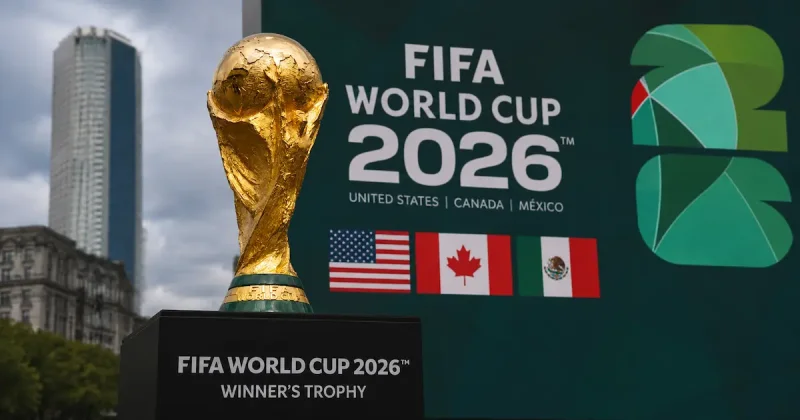
Imagine 48 nations. Three host countries. Sixteen iconic cities. One hundred and four matches spread across 39 electrifying days. The FIFA World Cup 2026 is not just another edition of the beautiful game's grandest stage, it is a complete reimagining of what a World Cup can be, and it all kicks off on June 11, 2026, building toward a spectacular final on July 19, 2026 at MetLife Stadium in East Rutherford, New Jersey.
For the first time in history, the 2026 FIFA World Cup will be co-hosted by three nations, the United States, Canada, and Mexico, spanning an entire continent and uniting cultures, languages, and football traditions like never before. This is also the first men's World Cup since South Korea/Japan 2002 to feature multiple host nations, a powerful echo of the sport's most collaborative spirit.
But the numbers alone barely scratch the surface of what makes this tournament watershed. The field has expanded from 32 to 48 teams, meaning nations like first-time qualifiers Cape Verde, Curaçao, Jordan, and Uzbekistan will make their World Cup debuts on the grandest stage in global sport. Defending champions Argentina return to defend their third World Cup crown won in Qatar 2022, while football powerhouses including Brazil, France, Spain, Germany, England, and the Netherlands will all be battling for glory across venues stretching from Vancouver to Miami.
Whether you are a lifelong football fanatic or a casual viewer drawn in by the spectacle, here is a snapshot of exactly what to expect from FIFA World Cup 2026:
| Feature | FIFA World Cup 2022 (Qatar) | FIFA World Cup 2026 (USA/Canada/Mexico) |
|---|---|---|
| Number of Teams | 32 | 48 |
| Total Matches | 64 | 104 |
| Host Nations | 1 (Qatar) | 3 (USA, Canada, Mexico) |
| Host Cities | 8 | 16 |
| Tournament Duration | 29 days | 39 days |
| Group Stage Format | 8 groups of 4 | 12 groups of 4 |
| Knockout Rounds Begin | Round of 16 | Round of 32 |
| Defending Champion | France (2018) | Argentina (2022) |
| Season | November–December (Winter) | June–July (Summer) |
| First-Time Qualifiers | 0 | 4 (Cape Verde, Curaçao, Jordan, Uzbekistan) |
The official FIFA World Cup 2026 tournament will see matches played across iconic stadiums in cities such as Los Angeles, where SoFi Stadium hosts the United States' opening match against Paraguay on June 12, 2026, all the way to Mexico City, Toronto, and Kansas City, each city bringing its own cultural flair and passionate fanbase to the world's biggest sporting party. Cities like Kansas City, proudly billing itself as the "Soccer Capital of America," and Los Angeles, with its deep roots in global football stretching back to the 1994 World Cup Final, are already buzzing with anticipation.
The tournament's new 12-group format, with each group containing four teams and the top two from each group plus the eight best third-placed teams advancing to a Round of 32, was approved by the FIFA Council on March 14, 2023, replacing an earlier proposal that critics warned risked match collusion. This refined structure ensures competitive integrity while delivering more football than any previous edition.
Off the pitch, three proud national mascots, Maple™ the Moose (Canada), Zayu™ the Jaguar (Mexico), and Clutch™ the Bald Eagle (United States), will be front and center, while adidas has launched the TRIONDA as the official match ball for the tournament. FIFA Fan Festivals will transform landmarks like the Los Angeles Memorial Coliseum into global celebrations of football, culture, and community.
In the pages below, we break down everything you need to know, from host cities and qualified nations, to the match schedule, key storylines, and how to get tickets, so you are fully prepared to experience the most ambitious FIFA World Cup in the sport's 96-year history.
Host Countries, Cities, and Stadiums: USA, Canada, and Mexico Venues
For the first time in the history of the competition, the FIFA World Cup will be co-hosted by three nations simultaneously, the United States, Canada, and Mexico. Spanning an entire continent, the 2026 edition will unfold across 16 host cities and 16 stadiums, making it the most geographically expansive World Cup ever staged. Eleven cities are located in the United States, three in Mexico, and two in Canada, collectively offering fans a journey through some of the most iconic sporting arenas on the planet.
The sixteen host cities were officially announced by FIFA on June 16, 2022, following a rigorous multi-round selection process that originally evaluated more than 40 candidate cities. The final 16 were chosen based on stadium capacity, infrastructure, transportation links, accommodation, and each city's ability to deliver a world-class fan experience. Below is a comprehensive breakdown of every host city and its stadium across all three nations.
United States Host Cities and Stadiums
The United States shoulders the largest share of the tournament, hosting 11 of the 16 cities and providing the venue for the FIFA World Cup 2026 Final at MetLife Stadium in East Rutherford, New Jersey, officially confirmed by FIFA on February 4, 2024. American venues range from NFL cathedrals to purpose-built football palaces, several of which feature retractable roofs with full climate control to protect players and fans from extreme weather conditions.
| City | Stadium | Capacity | Notable Features | Primary Tenants |
|---|---|---|---|---|
| New York / New Jersey | MetLife Stadium | ~82,500 | Host of the 2026 World Cup Final; open-air | New York Giants, New York Jets (NFL) |
| Los Angeles | SoFi Stadium | ~70,240 | Translucent roof, open-air, no climate control; hosts USMNT opening match vs. Paraguay on June 12 | LA Rams, LA Chargers (NFL) |
| Dallas | AT&T Stadium | ~80,000 | Retractable roof, full climate control, indoor | Dallas Cowboys (NFL) |
| Atlanta | Mercedes-Benz Stadium | ~71,000 | Retractable roof, full climate control, indoor | Atlanta Falcons (NFL), Atlanta United (MLS) |
| Houston | NRG Stadium | ~72,220 | Retractable roof, full climate control, indoor | Houston Texans (NFL) |
| Seattle | Lumen Field | ~69,000 | Retractable roof, full climate control, indoor | Seattle Seahawks (NFL), Seattle Sounders (MLS) |
| San Francisco Bay Area | Levi's Stadium | ~68,500 | Open-air; located in Santa Clara | San Francisco 49ers (NFL) |
| Miami | Hard Rock Stadium | ~65,326 | Canopy roof; open-air sides | Miami Dolphins (NFL), Inter Miami CF (MLS) |
| Boston | Gillette Stadium | ~65,878 | Open-air; located in Foxborough, Massachusetts | New England Patriots (NFL), New England Revolution (MLS) |
| Philadelphia | Lincoln Financial Field | ~69,796 | Open-air | Philadelphia Eagles (NFL), Philadelphia Union (MLS) |
| Kansas City | Arrowhead Stadium | ~76,416 | Open-air; Soccer Capital of America® venue | Kansas City Chiefs (NFL) |
Mexico Host Cities and Stadiums
Mexico enters the 2026 World Cup with a historic distinction: by co-hosting this edition alongside its previous solo hosting duties in 1970 and 1986, it becomes the first nation to host or co-host the men's FIFA World Cup three times. The three Mexican venues are among the most culturally rich and atmospherically intense stadiums anywhere in world football, carrying decades of World Cup heritage into 2026.
| City | Stadium | Capacity | Notable Features | Primary Tenants |
|---|---|---|---|---|
| Mexico City | Estadio Azteca | ~87,523 | Largest stadium in the tournament; hosted the 1970 and 1986 World Cup finals; iconic open-air cathedral of football | Club América, Cruz Azul (Liga MX) |
| Guadalajara | Estadio Akron | ~49,850 | Modern open-air venue; located in Zapopan, Jalisco | Chivas de Guadalajara (Liga MX) |
| Monterrey | Estadio BBVA | ~53,500 | Open-air; scenic mountain backdrop; one of Latin America's most modern stadiums | CF Monterrey (Liga MX) |
Canada Host Cities and Stadiums
Canada makes history of its own in 2026, appearing as a FIFA World Cup host nation for the very first time in the men's tournament. Two Canadian cities will welcome the world, including Toronto's BMO Field, which is undergoing a significant capacity expansion specifically for the tournament, growing from 30,000 to 45,500 seats to meet FIFA's minimum requirement of 40,000.
| City | Stadium | Capacity (2026) | Notable Features | Primary Tenants |
|---|---|---|---|---|
| Toronto | BMO Field | ~45,500 (expanded) | Purpose-built soccer-specific stadium; expanded from 30,000 for the 2026 tournament; Canada's first men's World Cup host venue | Toronto FC (MLS), Canada Soccer |
| Vancouver | BC Place | ~54,500 | Retractable roof, full climate control; rejoined bid in April 2022 after initially withdrawing; indoor stadium | Vancouver Whitecaps FC (MLS), BC Lions (CFL) |
Pitch Surfaces: A Massive Grass Conversion Project
One of the most logistically complex undertakings in the tournament's preparation is the conversion of artificial turf surfaces to natural grass. Eight of the sixteen chosen stadiums have permanent artificial turf surfaces that FIFA has mandated be replaced with grass ahead of the competition. A joint University of Tennessee–Michigan State University research team is directing this unprecedented grass installation program. The specific grass type used at each stadium depends on local climate conditions:
| Climate Type | Grass Mixture | Composition | Typical Venues |
|---|---|---|---|
| Cooler Temperatures | Hybrid Cool-Season Blend | 84% Kentucky Bluegrass + 16% Perennial Ryegrass | Northern stadiums (e.g., Toronto, Vancouver, Kansas City, Seattle) |
| Warmer Temperatures | Bermuda Grass | 100% Bermuda Grass | Southern and warm-climate stadiums (e.g., Miami, Houston, Atlanta, Dallas) |
Stadium Overview: All 16 Venues at a Glance
To provide a complete at-a-glance comparison across all three host nations, the table below consolidates every confirmed FIFA World Cup 2026 host city and stadium, organized by country and capacity:
| Country | City | Stadium | Approximate Capacity | Roof / Climate Control |
|---|---|---|---|---|
| USA | New York / New Jersey | MetLife Stadium | 82,500 | Open-air (World Cup Final venue) |
| USA | Dallas | AT&T Stadium | 80,000 | Retractable Roof / Climate Controlled |
| USA | Kansas City | Arrowhead Stadium | 76,416 | Open-air |
| Mexico | Mexico City | Estadio Azteca | 87,523 | Open-air |
| USA | Atlanta | Mercedes-Benz Stadium | 71,000 | Retractable Roof / Climate Controlled |
| USA | Houston | NRG Stadium | 72,220 | Retractable Roof / Climate Controlled |
| USA | Los Angeles | SoFi Stadium | 70,240 | Translucent Roof / No Climate Control |
| USA | Seattle | Lumen Field | 69,000 | Retractable Roof / Climate Controlled |
| USA | Philadelphia | Lincoln Financial Field | 69,796 | Open-air |
| USA | San Francisco Bay Area | Levi's Stadium | 68,500 | Open-air |
| USA | Miami | Hard Rock Stadium | 65,326 | Canopy / Open-air Sides |
| USA | Boston | Gillette Stadium | 65,878 | Open-air |
| Canada | Vancouver | BC Place | 54,500 | Retractable Roof / Climate Controlled |
| Mexico | Monterrey | Estadio BBVA | 53,500 | Open-air |
| Mexico | Guadalajara | Estadio Akron | 49,850 | Open-air |
| Canada | Toronto | BMO Field | 45,500 (expanded) | Open-air |
The Final: MetLife Stadium, New Jersey
Perhaps no single venue announcement generated more excitement than FIFA's confirmation that MetLife Stadium in East Rutherford, New Jersey, the largest stadium in the tournament, will host the FIFA World Cup 2026 Final on July 19, 2026. Home to both the New York Giants and the New York Jets of the NFL, MetLife Stadium sits just outside New York City and is one of the most recognizable sporting arenas in the world. Its selection as the Final venue crowns what is already the most ambitious stadium program in World Cup history, with the surrounding New York metropolitan area expected to generate unprecedented levels of global media attention and fan tourism throughout the tournament's closing stages.
With 16 iconic venues spread across three nations, six time zones, and dozens of distinct cultures, the FIFA World Cup 2026 promises a stadium experience unlike anything the sport has ever seen, a true continental celebration of the beautiful game from June 11 through July 19, 2026.
Tournament Format Explained: Expanded 48-Team Bracket, Groups, and Knockout Rounds
The 2026 FIFA World Cup marks the most significant structural overhaul in the tournament's history. For the first time ever, 48 national teams will compete, an increase of 16 sides compared to the 32-team field that defined every World Cup from 1998 through 2022. The expansion fundamentally reshapes how the competition is organized, how teams qualify from the group stage, and how the knockout bracket unfolds across a 39-day tournament spanning three host nations. Understanding the new format is essential for any fan planning to follow the action from the opening kick on June 11 through the Final at MetLife Stadium on July 19, 2026.
Why the Expansion Happened
The push to grow the World Cup to 48 teams was first floated as early as 2013 by then-UEFA president Michel Platini, and gained decisive momentum when FIFA president Gianni Infantino championed the idea in 2016. The official vote to expand was passed on January 10, 2017, with the underlying rationale being to give more confederations, particularly from Africa, Asia, and the Americas, a greater share of World Cup berths. Critics warned that expansion could dilute match quality and that the decision was politically motivated, but FIFA pressed ahead. The expansion also unlocks significant commercial upside: the jump from 64 to 104 total matches represents a 62.5% increase in inventory for broadcasters and sponsors, making FIFA World Cup 2026 the largest single-sport event ever staged.
Group Stage: Twelve Groups of Four Teams
After initially approving a format of 16 groups of three teams, a structure widely criticized for its high risk of collusion between teams needing only a draw to advance, FIFA's Council announced in March 2023 that the 2026 tournament would instead use twelve groups of four teams. This decision restored the familiar dynamic of three group-stage matches per team while eliminating the mathematical collusion danger inherent in two-team progression from three-team groups. Each group therefore mirrors the traditional format fans know well, with every nation guaranteed at least three matches before the knockout rounds begin.
The official FIFA competition page confirms the 48 nations are distributed across the 12 groups as follows: Groups A through L, each containing four teams drawn from different FIFA confederations wherever seeding and pot allocations allow. Teams earn three points for a win, one for a draw, and zero for a defeat, with goal difference, goals scored, and head-to-head record serving as tiebreakers in the standard FIFA order.
Who Advances from the Group Stage
This is where the 2026 format introduces its most distinctive innovation. Rather than taking only the top two teams from each group, which from 12 groups would yield just 24 qualifiers, FIFA approved a three-pronged advancement mechanism:
- Group winners (12 teams): The top-placed team from each of the 12 groups advances automatically to the Round of 32.
- Group runners-up (12 teams): The second-placed team from each of the 12 groups also advances automatically.
- Best third-placed teams (8 teams): Of the 12 third-placed teams, one from every group, the eight with the best records across all groups also progress to the Round of 32. This means finishing third in your group is not automatically fatal; a strong points tally and goal difference can still earn a spot in the knockout rounds.
This produces a total of 32 teams entering the knockout stage, which is why the next round is formally designated the Round of 32 rather than the Round of 16 familiar from previous tournaments. The ranking of the eight best third-placed teams is determined by points, then goal difference, then goals scored, and then FIFA World Ranking if still tied.
Full Format Comparison: 2022 vs. 2026
| Format Element | 2022 FIFA World Cup (Qatar) | 2026 FIFA World Cup (USA/Canada/Mexico) |
|---|---|---|
| Total Teams | 32 | 48 |
| Number of Groups | 8 groups of 4 | 12 groups of 4 |
| Teams Advancing Per Group | Top 2 from each group | Top 2 + 8 best third-placed teams |
| Total Teams Advancing from Groups | 16 | 32 |
| First Knockout Round | Round of 16 | Round of 32 |
| Knockout Rounds After Groups | 4 (R16, QF, SF, Final) | 5 (R32, R16, QF, SF, Final) |
| Total Matches Played | 64 | 104 |
| Matches for Finalists | 7 | 8 |
| Tournament Duration | 29 days | 39 days |
| Group Matches per Team | 3 | 3 |
| Host Nations | 1 (Qatar) | 3 (USA, Canada, Mexico) |
| Venues Used | 8 | 16 |
The Knockout Stage: Round by Round
Once the group stage concludes, the tournament transitions into a straight single-elimination bracket with no second chances. Every match from the Round of 32 onward is decided on the day, with extra time and a penalty shootout used if the score is level after 90 minutes. The full knockout pathway is outlined below.
| Knockout Round | Teams Remaining | Matches Played | New in 2026? |
|---|---|---|---|
| Round of 32 | 32 | 16 | Yes, brand new round |
| Round of 16 | 16 | 8 | No, existed previously |
| Quarterfinals | 8 | 4 | No, existed previously |
| Semifinals | 4 | 2 | No, existed previously |
| Third-Place Match | 2 (semifinal losers) | 1 | No, existed previously |
| Final | 2 | 1 | No, existed previously |
The addition of the Round of 32 is the single most consequential structural change in the knockout bracket. It means a team that finishes third in a competitive group, and still earns eight points, could theoretically advance, while a team that wins its group plays the same number of knockout matches as always. The Round of 32 adds 16 matches to the schedule, contributing significantly to the overall jump from 64 to 104 total games across the tournament.
Confederation Qualification Allocations
The expansion from 32 to 48 teams required FIFA to redistribute World Cup berths among its six confederations. As tracked by U.S. Soccer's official qualifier tracker, the allocation of spots, excluding the three automatically qualified host nations, breaks down as follows:
| Confederation | Region | World Cup Spots (2022) | World Cup Spots (2026) | Net Change |
|---|---|---|---|---|
| UEFA | Europe | 13 | 16 | +3 |
| CAF | Africa | 5 | 9 | +4 |
| AFC | Asia | 4.5 | 8 | +3.5 |
| CONMEBOL | South America | 4.5 | 6 | +1.5 |
| CONCACAF | N/C America & Caribbean | 3.5 | 6 (excl. hosts) | +2.5 |
| OFC | Oceania | 0.5 | 1 | +0.5 |
Africa and Asia are the biggest beneficiaries of the expansion in absolute and proportional terms. CAF's jump from 5 to 9 berths allows nations like Cape Verde and South Africa to qualify for the first time or return after long absences. The AFC's expanded allocation similarly enabled debut qualifiers Jordan and Uzbekistan to reach their maiden World Cup, a milestone confirmed by the U.S. Soccer qualification tracker.
Inter-Confederation Playoff: The Final Two Spots
In a further innovation, the final two berths at FIFA World Cup 2026 were not decided through confederation qualifying alone. A brand-new inter-confederation playoff tournament held in March 2026 brought together six teams, one each from AFC, CAF, CONMEBOL, and OFC, plus two from CONCACAF, competing in a mini-bracket for the last two places. This format replaced the previous bilateral inter-confederation playoff matchups and created a more equitable and dramatic path for teams on the bubble across multiple regions. The two teams that emerged victorious were Congo DR (via Path A) and Iraq (via Path B), with Iraq returning to the World Cup for the first time since 1986.
Match Schedule and Rest Periods
With 104 matches spread across 39 days and 16 venues in three countries, the scheduling logistics of FIFA World Cup 2026 are unprecedented. The tournament's Wikipedia entry confirms that the combined rest, release, and tournament period of 56 days remains identical to the 2010, 2014, and 2018 editions, ensuring that player welfare standards are maintained despite the larger field. Clubs were required to release players by May 25, 2026, with exceptions for those involved in continental club competition finals up to May 30, 2026. Teams reaching the Final will play eight matches in total, one more than in any previous World Cup, making squad depth and physical conditioning more critical than ever before.
What the New Format Means for Fans and Teams
The expanded 48-team, 104-match format fundamentally changes the calculus for players, coaches, and supporters alike. For fans, the FIFA World Cup 2026 schedule offers more matches, more nations, and more drama across a longer, 39-day festival, particularly for host cities like Los Angeles, which is staging eight matches including a quarterfinal, and Kansas City, which embraces its identity as the "Soccer Capital of America" for the biggest stage in world football. For teams, finishing third in a group is no longer an automatic exit, it is a genuine survival route. And for the sport globally, the inclusion of first-time qualifiers like Jordan, Uzbekistan, Cape Verde, and Curaçao signals that FIFA World Cup 2026 is genuinely the most inclusive edition of football's greatest tournament in the event's entire 96-year history.
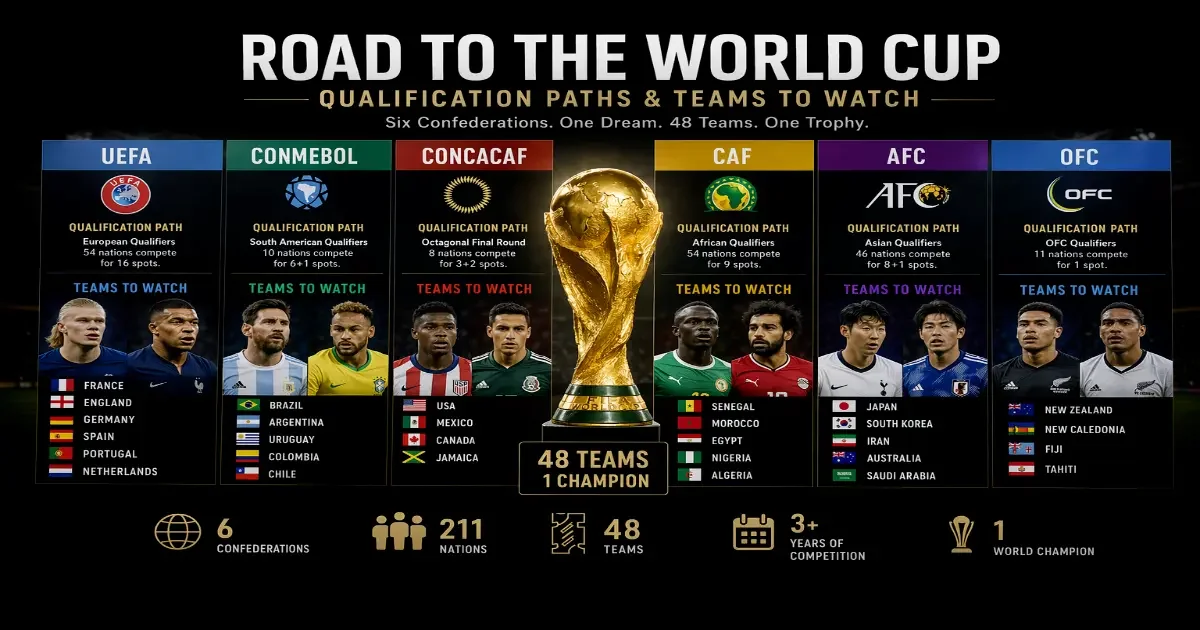
Qualification and Teams to Watch: UEFA, CONMEBOL, CONCACAF, CAF, AFC, OFC Paths
The road to the 2026 FIFA World Cup was the most expansive qualification campaign in football history, with 48 berths distributed across six confederations. From Europe's ultra-competitive playoff paths to Oceania's hard-fought regional campaign, every corner of the globe contributed to a field that is richer, deeper, and more diverse than any previous edition. The final two spots were decided on March 31, 2026, through an inter-confederation playoff tournament, a first in World Cup history, ensuring the drama continued right up to the eve of the tournament itself.
Below is a full breakdown of how each confederation allocated its spots, which nations secured qualification, and which teams carry the greatest hopes and expectations heading into the summer of 2026.
World Cup 2026 Spots by Confederation
| Confederation | Region | Allocated Spots | Notes |
|---|---|---|---|
| UEFA | Europe | 16 | Largest allocation; includes playoff paths A–D |
| CAF | Africa | 9 | Group winners across nine qualifying groups |
| AFC | Asia | 8 | Group winners and runners-up; one inter-confederation playoff spot |
| CONMEBOL | South America | 6 | Top six finishers in single South American table |
| CONCACAF | North/Central America & Caribbean | 6 (excl. hosts) | Hosts USA, Canada, Mexico auto-qualified; two inter-confederation playoff spots |
| OFC | Oceania | 1 | Group B winners; New Zealand qualified |
| Inter-Confederation Playoff | Global | 2 | Six teams; final spots decided March 31, 2026 |
UEFA, Europe's 16 Spots and the Teams to Watch
Europe's 16 FIFA World Cup 2026 berths made UEFA's allocation the largest of any confederation, reflecting the continent's dominant position in world football. Group winners secured automatic qualification, while four playoff paths, A through D, produced the final European representatives. The qualifying drama delivered several surprises: Norway ended a 28-year World Cup absence, and Scotland returned to the tournament for the first time since 1998. Bosnia and Herzegovina claimed their second-ever World Cup berth through Playoff Path A.
| Nation | How Qualified | Last Appearance | Total Appearances | Key Player to Watch |
|---|---|---|---|---|
| Spain | UEFA Group E winners | 2022 | 17 | Pau Cubarsi (Barcelona) |
| Germany | UEFA Group A winners | 2022 | 21 | Jamal Musiala |
| France | UEFA Group D winners | 2022 | 17 | Kylian Mbappé |
| England | UEFA Group K winners | 2022 | 17 | Jude Bellingham |
| Portugal | UEFA Group F winners | 2022 | 9 | Cristiano Ronaldo / Rafael Leão |
| Netherlands | UEFA Group G winners | 2022 | 12 | Virgil van Dijk |
| Belgium | UEFA Group J winners | 2022 | 15 | Romelu Lukaku |
| Croatia | UEFA Group L winners | 2022 | 6 | Luka Modrić |
| Switzerland | UEFA Group B winners | 2022 | 13 | Granit Xhaka |
| Austria | UEFA Group H winners | 1998 | 8 | Marcel Sabitzer |
| Norway | UEFA Group I winners | 1998 | 4 | Erling Haaland |
| Scotland | UEFA Group C winners | 1998 | 9 | Andy Robertson |
| Sweden | UEFA Playoff Path B winners | 2018 | 13 | Alexander Isak |
| Türkiye | UEFA Playoff Path C winners | 2002 | 3 | Hakan Çalhanoğlu |
| Czechia | UEFA Playoff Path D winners | 2006 | 10 | Tomáš Souček |
| Bosnia and Herzegovina | UEFA Playoff Path A winners | 2014 | 2 | Edin Džeko |
Team to Watch, Norway: Perhaps no UEFA qualifier generated more excitement than Norway's return after a 28-year World Cup absence. With Erling Haaland at the peak of his powers, Norway arrives in North America as a genuine dark-horse contender. Haaland's record-breaking club form at Manchester City has made him one of the most feared forwards on the planet, and a World Cup stage could transform his legacy. Spain's teenage prodigy Pau Cubarsi is similarly one to watch, a cultured centre-back whose composure belies his years, he is widely tipped to be one of the breakout stars of the tournament.
CONMEBOL, South America's Six Spots
South America's qualification format remains unique in world football: all ten CONMEBOL member nations compete in a single league table over 18 matchdays, and the top six earn direct World Cup berths. This grueling, marathon campaign, which unfolded across two years and multiple high-altitude venues, produced a qualified group featuring some of the tournament's strongest contenders.
| Nation | How Qualified | Last Appearance | Total Appearances | Key Player to Watch |
|---|---|---|---|---|
| Argentina | CONMEBOL winners (1st) | 2022 | 19 | Lionel Messi |
| Brazil | CONMEBOL top six | 2022 | 23 | Vinícius Júnior |
| Colombia | CONMEBOL top six | 2018 | 7 | Luis Díaz |
| Ecuador | CONMEBOL top six | 2022 | 5 | Moisés Caicedo |
| Uruguay | CONMEBOL top six | 2022 | 15 | Federico Valverde |
| Paraguay | CONMEBOL top six | 2010 | 9 | Miguel Almirón |
Team to Watch, Argentina: The defending champions arrive at FIFA World Cup 2026 with history in their sights and Lionel Messi potentially playing in his final World Cup. Argentina secured qualification early, topping the CONMEBOL standings, and their squad is built around a golden generation of talent supplemented by world-class club performers. Brazil, meanwhile, return as perennial favorites with 23 World Cup appearances, more than any other nation, and an electric attacking unit led by Vinícius Júnior. Colombia and Paraguay bring renewed optimism, with both sides having rediscovered their competitive edge during a strong qualifying campaign.
CONCACAF, The Host Nations and Six Additional Spots
As co-host nations, the United States, Canada, and Mexico all automatically qualified for FIFA World Cup 2026, leaving six additional CONCACAF berths to be contested through a competitive regional campaign involving group stages and playoff rounds. The CONCACAF allocation also included two inter-confederation playoff spots. The regional qualifiers produced some notable stories, including Curaçao's historic debut appearance and Haiti's return to the tournament after a 52-year absence.
| Nation | How Qualified | Last Appearance | Total Appearances | Key Player to Watch |
|---|---|---|---|---|
| USA | Co-host (auto-qualified) | 2022 | 12 | Christian Pulisic |
| Canada | Co-host (auto-qualified) | 2022 | 3 | Alphonso Davies |
| Mexico | Co-host (auto-qualified) | 2022 | 18 | Santiago Giménez |
| Panama | CONCACAF Group A winners | 2018 | 2 | Rolando Blackburn |
| Haiti | CONCACAF Group C winners | 1974 | 2 | Frantzdy Pierrot |
| Curaçao | CONCACAF Group B winners | Debut | 1 | Curaçao squad collective |
Team to Watch, USA (Host Nation): Playing on home soil for the first time since 1994, the USMNT opens their campaign at SoFi Stadium in Los Angeles against Paraguay on June 12, in front of what promises to be a passionate, partisan crowd. Managed by Mauricio Pochettino, the Americans possess a genuine golden generation of talent, led by Chelsea's Christian Pulisic, and host-nation momentum that could propel them deeper into the knockout rounds than any previous American side. Canada, meanwhile, make only their third World Cup appearance and will be bolstered by the exceptional pace and skill of Bayern Munich's Alphonso Davies.
CAF, Africa's Nine Spots
Africa's expanded allocation of nine spots, up from five in previous tournaments, reflects FIFA's commitment to broadening global representation at the 2026 edition. CAF's qualifying campaign was structured across nine groups, with each group winner earning direct qualification. The results delivered a strong, experienced African contingent alongside a historic first-time qualifier in Cape Verde.
| Nation | How Qualified | Last Appearance | Total Appearances | Key Player to Watch |
|---|---|---|---|---|
| Morocco | CAF Group E winners | 2022 | 7 | Achraf Hakimi |
| Senegal | CAF Group B winners | 2022 | 4 | Sadio Mané |
| Egypt | CAF Group A winners | 2018 | 4 | Mohamed Salah |
| Algeria | CAF Group G winners | 2014 | 5 | Riyad Mahrez |
| Ivory Coast | CAF Group F winners | 2014 | 4 | Sébastien Haller |
| Tunisia | CAF Group H winners | 2022 | 7 | Youssef Msakni |
| Ghana | CAF Group I winners | 2022 | 5 | Jordan Ayew |
| South Africa | CAF Group C winners | 2010 | 4 | Percy Tau |
| Cape Verde | CAF Group D winners | Debut | 1 | Ryan Mendes |
| Congo DR | Inter-Confederation Playoff Path A | 1974 | 2 | Cédric Bakambu |
Team to Watch, Morocco: The Atlas Lions arrive in North America riding a wave of historic momentum after their extraordinary 2022 World Cup campaign, in which they became the first African nation to reach a semi-final. Led by Paris Saint-Germain's Achraf Hakimi, Morocco possess elite quality at both ends of the pitch and a tactical sophistication that makes them genuine contenders. Egypt's Mohamed Salah, at or near the peak of his powers, will also command attention, while Cape Verde's debut appearance represents one of the most heartwarming qualification stories of the entire campaign.
AFC, Asia's Eight Spots
Asia's expanded allocation of eight places, up from four and a half in previous cycles, reflects the growing footballing infrastructure and talent across the continent. The AFC's qualification format saw teams compete in group stages, with group winners and runners-up earning direct berths, and one additional spot contested through the inter-confederation playoff. The campaign delivered a mix of established Asian powers alongside two historic first-time qualifiers: Jordan and Uzbekistan.
| Nation | How Qualified | Last Appearance | Total Appearances | Key Player to Watch |
|---|---|---|---|---|
| Japan | AFC Group C winners | 2022 | 8 | Takefusa Kubo |
| IR Iran | AFC Group A winners | 2022 | 7 | Mehdi Taremi |
| Korea Republic | AFC Group B winners | 2022 | 12 | Son Heung-min |
| Uzbekistan | AFC Group A runners-up | Debut | 1 | Eldor Shomurodov |
| Jordan | AFC Group B runners-up | Debut | 1 | Yazan Al-Naimat |
| Australia | AFC Group C runners-up | 2022 | 7 | Mathew Leckie |
| Saudi Arabia | AFC Group B winners | 2022 | 7 | Salem Al-Dawsari |
| Qatar | AFC Group A winners | 2022 | 2 | Akram Afif |
| Iraq | Inter-Confederation Playoff Path B | 1986 | 2 | Aymen Hussein |
Team to Watch, Japan: Consistently one of Asia's strongest sides, Japan arrive having defeated both Germany and Spain at the 2022 World Cup in Qatar. With a core of players performing at the highest level in Europe's top leagues, the Samurai Blue are well-equipped to make another deep run. South Korea's Son Heung-min, one of the most recognizable names in global football, makes his likely farewell World Cup appearance, while the debuts of Jordan and Uzbekistan represent genuine landmarks in the history of Asian football. Both nations qualified for the very first time, proof that the expanded 48-team format has opened the World Cup to football cultures that have long deserved a place on the global stage.
OFC, Oceania's Single Berth
Oceania's one guaranteed World Cup spot remains fiercely contested across the confederation's member nations, and at FIFA World Cup 2026, it is New Zealand, the All Whites, who secured the region's place after winning OFC Group B. It is New Zealand's third World Cup appearance and their first since 2010, when they famously drew all three group stage matches without being eliminated on points.
| Nation | How Qualified | Last Appearance | Total Appearances | Key Player to Watch |
|---|---|---|---|---|
| New Zealand | OFC Group B winners | 2010 | 3 | Chris Wood |
Team to Watch, New Zealand: The All Whites return to the World Cup stage for the first time in 16 years, and veteran striker Chris Wood, who has enjoyed an impressive career in English football, leads a side that will be eager to replicate the underdog spirit that captured imaginations in 2010. Playing in a group that includes Belgium, Bosnia and Herzegovina, and other competitive sides, New Zealand's challenge will be steep, but the expanded format, which now advances eight third-placed teams to the Round of 32, gives the All Whites a genuine mathematical chance of progressing beyond the group stage for the first time in their history.
The Complete Qualified Field at a Glance
The full 48-team field for FIFA World Cup 2026 represents every corner of the footballing world, from the historic powerhouses of Europe and South America to first-time qualifiers writing the opening chapters of their World Cup stories. It is, by every measurable standard, the most globally representative and competitively balanced World Cup in the tournament's 96-year history, and with the 16 host cities across the United States, Canada, and Mexico providing world-class venues, the stage is set for an unforgettable summer of football across North America.
Match Schedule, Ticketing, and Travel Planning: Dates, Fan Experience, and Logistics
The FIFA World Cup 2026 runs from June 11 to July 19, 2026, a 39-day festival of football spread across three nations and 16 iconic host cities. For fans, players, and organizers alike, the sheer scale of this tournament demands careful planning. With 104 matches taking place across venues stretching from Vancouver in the north to Guadalajara in the south, understanding the structure of the schedule, how to secure tickets, and how to navigate travel across North America is essential for anyone hoping to experience the tournament firsthand.
Tournament Phase Timeline
The expanded 48-team format introduces a new round, the Round of 32, meaning the knockout bracket is deeper than any previous World Cup. Here is a breakdown of the key phases and approximate scheduling windows fans should plan around:
| Tournament Phase | Approximate Dates | Number of Matches | Teams Involved |
|---|---|---|---|
| Group Stage | June 11 – July 2, 2026 | 72 matches | All 48 qualified nations (12 groups of 4) |
| Round of 32 | July 4 – July 7, 2026 | 16 matches | 24 group winners/runners-up + 8 best third-placed teams |
| Round of 16 | July 9 – July 11, 2026 | 8 matches | 16 surviving teams |
| Quarterfinals | July 13 – July 14, 2026 | 4 matches | 8 teams |
| Semifinals | July 16 – July 17, 2026 | 2 matches | 4 teams |
| Third-Place Match | July 18, 2026 | 1 match | 2 semifinal losers |
| Final | July 19, 2026 | 1 match | 2 finalists, MetLife Stadium, New Jersey |
As confirmed by tournament organizers, the Final will be held at MetLife Stadium in East Rutherford, New Jersey, the largest stadium in the host nation by capacity, on July 19, 2026. This was officially announced by FIFA on February 4, 2024, ending months of speculation about the prestige venue that would host football's most-watched single sporting event.
Host City Match Schedules: What to Expect Where
Each of the 16 host cities will stage a different number and combination of matches depending on their stadium capacity, infrastructure, and FIFA's scheduling determinations. Understanding which cities host which rounds is critical for fans building a multi-match itinerary.
| Host City | Country | Stadium | Notable Matches Hosted |
|---|---|---|---|
| New York / New Jersey | USA | MetLife Stadium | Group Stage + Final (July 19) |
| Los Angeles | USA | SoFi Stadium | Group Stage (incl. USMNT opener vs. Paraguay, June 12) + Round of 32 + Quarterfinal |
| Dallas | USA | AT&T Stadium | Group Stage + Knockout Rounds |
| San Francisco Bay Area | USA | Levi's Stadium | Group Stage + Knockout Rounds |
| Miami | USA | Hard Rock Stadium | Group Stage + Knockout Rounds |
| Atlanta | USA | Mercedes-Benz Stadium | Group Stage + Knockout Rounds |
| Seattle | USA | Lumen Field | Group Stage + Knockout Rounds |
| Houston | USA | NRG Stadium | Group Stage + Knockout Rounds |
| Kansas City | USA | Arrowhead Stadium | Group Stage + Knockout Rounds |
| Boston | USA | Gillette Stadium | Group Stage + Knockout Rounds |
| Philadelphia | USA | Lincoln Financial Field | Group Stage + Knockout Rounds |
| Mexico City | Mexico | Estadio Azteca | Group Stage (Opening Match, June 11) |
| Guadalajara | Mexico | Estadio Akron | Group Stage |
| Monterrey | Mexico | Estadio BBVA | Group Stage |
| Toronto | Canada | BMO Field (expanded to 45,500) | Group Stage + Knockout Rounds |
| Vancouver | Canada | BC Place | Group Stage + Knockout Rounds |
Notably, Los Angeles is one of the tournament's marquee venues, hosting eight matches in total, including the highly anticipated USMNT opening match against Paraguay on June 12, 2026 at SoFi Stadium. As detailed by the Los Angeles FIFA World Cup 2026 Host Committee, the LA schedule includes four additional group stage matches, two Round of 32 clashes, and a quarterfinal, making it one of the busiest and most vibrant host venues of the entire tournament.
Opening Match: June 11 at Estadio Azteca
The tournament's ceremonial opening match will take place on June 11, 2026, at Estadio Azteca in Mexico City, an iconic venue steeped in World Cup history, having previously hosted matches in both the 1970 and 1986 FIFA World Cups. This will make Mexico the first country in history to host or co-host the men's World Cup three times, a staggering footballing legacy that makes the Azteca the fitting backdrop for the opening ceremony and kickoff of the biggest World Cup in the sport's history.
Ticketing: How to Purchase and What to Expect
Tickets for the FIFA World Cup 2026 are sold exclusively through FIFA's official ticketing platform. Given the unprecedented demand for an expanded 48-team tournament, the first of its kind, fans are strongly advised to purchase tickets well in advance, as individual match allocations sell out rapidly, particularly for high-profile group stage fixtures and all knockout-round matches.
| Ticket Category | Match Type | Price Range (USD, Approx.) | Availability Notes |
|---|---|---|---|
| Category 4 (Supporter) | Group Stage | $105 – $175 | Limited availability; aimed at fans of competing nations |
| Category 3 | Group Stage | $175 – $350 | General public; standard seating tiers |
| Category 2 | Group Stage / Round of 32 | $350 – $600 | Mid-tier; good sightlines |
| Category 1 | Quarterfinals / Semifinals | $600 – $1,500+ | Premium seating; high demand |
| Final Tickets | World Cup Final (July 19) | $1,000 – $3,000+ | Extremely limited; MetLife Stadium, New Jersey |
| FIFA Hospitality Packages | All rounds available | $3,000 – $20,000+ | Includes premium lounges, catering, and exclusive access |
FIFA has also introduced official parking reservations for all match venues, with pre-purchased parking mandatory at most stadiums on match days. As noted on the FIFA host cities portal, parking spots are limited and are selling quickly, meaning fans driving to venues should reserve their spaces as early as possible through the official FIFA travel and logistics channels.
FIFA Fan Festivals: Free Access to the World Cup Atmosphere
For fans who cannot secure match tickets, or who simply want to extend their tournament experience beyond the stadium, the FIFA Fan Festival™ program provides free-access public viewing zones in each of the 16 host cities. These events transform public landmarks and open spaces into global football celebrations, featuring live match screenings on giant screens, entertainment stages, food and drink vendors representing cultures from around the world, and interactive football experiences.
In Los Angeles, the FIFA Fan Festival™ will be hosted at the historic Los Angeles Memorial Coliseum, with community ambassadors including Snoop Dogg, Magic Johnson, Mia Hamm, Will Ferrell, and Julie Foudy leading the celebrations across a 39-day program of fan engagement. In Kansas City, the FIFA Fan Festival™ Kansas City promises thousands of fans united across the Heart of America, with motorcoach bus services linking the city's international airport, match venue, and Fan Festival sites for convenient match-day travel.
Travel Planning: Getting Around a Three-Nation Tournament
Traveling between matches at a tri-nation World Cup presents both exciting opportunities and logistical challenges. With host cities spanning thousands of miles, from Vancouver, British Columbia in the northwest to Miami, Florida in the southeast, and across the border to Mexico City, Guadalajara, and Monterrey, fans attending multiple matches will need to factor in flights, border crossings, and accommodation well ahead of the tournament.
| Travel Consideration | Key Information | Fan Action Required |
|---|---|---|
| Passport & Visas | Traveling between USA, Canada, and Mexico requires valid passports; some nationalities need visas for one or more host nations | Check visa requirements for all three countries well in advance; apply early as demand will be high |
| FIFA PASS | FIFA has introduced an official travel and access document system called the FIFA PASS for tournament attendees | Register through the official FIFA platform; required for entry into certain venues and travel schemes |
| Domestic Flights (USA) | With 11 US host cities spread coast to coast, most multi-match itineraries within the US will require domestic air travel | Book flights early, prices surge during tournament windows; consider flexible booking options |
| Cross-Border Travel | Canada–USA and USA–Mexico border crossings are straightforward for most Western passport holders but require planning during high-traffic periods | Allow extra time at land border crossings; consider air travel for Mexico matches |
| Local Transportation | Each host city offers official match-day transport including motorcoach services, metro extensions, and park-and-ride schemes | Check each host city's transport page; pre-book where possible (e.g., Kansas City motorcoach passes) |
| Accommodation | Hotels and short-term rentals near all 16 stadiums are booking up rapidly across all price points | Book accommodation as soon as match allocations are confirmed; consider staying outside city centers for lower rates |
| Immigration Policy (USA) | International fans traveling to US venues should be aware of evolving US immigration policies, including the 2025 travel ban and visa bond program | Monitor official government and FIFA communications; ensure all travel documentation is complete before departure |
FIFA has launched its official FIFA PASS program to help fans navigate travel logistics to and within the tournament, providing visa guidance, transport coordination, and entry documentation support. As highlighted on the FIFA host cities page, fans are urged to ensure they are ready to travel with all necessary documentation well in advance of match dates.
Climate and Stadium Conditions: What Fans Should Prepare For
With matches taking place across wildly different climatic zones, from the cool Pacific Northwest in Seattle and Vancouver to the intense summer heat of Miami, Houston, and Dallas, fans attending multiple matches should be prepared for dramatically varying conditions. Tournament organizers have made specific infrastructure investments to manage this challenge.
| Stadium / City | Climate Type | Roof & Climate Control | Fan Comfort Notes |
|---|---|---|---|
| Atlanta (Mercedes-Benz Stadium) | Humid subtropical; hot summers | Retractable roof + full climate control | Indoor conditions; comfortable even in peak July heat |
| Dallas (AT&T Stadium) | Semi-arid; extremely hot summers | Retractable roof + full climate control | Indoor conditions; essential given Dallas July temperatures |
| Houston (NRG Stadium) | Humid subtropical; very hot & humid | Retractable roof + full climate control | Climate-controlled interior; humidity outside can be intense |
| Vancouver (BC Place) | Oceanic; mild summers | Retractable roof + full climate control | Generally comfortable; indoor facility |
| Los Angeles (SoFi Stadium) | Mediterranean; warm, dry summers | Translucent fixed roof; no climate control | Open-air feel with shade; bring sunscreen and water |
| New York / New Jersey (MetLife Stadium) | Humid continental; warm summers | Open-air; no roof | July weather typically warm; prepare for heat and occasional storms |
| Mexico City (Estadio Azteca) | Subtropical highland; mild due to altitude (2,240m) | Open-air | High altitude may affect players and fans; bring layers for cooler evenings |
As detailed in reporting on the tournament's venue preparations, four stadiums, Atlanta, Dallas, Houston, and Vancouver, feature retractable roof systems with full climate control, providing indoor-quality comfort regardless of outdoor temperatures. Los Angeles's SoFi Stadium features a translucent fixed roof but lacks active climate control, while MetLife Stadium, host of the Final, is an open-air venue. Fans attending outdoor venues in the southern United States during July should be prepared for extreme heat and should hydrate accordingly.
Planning Your Perfect World Cup Trip: A Practical Checklist
Given the complexity of navigating a 39-day, tri-nation, 16-city tournament, smart fans will want to plan methodically. Here is a step-by-step logistics checklist to ensure your FIFA World Cup 2026 experience is seamless from first whistle to final:
| Planning Step | Priority | Key Action | Recommended Timeline |
|---|---|---|---|
| 1. Secure Match Tickets | Critical | Register and purchase through FIFA's official ticketing portal; monitor re-sale windows | Immediately, tickets are selling fast |
| 2. Register for FIFA PASS | High | Complete the official FIFA PASS documentation for tournament entry and travel | As soon as tickets are confirmed |
| 3. Book Accommodation | Critical | Secure hotels or short-term rentals near match venues; compare prices city by city | Immediately, limited supply in all host cities |
| 4. Arrange Flights | High | Book domestic and international flights; consider flexible tickets for knockout-round travel | 3–6 months before tournament start |
| 5. Check Visa Requirements | High | Verify entry requirements for all host nations (USA, Canada, Mexico) based on your nationality | 6+ months in advance; apply early |
| 6. Reserve Stadium Parking | Medium | Pre-purchase official FIFA parking passes where driving to venues | As soon as available, selling fast |
| 7. Plan Local Transportation | Medium | Research match-day transport options (motorcoach, metro, park-and-ride) in each host city | 1–2 months before each match |
| 8. Locate FIFA Fan Festival | Low–Medium | Identify Fan Festival locations in each host city for non-match days and complementary experiences | Ongoing, check host city websites |
The Kansas City World Cup Host Committee and the Los Angeles World Cup 2026 Host Committee both offer dedicated fan travel guides and transportation booking portals on their respective websites, and similar resources are available through the official host committee sites for all 16 cities. These local resources are invaluable for fans navigating match-day logistics, local dining recommendations, and cultural experiences in each tournament city.
Whether you are planning a single match pilgrimage to one iconic venue or an ambitious multi-city odyssey following your nation's campaign from group stage to Final, the FIFA World Cup 2026 promises to be the most logistically rich and experientially rewarding tournament in the competition's history. With 104 matches, 16 host cities, and 48 nations all converging on North America from June 11 to July 19, 2026, the only question that remains is: how many matches can you see?
Legacy and Impact: Economic, Cultural, and Football Development Effects
When the final whistle sounds at MetLife Stadium on July 19, 2026, the curtain will fall on the largest FIFA World Cup in history, but the tournament's true story will only be beginning. The 2026 edition, co-hosted across 16 cities in the United States, Canada, and Mexico, is widely projected to leave a generational footprint across economic development, cultural identity, infrastructure investment, and grassroots football growth. For all three host nations, the stakes extend far beyond 104 matches and 48 competing teams. This is a tournament engineered, by design and ambition, to reshape the sporting and social landscape of North America for decades to come.
Economic Impact: A Tournament Built to Generate Record Returns
The financial scale of the FIFA World Cup 2026 dwarfs every previous edition of the competition. FIFA's own internal projections, combined with independent economic analyses commissioned by host city committees, point to a combined economic impact that could surpass $5 billion USD across the three host nations, driven by tourism spending, infrastructure investment, broadcasting revenues, and commercial sponsorships. The expansion to 48 teams and 104 matches, up from 64 in previous editions, means significantly more match days, longer fan stays, and higher cumulative spending in host cities.
Tourism alone is expected to be transformative. With 48 nations represented, the tournament draws traveling supporter bases from every corner of the globe simultaneously. Each of the 16 host cities will welcome a rotating cast of international fans across multiple match weeks, generating sustained hotel occupancy, restaurant revenues, retail spending, and transportation demand over the tournament's full 39-day calendar. Cities such as Los Angeles, New York/New Jersey, Miami, and Dallas, already among the world's premier international travel destinations, are positioned to see the most concentrated economic uplift, while secondary host cities like Kansas City and Seattle stand to benefit disproportionately from the exposure effect of hosting a global mega-event for the first time.
| Economic Category | Primary Beneficiaries | Projected Impact | Duration of Effect |
|---|---|---|---|
| International Tourism Spending | All 16 host cities | Billions in hotel, dining, retail, and transport revenue | June–July 2026 (short-term peak) |
| Stadium Infrastructure Upgrades | All 16 host venues | Grass installation, technology upgrades, accessibility improvements | Long-term (permanent venue improvements) |
| Transportation Network Investment | US, Canada, Mexico host cities | Enhanced transit links, airport capacity, road improvements | Long-term (infrastructure legacy) |
| Broadcasting & Media Revenue | FIFA, domestic broadcasters, digital platforms | Record global rights fees; expanded digital audience monetization | Pre-tournament through final (licensing period) |
| Commercial Sponsorship & Branding | FIFA partners, local business ecosystems | Official sponsor activations, local business visibility boost | Multi-year (pre-tournament through legacy campaigns) |
| Small Business & Hospitality Economy | Local restaurants, hotels, retailers near venues | Surge demand during match weeks; elevated brand profiles | Short-to-medium term |
| FIFA Prize Money Distribution | 48 participating national federations | Record prize pool distributed to confederations globally | Post-tournament (direct federation investment) |
| Post-Event Tourism Halo Effect | US, Canada, Mexico tourism boards | Elevated global destination awareness driving future travel | Multi-year (ongoing destination marketing value) |
The prize money distributed across the 48 participating nations also represents a meaningful development catalyst at the confederation level. FIFA has confirmed a record prize fund for the 2026 edition, with even group-stage exits rewarded with significant financial allocations. For smaller football nations, including first-time qualifiers such as Cape Verde, Curaçao, Jordan, and Uzbekistan, these prize distributions can represent transformational injections of capital into national federation infrastructure, youth development programs, and coaching education pipelines.
Mexico: A Historic Third Hosting, And a Development Milestone
With its hosting of the 1970 and 1986 tournaments, Mexico enters 2026 as the first country in history to host or co-host the men's FIFA World Cup three times, a distinction that carries both enormous pride and profound developmental responsibility. The three Mexican host cities, Mexico City, Guadalajara, and Monterrey, are among the most storied football venues on the planet, and their inclusion in the 2026 tournament reinforces Mexico's position as one of the game's great global heartlands.
For Mexican football, the legacy question centers on several interlocking themes: the ability to use World Cup exposure to accelerate Liga MX's international profile, the development of youth infrastructure in host regions, and the long-term impact of hosting group stage matches, including high-profile national team encounters, on fan engagement and the sport's commercial ecosystem within the country. The Querétaro–Atlas riot incident of 2022, which briefly threatened Mexico's co-hosting status, has since catalyzed structural reforms in stadium safety and fan conduct governance that may themselves represent a lasting institutional legacy of the tournament's organizational pressure.
Canada: First-Time Men's World Cup Host, Igniting a Football Moment
For Canada, the 2026 FIFA World Cup represents a categorically unique historical moment: the nation's first-ever co-hosting of the men's World Cup, coinciding with what is only Canada's third appearance at the tournament overall. The convergence of hosting duties and on-field participation creates a rare dual platform for Canadian football to seize a generation-defining opportunity.
The two Canadian host cities, Toronto and Vancouver, are among North America's most cosmopolitan and football-passionate metropolitan areas, home to enormous immigrant communities with deep roots in football culture across Europe, Africa, Latin America, and Asia. The tournament's presence in these cities is expected to catalyze grassroots participation surges, youth registration growth in provincial soccer associations, and a lasting elevation of the sport's profile within Canada's traditionally hockey-dominated sporting landscape.
Toronto's BMO Field is undergoing a significant capacity expansion, from 30,000 to 45,500 seats, specifically to meet FIFA's minimum venue requirements for the tournament. This infrastructure investment represents a direct, permanent legacy of World Cup 2026 for Canadian football, providing a world-class domestic venue that will serve the sport for decades beyond the tournament itself.
| Host Nation | World Cup Hosting History | Key Legacy Opportunity | Principal Development Area | Long-Term Football Goal |
|---|---|---|---|---|
| United States | 1994 (previously); 2026 (co-host) | Convert World Cup momentum into sustained MLS growth and USMNT global competitiveness | Youth soccer infrastructure; women's game integration; stadium ecosystem | Establish USA as a top-10 global football power and future World Cup contender |
| Canada | First-ever men's co-hosting; 2026 | Ignite a national football identity moment; expand grassroots participation post-tournament | Venue infrastructure (BMO Field expansion); provincial youth programs | Build Canada into a consistent CONCACAF qualifying nation and future World Cup host |
| Mexico | 1970, 1986 (previously); 2026 (co-host) | Leverage historic third hosting to modernize stadium safety, fan culture, and Liga MX global brand | Stadium governance reform; youth development in host regions; Liga MX international reach | Solidify Mexico as Latin America's dominant footballing institution and a top global export nation for players |
The United States: Completing a 32-Year Circle
The United States last hosted the FIFA World Cup in 1994, a tournament that, despite widespread skepticism at the time about American interest in "soccer," shattered attendance records and helped catalyze the formation of Major League Soccer in 1996. The 32-year interval between 1994 and 2026 represents one of the longest gaps between World Cup hosting duties for any nation, and in that time, the American football landscape has undergone a radical transformation.
MLS has grown from a fledgling eight-team league into a 30-club competition spanning the continent, with expanding international broadcast reach and a roster that now includes genuine global stars. The USMNT has qualified for 12 World Cups in total, and the tournament's arrival on home soil, with the team opening against Paraguay at SoFi Stadium in Los Angeles on June 12, 2026, creates an electric domestic narrative that could drive soccer's mainstream cultural penetration in the United States to an unprecedented level.
The legacy ambitions of U.S. Soccer extend beyond the tournament itself. With the Los Angeles World Cup 2026 Host Committee and counterparts in all 11 American host cities investing in community programming, youth clinics, and legacy funds, the organizational infrastructure being built around the tournament is designed to leave durable institutional assets. The Play Equity Fund partnership in Los Angeles, which aims to use the World Cup spotlight to expand youth soccer access in underserved communities, is a model being replicated across multiple host city legacy frameworks.
Cultural Impact: Football as a Global Unifier Across North America
Perhaps the most profound and least quantifiable dimension of the 2026 World Cup's legacy will be its cultural impact. With 48 nations competing and 16 host cities spread across three countries and multiple time zones, the tournament will function as a simultaneous, continent-wide celebration of global football culture, touching communities that speak dozens of languages, carry loyalties to nations across every confederation, and experience the beautiful game through vastly different cultural lenses.
The FIFA Fan Festivals being hosted in each of the 16 cities are explicitly designed to activate this cultural dimension. Los Angeles, whose FIFA Fan Festival will be anchored at the historic Los Angeles Memorial Coliseum, exemplifies the model: community ambassadors including Snoop Dogg, Magic Johnson, Mia Hamm, and Cobi Jones will help bridge the tournament's global football identity with LA's uniquely diverse civic culture. Similar community ambassador and cultural programming frameworks are being deployed across every host city, from Kansas City to Vancouver, Toronto to Miami.
| Cultural Legacy Dimension | Key Initiative | Host Cities / Regions Involved | Expected Long-Term Effect |
|---|---|---|---|
| Fan Festival Cultural Programming | FIFA Fan Festival™ at landmark cultural venues | All 16 host cities | Increased global football fandom; strengthened local football community identity |
| Diaspora Community Engagement | Multi-language outreach; culturally specific fan zones | Los Angeles, Toronto, Miami, New York, Vancouver | Elevated sense of inclusion; cross-cultural sporting diplomacy |
| Youth Football Clinics & Programs | Host committee legacy programs; Grow the Game clinics | Los Angeles, Kansas City, and all host city regions | Increased youth participation rates; diversified player pipelines |
| Human Rights & Inclusion Commitments | LA County Commission on Human Relations partnership; host city charters | Los Angeles (lead city); all host cities | Safer, more inclusive sporting environments; policy model for future mega-events |
| Mascot & Symbolic Identity | Maple™ (Canada), Zayu™ (Mexico), Clutch™ (USA) mascot campaigns | All three host nations | Shared tri-national cultural identity; youth engagement with tournament brand |
| Official Music & Arts Programs | Tournament official song; city-level arts and music activations | All 16 host cities | Cultural export value; lasting association of host cities with World Cup memory |
| Media & Broadcasting Legacy | Record global broadcast reach; expanded FIFA+ digital access | Global (anchored in North America) | Generational new football fan acquisition; sustained digital engagement |
Football Development: First-Time Qualifiers and the 48-Team Expansion Effect
One of the most significant structural legacies of the 2026 FIFA World Cup will be the developmental impact of the expanded 48-team format itself. By granting eight AFC berths, nine CAF berths, and a dedicated OFC slot, alongside the 16 UEFA and six CONMEBOL places, FIFA's expansion decision has opened the World Cup stage to nations that would never have qualified under the previous 32-team structure.
The four first-time qualifiers, Cape Verde (CAF), Curaçao (CONCACAF), Jordan (AFC), and Uzbekistan (AFC), each carry a development story that transcends mere participation. For Curaçao, a Caribbean island nation with a population of under 160,000, qualifying for a World Cup represents the pinnacle achievement of a generational football development program. For Jordan and Uzbekistan, the tournament debut opens doors to international exposure, broadcasting revenue, and sponsorship attention that can reshape the financial landscape of football in their respective regions for years to come.
The ripple effect of expanded qualification extends beyond the 48 participating nations themselves. The tighter qualifying races across all confederations, driven by increased available berths but also intensified competition, have pushed national federations in Africa, Asia, and CONCACAF to invest more heavily in coaching infrastructure, player development academies, and technical education. The qualification process for 2026 has itself become a development catalyst in regions where World Cup dreams were previously accessible only to a small elite of national programs.
Infrastructure Legacy: Stadiums, Transport, and the Built Environment
The physical infrastructure legacy of the 2026 World Cup is already materializing across all 16 host cities. Eight of the 16 selected venues are replacing existing artificial turf with natural or hybrid grass surfaces under FIFA direction, a significant and permanent alteration to their playing surfaces that will benefit MLS, NFL, and international match programming at those stadiums for years beyond the tournament. The turf research program, developed in collaboration with a University of Tennessee–Michigan State University research team, represents an applied scientific legacy that may influence stadium surface management globally.
Four indoor venues, Atlanta's Mercedes-Benz Stadium, Dallas's AT&T Stadium, Houston's NRG Stadium, and Vancouver's BC Place, are deploying retractable roof and climate control systems to ensure match conditions meet FIFA's standards regardless of local weather. These operational adaptations have required significant venue investment and generated learnings about mega-event management in climate-variable environments that will inform future tournament planning internationally.
| Infrastructure Investment Type | Venues / Cities Affected | Nature of Investment | Post-Tournament Legacy Use |
|---|---|---|---|
| Natural / Hybrid Grass Installation | 8 of 16 host venues | Replacement of permanent artificial turf; climate-specific grass selection | Permanent surface upgrade for MLS, NFL, and international matches |
| Venue Capacity Expansion | Toronto (BMO Field: 30,000 → 45,500) | Structural seating expansion to meet FIFA minimum requirements | Permanent increased capacity for Canadian Premier League, MLS, and international fixtures |
| Retractable Roof & Climate Control | Atlanta, Dallas, Houston, Vancouver | Optimization of existing retractable systems; climate control activation protocols | Enhanced event-hosting capability for all major events at these venues |
| Transportation & Transit Upgrades | All 16 host cities | Match-day transit planning; motorcoach services; parking infrastructure | Improved event transit frameworks reusable for future major events |
| Digital & Fan Experience Technology | All 16 host venues and Fan Festival sites | Connectivity, ticketing, broadcast infrastructure upgrades | Elevated digital infrastructure at venues for post-tournament commercial programming |
| Community Sports Facility Investment | Host city surrounding communities | Legacy fund investments in youth football pitches, community centers, coaching facilities | Direct grassroots football development asset for local communities |
The Broader Vision: A Tournament That Defines a Generation
The legacy of a FIFA World Cup is always written in layers, the immediate economic bounce, the medium-term cultural resonance, and the long-arc developmental effects that reshape how nations relate to football over subsequent decades. The 1994 World Cup in the United States demonstrated this phenomenon with startling clarity: a tournament that was greeted with international skepticism ultimately seeded the growth of MLS, elevated the profile of the USMNT, and planted the roots of what is now one of the world's most commercially significant football ecosystems.
The 2026 edition is positioned to do all of that, and more. With 48 teams competing across 104 matches in 16 cities spanning three nations, the tournament's sheer scale creates a legacy opportunity commensurate with its ambition. For first-time qualifiers discovering the global stage, for host communities experiencing the world arriving on their doorsteps, for youth players watching their national teams compete at home stadiums, and for the millions of fans traveling across North America in pursuit of the beautiful game, the 2026 FIFA World Cup is not merely a sporting event. It is a generational moment, one whose full impact will continue to unfold long after the final whistle at MetLife Stadium fades into the summer evening sky.
Comments
Leave a Comment
Your comment will appear after moderation.