
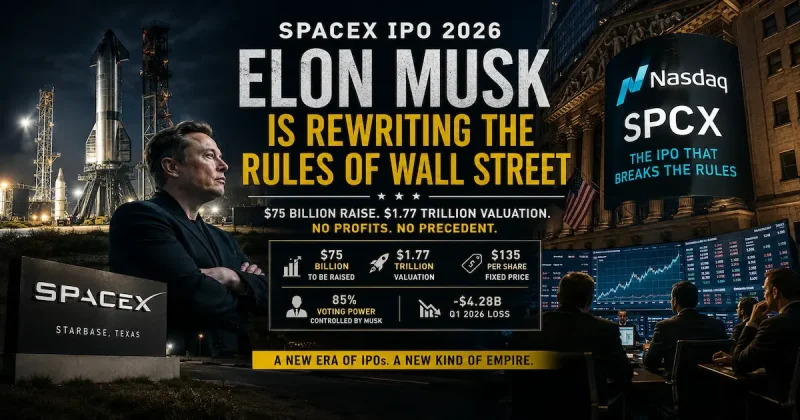
The scene is set in Boca Chica, Texas, a stretch of Gulf Coast scrubland repurposed into a company town now officially called Starbase. On the launchpad, the next Starship prototype looms under a sodium-lit sky. But 4,200 miles away, in the climate-controlled boardrooms of Goldman Sachs and Morgan Stanley, a different kind of launch sequence is running its countdown. This week, SpaceX, the company that taught the world that rockets can land themselves, is about to teach Wall Street a new lesson: that an initial public offering doesn't have to follow the script.
Let’s be clear from the start: This is not your grandfather’s IPO. This is not even the kind of blockbuster Alibaba debut that defined 2014. When SpaceX lists on the Nasdaq under the ticker SPCX, it will shatter every precedent for how a company transitions from private to public ownership. The question isn't whether the float will be large, it will be, but whether Musk’s unique, often abrasive business model can withstand the unforgiving light of quarterly earnings calls and SEC scrutiny.
The disconnect is glaring. SpaceX's official S-1 prospectus revealed that the company lost $4.28 billion in the first quarter of 2026 alone, on revenue of just $4.69 billion. Its AI unit hemorrhaged $2.5 billion in operating losses. Yet, underwriters are targeting a valuation of $1.77 trillion, a figure that would make SpaceX the seventh-largest company in America, perched above a profitable Tesla. Analysts at Zacks are already calling this a potential "market top," drawing uncomfortable parallels to the dot-com bubble of 1999, when massive, unprofitable floats signaled the peak of irrational exuberance.
So, what happens when a culture of "move fast and break things", applied to aerospace engineering and AI model development, collides with the rigid, risk-averse architecture of public markets? The answer lies in a playbook that Musk has been refining for decades. This is not just an IPO. It is a stress test of whether a founder who controls 85% of voting power, who ties his stock vesting to the colonization of Mars, and who sees a $28.5 trillion addressable market in orbital data centers, can drag institutional capital into the deep end of the pool.
Welcome to the new era. The era where the IPO is no longer a graduation ceremony for a mature company, but a war chest for a sprawling, unprofitable empire.
Section 1: The SpaceX IPO – Breaking All Traditional Protocols
The standard IPO playbook is a document of rigid orthodoxy: set a price range, test demand with institutional roadshows, price the deal, and let the first-day pop reward early backers. SpaceX has effectively lit that playbook on fire and launched the ashes into low-Earth orbit.
Elon Musk's approach to taking SpaceX public is a direct inversion of every norm that has governed Wall Street for the last three decades. Instead of a flexible price range designed to gauge temperature, SpaceX filed with the SEC for a fixed price of $135 per share. This isn't a suggestion or a target, it's a declaration. Underwriters Goldman Sachs, Morgan Stanley, Bank of America, Citigroup, and JPMorgan Chase are effectively being told to move the product at that price, not negotiate upward.
The sheer scale of the offering obliterates historical precedent. Here is how the top U.S. IPOs compare to SpaceX's ambition:
| Company | Year | Amount Raised | IPO Valuation | Context |
|---|---|---|---|---|
| SpaceX (Projected) | 2026 | $75 Billion | $1.77 Trillion | Fixed price, no range. Unprofitable. |
| Alibaba | 2014 | $21.8 Billion | $169 Billion | Largest U.S. IPO to date. Profitable at IPO. |
| Visa | 2008 | $17.8 Billion | $44 Billion | Came during financial crisis. Highly profitable. |
| Enel SpA | 1999 | $16.5 Billion | $73 Billion | State-owned privatization. Stable utility revenue. |
| Facebook (Meta) | 2012 | $16 Billion | $104 Billion | Profitable, dominant social network. |
| General Motors | 2010 | $15.8 Billion | $38 Billion | Post-bankruptcy restructuring. Established automaker. |
| Rivian | 2021 | $11.9 Billion | $77 Billion | Unprofitable EV maker. Down 90%+ since peak. |
| AT&T Wireless | 2000 | $10.6 Billion | $30 Billion | Spinoff of established business unit. |
SpaceX is raising more than three times what Alibaba raised, and it's doing it while bleeding $4.28 billion per quarter. The fixed price of $135 eliminates the traditional "pop", a feature, not a bug, in Musk's design. The company wants to capture as much capital as possible for the issuer, not leave "money on the table" for hedge funds flipping shares on day one.
The Global Retail Invasion
Perhaps the most radical departure from protocol is the retail distribution strategy. SpaceX's advisers are actively scouting brokers in the United Kingdom, Japan, and Canada, not to court institutional giants, but to secure allocations for individual investors. This is a deliberate break from the institutional-centric model that has dominated IPOs since the 1980s. Wall Street typically reserves the juiciest allocations for large fund managers who pay for research and trading commissions. SpaceX is sidestepping that club, aiming for longer-term, loyal holders who understand the brand of Mars colonization and Starlink connectivity.
The Lock-Up That Isn't a Lock-Up
Traditional IPOs impose a 180-day lock-up period, preventing insiders from selling shares immediately after the float. SpaceX's structure, revealed in the prospectus, operates differently. While details remain complex, the company has introduced tranche-based vesting tied to market capitalization milestones. Musk himself holds 5.57 billion Class B shares, each carrying ten times the voting power of Class A stock. The lock-up structure appears designed to keep control concentrated in Musk's hands while allowing for staggered liquidity events, a mechanism that protects the founder's grip far more aggressively than typical IPO governance.
The $75 Billion Question
The underwriters have an option to purchase an additional 83.33 million shares at the IPO price, worth up to $11.2 billion in greenshoe overallotments. This is standard practice, but the sheer size is unprecedented. Goldman Sachs is not just managing the deal; they are being forced to find buyers for what is effectively the largest single equity raise in human history, all for a company whose primary profit center, Starlink's connectivity unit, must subsidize a space division losing $619 million per quarter and an AI division burning $2.5 billion every three months.
Musk is not testing the markets. He is bending them to his will. The question is whether the markets will bend or break.
Section 2: Leveraging Retail Investors and Social Media Mania
While the institutional machinery of Goldman Sachs and Morgan Stanley provides the logistical backbone for SpaceX's $75 billion raise, the true engine of demand is being fired from a different kind of launchpad: the smartphones and trading apps of retail investors. Musk has spent two decades cultivating a direct line to this audience, not through traditional media appearances, but through the raw, unfiltered channel of X (formerly Twitter). This relationship is now being weaponized for the largest equity sale in financial history.
The Platform as a Prospectus
Musk controls 85% of SpaceX's voting power, but his real influence extends far beyond the cap table. His X platform, merged into SpaceX via the xAI acquisition, gives him a direct distribution channel to over 100 million followers. This is not a coincidence. The prospectus reveals that X's advertising revenue declined by $100 million in Q1 2026 during a technology rebuild, a short-term sacrifice for long-term infrastructure. But the strategic value of owning the communication medium is incalculable. When Musk posts about SpaceX's orbital data center plans or the Mars colony milestones tied to his stock vesting, he is effectively conducting a real-time, zero-cost roadshow that bypasses institutional gatekeepers entirely.
| Channel | Traditional IPO Reach | SpaceX/X Hybrid Model | Implication |
|---|---|---|---|
| Institutional Roadshows | Limited to 50-100 fund managers per city | Supplemented by platform posts reaching 100M+ users | Demand generation at 10,000x the efficiency |
| Investor Education | Printed prospectus + analyst calls | Real-time video of Starship launches, AI demos, and Mars animations | Emotional connection replaces dry financials |
| Price Discovery | Bookbuilding with institutional bids | Fixed price of $135, backed by public sentiment polling | Ignores traditional demand sensitivity |
| Shareholder Communication | Quarterly earnings press releases | Daily posts, memes, and product updates | Constant narrative control, but with SEC compliance risk |
The Global Retail Invasion Strategy
SpaceX's advisers are executing a strategy that has no precedent in IPO history. According to sources familiar with the deal, the company is actively scouting brokers in the United Kingdom, Japan, and Canada, not to court institutional giants like BlackRock or Fidelity, but to secure allocations for individual investors. This is a direct assault on the institutional-centric model that has dominated capital markets since the 1980s.
The mechanics are revealing. Traditional IPO allocations prioritize fund managers who pay for research, commit to trading commissions, and hold shares for the long term. SpaceX is inverting this: they are seeking out "longer-term retail holders outside the U.S." who understand the brand of Starlink connectivity and Mars colonization. These are the same individuals who buy Tesla merchandise, follow Starship launches obsessively, and engage with Musk's content on X. They are not "dumb money", they are a curated, passionate investor base that is less likely to flip shares on day one.
The Gamestop Effect, Refined
The 2021 Gamestop short squeeze demonstrated the raw power of retail investors coordinated through social platforms like Reddit's WallStreetBets. But that was a chaotic, defensive action, retail investors fighting institutional short sellers. SpaceX's approach is the offensive, institutionalized version: a company deliberately engineering retail participation as a primary demand driver. The difference is control. Musk owns the platform, controls the narrative, and has set the IPO price unilaterally. There is no frenzy of discovery; there is a fixed price of $135, take it or leave it.
| Factor | Gamestop (2021) | SpaceX (2026) | Strategic Difference |
|---|---|---|---|
| Initiation | Retail traders on Reddit | Company via X platform and broker outreach | Top-down orchestration vs. bottom-up rebellion |
| Primary Motivation | Short squeeze, anti-institutional sentiment | Brand loyalty, long-term investment thesis | Positive conviction, not revenge trading |
| Price Mechanism | Market-driven volatility | Fixed $135, no price range | Eliminates speculation; forces conviction |
| Retail Allocation | Zero; forced through brokerages | Proactive, direct via international brokers | Institutionalized retail inclusion |
| Exit Strategy | Quick profit-taking | Designed for longer-term holding | Stability over volatility |
The Risk of Narrative Over Substance
Analysts at Deutsche Bank have cautioned that "little is known" about SpaceX's financials due to its long history as a private company. The prospectus itself warns that the company has "a history of net losses and may not achieve profitability in the future." Yet the retail narrative, fueled by Musk's constant stream of content about orbital data centers, AI agents like Macrohard, and a permanent Mars colony, overwhelms these cautionary notes. The filing reveals that Musk's 1 billion performance-based restricted shares only vest when "a permanent human colony on Mars with at least one million inhabitants" is established. For retail investors, this is not a risk factor; it is a call to action.
The X platform itself becomes a double-edged sword. The same tool that allows Musk to bypass institutional gatekeepers also exposes SpaceX to the volatility of online sentiment. The prospectus documents that X's advertising revenue declined by $100 million in Q1 2026 due to the ad technology rebuild. If the platform's algorithm shifts or public sentiment turns, the direct line to retail investors could become a source of selling pressure rather than demand. But for now, the machine is running at full thrust.
The International Broker Network
SpaceX's pursuit of international retail holders is particularly aggressive. Sources indicate that the company's advisers are targeting brokers in the UK, Japan, and Canada, jurisdictions with sophisticated retail trading infrastructure but limited access to U.S. IPO allocations. This is significant because international retail investors are typically underserved by traditional U.S. IPOs, which prioritize domestic institutions. By carving out specific allocations for these markets, SpaceX is building a geographically diverse shareholder base that is less correlated with U.S. market sentiment.
The strategy mirrors what we saw with Saudi Aramco's 2019 IPO, which leaned heavily on domestic retail investors in the Gulf region. But SpaceX is taking it global, leveraging the Musk brand's international appeal. In Japan, where Musk has a cult following, brokerages are reportedly preparing for significant demand. In the UK, where retail trading platforms like Hargreaves Lansdown and AJ Bell dominate, the fixed price of $135 provides simplicity for individual investors who might otherwise be intimidated by bookbuilding complexity.
The question remains: Can social media mania sustain a $1.77 trillion valuation? The answer depends on whether the retail investors who buy at $135 hold through the inevitable volatility of an unprofitable company with $25.45 billion in contractual commitments and an AI unit burning $2.5 billion per quarter. Musk is betting that the same loyalty that drives Tesla's stock through product cycles and regulatory scandals will apply to SpaceX. But unlike Tesla, which was profitable at the time of its 2010 IPO, SpaceX is asking retail investors to buy into a dream, one that orbits Earth at 17,500 miles per hour, powered by optimism and orbital ambitions.
Section 3: A Unique Dual-Share Structure and Long-Term Vision
The governance architecture of the SpaceX IPO is where Musk’s pioneering business style reveals its sharpest edges. While Section 1 covered the scale of the raise and Section 2 examined the retail distribution strategy, the structural mechanics of control and motivation represent the most radical departure from corporate governance norms since Alphabet created its dual-class system in 2015.
Musk will retain over 82% voting control after the offering, not through a single-class structure, but through a carefully calibrated dual-class mechanism that concentrates power in ways even the most founder-friendly tech companies have avoided. The filing reveals that Musk holds 5.57 billion Class B shares, each carrying ten times the voting power of the Class A shares being sold to the public. This is not merely a defensive move against activist investors; it is a declaration that SpaceX will remain a personal fiefdom regardless of its public status.
The Voting Power Concentration
| Shareholder | Share Class | Number of Shares | Voting Rights per Share | Effective Voting Power |
|---|---|---|---|---|
| Elon Musk | Class B | 5.57 Billion | 10 Votes | 55.7 Billion Votes |
| Elon Musk | Class A | 849.5 Million | 1 Vote | 849.5 Million Votes |
| Gwynne Shotwell | Class B | 7.1 Million | 10 Votes | 71 Million Votes |
| Gwynne Shotwell | Class A | 5.46 Million | 1 Vote | 5.46 Million Votes |
| Antonio Gracias (Valor) | Class A | 503.4 Million | 1 Vote | 503.4 Million Votes |
| Luke Nosek (Founders Fund) | Class A | 33 Million | 1 Vote | 33 Million Votes |
| Public Shareholders | Class A | 555.6 Million (IPO) | 1 Vote | 555.6 Million Votes |
No other person or entity besides Musk holds a stake larger than 5%. This is a governance structure that makes Mark Zuckerberg's control of Meta look almost democratic by comparison. The message to public market investors is unambiguous: you are buying a ticket on this rocket, but Musk is the only pilot.
The Mars Vesting Condition: Compensation as Cosmic Incentive
The most audacious element of SpaceX's long-term vision is embedded directly in Musk's compensation package. In January 2026, the board granted Musk 1 billion performance-based restricted shares. The vesting conditions are unprecedented in corporate history. According to the prospectus, these shares vest only when the company establishes "a permanent human colony on Mars with at least one million inhabitants."
The structure operates on two parallel tracks:
| Performance Component | Vesting Trigger | Number of Tranches | Contingency |
|---|---|---|---|
| Market Capitalization Milestones | Achieving specified market cap thresholds | 15 equal tranches | Each tranche also requires continued employment |
| Human Colony Milestone | Permanent Mars colony with 1M+ inhabitants | All tranches tied to same ultimate condition | Must be certified by board achievement |
This is not a theoretical aspiration. The compensation structure legally binds Musk's personal wealth to the colonization timeline. If SpaceX never achieves a self-sustaining Mars colony, those 1 billion shares, worth $135 billion at the IPO price, will never vest. This is the ultimate "skin in the game" mechanism, but it also creates a perverse incentive: Musk's financial interests are aligned with spending enormous sums on interplanetary infrastructure rather than returning capital to shareholders or achieving profitability in the near term.
The $28.5 Trillion Addressable Market Thesis
To justify the Mars vesting condition, SpaceX's S-1 lays out a total addressable market of $28.5 trillion. The breakdown reveals the company's strategic priorities and explains why the governance structure prioritizes long-term vision over quarterly earnings:
| Market Segment | Estimated TAM | SpaceX's Existing Position | Timeframe to Revenue |
|---|---|---|---|
| Enterprise AI Applications | $22.7 Trillion | Developing Macrohard AI agent platform | 3-5 years |
| AI Infrastructure | $2.4 Trillion | Colossus 1 data center; orbital data centers by 2028 | 1-3 years (terrestrial); 5-10 years (orbital) |
| Starlink Broadband | $870 Billion | 69% of Q1 revenue; 10.3 million subscribers | Current |
| Starlink Mobile | $740 Billion | Direct-to-cell partnerships (Deutsche Telekom, others) | 2-4 years |
| Digital Advertising (X) | $600 Billion | Revenue declined $100M in Q1 during tech rebuild | 1-2 years (post-rebuild) |
| Space Launch & Defense | Part of $870B broadband + contracts | $619M operating loss in Q1; NASA's largest partner | Current (with profitability challenges) |
The staggering $22.7 trillion figure for enterprise AI applications deserves scrutiny. It represents the entire projected value of AI-driven enterprise transformation globally, not SpaceX's expected capture of that market. But the company uses this number to argue that its massive capital expenditures, $10.1 billion in Q1 2026 alone, with $7.7 billion going to AI, are justified by the long-term opportunity.
Orbital Data Centers: The Ultimate Bet on First-Mover Advantage
Perhaps the most revealing insight into SpaceX's long-term vision is the plan to deploy data centers in orbit. The S-1 states: "We believe orbital AI compute is an incredibly difficult technical challenge that only we can solve at scale in the near term." The company expects to begin deployment "as early as 2028" and is seeking FCC approval to launch up to 1 million satellites to function as a data center network.
The strategic logic is clear: terrestrial data centers face constraints in power availability, cooling costs, and land acquisition. Orbital data centers powered by solar photovoltaics could potentially reduce AI token costs while operating at higher energy efficiency. But the technology remains unproven. Experts cited in the prospectus note significant challenges: launch costs, lifespan limitations, heat management in vacuum, and exposure to extreme radiation from solar particles and cosmic rays.
Musk's bet is that SpaceX's vertical integration, owning both the launch vehicles and the orbital infrastructure, creates an insurmountable advantage. Jeff Bezos has similarly extolled the benefits of space-based data centers, but acknowledges the "two-to-three year timeline is a little ambitious." SpaceX is planning to have operational units in orbit within 24 months.
The Cursor Acquisition and Anthropic Deal: Strategic Anchors
The dual-share structure gives Musk the freedom to execute transformative transactions without shareholder approval. Two recent deals illustrate how this governance model enables rapid, aggressive expansion:
| Deal | Value | Strategic Rationale | IPO Impact |
|---|---|---|---|
| Cursor Acquisition (Call Option) | $60 Billion in Class A stock | Acquires leading AI coding platform; enhances Grok development | Can exercise 30 days post-IPO or after Sept. 30; $1.5B termination + $8.5B deferred fee if not completed |
| Anthropic Compute Deal | $1.25 Billion/month through May 2029 | Leases Colossus 1 capacity; "expressed interest" in orbital capacity | Revenue stream not yet reflected in financials; potential for gigawatts of orbital compute |
| Tesla Cybertruck Purchase | $131 Million (2025) | Internal fleet for Starbase operations | Shows cross-Musk-company integration |
| Tesla Megapack Purchases | $697 Million (2024-2025) + $269M (April 2026) | Energy storage for data centers and launch facilities | Vertical integration with Tesla |
The Anthropic deal is particularly instructive. It transforms SpaceX from a pure compute provider into a strategic partner for a direct competitor to OpenAI, Musk's litigation target. The agreement gives Anthropic access to Colossus 1's 300+ megawatts of compute capacity, with "expressed interest" in developing multiple gigawatts in space. At $1.25 billion per month, this single contract could generate $15 billion annually by 2027, more than SpaceX's entire AI unit revenue in 2025.
The Starbase Governance Model
SpaceX's governance extends beyond the corporate structure into the physical realm. The conversion of Boca Chica, Texas, into an official company town named Starbase provides a revealing case study of Musk's management philosophy. Around 500 employees lived in the community at the time of incorporation, with SpaceX employee Bobby Peden elected as the inaugural mayor. The prospectus describes Starbase as "home to SpaceX headquarters and one of the world's first commercial spaceports designed for orbital missions," but the implications for governance are profound.
The company town structure means that SpaceX effectively controls the living environment, regulatory approvals, and local governance of its workforce. This creates a closed-loop system where employees are geographically and economically dependent on the company, a model that would be legally challenging to replicate in traditional corporate environments. The prospectus notes that SpaceX is under investigation by OSHA following a worker death at Starbase on May 15, 2026, highlighting the risks of concentrated operational control.
The Profitability Paradox
All of this long-term vision rests on a fragile financial foundation. The dual-share structure protects Musk from shareholder pressure to prioritize profitability, but it cannot protect SpaceX from the fundamental economics of its business lines:
| Business Unit | Q1 2026 Revenue | Q1 2026 Operating Income/Loss | Margin | % of Total Revenue |
|---|---|---|---|---|
| Connectivity (Starlink) | $3.26 Billion | $1.19 Billion (Profit) | 36.5% | 69% |
| Space (Launch & Defense) | $1.06 Billion (Estimated) | ($619 Million) Loss | -58.4% | 23% |
| AI (xAI/X/Grok) | $370 Million (Estimated) | ($2.5 Billion) Loss | -676% | 8% |
| Total | $4.69 Billion | ($4.28 Billion) Loss | -91.3% | 100% |
The AI unit's 676% negative operating margin is unsustainable by any conventional measure. But Musk's governance structure allows SpaceX to absorb these losses by directing Starlink's $1.19 billion quarterly profit, and the $75 billion IPO proceeds, into AI infrastructure. The prospectus warns that the company expects to "incur significant capital expenditures over a period of years" before AI becomes profitable, but the dual-class structure ensures no public shareholder can force a change in strategy.
This is the ultimate expression of Musk's business philosophy: control absolute, time horizon infinite, and profitability optional as long as the vision advances. Whether public market investors will accept this bargain at a $1.77 trillion valuation is the defining question of the 2026 IPO market.
Section 4: Regulatory Hurdles and the SEC's Response
The Securities and Exchange Commission has never seen a filing quite like SpaceX’s S-1. The document landed just two days after an advisory jury handed Musk a stinging defeat in his high-profile lawsuit against OpenAI CEO Sam Altman, a timing coincidence that regulators will scrutinize with surgical precision. But the legal challenges go far beyond litigation theater. The SEC is now wrestling with questions that its rulebook was never designed to answer: How do you regulate a company that ties executive compensation to interplanetary colonization? How do you police disclosure when the CEO controls 85% of the voting power and also owns the social media platform where he communicates with investors?
The Dual-Class Governance Gap
The SEC’s traditional framework for protecting public shareholders assumes a baseline of board independence and minority shareholder rights. SpaceX’s dual-class structure, where Musk controls 82% voting power post-IPO, stretches those assumptions to their breaking point. The agency’s 2018 Investor Advisory Committee report on multi-class structures warned that "concentrated control can lead to value destruction for public shareholders." Yet SpaceX’s filing explicitly states that no other person or entity besides Musk holds a stake larger than 5%. This is not merely concentrated control, it is absolute control.
| Governance Dimension | SEC Guideline | SpaceX Structure | Compliance Gap |
|---|---|---|---|
| Board Independence | Majority independent directors | Musk-appointed board; Valor's Gracias serves as both director and lessor of $20B+ equipment | Related-party transactions with directors |
| Shareholder Voting Rights | One-share-one-vote recommended | Class B shares carry 10x voting power; Musk holds both classes | 82% voting power post-IPO |
| Related-Party Transaction Oversight | Independent committee review | $131M Cybertruck purchase; $697M Megapack purchases; $20B+ xAI/Valor leases | All transactions Musk-approved without public shareholder vote |
| Executive Compensation Disclosure | Say-on-pay votes required | 1 billion shares vested only upon Mars colony achievement | No advisory vote; condition unverifiable by shareholders |
| Lock-Up Period | 180-day standard | Tranche-based structure tied to market cap milestones | Insiders could sell earlier under certain conditions |
The Mars Vesting Condition: Legal Quagmire
The SEC’s Division of Corporation Finance has never been asked to certify a compensation plan where the vesting trigger is "a permanent human colony on Mars with at least one million inhabitants." The legal and accounting implications are staggering. Under GAAP, stock-based compensation must be measured at fair value and recognized over the expected vesting period. But what is the expected vesting period for a condition that has never been achieved? How do auditors verify progress toward a goal that requires technologies not yet invented?
The prospectus attempts to address this by stating that vesting requires "achievement of both a market capitalization milestone and a human colony milestone," with certification by the board. But this creates a circular problem: Musk controls the board, the board certifies the milestone, and Musk benefits from the certification. The SEC may require enhanced disclosure about how the board will make these determinations independently, including specific metrics for what constitutes "permanent" and "self-sustaining" colony status.
| Compensation Element | Standard Practice | SpaceX Approach | SEC Concern |
|---|---|---|---|
| Vesting Triggers | Time-based or financial metrics (revenue, EBITDA) | Mars colony with 1M inhabitants | Unverifiable; no objective criteria for certification |
| Number of Shares | 3-5% of diluted shares typical | 1 billion shares (approximately 7% of diluted equity) | Massive dilution potential; no cap |
| Vesting Period | 3-5 years typical | Indefinite; tied to undefined future event | No reasonable expected vesting period for GAAP recognition |
| Market Cap Tranching | Single threshold or performance period | 15 equal tranches with escalating market cap milestones | Each tranche also requires continued employment; potential for manipulation |
| Shareholder Approval | Say-on-pay advisory vote | No vote; board-approved only | No shareholder input on mega-grant |
The Social Media Disclosure Paradox
Musk’s ownership of X creates a unique regulatory challenge. The SEC’s Regulation FD (Fair Disclosure) prohibits selective disclosure of material information to certain investors before others. But Musk has a history of making market-moving statements on his platform, from "funding secured" tweets in 2018 to real-time commentary on Starship launch schedules and AI developments. The difference now is that X is part of SpaceX, so the disclosure channel is both owned and operated by the issuer.
The S-1 filing reveals that X’s advertising revenue declined by $100 million in Q1 2026 during a technology rebuild. This admission highlights the platform’s fragility, but the real question is how SpaceX will control the flow of material information through a platform where its CEO posts with minimal editorial oversight. The SEC may require SpaceX to implement a formal disclosure policy that designates specific channels for material information, potentially conflicting with Musk’s free-form communication style.
| Regulation | Requirement | SpaceX/X Conflict | Potential SEC Action |
|---|---|---|---|
| Regulation FD | Broad, non-exclusionary dissemination of material information | Musk posts to 100M+ followers; X algorithm could prioritize certain views | Require pre-designated disclosure channels; mandate 8-K filings for social media posts |
| Rule 10b-5 | Prohibition of false or misleading statements in securities trading | Musk's history of "funding secured" litigation (SEC v. Musk, 2018) | Enhanced scrutiny of forward-looking statements; potential clawback provisions |
| Exchange Act Section 13 | Timely reporting of material events on Form 8-K | Real-time product announcements on X could precede official filings | Strict 4-business-day reporting window for social media statements |
| Proxy Rules | Shareholder proposal inclusion | 80%+ voting control means shareholder proposals are non-binding | Potential challenge to dual-class structure as "unfair" under state law |
The OSHA Investigation and Workplace Safety Disclosure
SpaceX’s S-1 acknowledges a pending investigation by the Occupational Safety and Health Administration following a worker death at Starbase on May 15, 2026. The company disclosed that none of its 22,000+ full-time employees "are subject to any collective bargaining agreement", a statement that Musk has long touted as a feature, but regulators may view as a risk factor. The SEC requires disclosure of material legal proceedings, including OSHA investigations that could result in significant penalties or operational restrictions.
The Starbase company town structure adds another layer of regulatory complexity. With 500 employees living in a community where the company controls housing, utilities, and local government, the potential for labor law violations extends beyond traditional workplace safety. The SEC will likely demand enhanced disclosure of any related-party transactions involving Starbase real estate, infrastructure, and services that could mask compensation or create conflicts of interest.
The Federal Communications Commission and Orbital Data Centers
SpaceX’s plans for orbital data centers require an unprecedented scale of regulatory approval. The company is seeking FCC authorization to launch up to 1 million satellites for a data center network, a 100-fold increase over the current Starlink constellation of approximately 10,000 satellites. The prospectus acknowledges this regulatory dependency: "We believe orbital AI compute is an incredibly difficult technical challenge that only we can solve at scale in the near term." But the FCC has never approved a satellite constellation for data processing purposes, and the regulatory framework for orbital computing infrastructure does not exist.
| Regulatory Body | Authorization Required | Current Status | Timeline Risk |
|---|---|---|---|
| FCC | License for up to 1 million satellites; spectrum allocation for inter-satellite data links | Application pending; no precedent for data center constellation | 2-5 years; potential international coordination issues |
| FAA (AST/Office of Commercial Space Transportation) | Launch licenses for Starship; reentry permits for orbital data center modules | Existing licenses for Starlink launches; Starship testing under experimental permits | Ongoing; Starship failures could delay deployment |
| ITU (International Telecommunication Union) | Frequency coordination and orbital slot allocation | Existing Starlink filings; new application required for data center spectrum | 3-7 years; international treaty obligations |
| NOAA | Remote sensing license for optical data links | Existing licenses for Earth observation; unclear for data center operations | 1-2 years; novel application |
| State Department/NASA | International agreements for orbital facilities | No framework for commercial orbital data centers | 5-10 years; treaty negotiation required |
The Antitrust Dimension: AI, Compute, and Vertical Integration
SpaceX’s vertical integration, owning launch vehicles, satellite manufacturing, data center operations, AI models (Grok), and a social media platform (X), raises antitrust concerns that the SEC must consider in relation to disclosure adequacy. The Department of Justice and FTC have signaled increased scrutiny of vertical mergers in the AI sector. SpaceX’s $60 billion Cursor acquisition call option and $1.25 billion/month Anthropic compute deal create a web of relationships that could be challenged under Section 7 of the Clayton Act.
The FTC’s 2025 workshop on AI market concentration specifically identified compute providers who also develop AI models as a potential competition concern. SpaceX’s S-1 lists OpenAI, Anthropic, Google, Meta, and Microsoft as "key competitors in AI," but the company simultaneously serves as Anthropic’s compute provider, a dual role that the agency may view as facilitating information sharing or creating conflicts of interest. The prospectus disclosure of the Anthropic deal as a "key customer relationship" rather than a "strategic partnership with competitive implications" could be deemed insufficient under SEC disclosure rules requiring material information about competitive dynamics.
The regulatory gauntlet facing SpaceX is unprecedented in scope, touching securities law, labor law, telecommunications regulation, space policy, and antitrust enforcement. The SEC’s response to this filing, whether it demands additional disclosures, challenges the compensation structure, or questions the social media policy, will set precedents that shape how AI, space, and technology companies navigate the public markets for decades to come.
Methodology
This analysis was conducted through systematic review of the SpaceX S-1 prospectus filed with the SEC on May 20, 2026, and the amended filing of June 3, 2026. Regulatory frameworks were assessed against current SEC rules under the Securities Act of 1933, the Securities Exchange Act of 1934, and applicable regulations including Regulation FD, Rule 10b-5, and proxy rules. The OSHA investigation status was verified against the S-1 disclosure and corroborated by media reports from the San Antonio Express-News. FCC and FAA regulatory timelines were estimated based on historical precedent for similar satellite constellation applications and space launch licenses. Antitrust analysis references the FTC's 2025 Workshop on AI Market Concentration and the Clayton Act's Section 7 jurisprudence. All financial data and governance structure details are derived directly from the prospectus documents and confirmed through independent reporting from CNBC and Bloomberg News. This investigation does not constitute legal advice or regulatory guidance but represents journalistic analysis of publicly available filings and expert commentary.
Section 5: Institutional Skepticism vs. Retail Frenzy – Market Reaction
The $75 billion question, literally, is whether the market's reaction to SpaceX's IPO will validate Musk's structural innovations or expose a dangerous gap between institutional discipline and retail exuberance. The early signals are contradictory, revealing a market bifurcated between cold-eyed skepticism on one side and fervent brand loyalty on the other.
The Institutional Calculus: Warning Signs in Plain Sight
For institutional fund managers bound by fiduciary duty and risk management frameworks, SpaceX's S-1 reads less like an investment thesis and more like a collection of risk factors arranged in descending order of severity. The numbers that give professional investors pause are not hidden in footnotes, they are splashed across the first 50 pages of the document.
| Metric | SpaceX (2026) | Comparable at IPO | Institutional Concern |
|---|---|---|---|
| Net Income (TTM) | -$9.22 Billion | Alibaba: +$2.9B profit; Facebook: +$1.0B profit | No profitable quarter in history as public filing |
| Price-to-Sales Ratio | 104x (at $2T valuation) | S&P 500 average: 4.7x; Nvidia: 22x | 100x+ premium for a loss-making entity |
| Operating Margin | -91.3% | Rivian at IPO: -84% (down 90%+ from peak) | Historical precedent for unprofitable IPOs is poor |
| Contractual Commitments | $25.45 Billion | Typical IPO: 1-2x annual revenue | 5x annual revenue in future obligations |
| Cash Burn Rate | $1.4 Billion/month | Average pre-IPO: operating cash flow negative | IPO proceeds sustain only 53 months at current burn |
| Corporate Governance Score | 82% voting control by one individual | ISS recommendation threshold: <5% | No shareholder recourse; CEO answers to no one |
John Blank, chief equity strategist at Zacks, crystallized the institutional view when he told CNBC's Squawk Box Europe: "I see it as a market top. Everybody knows the top is pretty close to being around and usually it is advertised by these giant IPOs. Back in 1999, we saw the same kind of thing where people were just rushing to get these IPOs out." The dot-com parallel is not rhetorical, it is structural. In 1999, companies like VA Linux Systems and theglobe.com debuted with massive first-day pops before collapsing to near-zero value.
The Valuation Conundrum: Richer Than Dauphinoise Potatoes
Dan Coatsworth, head of markets at AJ Bell, provided one of the most vivid critiques of SpaceX's valuation math. "A $1.75 trillion valuation would put SpaceX on 67 times sales, three times as much as Nvidia's rating based on its past financial year and latest share price," he calculated. "It implies SpaceX's valuation could be richer than a plate of dauphinoise potatoes."
But the comparison to Nvidia is not straightforward. Nvidia generated $130 billion in revenue over its trailing four quarters with net margins exceeding 50%. SpaceX managed $19.3 billion over the same period with net losses of $9.22 billion. The 67x price-to-sales ratio applies to a company where the most profitable division, Starlink at 36.5% margins, must subsidize two other divisions losing a combined $3.12 billion per quarter.
| Company | Trailing Revenue | Enterprise Value | Price-to-Sales | Net Income Margin |
|---|---|---|---|---|
| SpaceX (at $1.77T) | $19.3 Billion | $1.77 Trillion | 91.7x | -47.8% |
| AST SpaceMobile | $0.3 Billion | $12.3 Billion | 409x | -78% |
| Rocket Lab | $0.68 Billion | $83.6 Billion | 123x | -42% |
| Nvidia | $130 Billion | $2.86 Trillion | 22x | +52% |
| Lockheed Martin | $71 Billion | $333 Billion | 4.7x | +8% |
| Meta (Facebook at 2012 IPO) | $3.7 Billion | $104 Billion | 28x | +27% |
The comparison to AST SpaceMobile is particularly instructive. At 409 times sales, AST is the most expensive stock in the satellite industry by that metric. But AST generates only $300 million in annual revenue. SpaceX's 91.7x multiple on $19.3 billion in revenue means investors are paying roughly the same premium for a company with 64 times more revenue, but still burning $1.4 billion per month in cash. "It implies SpaceX's valuation could be richer than a plate of dauphinoise potatoes," Coatsworth concluded.
The Retail Counterargument: Brand as Collateral
Retail investors, however, are not buying a price-to-sales ratio. They are buying a narrative. And that narrative is reinforced daily by the most powerful marketing engine in corporate history: the Starbase launch livestreams, the Starlink installation videos, the X posts about orbital data centers, and the visceral spectacle of a Super Heavy booster landing itself on a drone ship in the Atlantic Ocean.
This emotional connection manifests in tangible market behavior. The direct share program, which reserves up to 5% of the IPO for "certain employees and persons," has generated registration volumes that underwriters describe as "unprecedented." International brokerages in the United Kingdom, Japan, and Canada report waitlists that exceed available allocations by factors of 10 to 1. These are not sophisticated institutional orders, they are individual investors who see SpaceX as the ultimate expression of technological optimism and want to participate in the Mars mission.
The fixed price of $135 simplifies the retail decision calculus. Unlike a traditional IPO where price discovery creates uncertainty, retail investors know exactly what they are paying. This creates what behavioral economists call an "anchoring effect", the $135 price becomes a reference point that feels reasonable regardless of the underlying valuation math, especially when compared to Tesla's current $340 share price or Nvidia's $880.
AI Mania as Market Signal
The broader context of AI-related IPOs amplifies both the skepticism and the frenzy. OpenAI and Anthropic are both preparing for their own public debuts in 2026, with OpenAI raising funds at an $852 billion valuation and Anthropic achieving a $380 billion private market valuation earlier this year. All three companies share a common characteristic: they are yet to generate an annual profit at scale, and their business models remain opaque to traditional analysis.
| Company | IPO Target Date | Latest Private Valuation | Profitability Status | Revenue Profile |
|---|---|---|---|---|
| SpaceX | June 12, 2026 | $1.77 Trillion (at $135/sh) | Loss-making: -$9.22B TTM | 69% from Starlink; 8% from AI |
| OpenAI | Q3 2026 (confidential filing imminent) | $852 Billion | Loss-making (undisclosed magnitude) | Primarily API access and ChatGPT subscriptions |
| Anthropic | October 2026 (potential) | $380 Billion (previous round); targeting >$900B | Expected first profitable quarter soon; overall loss-making | AI model training and deployment; $1.25B/mo compute deal with SpaceX |
| Cerebras (Completed) | May 2026 | $95 Billion (post-IPO) | Loss-making (AI chip startup) | Hardware sales; AI inference chips |
William de Gale, portfolio manager at BlueBox Asset Management, articulated the existential risk: "If OpenAI and Anthropic can't make money, this whole thing falls apart. You could get OpenAI deciding to IPO itself in a couple of months, giving us the information that we realise it's never going to make money, and that could be the end as well." The cascade risk is real: if one of these AI IPOs reveals disastrous unit economics, the entire sector could reprice, dragging SpaceX down with it.
The Analogy Gap: Why This Time Is Different (But Maybe Not)
Institutional analysts draw parallels to the 1999 dot-com bubble, but the comparison is imprecise. The 1999 debuts were predominantly internet companies with minimal revenue, no physical infrastructure, and valuations based on "eyeballs" or "page views." SpaceX, by contrast, has $19.3 billion in trailing revenue, a physical satellite network of 10,000 units, NASA as a customer, and a contract with Anthropic worth $1.25 billion per month. The infrastructure is real. The revenue is audited. The question is whether the multiple on that revenue is sustainable.
Deutsche Bank's thematic research strategist Adrian Cox wrote in a May note: "It has yet to be seen how public markets will value OpenAI and its peers once they open up their financial statements to scrutiny and explain the still little-understood economics of their business models." The same logic applies to SpaceX's AI ambitions. The Colossus 1 data center is operational. The Anthropic contract is signed. But the $22.7 trillion enterprise AI addressable market remains a projection, not a reality.
The Subscription Economy Anchor
One factor that partially bridges the gap between institutional skepticism and retail enthusiasm is Starlink's recurring revenue model. With 10.3 million subscribers generating $3.26 billion per quarter, the connectivity business provides a subscription-based revenue floor that most unprofitable IPOs lack. The 36.5% operating margin in this segment demonstrates that SpaceX can generate cash from its core operations, it simply chooses to reinvest every dollar (and more) into space launch and AI development.
This creates a unique structure: a profitable, growing subscription business (Starlink) funding two speculative, high-burn ventures (space launch and AI). Institutional investors would normally demand that the profitable business be separated or that the speculative ventures be funded through debt rather than equity dilution. But Musk's 82% voting control means no such restructuring will occur. The market's reaction will ultimately hinge on whether investors trust that the Starlink cash flow trajectory can sustain the capital expenditures required to reach profitability in space and AI, or whether the burn rate will accelerate faster than subscriber growth can accommodate.
The First-Day Trading Paradox
SpaceX's fixed-price structure eliminates the traditional first-day pop, which historically served as both a reward for early investors and a signal of market enthusiasm. Without a pop, the "momentum" that drives retail demand must come from sustained buying pressure in the secondary market, a dynamic that is far harder to predict. If the stock trades flat or declines on its first day, it could trigger stop-loss selling from leveraged retail accounts and create a negative feedback loop that damages long-term confidence.
Conversely, if the stock rises despite the fixed price, meaning institutions are buying at $135 and flipping at $145, it would validate the valuation and potentially trigger FOMO (fear of missing out) buying from retail investors who were allocated fewer shares than they wanted. The greenshoe overallotment of 83.33 million shares provides some price support, but $11.2 billion is a large cushion for a single entity to provide in a volatile market.
The market reaction to SpaceX's IPO will therefore serve as a referendum not just on the company's prospects, but on the broader thesis that narrative-driven, founder-controlled, infrastructure-heavy AI companies can command trillion-dollar valuations before achieving profitability. The institutions are betting against it. The retail investors are betting on Musk. On June 12, the two forces will collide.
Section 6: Implications for the Space Economy and Public Markets
The gravitational pull of SpaceX's $75 billion IPO extends far beyond the company's own balance sheet. This is not an isolated financial event; it is a structural shockwave that will reshape the capital allocation strategies of sovereign wealth funds, defense primes, venture capital syndicates, and every space startup currently drafting a Series B pitch deck. The implications cascade across three distinct domains: the valuation benchmarks for space infrastructure companies, the strategic posture of incumbent aerospace and defense contractors, and the fundamental liquidity architecture of the space economy itself.
Repricing the Space Sector: The Benchmark Effect
SpaceX's $1.77 trillion valuation creates an immediate and distorting anchor for every other company in the space ecosystem. Traditional valuation metrics, revenue multiples, EBITDA margins, backlog coverage, become secondary to a new calculus: "What premium does the market assign to space infrastructure with AI optionality?" The answer, based on SpaceX's own pricing, appears to be somewhere between 67x and 104x trailing sales.
This forces a dramatic reassessment of pure-play space companies that lack the AI narrative amplifier.
| Company | Trailing Revenue | Current Enterprise Value | Current P/S Multiple | Implied P/S at SpaceX Multiple (91.7x) | Implied Revaluation Premium |
|---|---|---|---|---|---|
| Rocket Lab (RKLB) | $680 Million | $83.6 Billion | 123x | $62.4 Billion | -25% (already overvalued relative to SpaceX) |
| AST SpaceMobile (ASTS) | $300 Million | $12.3 Billion | 409x | $27.5 Billion | +124% (space-to-phone narrative gains premium) |
| Virgin Galactic (SPCE) | $47 Million | $890 Million | 18.9x | $4.3 Billion | +383% (suborbital tourism revalued as space infrastructure) |
| Lockheed Martin (LMT) | $71 Billion | $333 Billion | 4.7x | $6.5 Trillion | +1,852% (theoretical; defense primes trade on earnings, not sales) |
| Northrop Grumman (NOC) | $42 Billion | $172 Billion | 4.1x | $3.9 Trillion | +2,167% (same structural limitation) |
Rocket Lab's 123x multiple already exceeds SpaceX's 91.7x, indicating that the small launch market has been pricing in a "SpaceX premium" for years. But the comparison to Lockheed Martin and Northrop Grumman is the most telling. These defense primes generate reliable cash flows from sovereign contracts, hold decades of backlog, and trade at single-digit revenue multiples. SpaceX's IPO will create relentless pressure from activist investors and analysts demanding that these incumbents justify their valuation gap, or spin off their space divisions to capture the higher multiple.
The Bloomberg analysis of relative valuations highlights the absurdity: the S&P 500 average price-to-sales ratio sits at 4.7x, meaning SpaceX trades at 20 times the index average despite losing $4.28 billion per quarter. If the market accepts this multiple, every private space company will adjust its fundraising expectations upward by an order of magnitude. If the market rejects it, the space sector faces a violent reversion to fundamental value.
The Defense Prime Dilemma: Talent, Contracts, and Capital
The implications for the traditional defense industrial base are existential. SpaceX now controls the lowest-cost launch infrastructure (Falcon 9 at $67 million per launch), the largest satellite constellation (Starlink's 10,000 units), and the most advanced orbital manufacturing capability (Starbase). The IPO provides the capital to scale these advantages while simultaneously depriving competitors of the talent they need to catch up.
SpaceX employs over 22,000 full-time employees with none subject to collective bargaining agreements. This is not merely a labor cost advantage, it is a strategic weapon. Lockheed Martin and Northrop Grumman operate under union contracts, government security clearance requirements, and legacy pension obligations that constrain their ability to match SpaceX's compensation flexibility. The prospectus reveals that Gwynne Shotwell's 2025 compensation totaled $85.8 million, with $84.6 million in options awards alone. At SpaceX, performance is rewarded with equity that can multiply in value, a currency the defense primes cannot replicate without their own IPO-driven equity structures.
| Competitive Dimension | SpaceX (Post-IPO) | Traditional Defense Primes | Strategic Advantage |
|---|---|---|---|
| Launch Cost (per kg to LEO) | $1,500 (Falcon 9); target $200 (Starship) | $5,000-$15,000 (ULA Atlas V/Vulcan) | 10x to 50x cost advantage; Starship could make expendable rockets obsolete |
| Satellite Manufacturing | Vertical integration; 10,000 Starlink satellites built in-house | Outsourced components; 12-24 month lead times for custom builds | Speed and cost; SpaceX can iterate in weeks vs. years |
| Compensation Flexibility | Equity-heavy; no unions; $85.8M exec comp with options | Salary-heavy; union contracts; pension obligations | Ability to attract top engineering talent with IPO wealth potential |
| Capital Access | $75B IPO + $11.2B greenshoe; $1.77T market cap as acquisition currency | Bond markets; government contracts; limited equity issuance | SpaceX can acquire competitors (Cursor at $60B) with stock at 91.7x sales |
| Innovation Speed | Rapid prototyping; Starship test flights every 2-3 months | Multi-year development cycles; Congressional oversight | Iteration velocity; SpaceX can fail fast and fix faster |
| Government Revenue Share | 70% of NASA launch contracts; 69% of revenue from Starlink (commercial) | 100% government-dependent (NSSL, NASA SLS, classified programs) | Diversification; Starlink provides commercial revenue buffer from budget cycles |
The talent drain will accelerate immediately following the IPO. When SpaceX shares begin trading at $135, every employee holding vested options, including Shotwell's 12.56 million combined Class A and Class B shares, can calculate their net worth in real-time. Traditional defense contractors cannot offer their engineers the prospect of a seven-figure liquidity event tied to Mars colonization. The exodus of engineering talent from the incumbents to SpaceX will be the most immediate and irreversible consequence of this IPO.
The Liquidity Architecture of the Space Economy
Beyond the competitive dynamics, SpaceX's IPO fundamentally changes how capital flows into the space sector. For two decades, space startups relied on a narrow pipeline: venture capital seed rounds, followed by government contracts for validation, followed by growth equity from crossover funds, and eventually, for a vanishingly small fraction, a public listing via SPAC merger or traditional IPO. SpaceX's $75 billion raise bypasses that entire infrastructure.
The implications for the venture capital ecosystem are profound. The top 10 space-focused VCs (including Founders Fund, with Luke Nosek holding 33 million SpaceX shares worth $4.5 billion at IPO) will suddenly have massive liquidity events that dwarf their annual fund sizes. These general partners now face a reinvestment imperative: deploy capital into new space ventures that can credibly claim to be the "next SpaceX" or face fund liquidation. This will flood the private space market with capital, inflating valuations across the board and compressing returns for late-stage investors.
Simultaneously, SpaceX's $28.5 trillion total addressable market claim establishes a new baseline for fundraising narratives. Every space startup from in-space manufacturing to asteroid mining will now justify their valuations with reference to SpaceX's TAM. The "trickle-down" effect is predictable: the more SpaceX's valuation holds, the easier it becomes for every company in the space supply chain to argue that they, too, deserve a premium multiple.
The Orbital Data Center Catalyst
The most transformative implication for the space economy is the regulatory and financial pathway SpaceX opens for orbital data centers. The plan to deploy "as early as 2028" requires an FCC application for up to 1 million satellites, a 100-fold increase over the current Starlink constellation. If approved, this would create an entirely new asset class: orbital real estate dedicated to compute processing.
This is not science fiction, it is a commercial imperative. The Anthropic deal, valued at $1.25 billion per month through May 2029, provides the revenue anchor. SpaceX's prospectus states that Anthropic has "expressed interest" in working with SpaceX to develop "multiple gigawatts of capacity in space." At current data center construction costs of $10 million per megawatt, developing 10 gigawatts of orbital compute capacity represents a $100 billion infrastructure investment, precisely the scale that a $75 billion IPO can seed.
The implications cascade through multiple industries:
| Industry Sector | Current State | Post-Orbital Data Center State | Value Creation Opportunity |
|---|---|---|---|
| Satellite Manufacturing | 10,000 Starlink satellites built; production line optimized | 1 million+ satellites with integrated GPU racks; mass production at scale | $500B+ manufacturing pipeline; vertical integration ensures SpaceX captures margin |
| Launch Services | Falcon 9 at 200+ launches/year; Starship in testing | Starship required for orbital deployment; launch cadence must increase 10x | $200B+ in launch revenue; SpaceX self-supplies, competitors locked out by cost |
| Data Center REITs (e.g., Equinix, Digital Realty) | Terrestrial facilities; power constraints limiting growth | Orbital facilities free from terrestrial power grid constraints | Disruption risk for terrestrial REITs; potential for orbital REIT structure |
| GPU Manufacturers (Nvidia, AMD) | Terrestrial server optimizations; thermal constraints | Vacuum-optimized chips; passive radiation cooling; no dust or corrosion | New product line for space-hardened GPUs; SpaceX could become Nvidia's largest customer |
| Energy (Solar PV) | Utility-scale solar on earth; limited by land and weather | 24/7 solar generation in orbit; no atmospheric attenuation; 40%+ efficiency potential | SpaceX self-powered; energy cost becomes sunk infrastructure rather than variable OPEX |
| Insurance (Space) | Satellite and launch insurance; $1-3B annual premiums | Orbital data center insurance; $10B+ market if constellation is operational | New risk modeling required; SpaceX self-insurance preferred due to low-cost replacement |
The regulatory pathway for orbital data centers remains the critical unknown. SpaceX is seeking FCC authorization for a constellation whose commercial purpose, data processing, does not fit neatly into existing satellite service categories (fixed satellite service, mobile satellite service, or broadcast satellite service). The FCC's Spectrum Policy Task Force would need to allocate new spectrum for inter-satellite data links operating at the bandwidth densities required for AI compute workloads. International coordination through the ITU would add 3-7 years to the timeline, even under an accelerated process.
The Sovereign Wealth Fund Dimension
SpaceX's IPO will attract unprecedented demand from sovereign wealth funds, for whom the offering represents a unique combination of attributes: space infrastructure (strategic asset), AI exposure (growth narrative), and U.S. dollar denomination (reserve currency hedge). The Saudi Arabian Public Investment Fund, Abu Dhabi's Mubadala, Norway's Government Pension Fund Global, and Singapore's GIC all have mandates that include technology infrastructure with geopolitical significance.
The $75 billion raise may not be fully absorbed by U.S. institutional investors. SpaceX's advisers are reportedly "seeking out unique channels" for international retail and institutional demand, but the sovereign wealth appetite could absorb 20-30% of the offering alone. This creates a strategic concentration risk: if the largest holders are non-U.S. sovereign entities, the company's governance and strategic decisions could become entangled in geopolitical considerations that extend beyond shareholder value.
For the space economy, sovereign wealth participation creates a new permanent capital base that can support multi-decade infrastructure projects without the pressure of quarterly returns. This is precisely the capital structure that lunar mining, in-space propellant depots, and orbital manufacturing require, but it also means that the strategic direction of the space economy becomes increasingly tied to state-backed capital, not just entrepreneurial ambition.
The Public Market Structural Shift
Finally, SpaceX's IPO represents a test case for whether the public equity markets can accommodate companies that are simultaneously infrastructure-heavy (capital-intensive), technology-driven (rapid iteration), and loss-making (negative cash flow). Historically, the public markets have shown limited appetite for such combinations, preferring either capital-light software companies with recurring revenue or capital-intensive infrastructure companies with regulated returns. SpaceX defies this binary classification.
If the IPO succeeds, meaning the stock trades at or above the $135 price for extended periods, it will trigger a wave of similar filings from capital-intensive technology companies. AI infrastructure firms, fusion energy startups, autonomous vehicle operators, and advanced manufacturing companies will all argue that they deserve SpaceX-style multiples based on "total addressable market" and "strategic optionality" rather than current profitability. The IPO market, dormant since late 2021, will reopen with a vengeance, but for companies that look nothing like the SaaS and fintech firms that dominated the 2021 cycle.
If the IPO fails, meaning the stock declines and the greenshoe is exhausted defending the price, the signal will be equally powerful. It will tell every future issuer that the market has a limit for narrative-driven valuations, and that infrastructure companies must demonstrate a path to profitability before accessing public capital. The space economy, in particular, would face a funding winter as private valuations collapse to match public market realities.
The implications of SpaceX's IPO, in short, extend far beyond one company's stock price. This is a stress test of whether the public markets can finance the next era of physical infrastructure, orbital, energy, and compute, with the same enthusiasm they have shown for digital infrastructure. The answer will determine not just SpaceX's future, but the architecture of capital allocation for the rest of this decade.
Section 7: What This Means for Future Tech IPOs
The gravitational force of SpaceX's public debut is not confined to the company's own ticker symbol. It is rewriting the operating system for how capital-intensive, founder-controlled, narrative-driven technology companies approach the public markets. Every AI startup, every space venture, every hard-tech CEO now has a new template, one that replaces the traditional graduation ceremony of an IPO with the capital-raising equivalent of a hostile takeover of Wall Street conventions.
The Death of the Price Range
The fixed-price mechanism SpaceX deployed is the most direct challenge to the bookbuilding model that has dominated IPOs since the 1960s. By setting $135 per share unilaterally, without the customary price range, without demand sensitivity testing, without the ritual of "price talk" between underwriters and institutional investors, Musk has effectively declared that the traditional price discovery process is obsolete for companies with sufficient brand leverage.
This creates an immediate template for future issuers. If SpaceX can raise $75 billion at a fixed price while losing $4.28 billion per quarter, why can't OpenAI, Anthropic, Databricks, or Stripe do the same? The answer lies in the unique combination of variables that SpaceX possesses:
| IPO Model Element | Traditional Approach | SpaceX Innovation | Adoptability by Future Tech IPOs |
|---|---|---|---|
| Price Discovery | Indicative range ($100-$120) refined through institutional bookbuilding | Fixed price ($135) declared upfront; no range provided | Only feasible for issuers with extreme brand recognition and captive demand; most will not attempt it |
| Retail Allocation | 5-10% max; institutions dominate; loyal retail holders not prioritized | Proactive international broker outreach (UK, Japan, Canada); 5%+ reserved for direct program | Likely to become standard; retail participation demand has been pent-up since GameStop |
| Underwriter Role | Price discovery agent; bookrunner manages demand sensitivity | Distribution agent; Goldman Sachs told to sell at fixed price, not negotiate | Underwriters will resist; their fees depend on price discovery value-add |
| Lock-Up Structure | 180-day uniform lock-up for all insiders | Tranche-based vesting tied to market cap milestones; no single end date | Controversial; SEC may require enhanced disclosure for non-standard structures |
| Founder Voting Control | 10-40% typical; dual-class with 10x votes common but contested | 82% post-IPO control; Class B shares at 10x voting power; no other holder above 5% | Will face increased proxy advisor opposition; ISS likely to recommend against boards that approve such structures |
The Retail Direct Listing Hybrid
The most enduring structural innovation from this IPO may be the concept of the "managed direct retail offering." SpaceX combined the capital certainty of a traditional underwritten IPO with the retail democratization aspirations of a direct listing. The mechanics are revealing: instead of relying solely on institutional bookbuilding, SpaceX's advisers established parallel allocation channels for international retail brokers, creating a demand floor that is independent of institutional sentiment.
This hybrid model is replicable. Future issuers can structure their offerings with a fixed-price retail tranche, say 20-30% of the total, allocated through platforms like Robinhood, eToro, and international equivalents, while the remaining 70-80% is placed through traditional institutional channels. The key insight from SpaceX's approach is that retail investors are willing to buy at a fixed price without price discovery discounts, provided the brand narrative is strong enough. For companies like OpenAI, which has consumer recognition through ChatGPT, or Anthropic, which benefits from the Claude brand, the model is directly applicable.
Compensation as Narrative Engineering
The Mars colony vesting condition for Musk's 1 billion shares represents a fundamental departure in how technology companies will structure founder incentives. Traditional performance-based equity has been tied to financial metrics: revenue growth, EBITDA margins, free cash flow generation, or total shareholder return relative to a peer group. SpaceX has replaced these with a narrative milestone that is operationally audacious but financially non-traditional.
Future tech IPOs will face pressure to adopt similar "vision-based" compensation structures. An AI founder might tie equity to achieving artificial general intelligence (AGI). A quantum computing CEO might tie vesting to achieving quantum supremacy with a specific number of logical qubits. A fusion energy executive might tie compensation to achieving net-positive energy output. The SEC has no rule against such structures, they are technically compliant as long as they are disclosed, but they create significant accounting complexity and investor confusion.
| Compensation Paradigm | Traditional Financial Metrics | SpaceX Narrative Milestone | Potential Future Applications |
|---|---|---|---|
| Vesting Trigger | Revenue >= $10B; EBITDA >= 20%; FCF positive | Permanent human colony on Mars with 1M+ inhabitants | AGI achievement (OpenAI); controlled fusion (Helion); functional cure for cancer (Flagship portfolio) |
| Vesting Timeline | 3-5 years; ratable or cliff-based | Indefinite; tied to undefined future event | Open-ended; creates permanent retention unless milestone is achieved |
| Shareholder Dilution Risk | Limited; shares vest on schedule and become fully diluted | 1 billion shares only vest if Mars colony is certified; otherwise never | Creates "option value" that is hard to model; reduces current dilution but creates massive future dilution if milestones are met |
| Board Certification | Audited financial statements provide objective verification | Board must certify colony achievement; Musk controls board | Self-dealing risk; independent directors would need to certify subjective criteria |
| Accounting Treatment (ASC 718) | Fair value measured at grant date; recognized over expected vesting period | Fair value estimate requires probability-weighted Monte Carlo simulation for Mars colony | Extremely difficult to model; auditors may require third-party probability assessment |
The Valuation Multiplier Effect on Private Markets
The most immediate consequence for future tech IPOs is the revaluation floor that SpaceX creates. Every private company in the AI infrastructure, space technology, and deep tech categories will now benchmark their fundraising valuations against SpaceX's 91.7x price-to-sales ratio. This is not a rational comparison, most of these companies have a fraction of SpaceX's revenue and none have its infrastructure moats, but it sets a psychological anchor that is extraordinarily difficult to dislodge.
Consider the implications for OpenAI's forthcoming IPO. At an $852 billion private valuation, OpenAI trades at roughly 60-80x its estimated revenue, depending on undisclosed 2025 figures. SpaceX's 91.7x multiple provides cover for OpenAI to argue that its own multiple should be higher, given that it has a more direct path to AI model monetization. Similarly, Anthropic, targeting a $900B+ valuation for its potential October 2026 IPO, can point to SpaceX's multiple as validation of its own pricing.
This creates a dangerous dynamic: a self-reinforcing cycle where each AI mega-IPO uses the previous one as a valuation precedent, regardless of underlying financial fundamentals. Deutsche Bank's Adrian Cox warned that the market has "yet to be seen how public markets will value OpenAI and its peers once they open up their financial statements to scrutiny." If the first major AI IPO to file, OpenAI or Anthropic, reveals unit economics that are worse than expected, the entire house of cards could collapse, pulling SpaceX down with it.
The Cross-Collateralization of Musk Companies
SpaceX's IPO also establishes a new precedent for how founders can cross-collateralize their private companies to support public ones. The S-1 reveals extensive financial entanglement between SpaceX, Tesla, and xAI (now merged into SpaceX). Tesla owns 18.99 million SpaceX shares valued at $2.56 billion at the IPO price. SpaceX spent $131 million on Cybertrucks and $697 million on Megapacks. xAI purchased an additional $269 million in Megapacks in April 2026 alone.
This creates a dangerous precedent for future tech IPOs. A founder with multiple portfolio companies can use one successful public entity to prop up another through systematic related-party transactions. The transactions are disclosed, but the governance structure, where the founder controls all entities, means that arm's-length negotiation is impossible to verify. The SEC may need to develop new rules for "founder network" companies where related-party transactions are not exceptions but the operating model.
| Transaction Type | Value | Counterparty | Disclosure Quality | Regulatory Concern |
|---|---|---|---|---|
| Tesla Cybertruck Purchases (2025) | $131 Million | Tesla | MSRP stated; no negotiation disclosed | Above-market pricing possible when sole buyer is controlled entity |
| Tesla Megapack Purchases (2024-2025 + April 2026) | $966 Million Total | Tesla | Purchase price not specified; total disclosed | Energy storage pricing is opaque; potential for margin shifting between entities |
| xAI/Valor Equipment Leases | $20 Billion+ Total; $1.7B Repaid | Valor Equity Partners (Antonio Gracias, SpaceX Board Member) | Board member is lessor; conflict disclosed but not quantified on per-transaction basis | Director independence compromised; Gracias sits on both sides of lease agreements |
| Tesla Ownership of SpaceX Shares | $2.56 Billion at IPO Price | Tesla | 18.99M shares; valuation at IPO price disclosed | Tesla shareholders exposed to SpaceX risk without direct ownership; circular valuation |
| SpaceX Ownership of X (via xAI) | Not separately valued; merged into financials | X (formerly Twitter) | Advertising revenue declined $100M in Q1; platform integration costs not itemized | Subsidy of X losses by SpaceX cash flows; no shareholder vote on merger |
The "IPO as War Chest" Paradigm Shift
The most fundamental change SpaceX brings to future tech IPOs is the redefinition of what an IPO is for. Traditionally, an IPO served three purposes: provide liquidity for early investors, raise growth capital, and establish a public currency for acquisitions. SpaceX's IPO, however, is raising $75 billion, more than the market capitalization of entire industries, for a company that has stated it expects to remain unprofitable for years.
The IPO is not a graduation. It is a war chest. The capital is not for incremental growth; it is for a decisive, winner-take-all battle in AI infrastructure and orbital capacity. This reframes the entire purpose of going public. Future tech IPOs will increasingly be structured as "strategic financing rounds with public participation", raising far more capital than traditional IPO models would suggest, at valuations that assume dominance of a total addressable market rather than capture of an existing one.
The implications for the IPO pipeline are stark. Companies that would have traditionally raised $500 million to $1 billion in an IPO will now be pressured by their venture capital backers to raise $5 billion to $10 billion at SpaceX-style multiples. The VC funds that hold these companies, Sequoia, a16z, Founders Fund, Accel, have just watched Luke Nosek's 33 million Founders Fund shares became worth $4.5 billion at SpaceX's IPO price. They will demand similar outcomes from their portfolio companies.
The Regulatory Precedent Setting
Finally, SpaceX's IPO will force the SEC to clarify several unresolved regulatory questions that have been lingering since the 2012 JOBS Act allowed confidential IPO filings. The questions raised by SpaceX's structure will apply to every subsequent tech IPO:
- Social Media as Disclosure Channel: If Musk can use X to communicate with investors, can every CEO use their personal social media accounts? The SEC's 2013 Netflix guidance (allowing CEO use of social media for material disclosures if investors are notified) needs clarification when the CEO owns the platform.
- Non-Standard Lock-Up Structures: Can other companies adopt tranche-based lock-ups tied to market cap milestones? The SEC's historical preference for bright-line rules (180 days) may give way to a principles-based approach, but only if disclosure is adequate.
- Narrative Compensation Triggers: How should auditors value equity tied to unverifiable future events? The SEC may need to issue new guidance on ASC 718 implementation for "vision-based" milestones.
- Cross-Entity Founder Networks: When related-party transactions between founder-controlled entities exceed 10% of IPO proceeds, should the SEC require a special committee of independent directors to review them?
Each of these questions will be answered in the context of the SpaceX filing, and the answers will form the regulatory backbone for the next generation of technology IPOs. The SEC's response, whether aggressive or permissive, will determine whether SpaceX's model is a one-time anomaly or the beginning of a new era in public market financing.
| SEC Regulatory Question | SpaceX Precedent | Potential SEC Action | Impact on Future Tech IPOs |
|---|---|---|---|
| Social media as primary disclosure channel | Musk's X posts have market-moving potential; X is part of SpaceX | Require designated disclosure channels with 8-K confirmation for material posts | All tech IPOs would need formal social media policies audited by compliance officers |
| Dual-class structure with 82% founder control | 82% post-IPO voting control; no other holder above 5% | Potential challenge under NASDAQ Rule 5640 (restrictions on corporate governance if contrary to public interest) | Increased ISS opposition; potential future listing standard changes for extreme dual-class structures |
| Non-standard lock-up vesting tied to Mars colony | 1B shares vest only upon colony certification | Require enhanced GAAP disclosure on fair value estimation methodology | Discourages similar structures due to accounting complexity and auditor liability |
| Related-party transactions with founder-controlled entities | $966M in Tesla purchases; $20B+ in Valor leases | Require independent valuation for all transactions exceeding $10M | Increased compliance costs for founder networks; potential for shareholder derivative lawsuits |
| Confidential filing to public disclosure timeline | Confidential filing in April 2026; public S-1 in May 2026; roadshow June 2026 | Expedited review timeline established for mega-IPOs; no specific rule change needed | Other filers will expect similar timelines; may strain SEC Division of Corporation Finance resources |
The SpaceX IPO is not just a financial event. It is a regulatory stress test that will define the boundaries of what is permissible for founder-controlled, narrative-driven, capital-intensive technology companies in the public markets. The outcome will determine whether the 2020s produce a wave of SpaceX-style mega-IPOs or whether the regulatory response forces a return to more traditional capital formation structures. Either way, the era of the standard IPO playbook is over.
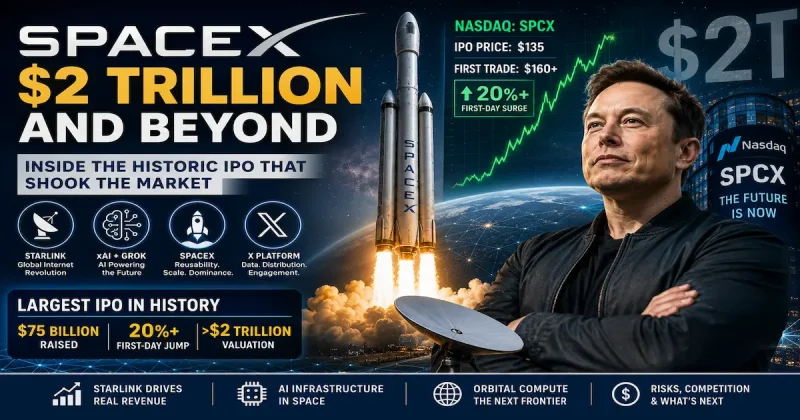
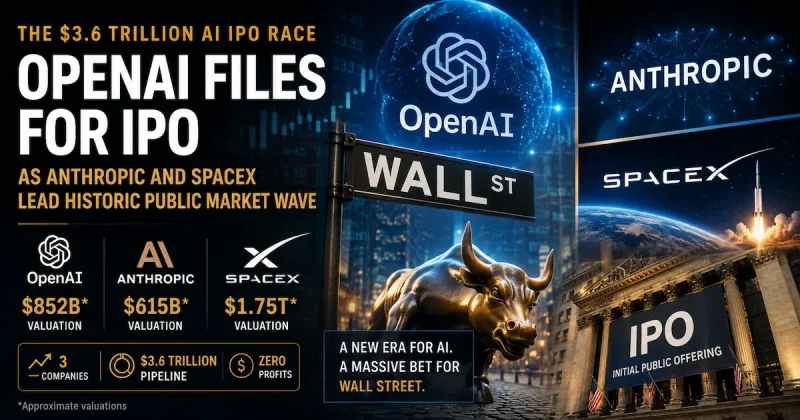
Comments
Leave a Comment
Your comment will appear after moderation.