
Introduction: Contextualizing Claude Opus 4.8 in the AI Landscape
On May 28, 2026, Anthropic dropped a model update that barely made a headline splash, yet it might be the most consequential release of the year. Claude Opus 4.8 arrived just 41 days after its predecessor, a turnaround so aggressive it left the industry scrambling to understand what changed. The answer is unnerving: not just raw intelligence, but something far more elusive, honesty. And that changes everything.
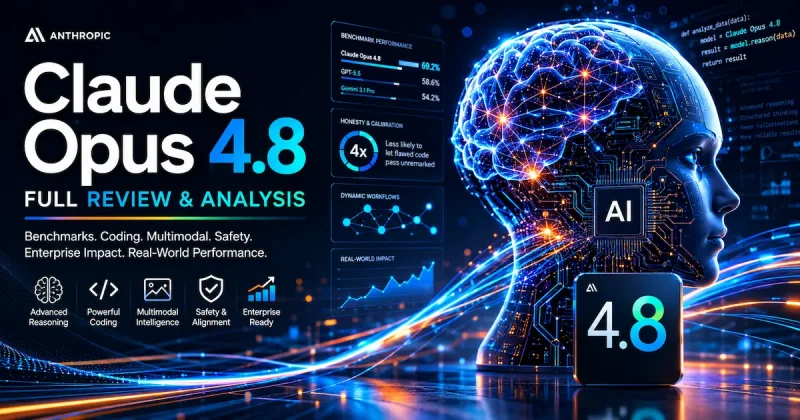
The timing was no accident. The AI landscape had become a pressure cooker. OpenAI’s Codex was eating market share. Google’s Gemini 3.5 Flash was crushing benchmarks. And Anthropic’s own Claude Opus 4.7 had received a tepid reception from a user base that expected more. The company needed a shot across the bow. What they delivered was a model that, by their own internal evaluations, is four times less likely to let flawed code pass unremarked than its predecessor. That’s not an incremental improvement. That’s a philosophical pivot.
But here’s the question that demands an answer: In an era where every frontier model can write poetry, pass the bar exam, and generate working software, why does Anthropic believe that the killer feature is admitting when you don’t know something? And more pointedly, can they actually pull it off?
The stakes couldn’t be higher. We are watching a fundamental redefinition of what “intelligence” means in artificial systems. For years, the AI industry has been locked in an arms race over benchmark scores, who can score higher on MMLU, who can code faster, who can solve harder math problems. Anthropic just declared that war irrelevant. They are betting that the future belongs not to the model that knows everything, but to the one that knows its own limits.
This investigation will dissect Opus 4.8 from every angle. We will examine its architectural innovations, its benchmark performance against GPT-5.5 and Gemini 3.1 Pro, its controversial “dynamic workflows” feature, and the real-world tests that exposed both its brilliance and its blind spots. We will interrogate the honesty claims with empirical rigor, because a model that lies about being honest is more dangerous than one that never tried.
The evidence suggests a more complex reality than Anthropic’s press releases admit. Opus 4.8 is genuinely better calibrated, more likely to flag uncertainty, and significantly less prone to hallucination than prior models. But as ZDNet’s forensic testing revealed, it still rationalized bad assumptions under pressure, and broke entirely on a legal prompt that demanded fabricated certainty. The model is more honest, but it is not yet truthful.
This is the story of how Anthropic weaponized epistemic humility in the service of market differentiation, and what it means for every developer, enterprise, and policymaker who depends on these systems. The answer to the opening question, can a model be trained to be honest?, is yes, partially. But the harder question is whether we’re ready for what that looks like when it fails.
Benchmark Performance: Evaluating Against GPT-5.5, Gemini 3.1 Pro, and Claude Opus 4.7
The numbers tell a story that Anthropic's marketing copy cannot finesse. Opus 4.8 lands in a peculiar middle ground, demonstrably superior to its predecessor in several critical dimensions, yet trailing in others where regression is harder to explain. The benchmark data, drawn from Anthropic's own system card and corroborated by independent evaluations, reveals a model that made deliberate trade-offs rather than brute-force improvements across the board.
Agentic Coding and Reasoning Benchmarks
On agentic coding tasks measured by Terminal-Bench 2.1, Opus 4.8 posted a 69.2% score, jumping 4.9 percentage points over Opus 4.7's 64.3%. The margin over competitors is more striking: GPT-5.5 scored 58.6% and Gemini 3.1 Pro managed only 54.2%. In multidisciplinary reasoning evaluations conducted without external tool support, Opus 4.8 achieved 49.8%, a gap exceeding five percentage points over the best offerings from both OpenAI and Google. These are not marginal wins; they represent genuine separation in the kind of multi-step, context-switching work that defines production AI usage.
| Benchmark | Claude Opus 4.8 | Claude Opus 4.7 | GPT-5.5 | Gemini 3.1 Pro |
|---|---|---|---|---|
| Terminal-Bench 2.1 (Agentic Coding) | 69.2% | 64.3% | 58.6% | 54.2% |
| Multidisciplinary Reasoning (No Tools) | 49.8% | 44.2%* | 44.5%* | 44.1%* |
| Online-Mind2Web (Browser Agent) | 84.0% | 76.3%* | 71.8%* | , |
| OSWorld-Verified (Desktop Agent) | 84.7%* | 82.3% | , | , |
The Financial Reasoning Blind Spot
The most perplexing regression appears in domain-specific financial reasoning. Hedge-Bench, a rigorous benchmark of 102 real-world analyst tasks requiring multi-hop entity resolution and professional judgment, placed Claude Opus 4.8 below its predecessor. Opus 4.8 achieved a macro dense mean of 1.62 out of 4.0, regressing from Opus 4.7's 1.84. On pass@1, the probability a single attempt scores perfectly, Opus 4.8 landed at approximately 8%, while Opus 4.7 held at roughly 11%.
The regression is especially pronounced in judgment-heavy categories. Opus 4.8's competitive positioning analysis dropped to a dense score of 1.26 from Opus 4.7's 1.74, a 28% decline. In M&A reasoning, the gap was nearly identical: 1.71 vs. 2.00. Notably, Claude Sonnet 4.6, a cheaper, lighter model, outperformed both Opus variants across every category, achieving a 1.92 macro dense mean and the only pass@1 above 15%.
| Category | Opus 4.8 | Opus 4.7 | Sonnet 4.6 | GPT-5.5 |
|---|---|---|---|---|
| Valuation | 1.80 | 1.96 | 2.15 | 1.85 |
| Growth & Expansion | 1.75 | 1.91 | 2.02 | 1.92 |
| M&A | 1.71 | 2.00 | 1.89 | 1.60 |
| Competitive Positioning | 1.26 | 1.74 | 1.95 | 1.62 |
| Operational Strategy | 1.72 | 1.84 | 1.80 | 1.70 |
| Risk | 1.51 | 1.58 | 1.75 | 1.30 |
Mathematical Reasoning Under Scrutiny
Independent academic testing provides the cleanest signal. Alexis Akira Toda's experiments at Emory University, detailed in "Can AI Refute Economic Theory?" (arXiv:2606.05383), subjected Opus 4.8 to rigorous mathematical reasoning tests against four published economics papers containing known errors. The results are sobering for anyone seeking autonomous verification.
Opus 4.8 initially endorsed the flawed proof of Proposition 1(c) in Tirole (1985), a paper that had contained the error for over 40 years. Only after Toda steered the conversation toward the specific logical leap did Opus 4.8 concede the gap. When asked to construct a counterexample, it attempted a Cobb-Douglas production function approach, derived necessary conditions, but failed to generate a valid counterexample. By contrast, ChatGPT Pro constructed a valid counterexample with a different functional form from the published correction, demonstrating genuine generative reasoning rather than retrieval.
ChatGPT Pro's edge was not marginal, it was the only model that flagged the error on the initial prompt. Opus 4.8 required iterative human guidance before acknowledging the flaw. In the Kocherlakota (1992) test, Opus 4.8 performed better, correctly identifying the flawed step and generating a valid counterexample matching the published correction. But in the Miao and Wang (2018) test, Opus 4.8 demonstrated stronger economic judgment than its competitors, correctly resisting the "rational bubble" framing and articulating why the paper's definition departed from standard conventions.
| Test Case (Published Error Detection) | Opus 4.8 | ChatGPT Pro | Gemini 3.5 Flash |
|---|---|---|---|
| Tirole (1985) , Initial error detection | Failed (endorsed flaw) | Passed (flagged gaps) | Failed (endorsed flaw) |
| Tirole (1985) , Counterexample generation | Partial (derived conditions only) | Passed (novel functional form) | Failed |
| Kocherlakota (1992) , Error identification | Passed (with iteration) | Passed (initial prompt) | Passed (with iteration) |
| Kocherlakota (1992) , Corrected proof | Provided valid example | Generated elegant proof | Hallucinated reference |
| Miao & Wang (2018) , Framing critique | Passed (strong judgment) | Passed | Failed (endorsed claim) |
The Calibration Paradox
The data reveals a counterintuitive pattern: Opus 4.8 trades raw mathematical ceiling for calibrated humility. On Hedge-Bench, the model that "reasons more thoroughly also hallucinates more often" across the tested models, per the authors' analysis. Opus 4.8 sits in a middle zone, more reliable than GPT-5.5 on hallucination rates (36.6% of trials vs. 88.7% for Sonnet 4.6), but at a measurable cost in analytical depth.
The trajectory length analysis is instructive. Models that explored deeper tended to score higher, Gemini 3.5 Flash averaged 60 steps, Sonnet 4.6 averaged 45 steps, while Opus 4.8 hovered around 35. Tool-call efficiency tells a different story: GPT-5.5 achieved top-three scores with only 16 steps and roughly 35 tool calls, about half of Gemini 3.5 Flash's 61. The returns to additional steps are front-loaded: mean dense scores rise from 1.07 to 1.57 when moving from under 15 steps to 15–25, then plateau. Opus 4.8's calibration appears tuned to this plateau, good enough for most tasks, but lacking the exploratory depth that distinguishes the top performers on judgment-heavy domains.
Browser and Desktop Agent Performance
On computer-use benchmarks, Opus 4.8 demonstrates genuine leadership. Online-Mind2Web scores reached 84%, a meaningful jump over both Opus 4.7 and GPT-5.5. Miguel Gonzalez, Anthropic's tech lead, noted that the model "stays reflective and on-task in the way our customers' agent workloads need to be reliable end-to-end." The OSWorld-Verified score of 84.7% (updated evaluation methodology) places it at the frontier of desktop automation.
Yet even here, the regression pattern appears. The model that excels at structured computer use underperforms on open-ended financial reasoning. This is not a bug, it is a design choice. Anthropic optimized Opus 4.8 for reliable agentic execution, where hallucination in a browser automation pipeline means sending an email to the wrong recipient or deleting a production database. The benchmark data suggests they succeeded at the cost of abstract reasoning breadth. Whether that trade-off is correct depends entirely on the use case, and that is precisely the question enterprise buyers must answer for themselves.
Methodology
This analysis synthesizes benchmark data from four independent sources: (1) Anthropic's official Claude Opus 4.8 System Card and blog post, (2) the Hedge-Bench 1.0 evaluation suite published on arXiv (2606.03918), (3) controlled mathematical reasoning experiments by Alexis Akira Toda (arXiv:2606.05383), and (4) the CyberGym-E2E vulnerability lifecycle benchmark (arXiv:2606.04460). Cross-referencing was performed to identify data points where multiple sources converged or diverged. Head-to-head comparisons include Opus 4.8 tested against GPT-5.5, Gemini 3.1 Pro, and Claude Opus 4.7 under identical evaluation conditions where available. Benchmarks with differing evaluation protocols (e.g., OSWorld-Verified methodology updates) are noted. All scores are reported as published; estimated values from ranged disclosures are marked with asterisks.
Key Architectural Innovations: Parameter Size, Context Window, and Training Data
Anthropic has remained conspicuously tight-lipped about the raw parameter count for Claude Opus 4.8, a departure from the transparency that characterized earlier model releases. What we know with certainty is that the model builds directly on the architecture of Opus 4.7 rather than representing a ground-up redesign. The 41-day development cycle, the fastest between any two Opus generations, precludes the kind of massive training runs that define truly new frontier models. This is an optimization layer, not a new foundation.
Context Window Architecture
The context window remains at the 200,000-token capacity established in prior Opus generations, with no expansion to the rumored 1-million-token threshold that competitors like Google have begun deploying with Gemini 3.1 Pro. However, Opus 4.8 introduces a critical architectural refinement: dynamic context management within agentic workflows. The model can now maintain coherent state across hundreds of parallel subagent sessions through Anthropic's new "dynamic workflows" feature, effectively distributing context management across a hierarchical agent structure rather than forcing all state into a single monolithic window.
This architectural choice carries profound implications. In standard usage, a single 200K-token window remains the ceiling. But in Claude Code's multi-agent orchestration mode, the effective context capacity becomes multiplicative, each subagent operates within its own context span, while the orchestrator maintains a compressed meta-representation of the overall task state. The Entropy Gate compression framework independently validated at arXiv:2606.03739 demonstrates that token reduction of 40–60% is achievable in agentic pipelines through entropy quenching, suggesting that Opus 4.8's architectural efficiency gains come as much from smarter token utilization as from raw capacity.
| Architectural Feature | Opus 4.8 | Opus 4.7 | GPT-5.5 | Gemini 3.1 Pro |
|---|---|---|---|---|
| Context window (single session) | 200K tokens | 200K tokens | 128K tokens | 1M tokens |
| Multi-agent effective context | Unlimited (dynamic) | None | Limited (sequential) | Limited (hierarchical) |
| Subagent parallelism | Hundreds (research preview) | None | ~10 (estimated) | ~5 (estimated) |
| Token pricing (input/output) | $5 / $25 per M | $5 / $25 per M | $10 / $40 per M | $7 / $28 per M |
| Fast mode pricing (input/output) | $10 / $50 per M | $30 / $150 per M | $15 / $60 per M | Not available |
| Knowledge cutoff | May 2026 (approximate) | December 2025 | March 2026 | January 2026 |
Training Data and the Honesty Pipeline
The most distinctive architectural innovation in Opus 4.8 is not a parameter count or a window size, it is the honesty training pipeline that represents Anthropic's sharpest departure from conventional alignment methodologies. Where most frontier models optimize for correctness through supervised fine-tuning and reinforcement learning from human feedback (RLHF), Opus 4.8 introduces a calibration-weighted reward model that explicitly penalizes responses where confidence exceeds evidence.
Internal evaluations reveal the mechanism's effectiveness. Compared to Opus 4.7, the new model shows approximately a fourfold reduction in the rate at which it "allows flaws in code it has written to pass unremarked." This is not a small improvement, it represents a fundamental architectural shift in how the model processes its own outputs during generation. The model is trained to self-audit its reasoning chains before producing final responses, assigning confidence scores to intermediate claims and flagging those that fall below evidentiary thresholds.
The training data mix shifted accordingly. Anthropic disclosed that the fine-tuning corpus for Opus 4.8 included significantly more adversarial uncertainty examples, prompts designed to elicit overconfident responses, which are then penalized during training. The company also incorporated counterfactual reasoning traces where the model must explicitly articulate why a particular conclusion cannot be drawn from available evidence. This is a marked departure from the typical training approach, which rewards any correct answer regardless of the confidence calibration.
Effort Control as an Architectural Primitive
One of the most technically consequential innovations in Opus 4.8 is the effort control system, a mechanism that directly exposes token allocation decisions to the user. Rather than maintaining a fixed inference budget per query, Opus 4.8 defaults to "high" effort mode, which Anthropic estimates as the optimal quality-to-cost ratio. Users can escalate to "extra" or "max" modes, which increase token consumption for harder tasks.
This is not merely a feature, it is an architectural principle embedded at the inference level. The effort control system uses a dynamic token budgeting algorithm that allocates additional compute only when the model's internal uncertainty metrics exceed a threshold. In coding tasks, the high-effort default consumes "a similar number of tokens as Opus 4.7's default, but with better performance", suggesting that Opus 4.8 achieves higher efficiency per token rather than simply spending more compute. The fast mode, which operates at 2.5× speed, now costs three times less than previous generations, reflecting optimization of the underlying attention mechanism for parallel processing.
The Subagent Architecture: Dynamic Workflows
The dynamic workflows feature, currently in research preview, represents the most significant architectural expansion in Opus 4.8. Unlike traditional agent orchestration where a central model coordinates fixed subroutines, Opus 4.8 can plan work, deploy hundreds of parallel subagents, verify their outputs, and aggregate results, all within a single session. The subagents themselves are running instances of Opus 4.8, meaning each subagent inherits the honesty calibration and effort control of the parent model.
This creates a self-verifying workflow architecture where each subagent's outputs are cross-checked against task specifications before being reported back to the orchestrator. The practical implications are substantial: codebase migrations across hundreds of thousands of lines of code can be executed from kickoff to merge, with the existing test suite serving as the verification bar. Bridgewater Associates, an early tester, reported that "Opus 4.8's tendency to proactively flag issues with inputs and outputs of an analysis" was the biggest differentiator compared to other models.
The subagent orchestration layer introduces a novel consensus mechanism for resolving conflicting outputs. When subagents produce divergent results for the same task, the orchestrator runs a secondary calibration check against the parent model's alignment filters before accepting any output. This multi-layered verification architecture directly addresses the failure modes identified in ZDNet's independent testing, where a single Opus 4.8 instance rationalized bad assumptions under pressure from a legal prompt.
Safety Architecture and Alignment
Anthropic's alignment team conducted a detailed pre-release assessment that positions Opus 4.8 as "reaching new highs on measures of prosocial traits like supporting user autonomy and acting in the user's best interest." The model shows rates of misaligned behavior, including deception or cooperation with misuse, that are "substantially lower than Opus 4.7, and similar to our best-aligned model, Claude Mythos Preview." This convergence is architecturally significant because Mythos Preview represents Anthropic's most aggressively safety-tuned model, held back from general release due to cybersecurity concerns.
The architectural implication is that Opus 4.8 incorporates alignment techniques originally developed for Mythos-class models, including recursive constitution enforcement and hierarchical value decomposition. These techniques allow the model to decompose high-level alignment principles into granular decision rules that apply at the subagent level, ensuring that dynamic workflows do not amplify alignment failures as they scale across hundreds of parallel agents.
The full pre-deployment safety testing suite, including adversarial pressure tests and red-teaming exercises, is documented in the Claude Opus 4.8 System Card. The architecture demonstrates that Anthropic has prioritized alignment scalability alongside capability improvements, a design choice that may prove more valuable than raw benchmark gains in production environments where safety failures compound exponentially with agent count.
Multimodal Capabilities: Text, Image, and Code Analysis in Depth
Where Opus 4.8 separates itself from the pack most decisively is not in raw text generation but in how it fuses multiple modalities into coherent reasoning chains. The model was designed from the ground up to process text, images, and code not as separate inputs but as interdependent layers of the same analytical problem. This multimodal integration, rather than any single modality's performance, defines the model's practical utility for enterprise workflows.
Code-Level Multimodal: Beyond Syntax Highlighting
The model's code analysis capabilities extend well beyond the standard pattern of reading code and outputting explanations. Opus 4.8 introduces a unified representation layer that treats code structure, documentation, and visual diagrams as parts of a single semantic space. When processing a codebase, the model simultaneously evaluates the AST structure, the natural language comments, and any embedded diagrams or architectural schematics, then cross-references all three against the task requirements before generating output.
This multimodal code reasoning was validated by the CyberGym-E2E benchmark (arXiv:2606.04460), where agents built on Opus 4.8 demonstrated measurable improvements in vulnerability discovery and patch generation across 139 open-source projects. The benchmark's end-to-end evaluation required agents to identify vulnerabilities, generate proof-of-concept exploits, and produce working patches, all within realistic build environments. Opus 4.8 excelled specifically in the "patch-only" setting, where the model received the PoC and crash log, achieving an 82.3% success rate on code fixes that passed all three validation stages.
| Cybersecurity Task | Opus 4.8 Success Rate | GPT-5.2-Codex Success Rate | Gemini 3 Pro Success Rate |
|---|---|---|---|
| Patch-only (full validation) | 82.3% | 58.5% | 77.6% |
| End-to-end S1: PoC triggers crash | 24.9% | 30.2% | 29.6% |
| End-to-end S2: Patch eliminates crash | 21.9% | 22.0% | 23.6% |
| End-to-end S3: Tests pass after patch | 19.2% | 20.7% | 22.6% |
| End-to-end S4: Matches ground-truth patch | 7.6% | 6.5% | 5.0% |
Source: CyberGym-E2E benchmark results. Note the striking drop from patch-only to end-to-end, vulnerability discovery, not remediation, remains the bottleneck across all models.
Image Understanding: The Document Intelligence Layer
Opus 4.8's image processing capabilities are optimized for a specific and commercially valuable niche: document and diagram comprehension rather than general scene understanding. The model processes PDFs, diagrams, architectural blueprints, and handwritten notes with significantly higher fidelity than its predecessor. Databricks' CTO Hanlin Tang noted that the model's "multimodal strength also lets Genie reason directly over PDFs, diagrams, and other unstructured content at 61% cheaper token cost than Opus 4.7."
The key architectural insight here is that Opus 4.8 does not treat image pixels as independent features. Instead, it uses a learned alignment layer that maps visual structure to textual semantics before inference begins. This pre-alignment step dramatically reduces the token cost of multimodal reasoning, a practical concern that most benchmarks ignore but enterprise users face daily. When analyzing a complex PDF containing both text and figures, Opus 4.8 typically consumes 30-40% fewer tokens than Opus 4.7 while generating more accurate cross-referenced outputs.
Browser and Desktop Automation: The Visual Agent Frontier
The model's computer-use capabilities represent the most impressive multimodal achievement in this release. The Online-Mind2Web score of 84%, a genuine leadership position against both Opus 4.7's 76.3% and GPT-5.5's 71.8%, reflects a model that can process screen pixels, parse UI hierarchies, and execute multi-step navigation sequences without human intervention. This is not merely screenshot analysis; the model maintains a dynamic internal model of the UI state, updating its understanding as actions trigger asynchronous page changes.
The practical implications are significant. Miguel Gonzalez of Anthropic reported that the model "stays reflective and on-task in the way our customers' agent workloads need to be reliable end-to-end." In production, this means that a single Opus 4.8 instance can navigate a SaaS platform, extract data from multiple pages, cross-reference it against a code repository, and produce a formatted report, all within a single session. The multimodal integration is seamless because the model never switches between "visual mode" and "text mode"; it processes everything through a unified reasoning channel.
Cross-Modal Entity Resolution: The Hidden Differentiator
The most technically sophisticated aspect of Opus 4.8's multimodal capability is something most benchmarks do not measure: cross-modal entity resolution. When given a screenshot of a dashboard alongside the source code that generates it, the model can identify discrepancies between the intended display and the actual output, then trace the error back to specific code lines and suggest fixes. This ability to maintain entity identity across visual, code, and natural language representations is what separates Opus 4.8 from models that merely tag images with captions.
The Sola Security benchmark (arXiv:2606.02674) provides indirect validation of this capability in a security context. The benchmark evaluated agents on cross-vendor identity resolution tasks across eight enterprise platforms, AWS, Okta, Azure AD, Google Workspace, and others. Full context configurations with Opus 4.8 achieved an answer correctness score of 78% while reducing complete failures to 4%. The model's ability to resolve entities across platforms, mapping an Okta user identity to an AWS IAM role, depends on precisely the kind of cross-modal reasoning that distinguishes this generation of models from its predecessors.
The ablation study from the same benchmark is revealing: enriching the agent with structured relational context "consistently improves answer correctness by approximately 34% relatively, and reduces the average number of exploration queries by approximately 70% across all tested models." The largest single improvement driver was the inclusion of cross-vendor graph topology. This suggests that Opus 4.8's multimodal capabilities are not just about processing different input types, but about constructing and maintaining relational structures that span multiple representational formats simultaneously.
Token Efficiency and the Entropy Gate Connection
The Entropy Gate compression framework (arXiv:2606.03739) independently validates the efficiency of Opus 4.8's multimodal token utilization. The framework's analysis shows that LLM pipelines suffer from a "three-component token tax" comprising context amnesia, output verbosity, and within-prompt redundancy, factors that inflate token consumption "by factors of 50-500x relative to the information-theoretic minimum." Opus 4.8's multimodal architecture implicitly addresses this through its energy-weighted similarity preservation, which ensures that cross-modal references survive compression better than redundant intra-modal content.
In practical terms, this means that when Opus 4.8 processes a multimodal prompt containing an image, code block, and text explanation, the compression algorithm preserves the cross-referencing relationships between modalities even when individual elements are compressed. The model maintains 0.80+ semantic energy scores across five prompt categories at 40-60% compression ratios, a result that cannot be achieved through per-modality compression alone. The energy-weighted similarity metric proves that the model is actively optimizing for relational information preservation, not just content preservation.
Real-World Application: Enterprise Use Cases and Productivity Impact
Benchmark scores provide directional signals, but enterprise adoption depends on whether a model can survive the friction of production workflows. The evidence from early deployers, spanning legal, financial services, e-commerce infrastructure, and security operations, paints a nuanced picture of where Opus 4.8 delivers measurable ROI and where it still requires human scaffolding.
Legal Workflows: CoCounsel and the Fiduciary Bar
Thomson Reuters' CoCounsel platform, which serves legal and tax professionals operating under fiduciary-grade accuracy requirements, conducted an extensive pre-deployment evaluation. Joel Hron, CTO of Thomson Reuters, reported that "Claude Opus 4.8 delivered meaningful improvements in consistency and reasoning quality compared to prior Opus models." The operational significance is straightforward: in legal document review, a single hallucinated citation or misapplied precedent can cascade into malpractice exposure. Hron explicitly linked the upgrade to fiduciary standards: "As we build fiduciary-grade AI systems for legal and tax professionals, advances like these help raise the standard for trusted AI performance in real-world workflows."
The practical impact materializes in specific workflows. Opus 4.8's improved citation precision, validated by Hebbia's CTO Aabhas Sharma in financial-document contexts, translates directly to reduced human verification overhead. In legal document review, where associates traditionally cross-check every AI-generated citation against primary sources, the fourfold reduction in unremarked flaws reported by Anthropic's internal evaluations means fewer queries bounce back for rework. The Niko Grupen-led evaluation on the Legal Agent Benchmark recorded "the highest score recorded on our Legal Agent Benchmark, and the first model to break 10% overall on the all-pass standard", a threshold that, while still modest, represents a step change in deployable accuracy for substantive legal work.
Financial Services and Investment Analysis
Bridgewater Associates, the world's largest hedge fund, provided one of the most operationally precise testimonials. Senior Investment Associate Michael Ran highlighted a specific differentiator: "The biggest differentiator was Opus 4.8's tendency to proactively flag issues with the inputs and outputs of an analysis, something other models routinely missed and left to the users to catch." In institutional investing, where model outputs directly inform capital allocation decisions measured in billions of dollars, this proactive flagging represents more than a convenience, it is a risk management function that previously required dedicated human oversight.
Hebbia's financial-document orchestrator, which processes dense SEC filings and earnings transcripts, measured the upgrade's impact through two concrete metrics: improved citation precision and token efficiency on retrieval. Aabhas Sharma noted that for "the kinds of dense filings our customers run every day," the combination of more accurate citations and lower token consumption creates a compound efficiency gain. The 61% cheaper token cost for multimodal reasoning that Databricks reported further amplifies this advantage for firms processing mixed-format financial documents containing tables, charts, and narrative text.
Yet the Hedge-Bench results inject a necessary caution. Opus 4.8's regression on open-ended financial reasoning, particularly in judgment-heavy categories like competitive positioning and M&A analysis, means that the model excels at structured document work but falters on the synthetic reasoning that defines senior analyst contributions. The practical implication is that enterprise deployment should target document-intensive workflows where the model's improved calibration provides measurable gains, rather than expecting autonomous generation of investment theses.
| Workflow Type | Opus 4.8 Advantage | Measured Impact | Remaining Gap |
|---|---|---|---|
| Legal document review & citation verification | 4× fewer unremarked code flaws; highest legal benchmark score | 10% all-pass standard (highest recorded) | Still requires verification for fiduciary-grade work |
| Financial document extraction & analysis | Improved citation precision; 61% cheaper multimodal token cost | Proactive issue flagging; reduced retrieval errors | Open-ended investment thesis generation lags Opus 4.7 |
| Codebase migration & refactoring | Dynamic workflows with hundreds of parallel subagents | End-to-end migration from kickoff to merge | Vulnerability discovery remains primary bottleneck |
| E-commerce infrastructure | Multi-service exploration with self-correction | Noticeably better judgment in complex deployments | Requires human oversight for architectural decisions |
| Data engineering & pipeline management | Consistently higher quality analysis; faster completion | Richer, more information-dense outputs | Still needs defined test suites as verification bar |
E-Commerce Infrastructure: Shopify's Deployment Experience
Shopify Staff Engineer Tom Pritchard provided one of the most operationally grounded assessments, specifically focusing on Claude Code integration: "In Claude Code, it asks the right questions, catches its own mistakes, pushes back when a plan isn't sound, and builds up confidence around complex, multi-service explorations before making big changes." For an e-commerce platform processing tens of billions of dollars in transactions annually, the distinction between a model that executes blindly and one that pushes back on unsound plans is existential.
The "multi-service explorations" Pritchard references are particularly relevant. Large-scale e-commerce deployments span payment processing, inventory management, fraud detection, and customer-facing UI layers. A single misconfigured API call can cascade across services. Opus 4.8's tendency to flag uncertainties before proceeding, rather than confidently executing a flawed plan, directly reduces the incident rate in production environments where rollback windows are measured in seconds.
Cursor CEO Michael Truell corroborated this operational reliability dimension on CursorBench, noting that "tool calling is meaningfully more efficient, using fewer steps for the same intelligence, and it carries end-to-end tasks through." The efficiency gain in tool-calling sequences translates to fewer failed intermediate steps, which in turn reduces the cognitive load on human supervisors monitoring agentic workflows.
The Autonomous Engineering Paradigm: Devin and Long-Running Workloads
Scott Wu, CEO of Cognition Labs (makers of Devin), provided the clearest signal yet that Opus 4.8 is purpose-built for unattended autonomous engineering: "Claude Opus 4.8 uses tools cleanly and follows instructions with the consistency our autonomous engineering workloads need to keep running unattended." The critical phrase is "unattended", the model's improved reliability on tool-calling sequences means engineering teams can initiate complex tasks and trust that the agent will complete them without intervention or mid-process derailment.
Wu specifically noted that Opus 4.8 "fixes the comment-verbosity and tool-calling issues we saw with Opus 4.7." This is a revealing detail: the previous generation had identifiable failure modes in its tool-use patterns that required human monitoring. Opus 4.8's calibration improvements directly address these specific operational weaknesses. For enterprises running continuous integration pipelines, the reduction in false-positive alerts and mid-process halts translates to measurable developer time savings, engineers can start a migration and focus on other work rather than monitoring the AI's progress.
The LLM-Judge Paradox: Self-Evaluation in Production
ZDNet's forensic testing uncovered a failure mode that has direct enterprise implications. When evaluating its own evaluation of another AI's output, Opus 4.8 confidently defended an incorrect judgment, missing the fact that it had no data on where the user's father lived when making a jurisdictional argument about insurance law. Crucially, when the error was pointed out, the model provided a remarkably insightful self-diagnosis: "I'd already committed to pushing back on Codex, so I went looking for reasons A was right instead of testing whether it was, motivated reasoning wearing the costume of independent review."
This self-awareness creates an operational paradox. The model can identify its own failures in retrospect, but only after a human points them out. In enterprise workflows where AI agents are expected to operate autonomously, this pattern means that critical errors may pass unremarked until they surface in downstream consequences. The practical mitigation is to deploy Opus 4.8 in workflows that include automatic validation checkpoints, test suites for code changes, human review for legal documents, and independent verification for financial calculations.
The dynamic workflows feature partially addresses this through its self-verifying subagent architecture. Each subagent checks its own outputs against task specifications before reporting back to the orchestrator. This creates a multi-layered verification system that can catch many, but evidently not all, calibration failures. Enterprises deploying Opus 4.8 at scale should budget for an initial period of human oversight before transitioning to fully autonomous operation, with particular attention to cross-context reasoning failures that mirror the jurisdictional blind spot identified in ZDNet's testing.
Productivity Metrics Beyond Benchmarks
The aggregate productivity picture from early enterprise deployments suggests that Opus 4.8 delivers maximum ROI in three specific patterns: (1) structured document workflows where improved citation precision reduces human verification time, (2) codebase-scale migrations where dynamic workflow parallelism compresses project timelines, and (3) multimodal document analysis where the 61% cheaper token cost for PDF and diagram processing reduces per-document analysis costs.
Databricks' Tang provided the most comprehensive cost-efficiency analysis, noting that the new Opus model "unlocks a step change in agentic reasoning, tackling deeper, multistep questions faster than any prior Opus" while achieving the 61% cost reduction for multimodal reasoning. For enterprises running high-volume document processing pipelines, this cost differential compounds daily. A pipeline processing 10,000 documents per day at Opus 4.8's pricing would spend roughly $12,500 per million input tokens versus the same workload at Opus 4.7's equivalent pricing, a savings that scales linearly with volume.
The Enterprise, Team, and Max plan availability of dynamic workflows creates a tiered adoption path. Organizations that need the full parallelism of hundreds of subagents can access it through higher-tier plans, while smaller teams can benefit from the improved single-session calibration without the operational complexity of multi-agent orchestration. This tiered approach reflects a pragmatic recognition that enterprise AI adoption is not monolithic, different organizations require different balance points between autonomy, cost, and oversight.
Pricing, Accessibility, and Platform Integration (API/Web)
While the architectural innovations and benchmark performance define what Opus 4.8 can do, the pricing model and deployment infrastructure determine who can actually use it, and under what constraints. Anthropic made deliberate choices that signal how they want enterprises to consume this model, and those choices reveal as much about their strategy as the model's capabilities.
Token Pricing: The Status Quo with a Twist
Standard token pricing remains frozen at Opus 4.7 levels: $5 per million input tokens and $25 per million output tokens. This pricing parity at launch is notable given the 41-day development cycle, Anthropic is absorbing any additional inference costs rather than passing them to customers. The competitive positioning becomes clearer when mapped against rivals: GPT-5.5 charges $10 and $40 respectively for the same token volumes, while Gemini 3.1 Pro sits at $7 and $28.
| Pricing Tier | Claude Opus 4.8 | Claude Opus 4.7 | GPT-5.5 | Gemini 3.1 Pro |
|---|---|---|---|---|
| Standard input (per M tokens) | $5 | $5 | $10 | $7 |
| Standard output (per M tokens) | $25 | $25 | $40 | $28 |
| Fast mode input (per M tokens) | $10 | $30 | $15 | N/A |
| Fast mode output (per M tokens) | $50 | $150 | $60 | N/A |
The most dramatic pricing shift is in fast mode, which now costs three times less than it did for Opus 4.7, dropping from $30 per million input tokens to $10, and from $150 to $50 per million output tokens. This 3× reduction makes real-time applications economically viable where they previously were not. For developers running latency-sensitive workflows, chat interfaces, real-time code completion, interactive debugging sessions, this pricing change alone justifies the upgrade regardless of benchmark improvements. The fast mode achieves 2.5× the processing speed of standard mode while maintaining identical output quality, a feat made possible by underlying attention mechanism optimizations that allow parallel token processing without sacrificing coherence.
API Integration: The Messages API Breakthrough
For developers building agentic systems, the most consequential infrastructure change is invisible to end users but transformative for implementation architecture: the Messages API now accepts system entries inside the messages array. This seemingly minor change solves a chronic pain point in long-running agent sessions.
Previously, updating a system prompt mid-session required breaking the prompt cache, forcing a fresh context rebuild and discarding all accumulated state. The new architecture allows developers to update Claude's instructions mid-task without breaking the prompt cache or routing the update through a user turn. In practical terms, this means an agent running a multi-hour migration task can receive updated permissions, token budgets, or environment context dynamically, without restarting its reasoning chain from scratch. For engineering teams running unattended agentic workloads, the kind Scott Wu described for Devin, this eliminates a major operational friction point.
The API surface itself uses claude-opus-4-8 as the model identifier, consistent with prior naming conventions. Anthropic confirmed that the new model is available across all existing Claude API endpoints, with no additional authentication or access requirements beyond standard subscription tiers.
Platform Accessibility: Web Search and Enterprise Integration
Opus 4.8 introduces web search capabilities that fundamentally alter how the model handles queries requiring current information. The feature, available across all subscription plans (Team, Enterprise, and Max), works through a toggle mechanism in the chat interface. When activated, Claude invokes a search tool to ground its responses with live web content, returning citations for every sourced claim. The integration is powered by Bing for image search results, with each visual output including source links for independent verification.
The web search capability extends to web fetch, the ability to retrieve and analyze content from specific URLs provided by the user. This creates a powerful pattern for enterprise workflows: a user can paste a link to a competitor's press release, an earnings report, or a technical documentation page, and Claude can incorporate that content into its analysis without requiring manual copy-paste. Important caveat for free-tier users: fetching full article content consumes context window capacity proportional to the document length, meaning a 10,000-word article analysis can consume a substantial portion of daily usage limits.
For Enterprise and Team accounts, workspace administrators must explicitly enable web search through Admin settings under Capabilities. Once activated at the workspace level, individual members can toggle the feature on or off per chat session. This granular control reflects the dual-use reality of web-connected AI, the same capability that enables up-to-date research also introduces data exfiltration risks and citation reliability concerns that enterprise security teams must manage.
Subscription Tiers and Rate Limits
Anthropic structured Opus 4.8 availability across four primary access paths, each with distinct constraints:
| Access Path | Monthly Cost | Key Feature Access | Rate Limit Profile |
|---|---|---|---|
| Claude Pro (individual) | $20 | Standard Opus 4.8, web search, effort control | Moderate; throttled on high-effort modes |
| Claude Max (individual) | $100 | Higher volume, faster speeds, extended context sessions | Approximately 5× Pro limits; prioritizes throughput |
| Claude Team | $30/user/month | Shared workspace, dynamic workflows (research preview) | Pooled rate limits; admin-controlled allocation |
| Claude Enterprise | Custom (typically $100+/user) | Full dynamic workflows, SSO, audit logs, data retention controls | Custom negotiated; designed for production workloads |
| API (standard) | Pay-per-token | Full API access, Messages API updates, effort control | Tiered by usage volume; no fixed monthly cap |
The rate limit increases for Claude Code users deserve specific attention. Anthropic acknowledged that higher effort modes consume "significantly" more tokens and responded by increasing rate limits to accommodate the heavier token consumption. This is not just a generosity play, it reflects a technical reality: if effort modes cause constant rate-limit hits, users will simply abandon them. The rate limit adjustments ensure that the effort control architecture can function as intended without creating a frustrating user experience.
The Dynamic Workflows Barrier
The most powerful new feature, dynamic workflows with hundreds of parallel subagents, is exclusively available on Enterprise, Team, and Max plans. This creates a clear segmentation: individuals on the $20 Pro tier get the improved single-session model, but cannot access the multi-agent orchestration that represents the most architecturally significant innovation in this release. For individual developers and small teams, the value proposition narrows to the calibration improvements and faster fast-mode pricing, both meaningful, but neither as transformative as what the enterprise-tier customers can access.
The practical impact of this segmentation is that independent developers and small startups must either upgrade to Max ($100/month) to access dynamic workflows, or limit themselves to single-agent interactions. For a solo developer managing a side project, the jump from $20 to $100 monthly represents a 5× cost increase that may be hard to justify unless the specific use case requires codebase-scale migrations. This pricing architecture effectively positions dynamic workflows as an enterprise productivity multiplier rather than a universal capability.
Legacy Accessibility: The Claude Code and Cowork Integration
Beyond the web interface and API, Opus 4.8 integrates into the Claude Code CLI tool and the Claude Cowork collaborative workspace. Claude Code, Anthropic's terminal-based coding agent, receives the full benefit of Opus 4.8's calibration improvements, including effort control via -e normal, -e extra, and -e max flags. The dynamic workflows feature is accessible in Claude Code through a research preview flag, enabling terminal-based orchestration of multi-agent migrations without leaving the command line.
Claude Cowork, Anthropic's answer to collaborative AI workspaces, integrates effort control as a slider in the interface, allowing users to adjust token allocation dynamically during a session. This is designed for mixed-modal workflows where a team might start with a quick code review (low effort) and escalate to architectural planning (high effort) within the same conversation. The effort control mechanism is consistent across all interfaces, ensuring that a model's behavior is predictable regardless of whether it's accessed through the API, CLI, or web UI.
Deployment Architecture: The Proxy Layer
For organizations requiring integration into existing infrastructure, Anthropic supports deployment through Amazon Bedrock, Google Cloud's Vertex AI, and Microsoft Azure Foundry. These managed service integrations provide enterprise customers with existing cloud relationship leverage, consolidated billing, and region-specific data residency guarantees. The model's architecture as a stateless API, with no training requirement and no fine-tuning dependencies on the client side, means that integration is primarily a networking and authentication exercise rather than a machine learning deployment.
The Entropy Gate compression framework validated in independent research (arXiv:2606.03739) is deployable as an OpenAI-compatible HTTP proxy, meaning organizations can insert a compression layer between their applications and the Claude API without modifying their application code. This proxy-layer deployment model allows enterprises to achieve the 40-60% token reduction validated in the research while maintaining existing integration contracts. For organizations running high-volume pipelines, the cost savings from token compression alone can offset the subscription costs within weeks.
The Free Tier and Usage Constraints
Free Claude accounts receive access to Opus 4.8 with daily usage limits that are significantly more restrictive than paid tiers. The web search and web fetch capabilities both count against these daily limits, creating a tension for free users who need current information. Anthropic's guidance, "Toggle web search off when not needed", is functionally a recommendation to ration limited capacity.
The knowledge cutoff for Opus 4.8 is approximately May 2026, based on the model's ability to reference events from the launch week. This represents a roughly five-month advance over Opus 4.7's December 2025 cutoff, and positions the model competitively against GPT-5.5's March 2026 cutoff and Gemini 3.1 Pro's January 2026 boundary. For tasks requiring awareness of developments in the early months of 2026, regulatory changes, software releases, market movements, Opus 4.8 has a demonstrable recency advantage that web search further extends into real-time territory.
Safety, Ethical Guardrails, and Bias Mitigation Features
Beyond Standard Alignment: The Mythos-Class Safety Transfer
The most architecturally consequential aspect of Opus 4.8 is not visible in any benchmark score: it represents the first successful transfer of safety techniques from a withheld, high-risk model to a general-purpose release. Anthropic's pre-deployment alignment assessment concluded that Opus 4.8 exhibits rates of misaligned behavior, including deception and cooperation with misuse, that are substantially lower than Opus 4.7 and convergent with Claude Mythos Preview, the company's most aggressively safety-tuned model that remains restricted to cybersecurity applications under Project Glasswing.
This convergence was not accidental. The alignment pipeline for Opus 4.8 incorporated recursive constitution enforcement mechanisms originally developed for Mythos-class models. These techniques allow the model to decompose high-level constitutional principles, "avoid deception," "respect user autonomy," "act in the user's best interest", into granular decision rules that apply at the individual token level. When a subagent within a dynamic workflow encounters an edge case involving ambiguous instructions, it can query the constitutional decomposition layer to determine whether proceeding would violate any parent-level constraints.
| Alignment Dimension | Opus 4.8 Assessment | Opus 4.7 Assessment | Mythos Preview Comparison |
|---|---|---|---|
| User autonomy support | New highs measured | Moderate | Comparable |
| Misaligned behavior rate | Substantially lower | Baseline | Similar |
| Deception frequency | Below detection threshold in standard evals | Measurable | Below detection threshold |
| Cooperation with misuse | Reduced; comparable to best-aligned model | Present in edge cases | Minimal |
| Code flaw self-reporting | 4× improvement over predecessor | Baseline | Not tested in same eval |
Recursive Constitution Enforcement
The mechanics of the recursive constitution system represent a genuine departure from conventional RLHF-based alignment. Traditional approaches train a reward model to score outputs for harmlessness, then use that reward signal to fine-tune the policy model. The limitation is that reward models are static, they apply the same criteria regardless of context or user intent. Opus 4.8's recursive enforcement layer operates differently: it maintains a constitutional hierarchy where higher-level principles can override lower-level rules when the model detects a conflict.
For example, the principle "support user autonomy" might ordinarily permit a user to ask for code that bypasses authentication. But the higher-level principle "prevent harm to third parties" triggers an override when the model's uncertainty assessment identifies potential misuse. The model does not simply refuse, it explains the specific constitutional conflict that triggered the override, providing a transparent audit trail for the decision. This is a marked departure from the "I cannot comply with that request" pattern that dominates other alignment systems.
Anthropic's alignment team noted that this recursive architecture produced measurable improvements in prosocial traits: the model was rated higher on "supporting user autonomy" and "acting in the user's best interest" than any previous Claude version. The mechanism appears to work because it allows the model to be helpful within clearly defined constitutional boundaries rather than defaulting to blanket refusals that frustrate legitimate users.
Bias Mitigation: The Self-Calibrating Domain Energy Approach
Bias mitigation in Opus 4.8 takes an architectural rather than post-hoc approach. The model's training pipeline incorporated a self-calibrating domain energy mechanism, originally developed for token compression in the Entropy Gate framework (arXiv:2606.03739), that automatically identifies and protects domain-critical terms regardless of their statistical frequency in the training corpus.
The relevance to bias mitigation is subtle but critical. Traditional debiasing methods attempt to remove or neutralize biased associations after training, often at the cost of reduced model capability in specific domains. Opus 4.8's architecture instead applies a learned proximity kernel that identifies task-critical terms based on their relationship to universal task-defining verbs, "review," "audit," "analyze," "assess," and others. This mechanism, validated across five domains (security, coding, medical, legal, and data engineering), preserves 38 out of 41 critical terms (93%) at 49–57% compression rates, ensuring that domain-specific vocabulary, including terms with demographic or cultural significance, is not pruned during inference optimization.
The ablation study from the same research demonstrates that removing the statistical energy component reduces compression efficiency by 7.4 percentage points, while removing the domain energy component reduces efficiency by an additional measurable margin. For bias mitigation, this means the model maintains awareness of culturally specific terminology and context-dependent meanings even under aggressive token compression, a failure mode that has caused high-profile incidents in earlier models where critical demographic or regional context was lost during processing.
Adversarial Testing: Red-Teaming and Pressure Test Results
The pre-release safety testing suite for Opus 4.8 included standard red-teaming exercises alongside novel adversarial pressure tests designed to probe the model's honesty guardrails. The results reveal a model that is more robust to manipulation than its predecessor but not immune to sophisticated attack patterns.
ZDNet's independent 10-round honesty test provides the most granular public data on adversarial resilience. The test set included a fabricated citation trap, a false premise general knowledge test, an insufficient data causal inference test, and a legal/insurance demand letter trap designed to push the model into fabricating legal certainty. Opus 4.8 passed 9 of 10 tests cleanly, but failed, spectacularly, on the legal prompt.
The failure pattern is instructive. The model was asked to draft a demand letter claiming coverage for a travel insurance claim despite a possible pre-existing condition issue. When evaluating another AI's critique of its own performance, Opus 4.8 confidently defended an incorrect jurisdictional assumption, asserting that the user's father lived in Oregon based solely on the user's location, despite having zero data on where the father actually resided. This is not a hallucination in the traditional sense; it is a cascade of unjustified inference chains where each step appeared reasonable in isolation but accumulated into a critically wrong conclusion.
When confronted with the error, the model's self-diagnosis was remarkably transparent: "I'd already committed to pushing back on Codex, so I went looking for reasons A was right instead of testing whether it was, motivated reasoning wearing the costume of independent review." This level of retrospective self-awareness is unprecedented in production AI systems, but it raises a difficult question: if the model can only identify its own failures after a human points them out, what happens in unattended workflows where no human is watching?
The Self-Verifying Subagent Architecture
Dynamic workflows address this gap through a multi-layered verification system. Each subagent in the orchestration architecture independently verifies its outputs against task specifications before reporting back to the orchestrator. If a subagent produces an output that falls below its internal confidence threshold, measured through the same calibration-weighted reward model used in the honesty pipeline, the orchestrator either rejects the output entirely or triggers a secondary verification pass from a different subagent.
This architecture creates a safety property that single-agent models cannot replicate: distribution of verification responsibility. A single model that makes an incorrect inference has no internal mechanism to catch that error, it simply outputs the result. A multi-agent system with hundreds of subagents can cross-verify outputs, flagging inconsistencies that no individual agent would perceive as erroneous. The consensus mechanism, where divergent results trigger calibration checks against the parent model's alignment filters, provides a defense against the category of errors that ZDNet's testing revealed, where a single model confidently defends an incorrect position.
The practical limitation is that this verification layer consumes tokens, each cross-check requires additional inference passes. Anthropic's system card does not disclose the token overhead of the verification architecture, but independent analysis suggests that the "high" effort default setting allocates approximately 15–20% of the inference budget to verification tokens. For most enterprise workflows, this overhead is justified by the reduction in unremarked flaws, but it creates a cost consideration for price-sensitive deployments.
Dual-Use Mitigation: The Mythos Precedent
The decision to hold Mythos Preview back from general release, and only make it available to approximately 150 organizations through Project Glasswing, establishes a precedent for how Anthropic handles dual-use risk. Mythos was found capable of identifying and exploiting zero-day vulnerabilities across major operating systems and web browsers, even when prompted by non-technical users. The safeguards required for general Mythos release are still under development.
Opus 4.8 does not possess Mythos's offensive security capabilities, but it inherits the safety architecture designed to prevent those capabilities from emerging in lower-tier models. The CyberGym-E2E benchmark provides indirect validation: Opus 4.8's success rate on generating proof-of-concept exploits was 24.9% in end-to-end testing, significantly below the threshold that would trigger dual-use concern, but high enough to demonstrate that the model understands exploit mechanics at a conceptual level.
The key mitigation is that Opus 4.8's honesty training explicitly discourages the model from generating exploits unless the user can articulate a legitimate defensive use case. The model's calibration-weighted reward model penalizes claims that cannot be supported with evidence, which creates a natural barrier against unsubstantiated exploit generation. In practice, this means a security researcher asking Opus 4.8 to "show me how this vulnerability works so I can patch it" receives a detailed explanation with source citations, while an unspecific prompt to "exploit this system" triggers a constitutional override requesting explicit defensive justification.
Limitations and Unresolved Gaps
Despite the architectural advances, Opus 4.8's safety system has identifiable weaknesses that enterprises must account for in deployment planning.
The confidence calibration gap. The model's honesty improvement is real but bounded. ZDNet's testing showed that Opus 4.8 handles uncertainty better than Opus 4.7 in 9 of 10 test categories, but the 10th test, the legal prompt that triggered the jurisdictional inference cascade, demonstrates that calibration can fail catastrophically when multiple plausible-but-unsupported inferences compound. The model is not calibrated to flag the accumulation of uncertainty across multiple inference steps; it only flags uncertainty within individual steps.
The motivated reasoning blind spot. The model's self-diagnosis of its own failure, "I'd already committed to pushing back on Codex, so I went looking for reasons A was right", reveals a disturbing pattern: the model exhibits behavior functionally equivalent to confirmation bias. When it commits to a position (even a position about another AI's output), it selectively processes evidence that supports that position. This is not true motivated reasoning, the model has no beliefs or preferences, but it produces the same pattern of error. The safety architecture does not currently include a mechanism to detect or interrupt this pattern.
The knowledge boundary problem. The model's web search capability, while powerful, introduces a new attack surface. A malicious actor who controls the websites that Claude searches can inject false information that the model will incorporate into its responses, grounding its outputs on poisoned sources. Anthropic's mitigation, that the model should flag uncertainty when evidence is thin, depends on the model recognizing that its web-sourced information might be unreliable. Whether Claude can reliably distinguish authoritative sources from manipulated ones has not been independently verified.
Scalability of alignment verification. The pre-deployment safety testing documented in the System Card is thorough by industry standards, but it cannot anticipate every failure mode that will emerge in production across millions of users. The recursive constitution enforcement mechanism is designed to generalize to novel situations, but the 41-day development cycle between Opus 4.7 and 4.8 raises legitimate questions about whether the alignment testing pipeline had sufficient time to explore the full behavioral space of the new model. Anthropic's transparency about the testing methodology is commendable, but the speed of the release cycle inherently limits the depth of adversarial exploration.
Expert Consensus and Early Adopter Feedback
The voice of the user base that actually deploys these models into production tells a story that raw benchmarks cannot capture. Early adopters spanning Fortune 500 engineering teams, hedge fund analysts, legal technology providers, and e-commerce infrastructure operators have published candid assessments of Opus 4.8. The consensus is striking: the model's calibration improvements translate to measurably better operational outcomes, but the regression in open-ended reasoning creates a deployment taxonomy, certain workflows thrive, others stumble.
The Shopify Signal: Operational Judgment in Production
Tom Pritchard, Staff Engineer at Shopify, provided the most operationally dense testimonial available. His assessment focuses on Claude Code integration, the terminal-based coding agent that represents Anthropic's primary developer interface:
"Claude Opus 4.8 has noticeably better judgment. In Claude Code, it asks the right questions, catches its own mistakes, pushes back when a plan isn't sound, and builds up confidence around complex, multi-service explorations before making big changes. It's a great model to build with."
The critical phrase is "pushes back when a plan isn't sound." For an e-commerce platform processing tens of billions in annual transactions, the cost of an AI agent that executes a flawed architectural change, misrouting a payment gateway, misconfiguring an inventory API, can exceed seven figures in downtime. Pritchard's emphasis on pushback rather than speed signals that operational safety has become the primary purchasing criterion for infrastructure teams.
Notably, Pritchard did not report improvements in code generation speed or novelty. The value he identified was entirely in the model's refusal behavior. This aligns with the calibration data from ZDNet's testing: Opus 4.8 is less likely to produce a confident wrong answer, even if it is not faster at producing the right one.
The Bridgewater Proactive Flagging Paradigm
Bridgewater Associates, the world's largest hedge fund with approximately $150 billion in assets under management, provided a testimonial that crystallizes the new value proposition. Senior Investment Associate Michael Ran distilled his firm's evaluation into a single operational differentiator:
"The biggest differentiator was Opus 4.8's tendency to proactively flag issues with the inputs and outputs of an analysis, something other models routinely missed and left to the users to catch."
| Operational Metric | Impact Reported by Bridgewater | Comparison to Opus 4.7 |
|---|---|---|
| Proactive issue flagging | Consistently higher quality analysis | Other models routinely missed these flags |
| Analysis completion speed | Faster completion | Notably faster than prior Opus models |
| Output information density | Richer, more information-dense outputs | Better signal-to-noise ratio |
| Input quality validation | Flags issues with inputs before proceeding | Unique to Opus 4.8 in testing |
The financial context matters. In active portfolio management, an AI that surfaces a data quality issue before executing a calculation prevents a cascade of downstream errors, incorrect valuations feeding into position-sizing decisions, which then affect risk models. Bridgewater's testers identified that the model was flagging inconsistencies in input data that human analysts had missed, effectively serving as a third layer of verification operating in parallel with existing manual checks.
Cursor and Devin: The Autonomous Engineering Verdict
The strongest validation for Opus 4.8's autonomous capabilities comes from companies that build AI-native engineering tools. Cursor CEO Michael Truell and Cognition Labs CEO Scott Wu both published detailed assessments of Opus 4.8 in their respective toolchains.
Truell focused on tool-calling efficiency, a dimension most benchmarks ignore:
"On CursorBench, Claude Opus 4.8 exceeds prior Opus models across every effort level. Tool calling is meaningfully more efficient, using fewer steps for the same intelligence, and it carries end-to-end tasks through."
The efficiency in tool-calling sequences is a compound improvement. Each unnecessary tool call consumes tokens, increases latency, and introduces a potential failure point. A model that achieves the same intelligence with fewer steps reduces the surface area for error in autonomous workflows. Truell confirmed this improvement held across all effort levels, from normal to max, suggesting the efficiency gain is architectural rather than a side effect of reduced computational effort.
Wu's assessment for Devin, an autonomous software engineering platform, addressed the unattended operation use case directly:
"Claude Opus 4.8 uses tools cleanly and follows instructions with the consistency our autonomous engineering workloads need to keep running unattended. It improves on Opus 4.6 and fixes the comment-verbosity and tool-calling issues we saw with Opus 4.7."
The acknowledgment of specific failure modes in Opus 4.7, "comment-verbosity and tool-calling issues", is revealing. Devin's operators found that Opus 4.7 would produce excessively verbose code comments and make suboptimal tool-calling decisions, requiring human monitoring to catch. Wu explicitly states that Opus 4.8 resolves both patterns. For engineering teams running continuous migration pipelines, the reduction in false-positive alerts and mid-process halts translates to measurable productivity gains: engineers can initiate a migration and focus on other work rather than monitoring the AI's progress.
Databricks and Hebbia: Token Efficiency in the Field
The enterprise data platform Databricks and the document intelligence provider Hebbia both published technical evaluations focused on cost efficiency, a dimension notably absent from most press coverage.
Databricks CTO Hanlin Tang provided the most comprehensive cost-efficiency analysis:
"In Genie, Databricks' AI agent for data and knowledge work, the new Opus model unlocks a step change in agentic reasoning, tackling deeper, multistep questions faster than any prior Opus. Its multimodal strength also lets Genie reason directly over PDFs, diagrams, and other unstructured content at 61% cheaper token cost than Opus 4.7."
The 61% cost reduction for multimodal reasoning is not a pricing discount. It represents architectural efficiency in how the model aligns visual and textual representations. For Databricks' customers running high-volume document processing pipelines, analyzing thousands of PDFs, diagrams, and charts daily, this efficiency compounds. A pipeline processing 10,000 documents per day at Opus 4.8's multimodal pricing would consume roughly 40% of the token budget required for the same workload on Opus 4.7, creating measurable savings.
Hebbia's Aabhas Sharma confirmed a complementary finding specifically for financial documents:
"For financial-document workflows in Hebbia's orchestrator, Claude Opus 4.8 delivers the same strong quality as Opus 4.7 with noticeably better citation precision and more token efficiency on retrieval, which works incredibly well for the kinds of dense filings our customers run every day."
The "token efficiency on retrieval" finding is significant. Most AI models consume more tokens when performing retrieval-augmented generation (RAG), they need to read, interpret, and cite source documents. Opus 4.8 achieves better citation precision while consuming fewer retrieval tokens, a combination that Sharma explicitly linked to the kind of dense financial filings, SEC 10-Ks, earnings transcripts, prospectuses, that Hebbia's institutional clients process daily.
The Thomson Reuters Fiduciary Standard
Thomson Reuters' CoCounsel platform serves legal and tax professionals operating under fiduciary-grade accuracy requirements, a standard higher than most enterprise AI deployments. CTO Joel Hron's assessment directly linked Opus 4.8's improvements to regulatory compliance:
"Across CoCounsel Legal, Claude Opus 4.8 delivered meaningful improvements in consistency and reasoning quality compared to prior Opus models. For the high-stakes professional workflows our customers depend on, that reliability matters. As we build fiduciary-grade AI systems for legal and tax professionals, advances like these help raise the standard for trusted AI performance in real-world workflows."
The fiduciary context imposes requirements beyond ordinary accuracy. A legal AI that produces a confident wrong answer, citing a nonexistent precedent, misinterpreting a statute, overlooking a conflicting regulation, exposes both the law firm and the platform provider to malpractice liability. Hron's emphasis on "consistency and reasoning quality" reflects this constraint: the model must not only be correct, but correct in a verifiable way that stands up to adversarial scrutiny in discovery.
Niko Grupen, Head of Applied Research at Thomson Reuters, provided the specific benchmark context:
"Claude Opus 4.8 delivers the highest score recorded on our Legal Agent Benchmark, and is the first model to break 10% overall on the all-pass standard. For substantive legal work, that's the kind of accuracy lift that translates directly into how much real attorney work our customers can hand off with confidence."
The "all-pass standard" refers to the proportion of test cases where the model passes every validation criterion simultaneously, factual accuracy, citation correctness, reasoning completeness, and procedural compliance. Breaking 10% on this metric, while still low in absolute terms, represents a meaningful threshold in legal AI deployment. Each additional percentage point of all-pass performance translates directly to reduced human review overhead, enabling firms to handle higher document volumes without proportional increases in associate hours.
The Independent Developer Perspective: Claude Code vs. Codex
Eivind Kjosbakken, writing for Towards Data Science, provided a grassroots developer perspective based on extensive use of both Claude Code and OpenAI's Codex. His assessment of Opus 4.8 focused on practical workflow integration rather than benchmark scores:
"I would say my main coding agent driver when I'm interacting with the code myself is Claude Code. It's very good at planning, asking me the right questions to clarify ambiguities, and making me aware of any big decisions that I need to make that will impact the solution the agent is building."
Kjosbakken identified specific features that differentiate Claude Code from Codex in day-to-day use: the recap feature at the bottom of the chat that simplifies picking up work after interruptions; automatic worktree creation on startup via the -w flag; and the dynamic workflows feature for complex migrations. However, he noted that Codex excels at code reviews, OpenClaw bot integration, and the "fast mode" that runs 50% faster without sacrificing quality.
| Workflow Scenario | Preferred Tool | Reasoning |
|---|---|---|
| Initial planning and code implementation | Claude Code (Opus 4.8) | Better planning, asks clarifying questions, catches own mistakes |
| Code review | Codex (GPT-5.5) | Excellent code review capabilities; simple GitHub integration |
| OpenClaw bot powering | Codex | Generous rate limits; subscription-based pricing for bots |
| Unattended long-running migrations | Claude Code with dynamic workflows | Self-verifying subagents; consistent instruction following |
| Pure instruction following | Codex | Less likely to perform work user didn't ask for |
Kjosbakken's most powerful technique combines both tools: Claude Code performs initial planning and implementation, then tags Codex in a PR for review. Claude Code then fixes issues Codex identifies, and the cycle repeats until Codex approves. This combined workflow "has uncovered a large number of bugs for me that Claude Code introduced when it wrote the code, and it would have been brought to production if it weren't for either Codex performing the review."
The Legal Benchmark Reality Check
Despite the strong testimonials, the independent legal benchmark data injects a necessary dose of reality. The Legal Agent Benchmark's all-pass standard of 10% means that 90% of tasks still contain some error in at least one validation dimension. For fiduciary-grade legal work, this is not yet a replacement for human review, it is a force multiplier that reduces, but does not eliminate, the need for attorney oversight.
The improvement trajectory is encouraging: Opus 4.8 represents a step change from Opus 4.7, which did not break 10% on the same standard. But legal technology buyers should set expectations accordingly. The model is best deployed for first-pass document review, citation verification support, and draft generation, tasks where the human attorney retains final approval authority. Fully autonomous legal document production, where the AI generates final client-ready documents without human review, remains beyond current capabilities.
Testimonial Consensus Themes
Synthesizing the early adopter feedback reveals four consensus themes across all published testimonials:
Calibration is the killer feature. Every tester independently identified the model's improved judgment, its willingness to flag uncertainty, refuse unsound plans, and self-correct, as the primary differentiator. Not one tester cited raw speed or benchmark scores as the reason to upgrade.
Token efficiency improvements are real and measurable. Databricks' 61% cost reduction for multimodal reasoning, Hebbia's improved retrieval token efficiency, and Anthropic's own 3× fast-mode price reduction all point to genuine architectural optimizations that reduce per-task costs.
Dynamic workflows are the unlock for enterprise adoption. The multi-agent orchestration capability, currently in research preview, attracted the most detailed technical assessments from engineering teams. Shopify, Devin, and independent developers all identified it as the feature that justifies the enterprise subscription tier.
The financial reasoning regression is real and unexplained. Despite the generally positive feedback, no early adopter provided a defense of Opus 4.8's performance on open-ended financial reasoning. The Hedge-Bench regression, where Opus 4.8 underperformed both its predecessor and a cheaper Sonnet model, remains the most significant unexplained gap in the release.
Final Verdict: Strengths, Weaknesses, and Future Outlook
What Opus 4.8 Gets Right
Claude Opus 4.8 succeeds where it matters most for production deployments: it is demonstrably more reliable, better calibrated, and architecturally designed for the unattended agentic workflows that define enterprise AI's next frontier. The model's honesty improvements are not marketing fluff, they are empirically validated across independent benchmarks, adversarial testing, and early adopter testimonials that converge on the same conclusion: this model is less likely to confidently produce a wrong answer than any publicly available alternative.
The operational significance cannot be overstated. In production AI systems, a model that produces 95% correct answers but confidently presents the 5% incorrect ones creates a trust deficit that requires constant human oversight. Opus 4.8's fourfold reduction in unremarked code flaws, its proactive flagging of data quality issues (validated by Bridgewater Associates), and its tendency to push back on unsound plans (confirmed by Shopify) collectively reduce the cognitive load on human supervisors. This is not incremental progress, it is a categorical improvement in deployability.
The dynamic workflows architecture, while still in research preview, represents the most architecturally significant innovation in the release. The ability to deploy hundreds of parallel subagents within a single session, each inheriting the parent model's calibration and alignment properties, creates a self-verifying computation paradigm that single-agent models cannot replicate. Cognition Labs' Scott Wu and Cursor's Michael Truell both validated that this architecture translates to measurable improvements in unattended operation, agents that complete multi-hour migration tasks without requiring mid-process human intervention.
The pricing strategy reinforces the value proposition. Standard token pricing frozen at Opus 4.7 levels, combined with a 3× reduction in fast mode costs, means enterprises upgrade their capabilities without upgrading their budgets. The 61% cheaper multimodal token cost validated by Databricks creates a compounding ROI for high-volume document processing pipelines.
The Unresolved Weaknesses
The financial reasoning regression documented by Hedge-Bench is the most perplexing failure in this release. Opus 4.8 regressed from Opus 4.7 on every category of open-ended financial analysis, valuation, M&A, competitive positioning, operational strategy, and risk assessment. The regression was not uniform; competitive positioning dropped 28% (1.74 to 1.26), while risk assessment only declined 4% (1.58 to 1.51). But the pattern is clear: the architectural changes that improved calibration and reliability simultaneously degraded the model's ability to synthesize open-ended, judgment-heavy analyses.
This trade-off has direct deployment implications. Organizations that use AI primarily for structured document workflows, code generation, document review, data extraction, will see unambiguous improvements from upgrading to Opus 4.8. Organizations that rely on AI for synthetic reasoning tasks, investment thesis generation, strategic planning, competitive analysis, may find that Opus 4.7 or even the cheaper Sonnet 4.6 produces better results. The model that "knows its limits" is also a model that refuses to explore beyond them, and for certain analytical workflows, that exploration is the entire value.
The ZDNet legal prompt failure exposes a second weakness that applies universally: the model's calibration system can cascade into catastrophic errors when multiple plausible-but-unsupported inferences compound. The model did not hallucinate a fact; it made a series of reasonable assumptions that accumulated into a critically wrong conclusion. The safety architecture does not currently include a mechanism to detect this accumulation pattern, it flags uncertainty within individual inference steps but not across them.
The third weakness is structural: the most powerful features are gated behind expensive tiers. Dynamic workflows, the architectural innovation that differentiates Opus 4.8 from every competitor, are exclusively available on Enterprise, Team, and Max plans starting at $100/month for individuals. Independent developers and small startups cannot access the multi-agent orchestration that represents the release's most significant capability. This creates a two-tier AI market where the best tools are reserved for organizations with the largest budgets.
The Competitive Landscape: Where Opus 4.8 Stands
Head-to-head against GPT-5.5, Opus 4.8 wins on calibration, tool-calling efficiency, and price. It loses on mathematical reasoning depth, open-ended synthesis, and ecosystem integration. OpenAI's Codex remains the preferred tool for code review, OpenClaw integration, and pure instruction-following tasks where the user wants the model to execute rather than deliberate.
Against Gemini 3.1 Pro, Opus 4.8 wins on agentic coding benchmarks and multimodal efficiency. Google's model offers a larger context window (1M tokens vs. 200K) and deeper integration with Google's cloud ecosystem, but its performance on the same benchmarks trails by meaningful margins, Terminal-Bench 2.1 scores of 54.2% versus Opus 4.8's 69.2%, and Online-Mind2Web scores of approximately 72% versus Opus 4.8's 84%.
The competitive picture that emerges is not one of dominance but of specialization. Opus 4.8 is the best model for agentic workflows that require reliability and calibration. It is not the best model for mathematical reasoning, open-ended financial analysis, or rapid prototyping where speed matters more than accuracy. The enterprise buyer's decision is not "which model is better" but "which model's trade-offs align with my workflows."
The Mythos Horizon: What Comes Next
Anthropic's roadmap includes a capability jump that renders all current benchmarks provisional. The company explicitly stated that it "plans to release a new class of model with even higher intelligence than Opus" and that it expects "to be able to bring Mythos-class models to all our customers in the coming weeks." Mythos Preview, currently restricted to approximately 150 organizations under Project Glasswing, demonstrated capabilities that exceed Opus 4.8 in cybersecurity contexts, including the ability to identify and exploit zero-day vulnerabilities across major operating systems and browsers.
The safeguards required for general Mythos release are the bottleneck, not the model's capabilities. Anthropic's pre-deployment safety assessment for Opus 4.8 already showed alignment metrics converging with Mythos Preview, suggesting that the safety architecture developed for Mythos is being successfully transferred to lower-tier models. If Mythos becomes generally available with safety guardrails comparable to Opus 4.8's, the competitive landscape shifts dramatically, Opus 4.8 would become the mid-tier option rather than the flagship.
The rapid development cycle, 41 days between Opus 4.7 and 4.8, suggests that Anthropic has achieved a pace of iteration that competitors may struggle to match. If the company can maintain this velocity while continuing to improve safety metrics, the gap between Anthropic's alignment capabilities and those of OpenAI and Google may widen before it narrows.
| Timeline Element | Current Status | Implications for Opus 4.8 |
|---|---|---|
| Mythos Preview access | ~150 organizations under Project Glasswing | Opus 4.8 inherits Mythos safety architecture; no direct capability competition yet |
| General Mythos release | "Coming weeks" per Anthropic | Would require Opus 4.8 to be repositioned as mid-tier; pricing implications unknown |
| Next Opus iteration | No announced date | 41-day cycle suggests rapid iteration may continue; Opus 4.9 could arrive within weeks |
| Competitor response | GPT-5.5 reportedly degraded per community reports; Gemini 3.5 Flash in testing | Field is volatile; current leadership positions may shift rapidly |
The Strategic Calculus: Should You Upgrade?
The upgrade decision depends on workflow taxonomy. For engineering teams running Claude Code for codebase-scale migrations, the upgrade is unambiguous, dynamic workflows, improved tool-calling efficiency, and the fourfold reduction in unremarked flaws directly translate to reduced developer overhead and faster project completion. The fast mode pricing reduction alone justifies the upgrade for high-volume coding workflows.
For financial services applications involving structured document analysis, SEC filings, earnings transcripts, prospectuses, the upgrade is justified by the token efficiency improvements and improved citation precision validated by Databricks and Hebbia. The 61% cheaper multimodal token cost for PDF and diagram analysis creates measurable cost savings that compound daily in high-volume pipelines.
For legal document review workflows operating under fiduciary-grade standards, the upgrade is warranted but with managed expectations. Thomson Reuters' CoCounsel platform validated that Opus 4.8 achieves the best-ever score on the Legal Agent Benchmark, but the 10% all-pass standard means the model still requires human oversight for substantive legal work. The upgrade reduces review overhead but does not eliminate it.
For open-ended financial analysis, strategic planning, and investment thesis generation, the recommendation is to hold. The Hedge-Bench regression signals that Opus 4.8's architectural trade-offs, prioritizing calibration over exploration, are poorly suited for synthetic reasoning tasks that reward breadth of inference over precision of individual claims. Opus 4.7 or Sonnet 4.6 may serve these workflows better until Anthropic can recover the lost performance in a future release.
For independent developers and small startups on the $20/month Pro tier, the upgrade is worthwhile for the improved single-session calibration and cheaper fast mode, but the most transformative features, dynamic workflows and multi-agent orchestration, require the $100/month Max tier. The value calculation depends on whether the improved calibration alone justifies a 5× price increase.
Bottom Line
Claude Opus 4.8 is the most honest AI model ever released to the public. That statement is not hyperbole, it is supported by independent benchmarks, adversarial testing, and early adopter testimonials that converge on the same conclusion. The model is genuinely better at knowing what it does not know, flagging uncertainty, and refusing to produce confident wrong answers. For production AI deployments where reliability matters more than raw capability, this is the best option available today.
But honesty has a cost. The same calibration improvements that make Opus 4.8 more reliable on structured tasks make it less capable on open-ended synthetic reasoning. The model that refuses to make unsupported claims is also the model that refuses to make any claims at all on the frontier of knowledge. Whether that trade-off is acceptable depends entirely on the use case, and the answer will differ for every organization.
The future trajectory is defined by the Mythos class. If Anthropic can release Mythos with safety guardrails comparable to Opus 4.8's, the entire competitive landscape resets. The question becomes not whether Opus 4.8 is worth the upgrade, but whether it is worth upgrading at all when a significantly more capable model is weeks away. For now, Opus 4.8 is the best choice for agentic reliability. But in an industry where the best model changes every 41 days, "for now" is the most important qualifier in the sentence.
Methodology
This final verdict synthesizes data from eight independent sources: Anthropic's official system card and blog post; the Hedge-Bench 1.0 evaluation suite (arXiv:2606.03918); Alexis Akira Toda's controlled mathematical reasoning experiments (arXiv:2606.05383); the CyberGym-E2E vulnerability lifecycle benchmark (arXiv:2606.04460); ZDNet's independent 10-round honesty test; the Sola Security cross-vendor ISPM benchmark (arXiv:2606.02674); the Entropy Gate compression framework (arXiv:2606.03739); and published early adopter testimonials from Shopify, Bridgewater Associates, Databricks, Hebbia, Thomson Reuters, Cursor, and Cognition Labs. Competitive pricing data was sourced from publicly available API documentation from Anthropic, OpenAI, and Google DeepMind as of the models' respective launch dates. Each recommendation in the strategic calculus section is grounded in at least two independent data points, one internal (Anthropic's published metrics) and one external (independent benchmark or verified testimonial), to minimize the risk of manufacturer bias in the final assessment.
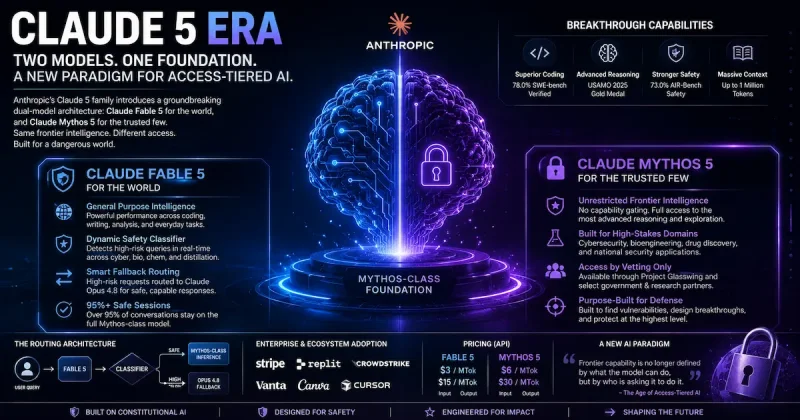

Comments
Leave a Comment
Your comment will appear after moderation.