
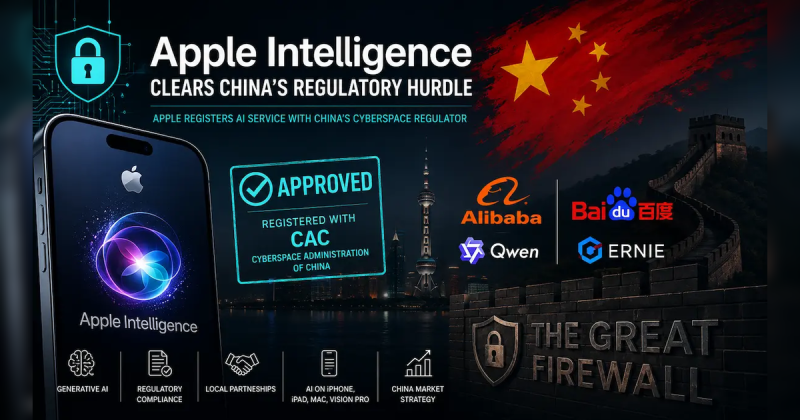
Apple Intelligence Clears China’s Regulatory Hurdle
Apple has officially registered Apple Intelligence with China’s cyberspace regulator. This is not a mere administrative formality. It is a strategic submission to the rigorous algorithmic governance of the Chinese state, paving the way for the rollout of generative AI across the world’s most complex consumer electronics market.
Compliance is the only currency in Beijing. Under current mandates, any entity deploying Large Language Models (LLMs) or generative AI must undergo a stringent registration process. For Apple, this filing represents the final gate before the integration of AI into the iPhone, iPad, Mac, and Vision Pro ecosystems within the region.
The Strategic Pivot: Localized Intelligence
Apple is not attempting to force a Western AI monolith into a restricted digital territory. Instead, the company is executing a tactical pivot toward domestic hybridity. To operate within the borders of the "Great Firewall," Apple is outsourcing the cognitive heavy lifting to China's AI titans.
- Alibaba Integration: Alibaba has confirmed that its Qwen model will serve as a foundational engine for Apple Intelligence, ensuring deep integration across iOS, iPadOS, macOS, and visionOS.
- Baidu Collaboration: Concurrent efforts with Baidu are underway to develop bespoke features, leveraging Baidu’s dominance in Chinese-language semantic search and neural processing.
This is a calculated concession. By integrating local LLMs, Apple bypasses the geopolitical friction inherent in deploying proprietary US-based models, ensuring that its "Intelligence" is both culturally aligned and politically compliant.
Market Gravity and the Cost of Absence
The urgency is driven by the numbers. While Apple reported a 24.4% year-on-year surge in China shipments during the second quarter, hardware sales alone cannot sustain a premium ecosystem in an era of AI-driven disruption. The Chinese consumer does not wait. They demand parity.
Without a functional AI layer, the iPhone risks becoming a legacy device—a high-end piece of glass devoid of the generative capabilities offered by domestic rivals. The registration of Apple Intelligence is a defensive maneuver to prevent a catastrophic erosion of market share.
A Crowded Battlefield
Apple is not the only player fighting for regulatory clearance. The landscape is becoming increasingly saturated with AI-native hardware. In a parallel move, the cyberspace regulator has registered the Nubia-Doubao smartphone, a collaboration between ZTE and ByteDance.
The entry of the Doubao model signals a dangerous trend for Apple: the rise of vertically integrated AI hardware born from the same companies that control the data. Apple is now racing against a clock where the hardware is secondary to the model powering it.
The verdict is clear: Apple has secured the permit. Now, it must prove that a fragmented, localized version of its AI vision can still deliver the seamless "magic" that justifies its premium price point.

Comments
Leave a Comment
Your comment will appear after moderation.