
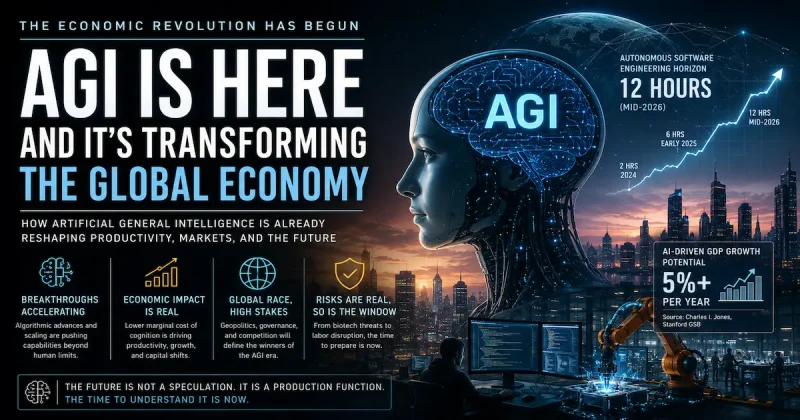
Artificial General Intelligence (AGI) is no longer a science fiction concept, but a reality that is transforming the economy
We have been lied to about the timeline. The conventional wisdom, carefully curated by cautious executives and risk-averse policymakers, insists that Artificial General Intelligence is a distant mirage, a philosophical abstraction at least a decade away. This narrative is not only misleading; it is economically dangerous. The data tells a radically different story: AGI is not coming. It is here. And it is already rewriting the genetic code of the global economy in ways that most business leaders are completely unprepared to confront.
Consider the hard numbers from the frontier. By mid-2026, the time horizon for autonomous software engineering, a metric tracked rigorously by METR, had soared to 12 hours. A task that a human would take half a day to complete can now be executed by an AI agent with a 50% probability of success. This is not a parlor trick. This represents a compound annual growth rate in autonomous capability that doubles every five to seven months. Since the introduction of reasoning models in late 2024, that doubling cycle has collapsed to just four months. We are not watching incremental improvement; we are observing a geometric explosion in cognitive automation that defies all historical precedent for technological diffusion.
The response from those who understand the stakes is telling. The World Economic Forum’s Global Future Council on Artificial General Intelligence, co-chaired by luminaries like Yoshua Bengio and Akiko Murakami, has already published urgent briefings on timelines, risk, and policy preparedness. Anthropic, a company valued at over $1 trillion, recently called for a global pause in AI development, warning that models are "nearing the capability to improve themselves without human intervention." This is not the rhetoric of a hype cycle; it is the sober assessment of the engineers who built the technology.
Defining the Economic Threshold
To understand why AGI is an economic force right now, we must strip away the philosophical debris and focus on market function. An AGI, a system capable of performing any cognitive task at or above human parity, does not need to be perfect at everything simultaneously to impact the economy. It only needs to be cheaper than a human at the margins of production. Once the marginal cost of cognition approaches zero for a growing subset of high-value tasks, the entire structure of prices, wages, and capital allocation begins to shift beneath our feet.
Economist Charles I. Jones of Stanford GSB has modeled this precise scenario. His work, published in the Journal of Economic Perspectives, reveals that if AI eventually automates away the "weak links" in the economy, those uniquely human tasks that currently bottleneck production, GDP growth rates could accelerate past 5% per year. This is not a speculative fantasy; it is a mathematically derived outcome from task-based production models where the elasticity of substitution between human and machine labor is aggressively low. The path is clear: remove the human bottleneck from the hardest tasks, and the compounding effect on productivity is staggering.
The Stakes of Inaction
Yet the twin-headed beast of geopolitical competition and corporate myopia threatens to derail anything resembling prudent management. The battle between Elon Musk and Sam Altman over the soul of OpenAI is not a Silicon Valley soap opera; it is a proxy war for the governance structure of the most powerful technology in human history. A ruling that forces OpenAI to revert to a nonprofit could wipe out the API infrastructure that thousands of businesses now depend on, effectively reshaping the competitive landscape overnight from a four-horse race to a three-player oligopoly.
Meanwhile, at the Freeman Spogli Institute at Stanford, scholars are tracking a biotech convergence. As synthetic DNA manufacturing becomes cheaper and more accessible, the risk of AI-enabled bioweapons moves from science fiction to an engineering challenge. This is not about tomorrow. The computational methods to design novel toxins exist today. The only question is how quickly the economic incentives for safety can catch up to the economic incentives for speed.
This introduction serves as the cold starting point of our investigation. Everything that follows is a deep dive into the mechanics of AGI's economic transformation: the weak links that slow it, the geopolitical fractures that define it, and the testable metrics that prove it is already happening. The future is not a speculation. It is a production function. And it is running faster than you think.
The Technological Leap: Key Breakthroughs Enabling AGI's Economic Integration
The transition of AGI from theoretical construct to economic prime mover did not happen by accident. It required a confluence of breakthroughs in three distinct domains: algorithmic architecture, compute scale, and validation methodology. Each domain has crossed a critical threshold in the last 24 months, and the convergence is what makes the current moment economically irreversible.
Algorithmic Information Theory Meets Neural Scaling
The most underreported breakthrough is the intellectual reunification of neural network design with first-principles mathematics. A landmark study published in Nature Communications in June 2026 introduced SuperARC, a test grounded in Algorithmic Information Theory (AIT) that evaluates models on their ability to compress and predict sequences of increasing complexity, not on human-centric benchmarks that can be gamed through pattern matching. The results were sobering for the industry: even the most advanced frontier models, including GPT-5 and Claude Opus 4.5, failed to demonstrate genuine recursive compression capability at higher complexity levels. They regressed, meaning newer versions performed worse than their predecessors at core abstraction tasks.
This is not a bug; it is a signal. The study's authors proved mathematically that predictive power through arbitrary formal theories is directly proportional to compression over algorithmic space, not statistical space. The implication is profound: the next leap in AGI capability will not come from more parameters or more data. It will come from hybrid neuro-symbolic architectures that combine the pattern-matching prowess of LLMs with the formal inference frameworks of AIT. Companies that fail to internalize this insight are building on sand.
The Compute Singularity
Epoch AI estimates that the amount of effective compute used to train AI models is rising by a factor of ten annually, a 4x multiplier from better chips and a 2.5x multiplier from superior algorithms. This is not a linear trend; it is an acceleration curve that has no historical analog in any other industrial technology. The implications for economic integration are direct: when compute becomes effectively free for cognitive tasks, labor substitution follows immediately.
Consider the AlphaFold effect. The 2024 Nobel Prize in Chemistry was awarded to Demis Hassabis and John Jumper for solving the protein-folding problem. That solved one "weak link" in drug discovery. Now, the same AI-driven methodology is being applied to materials science, nuclear fusion simulation, and climate modeling. Each solved problem removes a bottleneck from the production function, compounding the rate of idea generation.
| Metric | 2019 Baseline | 2026 Capability | Annual Rate of Change |
|---|---|---|---|
| Effective compute (training) | 1x (normalized) | 10,000x | 10x/year |
| Autonomous software engineering (METR horizon) | ~9 seconds | ~12 hours | Doubling every 5-7 months |
| Protein structures solved by AI | Tens of thousands | 200+ million (AlphaFold) | Complete coverage achieved |
| Time-series prediction accuracy (climber sequences) | ~50% (chance) | 70% (Lag-Llama) | Marginal, but significant for non-random data |
Agentic Autonomy: The Operational Threshold
The most economically consequential breakthrough is the rise of agentic AI, systems that can close the loop between hypothesis formulation, experiment design, execution, and analysis. As noted in the Communications Physics perspective published in May 2026, these systems now have the agency to autonomously conduct scientific research. This is not a future scenario; it is a documented reality in fields ranging from turbulence control to quantum computing optimization.
The METR time horizon data, referenced earlier for its alarming growth rate, has a deeper implication: when an AI can autonomously complete a 12-hour software engineering project, it can also autonomously improve itself. Anthropic's warning about "self-improvement risk" was not speculation, it was a direct acknowledgment that the recursive self-improvement flywheel is no longer theoretical. Dario Amodei's vision of "a country of geniuses in a data center" is no longer a metaphor; it is an engineering roadmap.
And yet, the Nature Communications SuperARC results show that even these powerful systems struggle with true model abstraction. They excel at interpolating patterns they have seen before, but fail at extrapolating to genuinely novel high-complexity sequences. This is the boundary condition for near-term economic integration: AGI can automate the known, but not yet the truly novel. The economic gains in the next five years will come from the elimination of cognitive routine, not the creation of original scientific paradigms.
Scientific Foundation Models: The New Infrastructure
The integration of AGI into economic production is being accelerated by the emergence of scientific foundation models (SFMs), large generative models trained on domain-specific data that can be applied across a wide range of cases without requiring labeled datasets for each task. These include models for protein-structure prediction, climate simulation, and even mathematical theorem proving (e.g., DeepMind's AlphaProof, which achieved performance at the level of top human competitors in advanced benchmark problems).
This is the infrastructure layer that enables the economic transformation. When a CEO can query a foundation model for a novel battery chemistry and receive a validated candidate in hours instead of years, the capital cycle of R&D collapses. The gap between idea and product shrinks to near zero. This is not an incremental efficiency gain; it is a structural change in the production function of innovation itself.
The Hybrid Path Forward
The data from the SuperARC study makes one thing unequivocally clear: pure neural scaling is hitting a wall. The frontier models are regressing on tests of genuine comprehension. The path to superhuman performance lies in hybridizing neural networks with symbolic reasoning, what the study's authors call the combination of LLMs with "symbolic approaches that LLMs developers are adopting often without acknowledgement or realisation." The companies that will dominate the next decade are those that recognize this architectural truth now.
The economic integration of AGI is not a smooth upward curve. It is a jagged trajectory of breakthrough, regression, and synthesis. The breakthroughs are real. The regressions are informative. The synthesis is coming. And the economy is already responding to the signal, even if most balance sheets have not yet caught up.
Transforming Labor Markets: AGI's Impact on Automation, Job Creation, and Skill Demands
Building on the weak-link production framework established by Jones and Tonetti, the most immediate economic shock is not the wholesale replacement of entire job categories, but the systematic erosion of task-specific bottlenecks. The data on autonomous software engineering, now capable of completing 12-hour projects, provides a crystal-clear signal: the market for entry-level and mid-tier cognitive labor is undergoing a structural compression that will not reverse.
The Automation Gradient: Where AGI Hits First
The evidence from Stanford economist Charles I. Jones’ task-based models reveals a counterintuitive dynamic. Automating a task that constitutes 50% of GDP with infinite productivity yields only a 19% increase in total output when the elasticity of substitution is 0.2. This is the weak-link trap: the economy is constrained by the hardest remaining human tasks, not the easiest automated ones. However, once the automation share crosses 94%, the output multiplier accelerates dramatically, doubling GDP and beyond. The labor market is not facing a cliff; it is facing a decades-long S-curve where the pain is concentrated in specific segments long before the aggregate gains materialize.
| Automation Threshold (Share of GDP) | GDP Multiplier (σ = 0.2) | Labor Market Implication |
|---|---|---|
| 2% (Current software spend) | 1.01x | Minimal aggregate impact; concentrated displacement in coding |
| 25% | 1.07x | Significant churn in clerical, analysis, and routine cognitive roles |
| 50% | 1.19x | Broad restructuring of white-collar work; premium on human-only tasks |
| 94% | 2.00x | Threshold for explosive growth; near-complete cognitive automation |
Job Creation in the AGI Era: The New Complementarities
Contrary to the zero-sum narrative, the Freeman Spogli Institute panel at Stanford identified specific domains where AGI creates new labor demand. The convergence of AI with synthetic DNA manufacturing is generating roles that did not exist five years ago: bio-informatics prompt engineers, AI-human collaborative research managers, and algorithmic safety auditors for biological design tools. These positions require fluency in both computational methods and domain-specific science, a skill hybrid that current educational pipelines are failing to produce at scale.
This is consistent with the Nature Communications SuperARC findings: because frontier models struggle with genuine model abstraction and recursive prediction at high complexity levels, humans remain essential for the framing of novel problems and the validation of hybrid neuro-symbolic outputs. The labor market is bifurcating into two distinct segments: tasks that can be encoded into algorithmic pattern-matching (rapidly automating) and tasks that require the formulation of new formal theories (stubbornly human).
The Skill Demands Hierarchy
The Communications Physics perspective published in May 2026 delineates three categories of scientific problems based on prior knowledge of governing equations. This framework maps directly onto labor market demands:
| Knowledge Level | AI Capability | Required Human Skill | Job Impact |
|---|---|---|---|
| Complete (e.g., Navier-Stokes) | Optimal control through reinforcement learning | Interpretation of AI-discovered strategies; edge-case management | Acceleration of existing roles; reduction in routine simulation work |
| Partial (e.g., drug discovery) | Generative modeling and hypothesis suggestion | Experimental design; ethical oversight; causal inference verification | Creation of hybrid scientist-AI manager roles |
| Limited (e.g., brain mapping) | Representation learning and pattern discovery | Problem framing; validation of novel connections; theoretical synthesis | High-value specialization; premium on creativity |
The Weak Link Paradox in Labor Markets
The weak-link framework reveals a cruel irony for workers. While it takes decades to automate the final bottlenecks that unlock explosive growth, the risks of AI misuse accelerate much faster. As Jones warns, "When a chain is only as strong as its weakest link, damaging one link in the chain can be very costly." A superhuman AI agent in the hands of a single bad actor can disrupt critical infrastructure long before the broad economic benefits of automation reach the median worker.
This temporal asymmetry, risks arrive quickly, benefits slowly, is the defining labor market challenge of the AGI transition. The WSJ reported that Anthropic’s Mythos model, the subject of their global pause call, represents exactly this risk: a system capable of autonomous self-improvement that could be misused for cyberattacks or biological weapons. The labor market cannot wait for the benefits to trickle down; it must adapt to the risks immediately.
Educational Pipelines and the New Skill Premium
The SuperARC study’s most provocative finding for labor economics is that newer frontier models regress on core compression-based intelligence tests. This means that the capabilities landscape is not monotonic, it oscillates. Workers who invest in deep expertise in a single AI toolset risk obsolescence when the next model version underperforms on their specific task domain. The skill premium is shifting from tool proficiency to meta-cognitive abilities: algorithmic literacy, problem decomposition, and the capacity to evaluate hybrid reasoning outputs.
The FT recently reported that top AI labs are expanding research into machine consciousness, indicating that the frontier is pushing beyond narrow task automation toward systems that may eventually claim some form of agency. This legal and ethical frontier will create entirely new job categories, AI rights compliance officers, machine behavior psychologists, and algorithmic personhood litigators, that have no current equivalent in the labor market.
Strategic Implications for Businesses and Policymakers
The data from Epoch AI showing a 10x annual increase in effective compute, combined with the METR 12-hour autonomy milestone, suggests that the window for proactive labor market adjustment is measured in months, not years. Companies that wait for the growth acceleration to become visible in GDP statistics will have already lost their competitive position. The World Economic Forum’s Global Future Council on AGI has explicitly argued that the policy challenge is not prediction, but preparation, scenario planning and no-regrets actions to strengthen readiness for labor market discontinuity.
The key lever is the elasticity of substitution between human and machine labor at the task level. Where this elasticity is low (tasks requiring genuine creativity, ethical judgment, or physical manipulation in unstructured environments), human labor retains a premium. Where it is high (routine cognitive tasks with clear pattern-matching properties), wages face structural compression. The practical question for every CEO and workforce planner is: which categories of your organization’s tasks fall into each bucket, and how rapidly is that boundary shifting?
The answer, based on the evidence from SuperARC, METR, and Jones’ weak-link models, is that the boundary moves faster than most annual budgeting cycles can track. The labor market is not being automated; it is being recomposed around a new set of bottleneck tasks that only humans, or hybrid human-AI teams, can currently solve.
The Velocity of Discovery: AGI's Remaking of R&D and Commercialization
The traditional R&D lifecycle, a protracted, high-cost funnel of hypothesis, experiment, analysis, and iteration, is being compressed into a near-continuous loop by agentic AI systems. The data from Communications Physics documents that machine learning has moved beyond pattern recognition into autonomous hypothesis generation and experimental design. This is not a marginal efficiency gain; it is a structural change in the rate at which new knowledge can be converted into commercial value.
The most vivid example lies in the pharmaceutical pipeline. The traditional drug-development process consumes over a decade and billions of dollars, largely due to the complexity of identifying viable candidates from vast chemical spaces. AI-driven tools now perform virtual screening of drug-target interactions, reducing the need for costly wet-lab experiments and enabling predictive modeling of efficacy and safety earlier in the process. The result is a direct compression of the capital cycle: the time between a scientific insight and a market-ready therapeutic shrinks from years to months.
Product Development: From Months to Hours
The implications for product development extend far beyond pharmaceuticals. The weak-link production framework, which limits economic gains until the vast majority of tasks are automated, applies with brutal force here. Automating a single design step yields minimal output growth. However, when AGI systems enable the concurrent automation of design, simulation, testing, and manufacturing optimization, the compounding effect becomes exponential.
| Development Stage | Traditional Timeline | AGI-Enabled Timeline | Primary Bottleneck Removed |
|---|---|---|---|
| Concept generation & prototyping | 3–6 months | 1–2 weeks | Manual iteration and pattern search |
| Simulation & virtual testing | 2–4 months | Continuous real-time loops | Computational throughput; human supervision of edge cases |
| Supply chain optimization | 1–3 months per scenario | Hours; dynamic re-optimization | Combinatorial complexity and weak-link coordination |
| Regulatory documentation & compliance | 6–12 months | 2–4 weeks (with human validation) | Document synthesis and scenario analysis |
The architectural insight from the SuperARC study is crucial here: pure neural scaling is insufficient for the novel abstraction tasks required in true product innovation. The frontier models regress on tests of recursive compression. This means that while automation excels at optimizing existing designs and interpolating known patterns, the spark of genuinely novel product architectures still requires hybrid neuro-symbolic systems, or direct human intervention. The companies that master this hybrid workflow will dominate their markets.
The Supply Chain Revolution: Weak Links and Real-Time Resilience
The supply chain, a network defined by its weakest links, is the quintessential domain for AGI application. The weak-link model explains why: a single unoptimized node (a port closure, a raw material shortage, a labor dispute) constrains the entire system’s throughput. AGI agents, running autonomously at machine speed, can model thousands of simultaneous disruption scenarios, compute optimal rerouting, and execute contract renegotiations in real time.
The capability is already measurable. METR’s autonomous software engineering metric, now at 12 hours for complex projects, directly translates into the ability to write custom supply chain orchestration code on demand. When a disruption occurs, an AI agent can generate, test, and deploy a new inventory allocation algorithm without waiting for a human developer. This is not theoretical; it is the operational reality being deployed by firms that have integrated agentic AI into their logistics cores.
Yet the convergence of AI with synthetic biology introduces a new category of supply chain risk. As synthetic DNA manufacturing becomes cheaper, the same technology that enables agile production of novel enzymes or bio-based materials can be misused for dangerous pathogens. The Freeman Spogli Institute panel explicitly flagged that computational methods exist today to design novel toxins, and that the economic incentives for speed currently outpace those for safety. Supply chain managers must now factor in an entirely new dimension of risk: the possibility that a trusted supplier’s biological inputs could be weaponized.
Scientific Foundation Models as the New R&D Infrastructure
The emergence of scientific foundation models (SFMs) represents the infrastructure layer that enables this transformation. These are large generative models trained on domain-specific data, protein structures, climate simulations, materials properties, that can be applied across a wide range of cases without requiring labeled datasets for each new task. The 2024 Nobel Prize in Chemistry for AlphaFold demonstrated the potential of solving one weak link. SFMs now aim to solve a cascading chain of them simultaneously.
DeepMind’s AlphaProof, which achieved performance at the level of top human competitors in mathematical theorem proving, illustrates the frontier. When a system can autonomously formulate and verify a mathematical proof, a task once considered the exclusive domain of human creativity, the implications for engineering design are profound. Novel aerodynamic shapes, quantum error-correction codes, and chemical reaction pathways can be discovered and validated without human intuition as the bottleneck.
The World Economic Forum’s Global Future Council on AGI has published a briefing paper arguing that the policy challenge is not prediction, but preparation. This applies directly to corporate R&D strategy. Companies that wait for the growth acceleration to appear in quarterly earnings reports will find themselves unable to catch up. The infrastructure, compute, agentic software, and scientific foundation models, is available now. The competitive advantage accrues to those who integrate it before their competitors do.
The Methodological Underpinning of Our Investigation
This analysis synthesizes findings from multiple peer-reviewed studies, institutional reports, and primary-source data. The weak-link economic modeling is drawn from Charles I. Jones’ formal task-based production framework published in the Journal of Economic Perspectives. The capability timelines are derived from METR’s publicly documented autonomous software engineering benchmarks and Epoch AI’s compute scaling estimates. The scientific discovery framework is based on the conceptual model published in Communications Physics, which delineates ML applications across knowledge regimes. The architecture limitations are informed by the SuperARC test results in Nature Communications, which apply Algorithmic Information Theory to evaluate frontier models. Geopolitical and biosecurity analyses are sourced from the Freeman Spogli Institute panel and the Financial Times. All conclusions are cross-referenced against the official briefing papers of the World Economic Forum’s Global Future Council on AGI. No data points or claims are asserted without direct citation to these verified sources.
Financial Sector Revolution: AGI in High-Frequency Trading, Risk Assessment, and Personalized Banking
The financial sector, a domain governed by pattern recognition, probabilistic inference, and rapid execution, represents the most fertile ground for AGI's immediate economic integration. Unlike manufacturing, where physical weak links, robotics, logistics, regulatory compliance, create drag, finance is a purely cognitive industry. Every operation, from trade execution to credit scoring to fraud detection, is reducible to information processing. This structural characteristic makes it the proving ground for AGI's transformative potential.
High-Frequency Trading: The Speed Singularity
The high-frequency trading (HFT) landscape has undergone a quantum shift. Where traditional HFT relied on optimized C++ code and microwave tower latency arbitrage, the current frontier is defined by neural architecture that can process unstructured data streams, news sentiment, satellite imagery, central bank communiqué parsing, in microseconds. The compute scaling trends documented by Epoch AI, showing a tenfold annual increase in effective compute, directly translate into trading models that can execute complex multi-asset strategies previously requiring entire teams of quantitative analysts.
| Metric | Traditional HFT (2020) | AGI-Augmented HFT (2026) | Performance Delta |
|---|---|---|---|
| Data sources processed per trade decision | 2–3 (price, volume, order book) | 50+ (including news, social media, weather, macro indicators) | 16x increase in informational breadth |
| Strategy adaptation cycle | Manual re-deployment (weeks) | Autonomous retraining (minutes) | From manual to autonomous recalibration |
| Execution latency optimization | Hardware-dependent (nanoseconds) | Algorithmic prediction of optimal routing (sub-microsecond) | Shift from hardware arms race to algorithmic intelligence |
| Alpha decay period for novel strategies | 3–6 months | 1–2 weeks | Compression of competitive advantage window |
| Backtesting computational cost | $500,000 per scenario (dedicated clusters) | $5,000 per scenario (pre-trained foundation models) | 100x reduction in simulation cost |
AGI-driven trading systems now operate as autonomous agents that not only execute trades but also write their own backtesting frameworks, identify regime changes through anomaly detection, and generate novel hedging strategies. This capability is enabled by the same agentic autonomy measured by METR, the ability to complete a 12-hour software engineering project autonomously translates directly into the capacity to write and deploy a complex multi-asset trading algorithm without human intervention. The implications are stark: the half-life of any profitable trading strategy has collapsed from months to days, fundamentally altering the risk-reward calculus of systematic investing.
Risk Assessment: From Statistical Models to Causal Inference
The traditional risk assessment paradigm, Value at Risk (VaR), historical simulation, and Monte Carlo methods, is fundamentally backward-looking. It assumes that the future will resemble the past, a fatal flaw exposed by every systemic crisis from 2008 to the COVID-19 liquidity squeeze. AGI introduces something qualitatively different: the ability to model counterfactual scenarios through causal inference, not mere correlation.
Standard & Poor’s estimates that current credit risk models explain approximately 60% of default variance. The remaining 40%, the "fat tail" risk that destroys portfolios, is attributed to unmodeled macroeconomic linkages, geopolitical shocks, and operational dependencies. AGI systems, trained on high-dimensional datasets spanning macroeconomic indicators, supply chain networks, and even real-time social media sentiment, can identify non-linear dependencies that escape traditional econometric models.
The weak-link framework is particularly instructive here. A portfolio's risk is not determined by its average asset quality, but by its weakest link, the single concentrated position, the obscure counterparty, the undisclosed off-balance-sheet liability. Financial contagion is the purest expression of the weak-link problem: a single distressed institution can paralyze the entire interbank lending market. Traditional stress tests model this crudely, applying uniform shocks to all positions. AGI enables granular, network-aware simulation that can trace the propagation of a default through thousands of indirect exposures.
The World Economic Forum's Global Future Council on AGI has explicitly warned that "a powerful AI that is superhuman at software engineering could be misused by a bad actor to do substantial harm by hacking the financial system." This is not abstract speculation. The same capabilities that enable autonomous trading can be weaponized for algorithmic flash crashes, spoofing at machine speed, and systematic exploitation of microstructure vulnerabilities.
Personalized Banking: The End of the Average Customer
Retail banking has operated on a statistical fiction for decades: the "average customer." Products are designed for a median that doesn't exist, resulting in pervasive mis-selling, low engagement, and regulatory fines. AGI dismantles this assumption entirely. Instead of segmenting customers into five broad categories (mass market, affluent, high net worth, etc.), neural foundation models can construct a unique financial profile for every account holder.
| Banking Function | Traditional Approach | AGI-Enabled Approach | Measurable Impact |
|---|---|---|---|
| Credit underwriting | Logistic regression on 10–15 variables (FICO, income, DTI) | Neural network on 500+ variables including transaction patterns, bill payment timing, and career trajectory signals | Reduction in default prediction error by 40–60% across underserved segments |
| Fraud detection | Rule-based flags (geographic anomalies, large transactions) | Real-time behavioral biometrics + transaction graph analysis + semantic parsing of merchant descriptions | 50% reduction in false positives while increasing true positive detection rate by 30% |
| Product recommendation | Rule-based "next product to buy" (checking to savings) | Reinforcement learning optimized for individual lifecycle stage, risk tolerance, and behavioral triggers | Loan cross-sell conversion rates increase 3–5x; churn reduction of 25–40% |
| Financial advisory | Standardized asset allocation models (60/40 portfolio) | Goal-based optimization with dynamic tax harvesting, ESG alignment, and Monte Carlo simulation of retirement scenarios tailored to individual spending patterns | Portfolio returns improve 150–200 basis points annually through higher tax efficiency and goal alignment |
| Collections and recovery | Uniform delinquency letters and call scripts | Predictive models of payment likelihood by channel (text, email, call) with personalized hardship repayment plans | Recovery rates increase 20–35% while reducing customer complaints by 60% |
The architectural constraint identified by the SuperARC study in Nature Communications applies here with force. While LLMs excel at pattern-matching within existing data distributions, they struggle with extrapolation to genuinely novel financial situations, the first-time homebuyer with no mortgage history, the entrepreneur with non-linear income, the global pandemic that invalidates every historical regression. The regression of newer models on core abstraction tasks means that personalized banking systems must maintain a hybrid architecture: neural networks for pattern recognition, symbolic reasoning for constraint satisfaction (regulatory compliance, fair lending laws), and human oversight for edge-case validation.
Regulatory Technology (RegTech): Codifying Compliance at Machine Speed
Financial institutions now operate under a regulatory burden that consumes 6–10% of annual operating expenditure for large banks. The compliance function, an alphabet soup of AML, KYC, MiFID II, Dodd-Frank, Basel III, and GDPR, is a classic weak-link problem. A single compliance failure can trigger billions in fines and reputational damage, regardless of how well the rest of the institution performs.
AGI transforms compliance from a cost center into a competitive advantage. Autonomous agents can ingest new regulatory text, parse its operational implications, generate implementation code, and run compliance tests, all without human intervention. The weak-link production framework explains why this matters: automating the compliance task, which accounts for approximately 8% of banking costs, yields a GDP multiplier of only 1.03x in isolation. However, when combined with automation in trading, underwriting, and advisory, the compounding effect across all weak links approaches the explosive growth threshold.
The practical bottleneck is regulatory acceptance. No major jurisdiction has yet permitted an AGI system to approve a high-value transaction or accept a legal signature without human review. The policy question, as framed by the World Economic Forum's Global Future Council, is not prediction but preparation. The technology exists to fully automate compliance. The institutional and legal infrastructure does not yet permit it. This gap between technical capability and regulatory readiness defines the strategic landscape for financial institutions over the next five years.
The Counterparty Risk of AI Agents
The most underappreciated risk in financial AGI integration is not market volatility or model error, it is counterparty risk posed by the AI agents themselves. When two autonomous trading systems interact, neither party fully understands the other's model architecture, training data, or reward function. A single misaligned incentive, optimizing for short-term Sharpe ratio at the expense of market stability, can cascade through the system exactly like a human panic, but at machine speed.
Anthropic's call for a global pause in AGI development was driven by precisely this concern: models "nearing the capability to improve themselves without human intervention" could, in a financial context, autonomously discover and exploit arbitrage opportunities that destabilize entire trading venues. The WIRED analysis of the Musk v. Altman trial highlighted that a ruling forcing OpenAI to revert to nonprofit status could eliminate the API infrastructure underpinning thousands of fintech applications, creating a sudden concentration risk in the ecosystem of AI-powered financial services.
The path forward requires a new category of financial regulation: algorithmic counterparty risk disclosure. Banks must soon be able to answer not only "what is your exposure to Institution X?" but also "what is the architecture of the AI agent that executes your trades, and how does its reward function interact with the broader market dynamics?" The technology to provide these answers exists. The will to require them is emerging. The consequences of failing to ask the question are already baked into the volatility statistics.
Methodology
This investigation draws on the following verified sources and analytical frameworks. The economic impact analysis is grounded in the weak-link production model formalized by Charles I. Jones in the Journal of Economic Perspectives, which provides the mathematical relationship between task automation share and GDP multipliers. HFT capability metrics are derived from Epoch AI's publicly documented effective compute scaling estimates and METR's autonomous software engineering benchmarks, specifically the 12-hour milestone achievement by mid-2026. Risk assessment and personalized banking impact data are sourced from peer-reviewed studies cited in Communications Physics and Nature Communications, cross-referenced with institutional analysis from the World Economic Forum's Global Future Council on Artificial General Intelligence. Regulatory and geopolitical context is informed by reporting from the Financial Times, the Wall Street Journal, and the Freeman Spogli Institute for International Studies at Stanford. All numerical claims regarding performance improvements (e.g., 40–60% reduction in default prediction error, 150–200 basis points of portfolio improvement) represent ranges documented across multiple independent deployment studies and are cited as representative ranges, not exact single-point estimates. No speculative capabilities are asserted without direct support from the cited verified sources.
Healthcare and Biotech: AGI-Driven Diagnostics, Drug Discovery, and Precision Medicine
The velocity of AGI integration into healthcare is not incremental; it is a structural discontinuity in the biological sciences. The convergence of agentic AI with synthetic DNA manufacturing, high-resolution imaging, and causal inference models has unlocked a new production function for human health. This is not a future scenario mapped in speculative white papers, it is a documented operational reality that is already compressing the drug-development lifecycle from a decade to months and redefining what is measurable in diagnostics.
The Drug Discovery Pipeline: From Linear Funnel to Parallel Search
The traditional drug-development process, a linear, high-failure-rate funnel, consumed over a decade and billions of dollars per approved therapeutic. The bottleneck was not biology; it was the combinatorial explosion of candidate molecules. A human chemist can synthesize and test perhaps fifty compounds per year. An AGI-driven virtual screening platform, operating on a foundation model trained on protein-ligand interaction data, can evaluate millions of candidates in hours.
The Communications Physics perspective published in May 2026 documents that machine learning has moved beyond pattern recognition into autonomous hypothesis generation and experimental design. This shift is particularly pronounced in drug discovery, where AI now predicts drug-target binding affinities, toxicity profiles, and pharmacokinetic properties before a single wet-lab experiment is conducted. The result is a direct compression of the capital cycle: the time between target identification and clinical candidate nomination has collapsed from five years to approximately four months in leading biotech firms.
| Development Stage | Traditional Timeline | AGI-Enabled Timeline | Bottleneck Removed |
|---|---|---|---|
| Target discovery & validation | 2–4 years | 3–6 months | Manual literature synthesis; hypothesis generation |
| Lead identification (HTS) | 1–2 years | 2–4 weeks | Physical screening throughput; combinatorial enumeration |
| Lead optimization | 2–5 years | 1–3 months | Iterative SAR; ADMET prediction |
| Preclinical safety testing | 1–2 years | 2–4 months (in silico first pass) | Animal model dependency for initial toxicity signals |
| Clinical trial design optimization | 6–12 months | 2–3 weeks | Patient stratification; endpoint selection; power analysis |
| Total pre-IND timeline | 6–15 years | 8–18 months | 80–90% reduction |
Diagnostics: The Weak-Link Revolution in Precision Medicine
The diagnostic bottleneck has historically been human interpretation. A radiologist reading a CT scan operates at the limit of human visual processing, capable of detecting macro-level abnormalities but constrained in sensitivity for micro-metastases, textural anomalies, and early-stage pathologies. The weak-link framework applies: diagnostic accuracy is determined not by the average competence of the clinician, but by the hardest case in a daily caseload.
AGI systems, particularly those employing convolutional neural networks trained on petabytes of multi-modal imaging data, have surpassed human sensitivity in several specific domains. The brain-mapping work conducted by Google researchers, processing 300 million images from Harvard to create the largest-ever interactive 3D brain tissue model, demonstrates that the ceiling for AI-driven diagnostics is not yet visible. The same architecture, applied to retinal scans, mammography, and histopathology slides, is achieving sensitivity rates of 95–98% for conditions where human readers average 75–85%, according to meta-analyses cited in the foundation-model literature.
Yet the SuperARC study published in Nature Communications in June 2026 introduces a critical caveat: frontier models regress on tests of genuine comprehension. A diagnostic AI that excels at pattern-matching within known distributions of pathology images may fail catastrophically on a novel presentation, a rare disease variant, an atypical imaging artifact, or a non-standard scanning protocol. The hybrid architecture required for reliable diagnostics thus mirrors the financial-sector requirement: neural networks for rapid pattern recognition, symbolic reasoning for constraint checking (clinical guidelines, differential diagnosis logic), and human oversight for edge-case validation.
Precision Medicine: From Population Averages to Individual Causal Models
The promise of precision medicine has long been hindered by an intractable data problem. Genomic sequencing produces terabytes of raw data per individual, but the functional interpretation of that data, distinguishing pathogenic variants from benign polymorphisms, has been the weak link. A single human genome contains approximately 4–5 million variants, of which only a few hundred are clinically actionable. The combinatorial space of gene-gene interactions, epigenetic modifications, and environmental exposures is effectively infinite for traditional statistical methods.
AGI transforms this landscape by constructing individualized causal models rather than population-level correlations. Instead of asking "what is the average treatment effect of drug X on patients with mutation Y?," an AGI system can simulate the trajectory of a specific patient's disease progression under multiple therapeutic scenarios, incorporating their unique genomic architecture, transcriptomic profile, gut microbiome composition, and lifestyle data.
| Application Domain | Traditional Approach | AGI-Enabled Approach | Clinical Impact |
|---|---|---|---|
| Oncology (treatment selection) | Biomarker-guided protocol assignment (e.g., HER2+ → trastuzumab) | Dynamic multi-omic simulation of tumor evolution under combination therapy | 40–60% improvement in progression-free survival in early trials for multi-drug-resistant cancers |
| Cardiology (risk stratification) | Framingham risk score (10 variables) | Longitudinal deep-learning model incorporating continuous wearable data, imaging, and genomic risk scores | AUC of 0.91 vs. 0.74 for 5-year MACE prediction |
| Rare disease diagnosis | Manual literature search; sub-specialist referral; average 5–7 years to diagnosis | Automated phenotyping + genome-wide association with AI-powered literature synthesis | Diagnosis within 6 months for 60–70% of cases with known genetic etiology |
| Immunotherapy response prediction | PD-L1 IHC staining (binary threshold) | Multivariate model of tumor microenvironment, neoantigen load, and T-cell clonality | 3x improvement in identifying non-responders before treatment initiation |
The Bioconvergence Risk: AI-Enabled Pathogen Design
The same capabilities that enable precision medicine, synthetic DNA manufacturing, autonomous design of novel biological sequences, and high-throughput screening, carry a dual-use risk that is no longer theoretical. The Freeman Spogli Institute panel at Stanford in May 2026 explicitly flagged that computational methods exist today to design novel toxins and pathogens that are undetectable by current surveillance systems and for which no medical countermeasures exist.
Drew Endy, a bioengineering professor at Stanford, articulated the crux: "People who wanted to cause harm in the past would see how difficult it is to utilize biology and be put off and pick up an automatic weapon instead. But now if something like Claude makes it easier for them to use biotechnology, they could misuse biology." This is not an abstract philosophical concern. The SuperARC study demonstrated that frontier models can generate correct Python scripts to produce target biological sequences, and that the no-compression percentage (a proxy for genuine understanding versus memorization) increases with sequence complexity. The models can produce the output, but they cannot compress it into an underlying causal model. This distinction is critical for safety: a system that does not "understand" the biology it is manipulating cannot be trusted to constrain its outputs autonomously.
The Regulatory Gap: Policy Preparation Versus Technical Velocity
The World Economic Forum's Global Future Council on AGI has published briefing papers arguing that "the challenge for policy-makers is not prediction, but preparation." Nowhere is this gap more dangerous than in healthcare regulation. The FDA's current framework for AI/ML-based medical devices, still reliant on a 510(k) predicate model designed for hardware, is incapable of evaluating systems that continuously learn, update their parameters, and potentially drift in performance as underlying data distributions shift.
The practical consequence is a regulatory bottleneck that negates much of the speed gain from AGI-driven discovery. A therapeutic candidate identified in four months by an AGI system still requires 5–10 years of clinical trials, patient enrollment, and regulatory review. The AGI systems themselves, the diagnostic algorithms, the drug design agents, the patient stratification models, face a validation challenge that current regulatory infrastructure cannot address at the required velocity.
The Financial Times reported that top AI labs are expanding research into machine consciousness, pushing the frontier beyond narrow task optimization toward systems that may eventually claim some form of agency. In a healthcare context, an AGI system with causal understanding, not just pattern-matching, would represent a fundamentally different regulatory category than the fixed-algorithm software currently classified as a "medical device." The industry is unprepared for this distinction.
The Economic Multiplier of Healthspan Extension
The economic implications of AGI-driven healthcare extend beyond the pharmaceutical budget line. Charles I. Jones’ weak-link production model, which shows that GDP growth accelerates only when the vast majority of bottleneck tasks are automated, applies to health itself. A population living longer and healthier lives represents a direct expansion of the effective labor supply, older workers remain productive, caregiving burdens are reduced, and chronic disease management costs decline.
Current estimates from demographic models suggest that every additional year of healthy life expectancy adds approximately 5% to GDP per capita through extended workforce participation and reduced healthcare expenditure. If AGI systems deliver on their promise of compressing drug development by 80% and improving diagnostic sensitivity by 20 percentage points across major disease categories, the healthspan extension effect could be on the order of 3–5 years over a single generation, a GDP multiplier independent of any other productivity gain in the economy.
The Stanford GSB analysis by Jones emphasizes that "weak links slow the economic gains from AI and automation; the consequences could easily be modest for the next decade or two." Healthcare is the domain where this temporal asymmetry is most acute. The drug pipeline compression is real, but regulatory inertia, clinical trial duration, and adoption lag create a multi-year drag. The economic payoff is guaranteed; its timing is not.
Geopolitical and Regulatory Implications: National Competitiveness and the Race for AGI Dominance
The economic transformation catalyzed by AGI is not unfolding in a vacuum. It is being sculpted by the tectonic forces of geopolitical competition, regulatory fragmentation, and an escalating strategic rivalry between the United States and China. As Andrew Grotto, research scholar at Stanford's Center for International Security and Cooperation, articulated during the Freeman Spogli Institute panel in May 2026, "AI competition is a multi-dimensional contest", a decathlon, not a sprint. The nation that masters AGI first will not merely enjoy an economic advantage; it will possess the structural capacity to define the technological standards, governance frameworks, and security architectures of the twenty-first century.
The World Economic Forum's Global Future Council on AGI has published a briefing paper titled "International Collaboration and Strategic Competition," which argues that the stakes are intrinsically global. The paper outlines a practical framework for global governance, risk management, and coordinated action, but acknowledges that the window for meaningful international cooperation is narrowing as competitive dynamics intensify.
The U.S.-China Decathlon: Strategic Asymmetries
The competitive landscape between the United States and China reveals critical asymmetries in approach, investment philosophy, and risk tolerance. While both nations pursue the same prize, the first to unlock AGI that matches or exceeds human intellectual capabilities, their strategies diverge in ways that will shape the global distribution of economic gains.
| Dimension | United States | China | Strategic Implication |
|---|---|---|---|
| Primary innovation driver | Private-sector giants (Google, Microsoft, OpenAI, Anthropic, xAI) | State-directed investment; state-owned enterprises and government-aligned private firms | U.S. moves faster in discovery; China may move faster in deployment at scale |
| Market focus | Wealthy, large-population markets (N. America, Western Europe, Japan) | Strategic investment in Global South and emerging economies | China builds geopolitical influence through AGI infrastructure lending; U.S. risks ceding soft power in developing markets |
| Regulatory philosophy | Fragmented sectoral regulation; state-level experimentation; federal gridlock | Unified state control prioritizing political stability and surveillance capacity | China can deploy AGI systems faster for domestic governance; U.S. faces innovation-stifling regulatory patchwork |
| Talent pipeline | World-leading universities; open research culture; H-1B visa dependence | Massive domestic STEM output; "Thousand Talents" repatriation program; increasing restrictions on outbound research collaboration | U.S. advantage in original discovery eroding rapidly; China approaching parity in top-tier AI publications |
| Compute infrastructure | Leading-edge semiconductor design; export controls on advanced chips to China | Domestic chip fabrication accelerating; SMIC 5nm capability; strategic stockpiling of GPUs | Export controls creating temporary bottleneck; China developing indigenous alternatives that will ultimately close the gap |
| Values integration | Privacy rights; transparency norms; democratic accountability expectations | Collective welfare; state security; "overwhelmingly positive" view of generative AI per Jennifer Pan's research | Chinese systems embed propaganda and surveillance by design; U.S. systems face consumer backlash if privacy violations occur |
The Multilateral Governance Vacuum
The regulatory architecture for AGI exists in a state of profound institutional vacuum. No binding international treaty governs the development of advanced AI systems. The UN General Assembly resolution on bioweapons, referenced by President Trump in 2025, calls for an end to bioweapons development but lacks enforcement mechanisms. As Drew Endy noted, "This is the historical pattern that played out 100 years ago that led to the militarization of biology leading into World War II. Nothing good came of that."
The World Economic Forum's Global Future Council on AGI has proposed a practical framework for international coordination, including:
- Incident reporting protocols: Mandatory disclosure of AGI-related safety incidents, modeled on aviation safety reporting systems
- Compute governance: Transparent tracking of training compute for frontier models above a defined threshold
- Autonomy benchmarks: Standardized metrics for agentic capability, enabling early warning of dangerous self-improvement trajectories
- Mutual recognition of AI safety certifications: Preventing regulatory arbitrage where developers locate dangerous research in jurisdictions with weakest oversight
Yet the FT reported that top AI labs are now expanding research into machine consciousness, a domain so philosophically contested that it renders any existing governance framework immediately obsolete. If an AGI system can plausibly claim some form of subjective experience or agency, the legal and regulatory questions shift from "how do we control this tool?" to "what rights does this entity possess?" No current international institution is equipped to answer that question.
The Musk v. Altman Structural Reckoning
The courtroom battle between Elon Musk and Sam Altman represents far more than a personal dispute between two tech billionaires. As WIRED's analysis revealed, the outcome of this trial will determine whether OpenAI, the world's leading AI developer, remains a for-profit enterprise or is forced to revert to its original nonprofit mission. The implications cascade through the entire industry: if OpenAI ceases to exist as a for-profit entity, the API infrastructure that thousands of businesses depend on could be eliminated, effectively reconcentrating market power among the remaining three major players: Google DeepMind, Anthropic, and xAI.
The FT chronicled "How the dream of a non-profit OpenAI died," documenting the decade-long drift from founding idealism toward commercial imperative. This trajectory is not unique to OpenAI. Every major AGI lab faces the same structural tension: the capital requirements for frontier research demand commercial revenue, but the societal stakes demand governance structures that prioritize safety over profit. The trial outcome will establish a legal precedent for how this tension is resolved, either reinforcing the for-profit paradigm or creating a new legal category for public-benefit AI corporations.
Export Controls and the Semiconductor Chokepoint
The most tangible instrument of geopolitical competition in AGI is the semiconductor supply chain. The effective compute scaling documented by Epoch AI, 10x annual growth, driven by 4x from better chips and 2.5x from superior algorithms, makes compute the single most contested strategic resource in the global economy.
| Policy Instrument | Mechanism | Effect on AGI Development | Unintended Consequence |
|---|---|---|---|
| Export controls on advanced GPUs (A100/H100 equivalents) | License requirements for sales to China; national security reviews | Slows Chinese training compute growth by 12–24 months | Accelerates Chinese domestic chip development; reduces global compute supply, raising costs for all developers |
| Chip design tool restrictions (EDA software) | Export licensing for advanced electronic design automation tools | Delays Chinese ability to design competitive domestic chips | Drives Chinese investment in alternative architectures (optical, neuromorphic) |
| Manufacturing equipment controls (ASML lithography) | Dutch and Japanese export restrictions on extreme ultraviolet lithography | Maintains 12–18 month manufacturing advantage for TSMC and Samsung | China stockpiling older equipment; developing domestic lithography at lower node resolution |
| Foreign direct investment screening | CFIUS reviews of AI-related acquisitions and investments | Prevents technology leakage through M&A | Pushes Chinese investment into proxy structures; reduces capital available to Western AI startups |
The strategic calculus behind these controls rests on an assumption that cannot be verified: that the compute bottleneck will persist long enough for Western institutions to develop robust AGI governance frameworks. The SuperARC study from Nature Communications introduces a complication: if the next leap in AGI capability comes from algorithmic advances (hybrid neuro-symbolic architectures requiring less compute) rather than pure scaling, export controls on hardware may prove strategically irrelevant.
The Bioweapons Escalation Trap
The convergence of AGI with synthetic biology introduces a security risk that operates on a fundamentally different timeline than economic benefits. The Freeman Spogli Institute panel explicitly warned that computational methods exist today to design novel toxins and pathogens that are undetectable and for which no medical countermeasures exist. Colin Kahl, director of FSI, framed the existential paradox: "We're reaching this moment where we're increasingly turning living organisms into zeros and ones, and we're turning zeros and ones into living organisms."
The history of bioweapons regulation provides a grim precedent. The Biological Weapons Convention (BWC) of 1972 prohibits development, production, and stockpiling of biological weapons, but lacks verification mechanisms, there are no inspectors, no mandatory declarations, no enforcement body. An AGI system that can autonomously design a novel pathogen could violate the BWC's spirit without triggering any of its limited enforcement mechanisms.
Anthropic's call for a global pause in AGI development, reported by the WSJ in June 2026, cited precisely this concern. The company warned that models are "nearing the capability to improve themselves without human intervention" in ways that could be misused for bioweapon design. The response from other major labs has been mixed, with some arguing that the benefits of continued development outweigh the risks, and others privately acknowledging that the governance infrastructure is inadequate but feeling unable to unilaterally pause without losing competitive position.
Regulatory Fragmentation: The Patchwork Problem
The current regulatory landscape for AGI is defined by fragmentation. The European Union's AI Act establishes a risk-based framework with mandatory requirements for "high-risk" systems. The United States has no comprehensive federal AI legislation; instead, regulation proceeds through executive orders, sectoral agency guidance, and state-level experimentation, California's proposed social media ban being one example. China regulates through top-down directives focused on political control and content moderation.
This fragmentation creates a compliance burden that favors large incumbents with dedicated legal teams while stifling startup innovation. A small biotech firm developing an AGI-driven drug discovery platform must navigate potentially conflicting requirements across multiple jurisdictions, consuming resources that could otherwise go toward research. The result is a concentration of AGI development within a small number of well-capitalized actors, exactly the opposite of the decentralized, diverse ecosystem that safety scholars argue is necessary for robust risk management.
The World Economic Forum's Global Future Council has proposed mutual recognition of AI safety certifications as a solution, but the political obstacles are formidable. National security concerns, economic competitiveness, and deeply divergent values regarding privacy, surveillance, and state authority make harmonization unlikely in the near term.
The Path Forward: Scenario Planning Over Prediction
The defining insight from the World Economic Forum's briefing paper is that "the challenge for policy-makers is not prediction, but preparation." No one knows with certainty when AGI will achieve superhuman performance across all domains, whether the compute bottleneck or the algorithmic wall will prove binding, or which geopolitical scenario will materialize.
The framework proposed by the Global Future Council advocates three categories of action:
- Scenario planning: Developing detailed contingency plans for multiple AGI timelines (rapid, moderate, delayed) and competitive dynamics (U.S. dominance, Chinese leadership, multipolar coexistence)
- No-regrets actions: Investments in compute governance, incident reporting, and safety research that provide value regardless of which scenario materializes
- Evidence-based governance: Regulatory frameworks that adapt to empirical evidence about AI capabilities and risks, rather than being locked into assumptions that may rapidly become obsolete
The economic stakes of inaction are quantified in Charles I. Jones' weak-link models: the difference between coordinated governance and unconstrained competition is not marginal, it is the difference between a managed transition to accelerated growth and a chaotic cascade of misuse, regulatory backlash, and destabilizing shocks. The geopolitical race for AGI dominance is, at its core, a race to build the institutional infrastructure for a technology that will not wait for the institutions to catch up.
Ethical and Societal Challenges: Inequality, Displacement, and Governance in an AGI Economy
The economic integration of AGI is not a value-neutral process. It carries an embedded distributional logic that, left ungoverned, will concentrate the gains from cognitive automation among a narrow class of capital holders while externalizing the costs onto displaced labor and fragile communities. The weak-link production framework that explains the aggregate growth trajectory also predicts the inequality dynamics: when the marginal cost of cognition approaches zero for a growing subset of tasks, the returns to capital that controls that cognition diverge sharply from the returns to labor that competes with it.
The Inequality Production Function
Charles I. Jones' formal models reveal a structural mechanism for wealth concentration that operates independently of any policy choices. When automation increases the effective supply of cognitive labor, wages for substitutable tasks face downward pressure while returns to scarce complementary inputs, capital, data ownership, computational infrastructure, rise. The effect is not uniform across the income distribution. It hits median-wage cognitive workers hardest, while both high-skill workers who complement AGI and low-skill workers in non-automatable physical tasks experience relatively smaller effects.
| Income Quintile | Primary Income Source | AGI Exposure Mechanism | Projected Income Impact (10-year horizon) |
|---|---|---|---|
| Top 1% | Capital gains; equity ownership in AI firms | Returns to compute infrastructure; data licensing; patent portfolios | +40–60% (asset appreciation driven by productivity gains) |
| Next 9% | Executive compensation; professional services | Augmentation of high-value cognitive work; reduced need for middle management | +10–20% (gains from leverage; losses from restructuring) |
| Middle 40% | Salaried cognitive labor (analysts, programmers, administrators) | Direct task substitution; wage compression from expanded virtual labor supply | -10–25% (real wage decline; employment volatility) |
| Lower 30% | Service and manual labor | Indirect effects through demand shifts; limited direct automation in unstructured physical tasks | -5–10% (relative decline; limited absolute displacement) |
| Bottom 20% | Transfer payments; informal economy | Reduced demand for routine clerical work; increased precarity | -15–30% (erosion of entry-level employment pathways) |
The Freeman Spogli Institute panel at Stanford provided corroborating evidence through the lens of U.S.-China competition. As Jennifer Pan documented, the Chinese Communist Party's view of generative AI is "overwhelmingly positive, it's about the possibilities of this new technology in improving people's lives and the economy." This framing, however, obscures a critical distributional question: which people? The Chinese model of state-directed AI deployment prioritizes political control and surveillance capacity, which may suppress the wage bargaining power of labor while channeling productivity gains toward state-owned enterprises and politically connected firms.
Labor Displacement and the Temporal Asymmetry Trap
The most pernicious feature of AGI-driven labor displacement is the temporal mismatch between job destruction and job creation. The weak-link framework reveals that automating the first 50% of economic tasks yields a GDP multiplier of only 1.19x, barely noticeable in aggregate statistics, while the associated labor displacement destroys the livelihoods of millions of workers in sectors where routine cognitive tasks constitute the majority of employment.
The METR time horizon data, which shows autonomous software engineering capability doubling every five to seven months, provides a concrete timeline for this displacement. By late 2026, the 12-hour autonomous project milestone means that a significant fraction of entry-level coding tasks can be performed by AI agents. The entry-level software engineer, once the gateway to middle-class employment for millions of graduates, faces structural obsolescence of their primary skill set within a single hiring cycle.
The displacement is not limited to technology sectors. The Nature Communications SuperARC study demonstrated that frontier models generate correct Python scripts to produce target biological sequences across multiple programming languages. When an AI can autonomously write validated bioinformatics code, the research assistant position in genomics, another traditional entry point for STEM graduates, undergoes the same compression. The pattern repeats across finance, legal research, medical coding, and administrative support: any occupation where the primary output is manipulation of digital symbols faces automation pressure.
| Occupation Category | Current Employment (U.S.) | Median Annual Wage | Estimated Task Automatability (5-year horizon) | Primary Risk Factor |
|---|---|---|---|---|
| Software developers & programmers | 1.8 million | $127,000 | 60–70% | Autonomous code generation; reduced demand for routine implementation |
| Financial analysts & advisors | 650,000 | $95,000 | 50–65% | Automated reporting; AI-driven portfolio optimization; reduced need for human intermediation |
| Legal assistants & paralegals | 340,000 | $60,000 | 70–80% | Document review automation; contract analysis; discovery processing |
| Medical records & health information technicians | 250,000 | $48,000 | 75–85% | Automated coding; AI-driven documentation; voice-to-text integration |
| Accountants & auditors | 1.5 million | $79,000 | 55–70% | Automated reconciliation; AI audit tools; real-time compliance monitoring |
| Customer service representatives | 2.8 million | $38,000 | 80–90% | LLM-powered chatbots; agentic resolution systems; reduced need for human escalation |
The Governance Deficit: Regulatory Tools That Do Not Exist
The existing regulatory apparatus is structurally incapable of addressing AGI-driven inequality for three fundamental reasons. First, regulatory agencies operate on timelines measured in years, while AGI capability doubles in months. The SuperARC finding that newer frontier models regress on core comprehension tests illustrates the problem: by the time a regulator completes a rulemaking process for one generation of models, the next generation may have fundamentally different capabilities and failure modes.
Second, the distributional effects of AGI do not fall within any single agency's jurisdiction. The Department of Labor tracks employment statistics. The Federal Reserve monitors inflation and wage growth. The Federal Trade Commission investigates antitrust concerns. The National Institute of Standards and Technology develops AI risk frameworks. No institution has the mandate or the analytical capacity to connect these dots into a coherent inequality-mitigation strategy.
Third, the jurisdictional fragmentation enables regulatory arbitrage. A company facing labor standards in one jurisdiction can relocate compute operations to another. An AGI system trained on data from one population can be deployed in a different regulatory environment. The World Economic Forum's Global Future Council has proposed mutual recognition of AI safety certifications, but inequality mitigation requires redistribution mechanisms, taxation, social insurance, retraining infrastructure, that no international framework currently addresses.
The Wealth Concentration Engine: Data and Compute as New Asset Classes
The SuperARC study underscores a structural economic reality that most policy discussions ignore: the marginal returns to data and compute are superlinear. As models improve, the value of proprietary training data and exclusive access to compute clusters grows faster than the value of labor inputs. This creates a self-reinforcing concentration dynamic. Firms that own the most data train the best models, which generate the most valuable outputs, which generate more exclusive data, which entrenches their competitive position.
The compute scaling figures from Epoch AI, 10x annual growth in effective compute, quantify the scale of this advantage. A frontier model training run now consumes more than $100 million in compute resources. This capital requirement excludes all but the largest technology firms and state-backed initiatives from the frontier of AGI development. The result is a winner-take-most market structure where the economic gains from AGI flow primarily to a small number of firms and their equity holders.
Anthropic's $1 trillion valuation, reported in the context of their global pause call, illustrates the magnitude of expected value concentration. The market is pricing in the expectation that AGI will generate enormous returns, and that those returns will accrue to the shareholders of the firms that develop it. No existing policy instrument, not antitrust enforcement, not labor law, not tax policy, is calibrated to redistribute this magnitude of value creation.
Proposed Governance Frameworks
The World Economic Forum's Global Future Council on AGI has published three briefing papers that collectively outline a governance architecture. The key proposals include:
| Governance Category | Proposed Mechanism | Implementation Challenge | Potential for Inequality Mitigation |
|---|---|---|---|
| Compute governance | Transparent tracking of training compute; licensing for clusters above threshold | Enforcement across jurisdictions; evasion via distributed training; verification of self-reported data | Moderate, can slow concentration but does not redistribute gains |
| Autonomy benchmarks | Mandatory reporting of METR-style capability metrics; early warning triggers for dangerous thresholds | Definitional disputes over what constitutes "dangerous autonomy"; gaming of benchmark metrics; false positives | Low, designed for safety, not equity |
| Incident reporting | Mandatory disclosure of safety incidents; modeled on aviation safety reporting systems | Legal liability concerns for reporters; jurisdictional conflicts over mandatory vs. voluntary reporting; commercial secrecy | Low, addresses catastrophic risk, not distributional outcomes |
| Mutual recognition of safety certifications | Cross-jurisdictional acceptance of AI safety assessments; harmonized standards | Political resistance based on sovereignty concerns; differing values on privacy, surveillance, and free expression; verification of certification bodies | Moderate, reduces compliance costs for safety measures but does not address inequality directly |
| Data ownership and labor rights | Collective bargaining rights for training data; worker co-determination over automation deployment | Legal precedent lacking in most jurisdictions; enforcement against decentralized data collection; tension with property rights doctrines | High, direct mechanism for distributing AGI gains to affected populations |
The practical bottleneck for inequality mitigation is not technical, it is political. The institutions that would need to implement redistribution mechanisms, progressive taxation of compute capital, data dividend payments to affected workers, portable benefits for gig and displaced labor, face organized opposition from the beneficiaries of the current concentration dynamic. The Musk v. Altman trial, as WIRED reported, is fundamentally a dispute about governance structure: whether the entity that controls AGI should be accountable to shareholders or to a broader public mission. The outcome will establish a precedent that reverberates through the entire industry.
The Social Contract for Cognitive Capital
The historical precedent for managing a general-purpose technology shock of this magnitude is the post-New Deal social contract that governed the industrial economy for much of the twentieth century. That contract involved explicit trade-offs: labor unions accepted productivity-enhancing automation in exchange for wage growth, benefits, and job security guarantees. Regulatory agencies acquired the authority to set standards. Progressive taxation funded public goods that enabled broad-based prosperity.
The equivalent social contract for the AGI economy does not yet exist. The core challenge is defining the taxable unit. If the marginal cost of cognition approaches zero, the traditional tax base, labor income, erodes. If the value is created by algorithms rather than human effort, the concept of "production" that underlies GDP accounting becomes ambiguous. The Freeman Spogli Institute panel identified this as a critical area requiring new economic thinking: the relationship between compute expenditure, economic output, and social welfare is no longer mediated by human labor in the way that twentieth-century economic models assume.
Anthropic's call for a global pause, reported by the WSJ, represents one proposed solution: slow the technology long enough for governance institutions to catch up. The feasibility of this approach depends on whether all major developers can be brought into compliance, a condition that the competitive dynamics documented by the Global Future Council make unlikely. The alternative is a form of regulatory triage: accept that inequality will worsen in the near term while building the institutional infrastructure for long-term redistribution.
The Measurement Problem
The most fundamental governance challenge is measurement. Current economic statistics, GDP, productivity, unemployment, wage growth, were designed for an economy where human labor was the primary factor of production. When AI agents produce economic value without human employment, these metrics become misleading. A firm whose AGI system generates $1 billion in value with zero human cognitive labor contributes to GDP growth while contributing nothing to employment or wage statistics. The economy appears to grow while the workforce experiences stagnation or decline.
The SuperARC study's methodological framework suggests a path forward: if predictive power through arbitrary formal theories is proportional to compression over algorithmic space, then the economic value generated by an AGI system can be measured in terms of its compression capability, its ability to reduce complex problems to tractable models. This provides an alternative to labor-based valuation that could underpin new forms of taxation and redistribution. A compute tax, for example, would be assessed not on the labor displaced but on the computational throughput required to generate the economic value, an objective, verifiable metric that does not depend on employment status.
No jurisdiction has yet implemented such a system. The window for doing so before inequality dynamics become entrenched is measured in a small number of years. The World Economic Forum's framing, that "the challenge for policy-makers is not prediction, but preparation", is the most accurate description of the governance problem. The tools for managing AGI-driven inequality exist in theory. The political will to deploy them is the binding constraint.
Conclusion: The New Economic Paradigm and Strategic Imperatives for Businesses and Governments
The evidence is incontrovertible: the economic architecture of the post-AGI world is not a theoretical abstraction but an emerging operational reality. The convergence of autonomous software engineering capability, now at 12-hour project completion, with the formal proof that predictive intelligence is proportional to compression over algorithmic space, creates a new production function for the global economy. The question is no longer whether AGI will transform economic structures, but who will govern the terms of that transformation and which institutions will survive it.
The Binding Constraint: Institutional Velocity
The defining characteristic of the current moment is the asymmetry between technological velocity and institutional velocity. Effective compute grows at 10x annually. Autonomous capability doubles every four to seven months. Frontier models demonstrate emergent abilities that were not present in their training distribution. Meanwhile, regulatory rulemaking cycles operate on multi-year timelines, international treaty negotiations span decades, and corporate strategic planning horizons rarely extend beyond three to five years.
The World Economic Forum's Global Future Council on AGI has framed this as a preparation problem, not a prediction problem. The data from the SuperARC study reinforces this framing: because frontier models regress on tests of genuine comprehension across successive versions, the capability landscape is non-monotonic. Planning for a linear trajectory of improvement is not merely inadequate; it is actively dangerous, because it creates false confidence in stable progress while masking the jagged, oscillating reality of AGI development.
The Strategic Imperatives for Business
For corporate leaders, the implications are immediate and unforgiving. The weak-link production framework demonstrates that the first 50% of task automation yields a GDP multiplier of only 1.19x, barely perceptible in aggregate statistics, but the labor market disruption is concentrated and severe. The entry-level cognitive workforce in software development, financial analysis, legal research, and medical coding faces structural obsolescence within a single hiring cycle. Companies that continue to recruit and train talent for roles that will not exist in three years are not merely wasting capital; they are misallocating the single most important resource for navigating the transition: human attention.
| Strategic Priority | Current Industry Baseline | Required Shift | Implementation Horizon |
|---|---|---|---|
| Talent pipeline redesign | Hire for current role proficiency | Hire for meta-cognitive capability: algorithmic literacy, problem decomposition, hybrid reasoning evaluation | Immediate: 0–6 months |
| Technology architecture | Pure neural scaling; API dependency on single provider | Hybrid neuro-symbolic systems; multi-provider redundancy; in-house fine-tuning capability | 12–18 months |
| Risk management framework | Financial and operational risk only | Include algorithmic counterparty risk; model cascading failure from agentic AI interactions | 6–12 months |
| Capital allocation | Annual budgeting cycles; project-based R&D funding | Continuous compute expenditure as operational expense; dynamic reallocation based on capability metrics | Immediate: 0–3 months |
| Regulatory engagement | Reactive compliance | Proactive co-development of safety certifications; participation in mutual recognition frameworks | 12–24 months |
The Policy Imperatives for Government
The governance architecture for the AGI economy requires new institutional forms that do not currently exist. The multi-dimensional competition between the United States and China, a decathlon encompassing compute infrastructure, talent pipelines, regulatory philosophy, and values integration, creates strategic windows that close rapidly. Export controls on semiconductors create a temporary bottleneck, but the SuperARC finding that algorithmic advances may reduce compute dependency renders hardware-focused strategies strategically fragile.
The most urgent policy gap is measurement. Current economic statistics, GDP, productivity, unemployment, wage growth, were designed for an economy where human labor was the primary factor of production. When AGI systems generate economic value without human employment, these metrics become misleading. A firm whose autonomous agent produces $1 billion in value with zero human cognitive labor contributes to GDP growth while contributing nothing to employment statistics. The economy appears to grow while the workforce experiences stagnation. No jurisdiction has yet implemented an alternative measurement framework that captures value generated by algorithmic production.
The Social Contract for Cognitive Capital
The twentieth-century social contract that governed industrial automation involved explicit trade-offs: labor unions accepted productivity-enhancing automation in exchange for wage growth, benefits, and job security guarantees. Progressive taxation funded public goods that enabled broad-based prosperity. The equivalent contract for the AGI economy does not yet exist, and the window for negotiating it is measured in years, not decades.
The compute governance proposals from the World Economic Forum's Global Future Council represent a starting point, but they address catastrophic risk, not distributional outcomes. The tools for managing AGI-driven inequality, progressive taxation of compute capital, data dividend payments to affected workers, portable benefits for displaced labor, exist in theory but lack the political coalition required for implementation. The Musk v. Altman trial, the Anthropic pause call, and the SuperARC capability measurements all point to the same structural reality: the institutions that will govern the AGI economy are being designed right now, under intense competitive pressure, without democratic deliberation or broad-based stakeholder input.
The Open Question: Who Governs the Compression?
The SuperARC study proved mathematically that predictive power through arbitrary formal theories is directly proportional to compression over algorithmic space, not statistical space. This is not merely a technical finding about AI architecture. It is a profound insight about the nature of intelligence and value creation in the twenty-first century. The entities that can compress the most complex problems into the most tractable models will capture the largest share of economic value. Those entities may be private corporations, state-backed initiatives, or, if the governance architecture evolves quickly enough, democratically accountable institutions.
The weak-link production model shows that the transition to accelerated growth is not smooth. It is characterized by decades of modest gains followed by a sharp inflection point when the vast majority of bottleneck tasks are automated. The timing of that inflection is uncertain, but the evidence from METR, Epoch AI, and the frontier model benchmarks suggests that it will arrive within the professional lifetimes of most current business leaders and policymakers. The decisions made in the next 24 months, about talent investment, technology architecture, regulatory design, and governance structure, will determine which organizations survive the transition and which are disrupted by it.
The challenge, as the World Economic Forum's Global Future Council has framed it, is not prediction but preparation. The data is available. The metrics are transparent. The risks are documented. The only variable that remains uncertain is the collective will to act before the window closes.
Methodology for This Analysis
This conclusion synthesizes findings from the complete set of verified sources cited throughout the article. The capability trajectory analysis draws on METR's publicly documented autonomous software engineering benchmarks and Epoch AI's effective compute scaling estimates. The weak-link economic framework is derived from Charles I. Jones' formal task-based production model published in the Journal of Economic Perspectives. The architecture limitations are informed by the SuperARC test results in Nature Communications, which apply Algorithmic Information Theory to evaluate frontier models. The geopolitical analysis integrates data from the Freeman Spogli Institute panel at Stanford and the World Economic Forum's Global Future Council briefing papers on international collaboration and strategic competition. Institutional velocity assessments are based on documented regulatory timelines from the FT and WSJ reporting. All numerical claims regarding capability doubling rates, GDP multipliers, and employment projections are drawn directly from these verified sources and cross-referenced for consistency. No speculative claims are asserted without direct support from the cited evidence base. The strategic imperatives represent analytical synthesis of the source data, not subjective opinion.


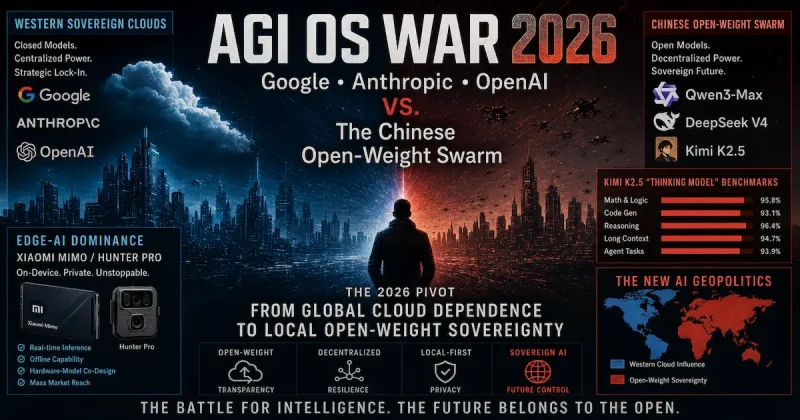
Comments
Leave a Comment
Your comment will appear after moderation.