
Hangzhou DeepSeek Artificial Intelligence Basic Technology Research Co., Ltd., doing business as DeepSeek, is a Chinese artificial intelligence (AI) company that develops large language models (LLMs). Based in Hangzhou, Zhejiang, DeepSeek is owned and funded by High-Flyer, a Chinese hedge fund. DeepSeek was founded in July 2023 by Liang Wenfeng, the co-founder of High-Flyer, who also serves as the CEO for both of the companies. The company launched an eponymous chatbot alongside its DeepSeek-R1 model in January 2025.
DeepSeek-R1 provided responses comparable to other contemporary large language models, such as OpenAI's GPT-4 and o1. Its training cost was reported to be significantly lower than other LLMs. The company claims that it trained its V3 model for US$6 million—far less than the US$100 million cost for OpenAI's GPT-4 in 2023—and using approximately one-tenth the computing power consumed by Meta's comparable model, Llama 3.1. DeepSeek's success against larger and more established rivals has been described as "upending AI".
DeepSeek's models are described as "open-weight", meaning the exact parameters are openly shared, but the training data is not openly licensed. Since the January 2025 debut of DeepSeek-R1, the company has made its new models available under free and open-source software licenses, primarily the MIT License. The company reportedly recruits AI researchers from top Chinese universities and also hires from outside traditional computer science fields to broaden its models' knowledge and capabilities.
DeepSeek significantly reduced training expenses for their R1 model by incorporating techniques such as mixture of experts (MoE) layers. The company also trained its models during ongoing trade restrictions on AI chip exports to China, using weaker AI chips intended for export and employing fewer units overall. Observers say this breakthrough sent "shock waves" through the industry which were described as triggering a "Sputnik moment" for the US in the field of artificial intelligence, particularly due to its open-source, cost-effective, and high-performing AI models. This threatened established AI hardware leaders such as Nvidia; Nvidia's share price dropped sharply, losing US$600 billion in market value, the largest single-company decline in U.S. stock market history.
== History ==
=== Founding and early years (2016–2023) ===
In February 2016, High-Flyer was co-founded by AI enthusiast Liang Wenfeng, who had been trading since the 2008 financial crisis while attending Zhejiang University. The company began stock trading using a GPU-dependent deep learning model on 21 October 2016; before then, it had used CPU-based linear models. By the end of 2017, most of its trading was driven by AI.
Liang established High-Flyer as a hedge fund focused on developing and using AI trading algorithms, and by 2021 the firm was using AI exclusively, often using Nvidia chips.
In 2019, the company began constructing its first computing cluster, Fire-Flyer, at a cost of 200 million yuan; it contained 1,100 GPUs interconnected at 200 Gbit/s and was retired after 1.5 years in operation.
By 2021, Liang had started buying large quantities of Nvidia GPUs for an AI project, reportedly obtaining 10,000 Nvidia A100 GPUs before the United States restricted chip sales to China. Computing cluster Fire-Flyer 2 began construction in 2021 with a budget of 1 billion yuan.
It was reported that in 2022, Fire-Flyer 2's capacity had been used at over 96%, totaling 56.74 million GPU hours. 27% was used to support scientific computing outside the company.
During 2022, Fire-Flyer 2 had 5,000 PCIe A100 GPUs in 625 nodes, each containing 8 GPUs. At the time, it exclusively used PCIe instead of the DGX version of A100, since at the time the models it trained could fit within a single 40 GB GPU VRAM and so there was no need for the higher bandwidth of DGX (i.e., it required only data parallelism but not model parallelism). Later, it incorporated NVLinks and NCCL (Nvidia Collective Communications Library) to train larger models that required model parallelism.
On 14 April 2023, High-Flyer announced the launch of an artificial general intelligence (AGI) research lab, stating that the new lab would focus on developing AI tools unrelated to the firm's financial business. Two months later, on 17 July 2023, that lab was spun off into an independent company, DeepSeek, with High-Flyer as its principal investor and backer. Venture capital investors were reluctant to provide funding, as they considered it unlikely that the venture would be able to quickly generate an "exit".
=== Model releases since 2023 ===
DeepSeek released its first model, DeepSeek Coder, on 2 November 2023, followed by the DeepSeek-LLM series on 29 November 2023. In January 2024, it released two DeepSeek-MoE models (Base and Chat), and in April 3 DeepSeek-Math models (Base, Instruct, and RL).
DeepSeek-V2 was released in May 2024, followed a month later by the DeepSeek-Coder V2 series. In September 2024, DeepSeek V2.5 was introduced and revised in December. On 20 November 2024, the preview of DeepSeek-R1-Lite became available via chat. In December, DeepSeek-V3-Base and DeepSeek-V3 (chat) were released.
On 20 January 2025, DeepSeek launched the DeepSeek chatbot—based on the DeepSeek-R1 model—free for iOS and Android. By 27 January, DeepSeek surpassed ChatGPT as the most downloaded freeware app on the iOS App Store in the United States, triggering an 18% drop in Nvidia's share price.
On 24 March 2025, DeepSeek released DeepSeek-V3-0324 under the MIT License.
On 28 May 2025, DeepSeek released DeepSeek-R1-0528 under the MIT License. The model has been noted for more tightly following official Chinese Communist Party ideology and censorship in its answers to questions than prior models.
On 21 August 2025, DeepSeek released DeepSeek V3.1 under the MIT License. This model features a hybrid architecture with thinking and non-thinking modes. It also surpasses prior models like V3 and R1, by over 40% on certain benchmarks like SWE-bench and Terminal-bench. It was updated to V3.1-Terminus on 22 September 2025. V3.2-Exp was released on 29 September 2025. It uses DeepSeek Sparse Attention, a more efficient attention mechanism based on previous research published in February. DeepSeek-V3.2 was released on 1 December 2025, alongside a DeepSeek-V3.2-Speciale variant that focused on reasoning.
In February 2026, Anthropic accused DeepSeek of using thousands of fraudulent accounts to generate millions of conversations with Claude to train its own large language models.
In April 2026, investors began speaking with DeepSeek for a $300 million funding round, which would bring DeepSeek to a total valuation of $10 billion.
On April 24, 2026, DeepSeek released a preview of its V4 series, including the 1.6-trillion parameter DeepSeek-V4-Pro and the 284-billion parameter DeepSeek-V4-Flash, both featuring a 1-million token context window, under the MIT License. DeepSeek's V4 LLM has been adopted by key semiconductor manufacturers and artificial intelligence chipmakers such as Huawei and Cambricon.
== Company operation ==
DeepSeek is headquartered in Hangzhou, Zhejiang, and is owned and funded by High-Flyer. Its co-founder, Liang Wenfeng, serves as CEO. As of May 2024, Liang personally held an 84% stake in DeepSeek through two shell corporations.
=== Strategy ===
DeepSeek has stated that it focuses on research and does not have immediate plans for commercialization. This posture also means it can skirt certain provisions of China's AI regulations aimed at consumer-facing technologies.
DeepSeek's hiring approach emphasizes skills over lengthy work experience, resulting in many hires fresh out of university. The company likewise recruits individuals without computer science backgrounds to expand the range of expertise incorporated into the models, for instance in poetry or advanced mathematics. According to The New York Times, dozens of DeepSeek researchers have or have previously had affiliations with People's Liberation Army laboratories and the Seven Sons of National Defence.
Due to the impact of United States restrictions on chips, DeepSeek refined its algorithms to maximise computational efficiency and thereby leveraged older hardware and reduced energy consumption.
DeepSeek also expanded on the African continent as it offers more affordable and less power-hungry AI solutions. The company has bolstered African language models and generated a number of startups, for example in Nairobi. Along with Huawei's storage and cloud computing services, the impact on the tech scene in sub-saharan Africa is considerable. DeepSeek offers local data sovereignty and more flexibility compared to Western AI platforms.
== Training framework ==
High-Flyer/DeepSeek had operated at least two primary computing clusters: Fire-Flyer (萤火一号) and Fire-Flyer 2 (萤火二号). Fire-Flyer 1 was constructed in 2019 and was retired after 1.5 years of operation. Fire-Flyer 2 is still in operation as of 2025. Fire-Flyer 2 consists of co-designed software and hardware architecture. On the hardware side, Nvidia GPUs use 200 Gbps interconnects. The cluster is divided into two "zones", and the platform supports cross-zone tasks. The network topology was two fat trees, chosen for high bisection bandwidth. On the software side are:
3FS (Fire-Flyer File System): A distributed parallel file system, specifically designed for asynchronous random reads. It uses Direct I/O and RDMA Read. In contrast to standard Buffered I/O, Direct I/O does not cache data. Caching is useless in this case, since each piece of data read is random and is not reused.
hfreduce: Library for asynchronous communication, originally designed to replace Nvidia Collective Communication Library (NCCL). It is mainly used for allreduce, especially of gradients during backpropagation. It is asynchronously run on the CPU to avoid blocking kernels on the GPU. It uses two-tree broadcast like NCCL.
hfai.nn: Software library of commonly used operators for neural network training, similar to torch.nn in PyTorch.
HaiScale Distributed Data Parallel (DDP): Parallel training library that implements various forms of parallelism such as Data Parallelism (DP), Pipeline Parallelism (PP), Tensor Parallelism (TP), Experts Parallelism (EP), Fully Sharded Data Parallel (FSDP) and Zero Redundancy Optimizer (ZeRO). It is similar to PyTorch DDP, which uses NCCL on the backend.
HAI Platform: Various applications such as task scheduling, fault handling, and disaster recovery.
As of 2022, Fire-Flyer 2 had 5,000 PCIe A100 GPUs in 625 nodes, each containing 8 GPUs. It later incorporated NVLinks and NCCL to train larger models that required model parallelism.
== Development and release history ==
The first DeepSeek models were essentially the same as Llama, which were dense decoder-only transformers. Later models incorporated the multi-head latent attention (MLA), Mixture of Experts (MoE), and KV caching.
A decoder-only transformer consists of multiple identical decoder layers. Each of these layers features two main components: an attention layer and a feedforward network (FFN) layer. V2 replaced the standard multi-head attention mechanism (MHA) with multi-head latent attention (MLA). This introduces compressed latent vectors to reduce KV (key–value) cache size, and thus memory usage.
A standard MoE Transformer generally use the sparsely-gated MoE layers in the FFN layers. In such an MoE layer, there are several FFN modules in parallel ("routed experts") and a small classifier ("gate") to compute a score for all these modules upon each token. Only the highest-scoring modules are activated. Starting with DeepSeekMoE, DeepSeek adopted a variant that adds "shared experts", which are always activated.
== Overview of models and technical specifications ==
DeepSeek's models are "open weight", which provides less freedom for modification than true open source software.
=== DeepSeek Coder ===
DeepSeek Coder is a series of eight models, four pretrained (Base) and four instruction-finetuned (Instruct). All have 16K context lengths. The model was made source-available under the DeepSeek License, which includes "open and responsible downstream usage" restrictions.
The training program was:
Pretraining: 1.8T tokens (87% source code, 10% code-related English (GitHub markdown and Stack Exchange), and 3% code-unrelated Chinese).
Long-context pretraining: 200B tokens. This extends the context length from 4K to 16K. This produced the Base models.
Supervised finetuning (SFT): 2B tokens of instruction data. This produced the Instruct models.
They were trained on clusters of A100 and H800 Nvidia GPUs, connected by InfiniBand, NVLink, NVSwitch.
=== DeepSeek-LLM ===
The DeepSeek-LLM series was released in November 2023. It has 7B and 67B parameters in both Base and Chat forms. DeepSeek's accompanying paper claimed benchmark results higher than Llama 2 and most open-source LLMs at the time. The model code is under the source-available DeepSeek License.
The architecture was essentially the same as the Llama series. They used the pre-norm decoder-only Transformer with RMSNorm as the normalization, SwiGLU in the feedforward layers, rotary positional embedding (RoPE), and grouped-query attention (GQA). Both had vocabulary size 102,400 (byte-level BPE) and context length of 4096. They trained on 2 trillion tokens of English and Chinese text obtained by deduplicating the Common Crawl.
The Chat versions of the two Base models was released concurrently, obtained by training Base by supervised finetuning (SFT) followed by direct policy optimization (DPO).
==== MoE ====
DeepSeek-MoE models (Base and Chat), each have 16B parameters (2.7B activated per token, 4K context length). The training was essentially the same as DeepSeek-LLM 7B, and was trained on a part of its training dataset. They claimed performance comparable to a 16B MoE as a 7B non-MoE. It is a variant of the standard sparsely-gated MoE, with "shared experts" that are always queried, and "routed experts" that might not be. They found this to help with expert balancing. In standard MoE, some experts can become overused, while others are rarely used, wasting space. Attempting to balance expert usage causes experts to replicate the same capacity. They proposed the shared experts to learn core capacities that are often used, and let the routed experts learn peripheral capacities that are rarely used.
==== Math ====
DeepSeek-Math includes 3 models: Base, Instruct, and RL. Math was trained as follows:
Initialize with a previously pretrained DeepSeek-Coder Base v1.5 7B.
Further pretrain with 500B tokens (6% DeepSeekMath Corpus, 4% AlgebraicStack, 10% arXiv, 20% GitHub code, 10% Common Crawl). This produced Base.
Train an instruction-following model by SFT Base with 776K math problems and tool-use-integrated step-by-step solutions. This produced Instruct.
Reinforcement learning (RL): The reward model was a process reward model (PRM) trained from Base according to the Math-Shepherd method. This reward model was then used to train Instruct using Group Relative Policy Optimization (GRPO) on a dataset of 144K math questions "related to GSM8K and MATH". The reward model was continuously updated during training to avoid reward hacking. This resulted in RL.
=== V2 ===
In May 2024, DeepSeek released the DeepSeek-V2 series. The series includes 4 models, 2 base models (DeepSeek-V2, DeepSeek-V2 Lite) and 2 chatbots (Chat). The two larger models were trained as follows:
Pretrain on a dataset of 8.1T tokens, using 12% more Chinese tokens than English ones.
Extend context length from 4K to 128K using YaRN. This resulted in DeepSeek-V2.
SFT with 1.2M instances for helpfulness and 0.3M for safety. This resulted in Chat SFT, which was not released.
RL using GRPO in two stages. The first stage was trained to solve math and coding problems. This stage used 1 reward model, trained on compiler feedback (for coding) and ground-truth labels (for math). The second stage was trained to be helpful, safe, and follow rules. This stage used 3 reward models. The helpfulness and safety reward models were trained on human preference data. The rule-based reward model was manually programmed. All trained reward models were initialized from Chat (SFT). This resulted in the released version of Chat.
They opted for 2-staged RL, because they found that RL on reasoning data had "unique characteristics" different from RL on general data. For example, RL on reasoning could improve over more training steps.
The two V2-Lite models were smaller, and trained similarly. DeepSeek-V2 Lite-Chat underwent only SFT, not RL. They trained the Lite version to help "further research and development on MLA and DeepSeekMoE".
Architecturally, the V2 models were significantly different from the DeepSeek LLM series. They changed the standard attention mechanism by a low-rank approximation called multi-head latent attention (MLA), and used the previously published mixture of experts (MoE) variant.
The Financial Times reported that it was cheaper than its peers with a price of 2 RMB for every million output tokens. The University of Waterloo Tiger Lab's leaderboard ranked DeepSeek-V2 seventh on its LLM ranking.
The DeepSeek-Coder V2 series included V2-Base, V2-Lite-Base, V2-Instruct, and V20-Lite-Instruct.. Training:
Base models were initialized from corresponding intermediate checkpoints after pretraining on 4.2T tokens (not the version at the end of pretraining), then pretrained further for 6T tokens, then context-extended to 128K context length.
DeepSeek-Coder and DeepSeek-Math were used to generate 20K code-related and 30K math-related instruction data, then combined with an instruction dataset of 300M tokens. This was used for SFT.
RL with GRPO. The reward for math problems was computed by comparing with the ground-truth label. The reward for code problems was generated by a reward model trained to predict whether a program would pass the unit tests.
DeepSeek-V2.5 was made by combining DeepSeek-V2-Chat and DeepSeek-Coder-V2-Instruct.
=== V3 ===
DeepSeek-V3-Base and DeepSeek-V3 (a chat model) use essentially the same architecture as V2 with the addition of multi-token prediction, which (optionally) decodes extra tokens faster but less accurately. Training process:
Pretraining on 14.8T tokens of a multilingual corpus, mostly English and Chinese. It contained a higher ratio of math and programming than the pretraining dataset of V2.
Extend context length twice, from 4K to 32K and then to 128K, using YaRN. This produced DeepSeek-V3-Base.
SFT for 2 epochs on 1.5M samples of reasoning (math, programming, logic) and non-reasoning (creative writing, roleplay, simple question answering) data. Reasoning data was generated by "expert models". Non-reasoning data was generated by DeepSeek-V2.5 and checked by humans.
The "expert models" were trained by starting with an unspecified base model, then SFT on both
Tech
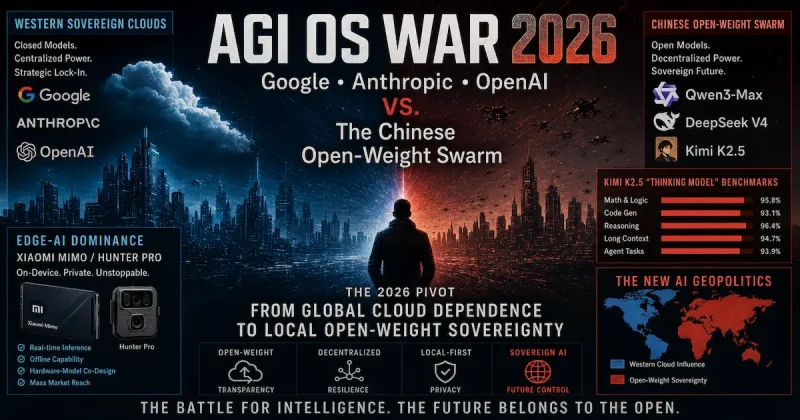
AGI OS War 2026: USA vs China
AGI OS War 2026: USA (Anthropic/OpenAI/Google) vs China’s Open-Weight Swarm. Strategic report on local AI sovereignty, …